History of the Jews in Lithuania

Children’s Safety Questioned after Swastika Appears at LJC

Children’s Safety Questioned after Swastika Appears at LJC

Children’s events, workshops, clubs and so forth are held often at the Lithuanian Jewish Community, as are Hebrew lessons, chess matches and Jewish holiday events attended by children. The safety of children attending events at the LJC is being called into question by the appearance of a swastika just meters from the front door. Its appearance coincided with the Peoples Fair inside, where children were preparing to give a concert. The goal of the Peoples Fair is to bring together the ethnic minority communities who call Lithuania home.

While the children were getting ready for the concert upstairs, down at the Bagel Shop Café a group of 43 elderly religious Jews from Jerusalem were holding prayers and waiting for breakfast when the swastika appeared, even closer to the front door of the kosher food outlet.

Lithuanian Jewish Community chairwoman Faina Kukliaksy said there should actually be reverse discrimination for the Lithuanian Jewish Community considering how small it is now following the Holocaust.

No other state in Europe fails to provide protection and security for its Jewish community.

Swastika at the Lithuanian Jewish Community

Swastika at the Lithuanian Jewish Community

A week before Lithuania marks its Day of Remembrance for Jewish Victims of Genocide in Lithuania, a swastika appeared on the sidewalk close to the main entrance of the LJC at Pylimo street no. 2, where some LJC security cameras are pointed.

Who did it and why? As Sergey Kanovich has written:

“It’s not really bad now is it? After all good come quickly after… and it was created by heroes. What after this, a broken window, a match? When the authorities remain silent, evil doesn’t sleep.”

There is no other Jewish community in Europe where the state doesn’t provide protection and security.

Meeting with Students from the Viltis Pre-Gymnasium in Panevėžys

The month of September is marked by a painful historical tragedy and is the month we mark the Day of Lithuanian Jewish Victims of Genocide. The Vilnius ghetto was liquidated over the course of the month of September.

Every year the Panevėžys Jewish Community organizes commemoration ceremonies at the mass murder sites in the Kurganava forest, the Žalioji forest, Krekenava, Raguva and other villages in the Panevėžys region.

The plan this year is to hold a quiz with students on September 24, show a film about the Holocaust from Yad Vashem and to introduce young people to Holocaust survivors. This meeting took place at the Panevėžys Jewish Community in early September with students from the Viltis Pre-Gymnasium.

Panevėžys Jewish Community chairman Gennady Kofman told the painful history of the Jews of the Panevėžys area.

Local Nazi collaborators murdered Jewish men, women and children throughout Lithuania, in Ukraine and in so many other European countries. Jews will never forget those people who helped and rescued them from the Holocaust.

One wonders why today a small group of Lithuanians is attempting to return to the past and to commemorate the collaborators who murdered and destroyed their fellow citizens.

University of Illinois at Chicago Hosts Discussion “Narratives of Pluralism in Lithuania Yesterday and Today”

University of Illinois at Chicago Hosts Discussion “Narratives of Pluralism in Lithuania Yesterday and Today”

Tuesday evening the University of Illinois at Chicago held a discussion called “Narratives of Pluralism in Lithuania Yesterday and Today.” Speakers included professor Tomas Venclova, Lithuanian minister of culture Dr. Mindaugas Kvietkauskas, Lithuanian Jewish Community chairwoman Faina Kukliansky, YIVO director Jonathen Brent, with teacher of Polish literature and Polish-Jewish relations Karen Underhill moderating. Discussion focused on multiculturalism in Lithuania, changes in ethnic minority communities in Lithuania over the centuries, contributions the ethnic minorities made to founding the modern state and Litvak contributions to the nation’s cultural and political life, as well as Holocaust education and commemoration.

Lithuanian consul general Mantvydas Bekesius thanked professor Venclova, Lithuanian cultural attaché in New York Gražina Michnevičiūtė and all audience members and speakers.

Photos by Sandra Scedrina

Keiko Borjeson Concert in Kaunas Honors Righteous Gentile

Keiko Borjeson Concert in Kaunas Honors Righteous Gentile

The Kaunas State Philharmonic held a concert September 6 to honor Righteous Gentile Ona Jablonskytė-Landsbergienė on what would have been her 125th birthday.

Actor and director Aleksandras Rubinovas presented a brief biography of the woman including how she hid Jews during the Holocaust. Her son was present and shared his memories of his mother’s deeds and views.

Jazz vocalist Keiko Borjeson (ボルジェソン ケイコ) of Japan, Arvydas Joffe on percussion, Mykolas Bazaras on bass and Tomas Botyrius on sax delivered a program of jazz standards, improvisation and Jewish melodies.

Kaunas Library Conducting Jewish Tours

Kaunas Library Conducting Jewish Tours

The Vincas Kudirka Public Library in Kaunas invites the public to a series of tours in a project called Jewish Heritage in Kaunas. The tours will be conducted on September 6, 8 and 10 and will cover modern architecture, the Old Town, Slobodka and major achievements by Litvaks. Registration required. Call (37) 22 23 57 or send an email to renginiai@kaunas.mvb.lt

The guided tour on September 10 begins at 6:00 P.M. and will be led by local guide Asia Gutermanaitė.

March of the Living

March of the Living

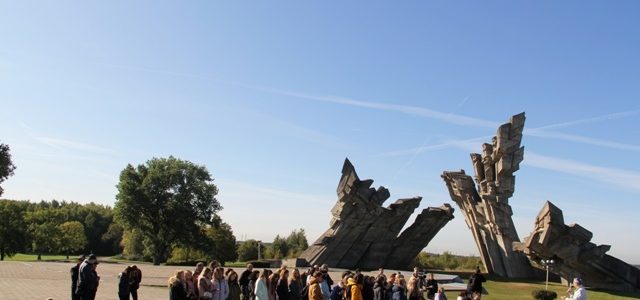
You’re invited to take part in the March of the Living procession in Ponar at 1:00 P.M. on September 23, 2019. The march begins at the Ponar railroad station and concludes at the main memorial in the Ponar Memorial Complex, where a commemoration ceremony to remember the genocide of the Jews of Lithuania will begin at 1:15.

A bus will offer transport from the LJC to the memorial complex leaving at 12 noon. Registration begins September 16. To register, call 8 5 261 3003.


European Day of Jewish Culture in Šeduva September 15

European Day of Jewish Culture in Šeduva September 15

A lesson on how to bake traditional challa bread will be held at 3:00 P.M. on September 15 at the Šeduva Crafts and Culture Center located at Vilniaus street no. 1 in Šeduva. Chefs from the Bagel Shop Café will share the secrets of traditional Litvak holiday customs and cuisine.

European Day of Jewish Culture Events in Šiauliai

European Day of Jewish Culture Events in Šiauliai

The Aušra Museum in Šiauliai will mark European Day of Jewish Culture on September 8, 2019. At 1:00 P.M. a game will be held on the grounds of the Frankel factory. At 2:00 P.M. the museum will open the exhibit “The Frankel Factory: A Symbol of Šiauliai Industry and Modernization” and screen a series of documentary films about Jews of Šiauliai called “Dingusio pasaulio pėdsakais. Žydiškieji Šiauliai” [Traces of a Lost World: Jewish Šiauliai] directed by Jūratė Sobutienė at the Chaim Frankel villa.

The game will requires teams of from 2 to 4 people with telephones or tablets with internet access. To register your team call 8 41 524 392 or send an e-mail to istorija@ausrosmuziejus.lt

More information:
www.ausrosmuziejus.lt
https://www.facebook.com/events/698501067290781

Augustė Labenskytė, acting director,
History Department, Aušra Museum

First Day of School

First Day of School

The Sholem Aleichem ORT Gymnasium began the school year Monday with a large welcome-back ceremony attended by new Israeli ambassador to Lithuania Yossi Avni Levy. Principal Miša Jakobas spoke to the large audience of pupils, parents and teachers:

“This is my last September today. All these years I’ve been with you, I’ve shared my heart and feelings with you. There is no greater feeling today than that which I feel seeing Lithuanian and Jewish children sing the Israeli anthem. I would like to thank everyone who believed in me. The school and the high school understand that nothing lasts forever. Today I can only take pride in our wonderful teachers and great atmosphere,” he said. After thanking teachers by name, he added: “I am very proud that our 70 gymnasium students are doing especially well.”

Home Movies from Before the Flood

Home Movies from Before the Flood

On Wednesday Kaunas Holocaust survivor Dita Zupavičienė-Šperlingienė spoke at the Vilnius Jewish Public Library and presented a home movie.

The silent film was a series of street scenes from Vilnius, Riga and Lvov before the war. Zupavičienė-Šperlingienė explained how her uncle Hanon, a medical student in Paris, used to come visit the family. In bed for over a week with scarlet fever, the young Dita was overjoyed when her physician uncle told the family she could get up and do things around the house without making it worse. Dita said she jumped out of bed at the first opportunity and from that time on Hanon became her favorite uncle.

Hanon was an amateur filmmaker and used an 8 mm camera on some of his travels. As the Nazis drew closer to Paris, he grabbed a bicycle and rode south, to Vichy France. Zupavičienė-Šperlingienė said he soon discovered life was dangerous for a Jew there, as well. After the Holocaust Hanon continued to live in Paris. Dita made it to Israel where it turned out she was, for whatever reason, one of the few Jews able to teach the German language. In the early 1970s she had the opportunity to improve her German teaching skills in West Germany, and visited Hanon in Paris during that trip. That’s when he mentioned he still had some of the footage he had taken before the Holocaust.

Reception for New Israeli Ambassador

Reception for New Israeli Ambassador

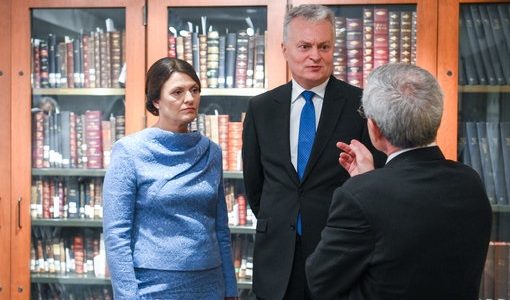
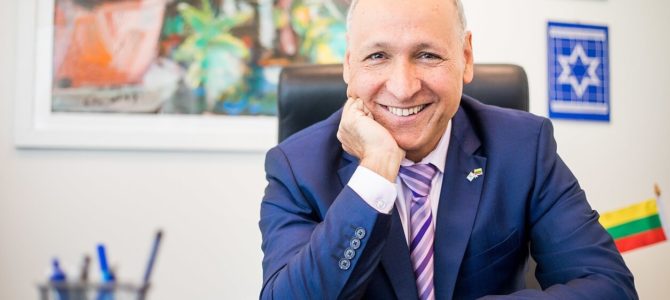
The Lithuanian Jewish Community held a reception for Israel’s new ambassador to Lithuania Yossi Avni Levy and her team last week. Chairmen of the regional Lithuanian Jewish communities attended the event. LJC chairwoman Faina Kukliansky welcomed the new ambassador’s arrival and introduced him to members of the Community at the event.

Levy is an Israeli writer and diplomat. He has held various posts at Israeli embassies in Bonn, Berlin, Belgrade and Warsaw. His literary work has received the prize of the Israeli prime minister’s office.

Born in 1962, Levy’s mother has roots in Iran and his father in Afghanistan. He was graduated with honors by Hebrew University in Jerusalem in history of the Middle East and Arabic in 1983.

Focus on Cuisine and History at European Day of Jewish Culture Events

Focus on Cuisine and History at European Day of Jewish Culture Events

VILNIUS, September 1, BNS–Events were held to celebrate European Day of Jewish Culture in Vilnius on the first Sunday in September. Tours of the Lithuanian capital, lectures and authentic Jewish cuisine were offered to the public.

The events program included Jewish music in the Vilnius Old Town–the old Jewish Quarter–and restaurants offering authentic Jewish foods.

“Jewish cuisine is an inalienable part of Jewish culture, Jewish tradition and Jewish heritage. Jewish cuisine is a prerequisite part of any Jewish holiday,” Lithuanian Jewish Community projects director Dovilė Rūkaitė told BNS.

Full story in Lithuanian here.

LJC Celebrates 20th European Day of Jewish Culture in Vilnius Old Town

LJC Celebrates 20th European Day of Jewish Culture in Vilnius Old Town

The Lithuanian Jewish Community celebrated the 20th European Day of Jewish Culture in the traditional Jewish Quarter of Vilnius September 1 with song, dance and food. The weather was beautiful. Restaurants in the Vilnius Old Town feature Jewish foods with traditional breakfast served at the Bagel Shop Café, restaurants and cafés on Žydų and Stiklių streets and other locations. DJs RafRaf, Akvilina and Marius Šmitas provided dance music with a 10-hour musical program at the Amadeus Bar.

LJC chairwoman Faina Kukliansky greeted celebrants and Vidmantas Bezaras, director of the Cultural Heritage Deparment, and Vida Montvydaitė, director of the Department of Ethnic Minorities, also spoke, noting there is no town or village in Lithuania without some sign of a Jewish presence. Vida Montvydaitė said this isn’t just Jewish heritage, it’s Lithuania’s legacy, and protecting it is becoming ever more important.

The writer Kristina Sabaliauskaitė spoke about her childhood memories of the Jews who still lived in central Vilnius then and with whom she made lasting friendships. She says interpersonal relationships are still one of the most important things in life to her.

Holocaust Survivor Dita Zupavičienė-Šperlingienė to Speak at Vilnius Jewish Public Library

Holocaust Survivor Dita Zupavičienė-Šperlingienė to Speak at Vilnius Jewish Public Library

The Vilnius, Jerusalem of Lithuania Jewish Community invites the public to attend a meeting with Dita Zupavičienė-Šperlingienė, a living legend, a survivor of the Kaunas ghetto, the Stutthof concentration camp and other concentration camps and of the final death march. The meeting will include a presentation of unique footage from Kaunas in 1929, filmed by Dita’s uncle Honon who came for a short visit before going on to Riga and Lvov, which also feature in the film. Members of Dita’s family look at us through time and Dita will tell their stories and how the film itself made it through the war and came to her.

The meeting will take place at 6:00 P.M. on September 4 at the Vilnius Jewish Public Library.

Sergejus Kanovičius: Revolutionary Pessimist, Writer, Successful but Still Looking for His Calling

Sergejus Kanovičius: Revolutionary Pessimist, Writer, Successful but Still Looking for His Calling

by Evaldas Labanauskas 15min.lt

When you put “Sergejus Kanovičius” into a search engine, it comes back with “poet, essayist, translation…” There are also references to Grigoriy Kanovich, who recently celebrated his 90th birthday. The latter is a Writer with a capital W, and Sergejus also talks about his Father (also capitalized).

When I read one of your father’s works, “Žydų parkas” [Jewish Park], I got the impression that it was a monument to Litvak culture and civilization, spanning 700 years but now dead. What is the current situation of Litvaks in Lithuania? Do you think this culture/civilization is being reborn?

There are people who express the opinion there are certain parallels between the project which I lead and my father’s work. If one is a material monument to the culture of the Jews of Lithuania, then my father’s work is a literary monument to an extinct ethnos. I think the Jewish community in Lithuania is experiencing a period of transformation. The word “reborn” might be more appropriate if we were talking about what happened 30 years ago, when there were 20,000 Jews in Lithuania, but today there are barely 3,000 Jews in Lithuania. Any sort of activity is encouraging, but claiming there is some kind of very bright future–I, as a revolutionary pessimist, would refrain from that sort of evaluation. Honestly, I am very glad about what is happening, and as much as I’m able I contribute to the activities of the Jewish community, but… while there is a lot of action, there is the question: is there a future?

Šiauliai Regional Jewish Community Tours Jewish Sites in Akmenė Region

Šiauliai Regional Jewish Community Tours Jewish Sites in Akmenė Region

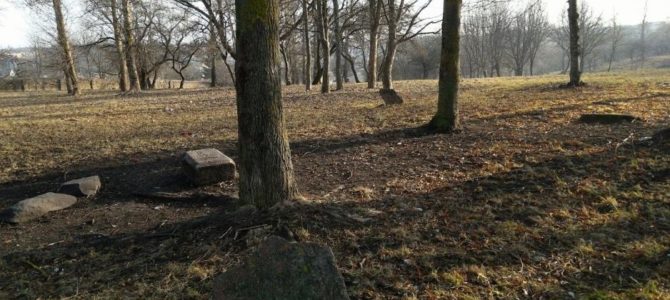
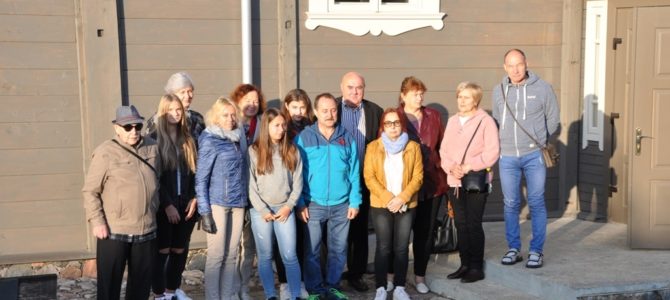
Members of the Šiauliai Regional Jewish Community spent the day of August 20 touring the Akmenė visiting sites with once populous Jewish communities. The tour began in Šiauliai and continued on in Papilė, where wood carver, traveller, naturalist and geographer Steponas Adomavičius met the group and gave them a guided tour of Jewish residences from before the Holocaust. Members visited the old Jewish cemetery in Papilė, a cemetery which features a commemorative stone and which Adomavičius himself maintains without remuneration. He cuts the grass and hedges and plants small trees. A grateful Jewish man living in America installed a bench bearing Steponas Adomavičius’s name in the cemetery in order to thank him.

The group was unable to reach the Jewish mass murder site in the woods of the Papilė aldermanship because there was no path through the forest at all. Adomavičius spoke about new projects he’s doing in connection with preserving the memory of the Jewish people.

From Papilė the group went on towards Akmenė, where the teacher Rita Ringienė met them and imparted much important information. Some Jewish structures survive in Akmenė. The teacher and pupils from her higher classes have done a study called “Inscriptions on Headstones in the Akmenė Jewish Cemetery and Their Translation to Lithuanian.” The group visited the old Jewish cemetery in Akmenė.