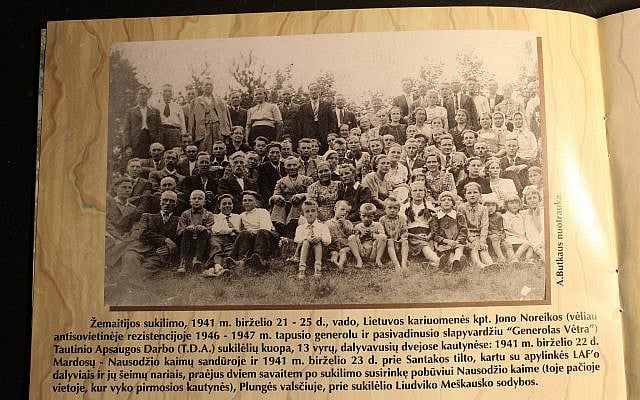

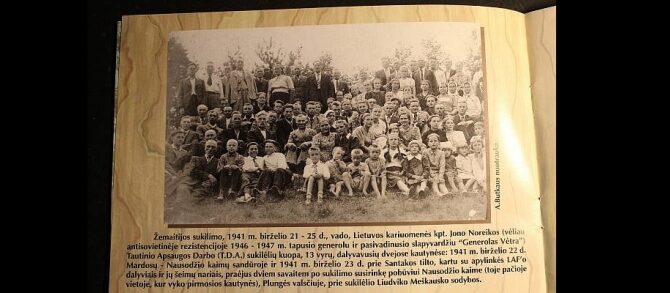
Photo: celebrate. My grandfather, Jonas Noreika, is in the third row. My mother, then two years old, is among them. Source: Silvia Foti, The Nazi’s Granddaughter (Regnery History, 2021).
by Silvia Foti
An open letter to Liam, on his bar mitzvah
Dear Liam,
You do not know my background and what I carry, as I know your background and your family history. You barely know me, and there is no gentle way to tell you who I am. I read about you in an article your cousin Grant Gochin published in The Times of Israel, about your family and mine. I am writing to a boy I have met just once, for a singular moment, at your cousin Grant’s home, to bless you shortly after the day you were called to the Torah and became a man. I am the granddaughter of the man whose orders helped empty your family’s world of Jews.
My grandfather was Jonas Noreika. He governed the Lithuanian district of Šiauliai, where the town of Papilė lies. He signed orders that confined its Jews and gave away what was stolen from them. Your family was murdered inside the system he ran. Tsile Gochin, the sister of your great-grandmother Sarah, was one of them. My grandfather bears responsibility for her murder, and that of your cousins, relatives, friends and neighbors.
So we are bound, you and I, by the worst thing that can bind two strangers. You descend from the people mine tried to erase. I descend from the man who tried to erase them. That is the history that links us, and I will not soften it.
Lithuania remembers my grandfather as a hero. In 1997, it posthumously awarded him the Order of the Cross of Vytis, First Degree, and has spent years defending his name. I spent those same years learning the truth instead.
By the middle of July 1941, nearly every Jew in the town of Plungė had been murdered. Two thousand innocent victims, thrown into ten death pits at the killing fields at the edge of town. Plungė lost half its residents in three weeks. Two weeks after the last pit was covered, my family gathered on a farm to celebrate.
About a hundred people came. They sat in seven rows and squinted into the bright sun while someone took the photograph you have just seen. My grandfather is in the third row. My grandmother is near him. My aunt is holding my mother, who was two years old. Their faces are happy. They called it a celebration of freedom.
I have spent years inside that photograph, Liam. I know where everyone is sitting. I know my mother’s small face. When I asked an old Lithuanian man how anyone could hold a party so soon after two thousand people were murdered, he told me the killing was someone else’s doing and the celebration was only about chasing out the Communists. My country still answers that way. The pits were a short drive from the farm. The ground was still settling. My family posed in the sun.
You recently had a party too.
Your family and friends gathered. They sat together. They placed you at the center of the room, the way a family holds a child it loves. Photographs were taken. A generation from now, someone will study those photographs the way I have studied mine, and count the rows, and find the faces.
The photographs may one day resemble each other: a large family gathered around a child, rows of faces turned toward a camera. Their meanings could not be more different. Mine was held over a death pit and called freedom. Yours was held over a Torah and called covenant. My family gathered to celebrate that the Jews were dead. Your family gathered to declare that you are here. That Sarah came through the forests, through Russia, through Kazakhstan. That she built a synagogue in Tehran and a life in Zurich. That her great-grandson could stand before the Torah scroll and chant.
So here is what I wish for you.
That you chanted your portion in a clear voice, and forgot the trembling the moment the congregation answered you. That the tallit on your shoulders felt like the arms of everyone who carried your family this far. May your life be long, and gloriously ordinary, full of the small joys the people in my photograph tried to make impossible. May you stand one day under a chuppah and break the glass, and remember for a single second beneath the joy why you break it. May you raise children who know Sarah’s name, and Tsile’s name, without ever having to be told. And may you stand one day as an old man beside a grandson of your own at the Torah, and feel the circle widen again.
You are the verdict on my family’s photograph. Every smiling face in those seven rows believed the matter was settled. They were certain there would be no more Jewish boys called to the Torah, no more families crossing continents to find one another, no more parties thrown for a child who carries the names of the murdered. You are the proof they were wrong. You are the answer they did not live to hear.
I want to tell you what it means to me that I am able to write this letter at all.
History could have left a descendant of Noreika with nothing to say to a Jewish child, but an apology spoken over a grave. Instead it has given me this. A boy named Liam, alive, who was recently called to the Torah, and the granddaughter of the man who tried to make certain no such boy would exist, free to send him her blessing. That I am permitted to write to you in joy, and not only in grief, is a mercy I did not earn and will not waste.
I hope that, now or one day in the future, you will read this with the love in which it was written, and with the sorrow I carry. Both are true. Both are yours.
Mazel tov, Liam. The Jews are still here. You are the reason.
L’dor v’dor.
With love, and with sorrow,
Silvia Foti
Wishing you truth and peace in the storms of your life.
Full text here.