LJC Challa-Making Event Big Success

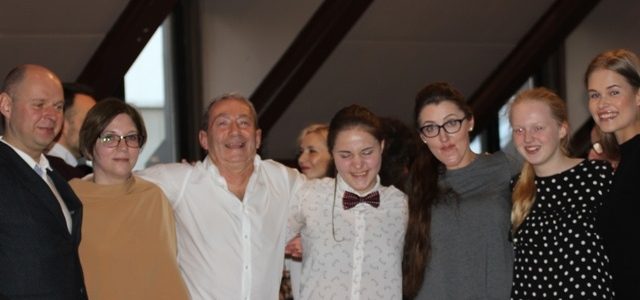
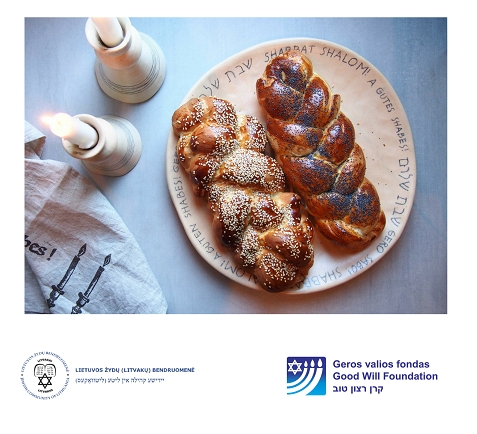
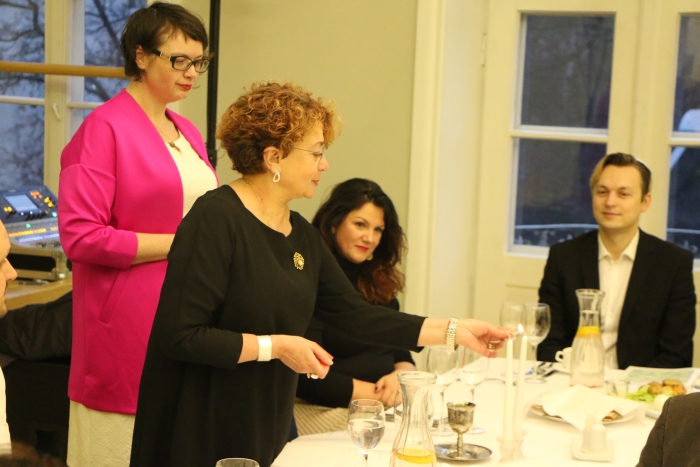
The challa-making event at the Lithuanian Jewish Community on October 26 was a fun-filled evening with klezmer music and treats from the Bagel Shop Café. Four generations of women participated, some with their children and grand-children, others with friends, kneading and braiding the dough which was then baked and taken home.
The event was in solidarity with the annual Shabbos Project, now in its fourth year.

More photos here.
First Plaque Commemorating Rescuers in Lithuania

Panevėžys Is the First to Thank Jewish Rescuers
www.sekundė.lt
The first plaque commemorating those who rescued Jews during the Holocaust has been unveiled in Panevėžys, Lithuania. It honors nun, activist, nurse and teacher Marija Rusteikaitė of the Congregation of the Sisters of the Love of God and her fellow nuns. The stone plaque was unveiled at a ceremony at the intersection of J. Tilvyčio and Krekenavos streets in the Lithuanian city, close to where the Sisters of the Love of God monastery and hospital were located, according to historical documents.
“It was namely this spot, a few dozen meters away, which is the most important historical site of the monastery for us, because this is where Marija Rusteikaitė brought together the nuns, the first sisters of the Love of God, between 1925 and 1936. As soon as she completed the university of medicine in St. Petersburg, the mother superior from Žemaitija joined the St. Vincent de Paul society in order to help the poor people of the city of Panevėžys and surrounding areas. Before that she taught mathematics and geography at the Kražiai pre-gymnasium and Polish at another location,” sister Leonora Kasiulytė, who has long taken an interest in the historical figure, said of the founder of her monastery.
Yuri Tabak to Address Gešer Club
Yuri Tabak, the religious studies scholar, author of numerous books, one of the favorite speakers at Limmud and a wonderful storyteller from Moscow, will visit the Gešer Club of the Lithuanian Jewish Community to speak at 7:00 P.M. on Friday, October 27. Space is limited and registration is required by sending an email or calling Žana Skudovičienė at zanas@scb.lzb.lt or 8 678 815 14.
Come Celebrate Sabbath Together at the Choral Synagogue
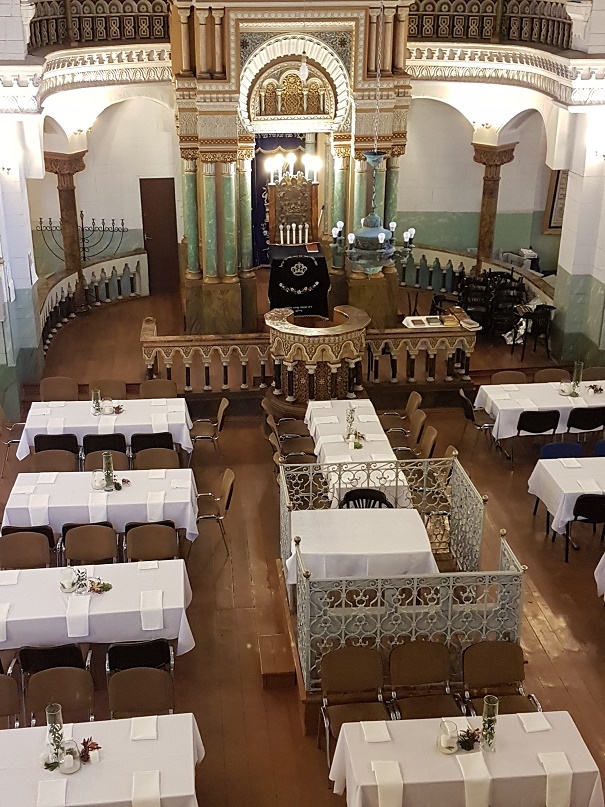
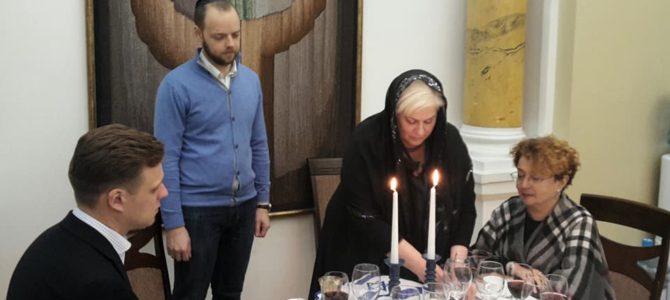
Come celebrate Sabbath at the Choral Synagogue on October 27. Services begin at 5:30, followed by a special Sabbath dinner in solidarity with the world-wide Shabbos Project.
Vilnius Jewish Religious Community
Righteous Gentile Marija Rusteikaitė to Be Commemorated in Panevėžys
Dear members,
A ceremony to unveil a stele honoring Marija Rusteikaitė, rescuer of Jews, teacher, nurse, public figure and founder of the Congregation of the Sisters of the Love of God, will be held at 1:00 P.M. on Friday, October 27.
The ceremony will be held at the intersection of Tilvyčio and Krekenavos streets in Panevėžys. Bus transportation from Vilnius will be provided from the Lithuanian Jewish Community at Pylimo street no. 4 in Vilnius at 10:45 A.M. There are ten seats left at the time of this writing. Those wishing to take the bus should send an email to info@lzb.lt
Those riding by bus will be delivered back in Vilnius in time for the special Sabbath at the Choral Synagogue in Vilnius.
One People, One Sabbath
For the fourth time in as many years, Jews around the world will meet in their communities for an evening of making challa and greeting the Sabbath. The point of the international Shabbos Project is to unite Jews at least once a year wherever they may be around the world and to celebrate Sabbath together. This time, October 26 to 28, over a million Jews in 96 countries and 1,357 are expected to take part.
Last year 6,000 volunteers in 95 countries and 1,152 cities organized challa-making events during a single Sabbath, events which included over 8,000 women and participants speaking more than 10 different languages in Buenos Aires, and five city blocks in Los Angeles were closed to traffic for setting up cooking tables in the streets. In Melbourne 10,000 people attended the havdala concert and the event generated 61,884,223 images posted on the internet.
The Shabbos Project has been called the Jewish spring, a global social phenomenon and an incredible experience.
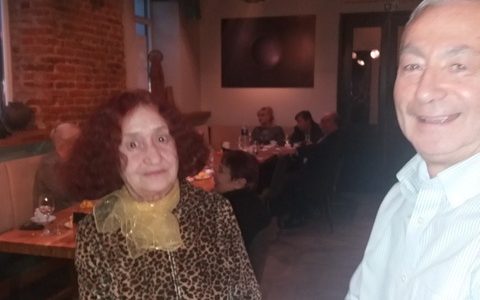
We’re inviting everyone to the Lithuanian Jewish Community at 6:00 P.M. on October 26 for an evening of challa-making and baking. The program includes kneading and baking, a contest for the best braided loaf, a presentation of women’s obligations on Sabbath and song and dance with the Rakja Klezmer Orekstar. So far over 100 Community members and friends have signed up, spanning four generations. Riva Portnaja, the senior chef at the Bagel Shop Café, will be showing her one-year-old great-granddaughter how challa is made at the event.
Everyone is welcome. We begin activating the yeast at 6:00 P.M. on October 26 at the Bagel Shop Café inside the Lithuanian Jewish Community at Pylimo street no. 4 in Vilnius.
For more information, contact Dovilė Rūkaitė at projects@lzb.lt
LJC Calendar for 5777 Wins Prize at Unusual Ceremony

A Jewish calendar published by the Lithuanian Jewish Community last year took first place in an annual Lithuanian calendar contest October 20.
The 28th annual Laurynas Ivinskis Prize ceremony was held in Kuršėnai, Lithuania with live Lithuanian folk music and a performance by the Fayerlakh ensemble.
The theme of the LJC calendar for 5777 was Lithuanian rescuers of Jews. It featured interwar president Kazys Grinius and wife Kristina on the cover, both Righteous Gentiles. Each month featured more than one story of rescue.
Laurynas Ivinskis (1810-1881) was a 19th century calendar maker whose agricultural calendars were also more text than calendar, and were for a period of time forbidden by Russian authorities because they were written in Lithuanian using the Latin rather than Cyrillic alphabet. His almanachs included stories and parables in pre-standard Lithuanian.
Jewish Gravestone Fragments to be Used in Memorial

by Monika Petrulienė, LRT TV News Service, LRT.lt
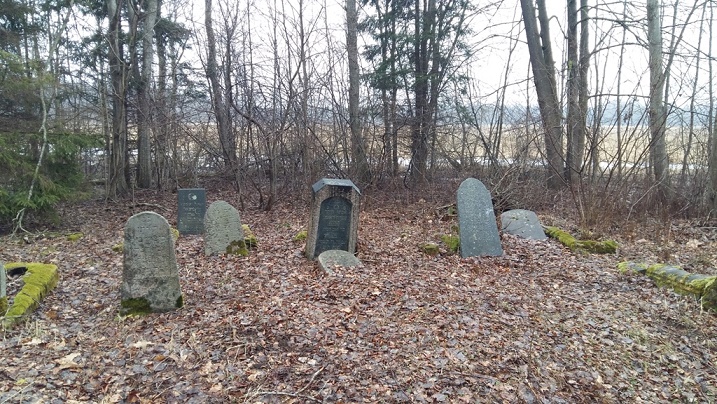
Jewish headstones used during the Soviet era for construction in Vilnius are being returned to the Jewish cemetery on Olandų street. Fragments of grave markers were removed from buildings and stairwells in the capital. A memorial will be made from the remains of headstones at the cemetery.
More than 1,000 metric tons of grave stones are being transported to the old Jewish cemetery on Olandų street. Less than half have been brought there so far. They are to be examined by experts to determine to which cemetery they will be returned ultimately. The Jewish cemetery on Olandų street covers almost 12 hectares and is roughly equal to the Rasos cemetery in Vilnius in size and number of burials.
“The first decision made was that the stones should be arrayed somewhere in what we might call an open working area, so that project authors, architects and landscape artists can learn about and get a feel for them, and so that they can be used directly from that area for certain compositions,” Martynas Užpelkis, heritage protection specialist for the Lithuanian Jewish Community, said.
Heritage protection experts say the majority of the Jewish grave markers were used in building stairs on Tauro hill in Vilnius. Many were also used in constructing electrical transformer substations and support walls in the city. Historians have examined about 2,500 pieces so far. The majority of inscriptions have been in Hebrew, but there are also inscriptions in Yiddish, Polish and Russian. The plan is for most of the stone fragments to stay at Olandų street, with the remainder going to the old Jewish cemetery in the Šnipiškės neighborhood.
Lithuanian Government Sets New Deadline for Reconstruction of Palace of Sports

Photo: Tomas Lukšys/BFL, © 2017 Baltijos fotografijos linija
The Lithuanian Government decided Wednesday to push back the deadline for reconstruction of the Palace of Sports in Vilnius for use as conference center and cultural events venue from 2018 to 2021. The move follows law enforcement getting bogged down in investigations of earlier public procurement for the project.
A statement by the Government said under the new scheme the Vilnius Congress Center project would be implemented within three years. The sitting of the cabinet of ministers approved a proposal from the Finance Ministry on the issue.
Lithuanian prime minister Saulius Skvernelis said the lack of a modern conference center in Vilnius would hinder greatly the expansion of conference tourism in Lithuania.
Come Make Challa with Us

The Shabbos Project has been called a Jewish spring, a global social phenomenon and an incredible experience.
Last year 6,000 volunteers in 95 countries and 1,152 cities organized challa-making events during a single Sabbath, events which included over 8,000 women and participants speaking more than 10 different languages in Buenos Aires, and five city blocks in Los Angeles were closed to traffic for setting up cooking tables in the streets. In Melbourne 10,000 people attended the havdala concert and the event generated 61,884,223 images posted on the internet.
We’re inviting everyone to the Lithuanian Jewish Community at 6:00 P.M. on October 26 for an evening of challa-making and baking. Challa is the traditional bread served at Sabbath dinner. Please register here.
AJC on US Exit from UNESCO
October 12, 2017, New York–AJC, the global Jewish advocacy organization, called the United States’ decision to leave UNESCO regrettable, but one that should serve as a wake-up call for the other member-states.
“UNESCO without the United States will be a diminished organization, and the U.S. outside UNESCO runs the risk of reducing our nation’s global role,” said AJC CEO David Harris. “We can only hope that member states will address the U.S. concerns seriously and swiftly. All will be better off with the U.S. in, not out.”
The State Department announced on October 12th that due to “U.S. concerns with mounting arrears at UNESCO, the need for fundamental reform in the organization and continuing anti-Israel bias at UNESCO” the U.S. will withdraw from the Paris-based UN specialized agency effective December 31, 2018.
Vilnius Returns Jewish Headstones to Cemetery

photo: S. Žiūra
This week the Vilnius municipality is sending all known fragments of Jewish gravestones from different Soviet-era sites around the city to the old Jewish cemetery on Olandų street. The headstone fragments mainly came from the historic Olandų and Šnipiškės Jewish cemeteries and were used as construction material during Soviet times. More than 1,000 metric tons of grave marker stone were sent to the Olandų cemetery. All fragments will undergo examination to determine their final destination, either the Olandų or the Šnipiškės cemetery.

Vilnius mayor Remigijus Šimašius said: “Modern Vilnius must assess, remember and honor appropriately the history of the city and its residents. The return of a huge number of headstones to their historic and sacred sites demonstrates the respect Vilnius residents have for the Jewish community and the commemoration of the dead. Stones from the disassembled transformer station and other sites in the city where the Soviets used Jewish headstones for construction have already been returned to the Olandų cemetery. Our goal is for all gravestones to be returned to the location where they belong.”
About 1,000 metric tons of Jewish cemetery marker stones have been collected and stored at the Vilniaus žaluma company so far.
Full story in Lithuanian here.
Cipla’s Journey: How a Muslim-Jewish Romance Shaped One of India’s Biggest Pharma Firms
by Kenneth X. Robbins and John Mcleod
In 1992, the editor of the Times of India telephoned one of Mumbai’s most prominent businessmen–Yusuf K Hamied. The editor asked Yusuf “as a Muslim leader” his opinion on communal riots that were taking place in the city. “Why aren’t you asking me as an Indian Jew? Because my name is Hamied? My mother was Jewish,” Yusuf replied. His maternal grandparents perished in the Holocaust.
Yusuf, chairman of one of India’s largest pharmaceutical firms, is the son of an aristocratic Muslim scientist from India and a Jewish Communist from what is now Lithuania. Defined by his parents’ extraordinary marriage, he unites his father’s scientific skills, business acumen, and Indian patriotism with his mother’s compassion for the less fortunate. He charges the Western pharmaceutical industry with “holding three billion people in the Third World to ransom by using their monopoly status to charge higher prices.” And he has devoted himself to making life-saving inexpensive generic medications for the inhabitants of poorer countries.
LJC Hosts “Person with a Backbone” Discussion on Public Holocaust Awareness

The Lithuanian Jewish Community together with the Polish Institute in Vilnius, the Goodwill Foundation and the Czarne publishing house hosted a discussion September 27 called “Person with a Strong Backbone” on public awareness of the Holocaust and of Polish and Lithuanian Righteous Gentiles who rescued Jews from death. The guest of honor was Romuald Weksler-Waszkinel who was born in Švenčionys and escaped death due to the efforts of Righteous Gentiles.
The discussion was based on the book of the same name by Polish radio journalist Dariusz Rosiak who discovered a hero in Waszkinel (Człowiek o twardym karku. Historia księdza Romualda Jakuba Wekslera-Waszkinela, Wydawnictwo Czarne, Wołowiec 2013). The author and his book’s main character shared with the audience memories and reflections of Polish and Lithuanian Righteous Gentiles against the backdrop of Waszkinel’s moving story of his salvation by Polish rescuers and how they raised him as one of the family.
Vilnius Polish Institute director Marcin Łapczyński said: “The Holocaust is one of the greatest and most horrific tragedies in the history of humanity. Millions of Jews lost their lives because of the crime planned by the Germans. About half of Poland’s 6 million citizens who died during World War II were Jews. It’s worth recalling Poles constitute about 25 percent of all people awarded the title of Righteous among the Nations for the heroic rescue of Jews. They are in first place in the awards list. Likewise, Polish families in Lithuania helped Jews. Examples include Katarzyna and Ignacy Bujel from Vaidotai, Maria and Antoni Kruminis-Łozowski from i Jašiūnai and of course Emilia and Piotr Waszkinel from Švenčionys. Among the almost 900 Lithuanian citizens who are Righteous Gentiles, Poles form the majority.”
Well-known Vilnius teacher, bibliophile and proponent of multiculturalism Vytautas Toleikis led the discussion, after which Grzegorz Lindowski’s documentary film “Embedded in David’s Star, the Cross” (“…wpisany w gwiazdę Dawida – krzyżm,” 1997) was shown, in which Romuald Waszkinel shares his dramatic story, his dilemmas and thoughts which led him to inner peace and certainty.
Žiežmariai Synagogue One of a Handful of Surviving Wooden Synagogues in Europe

LRT TV News Service LRT.lt
When Lithuania joined the European Route of Jewish Cultural Heritage, the synagogue in Žiežmariai was chosen as the symbolic first site. The wooden house of prayer is a rare surviving example of wooden synagogues in Europe. Even so, it took more than a decade for reconstruction to begin. After work is done, the plan is for the small building located in a town along Lithuania’s main highway to host a museum.
About 500 Jews lived in Žiežmariai when the synagogue was built in the 19th century. Before the war there were up to a thousand. Now the synagogue is getting back its former face, with work on the façade, windows, walls and the already-finished roof.
Restoration experts working on the building say the synagogue succeeded in surviving because of daily care by local residents. They boarded up windows and removed garbage dating back to Soviet times, when the building was used as storage. Neighbor Liudvikas Markuntavičius said the synagogue serves more than just to remind the small town of a glorious past. During World War II the synagogue territory was used as a ghetto and the Jews of Žasliai and Kaišiadorys were imprisoned there.
Mikveh Opens in Kaunas

After a break of more than 70 years a mikveh, or Jewish ritual bath, was recently built and opened in the Old Town of Kaunas, thanks to the Kaunas Jewish Center. Mikveh construction was supervised by Rabbi Gedalia Olshtein, a leading world expert in the field. The luxurious mikveh is intended mainly for Israeli students studying in Kaunas, bet all female Lithuanian Jews are welcome to use it as well. William Stern, founder and patron of the Kaunas Jewish Center, hung a mezzuzah, a sort of Jewish good-luck charm, on the door frame at the opening ceremony. Rabbis and guests from around the world and representatives of the Kaunas Jewish Community attended the opening ceremony. Rabbi Moshe Sheinfeld, who has lived in Kaunas for six years, was responsible for all the work setting up the mikveh, with help from his wife Racheli. The rabbi said he had several choices for where to put the mikveh, but one abandoned building had a mezzuzah on its door-frame, which apparently made up his mind. The building was purchased from Lithuanians and no one now knows who the Jewish owners might have been.
Sukkot Celebration in Panevėžys

The Panevėžys Jewish Community set up the traditional sukka for celebrating Sukkot, the harvest festival and recollection of the flight of the Jews through the Sinai living in tents. Each family and community makes a sukka according to their means. This time there was a special celebration in which children were explained the meaning of Sukkot, and they had the chance to “dwell” in the temporary shelter, playing, having fun and eating. There were also photo sessions held in the sukka, photographs being sent to parents and kept in the Community archives. All Community members contributed by bringing in the fruits of their harvests, including apples, watermelons, pumpkins and grapes.
Lithuanian Jewish Community executive director Renaldas Vaisbrodas participated at the celebration, greeted everyone in the name of the LJC and wished everyone a happy and full new year, health, joy and mutual goodwill.
Later a prayer was read, the blessing of the Most High. Holiday greetings from Israel, the USA and LJC chairwoman Faina Kukliansky were read out.
After a sumptuous dinner made by the women of the Community and café staff, games and dances were held. Children gave improvised performances and were rewarded with small gifts. The celebration carried on long into the evening.
![]()
Chabad Feuds with Jewish Leaders over Cozy Ties to Eastern European Autocrats

by Lili Bayer and Larry Cohler-Esses
In the former Communist states of Central and Eastern Europe, established mainstream Jewish groups are increasingly worried that Chabad, the international Hasidic movement, is allying itself with authoritarian governments.
In countries from Hungary to Russia, they say, Chabad is at times playing down anti-Semitism in a bid to compete with local Jewish groups and win access to financial resources and political influence.
Chabad, in turn, says that mainstream groups are too embroiled in secular and political issues, including polarizing disputes about democracy and civil liberties, at the expense of guarding core communal Jewish interests of physical security and Jewish religious freedom. In some cases, Chabad officials say, these establishment groups are also corrupt.
The increasing tensions between Chabad and more established Jewish groups are playing out in different ways in different countries. Each case is unique:
Jewish Lithuanian Soldier Volf Kagan Remembered in Balbirishok

A commemorative plaque was unveiled on October 5 to honor the memory of Volf Kagan, Jewish Lithuanian soldier and two-time recipient of the order of the Cross of Vytis, in the town square of Balbieriškis (Balbirishok) next to the local government building in the Prienai region of Lithuania. Volf Kagan (1900-1941) came from this town.
According to Balbieriškis Tolerance Center director Vitas Rymantas Sidaravičius, the plaque honors both Kagan and the former Jewish community of Balbieriškis. The plaque was the brain-child of Lithuanian journalist Vilius Kavaliauskas, author and editor of articles and the book “Pažadėtoji žemė – Lietuva” [Lithuania: The Promised Land] about Litvaks, and was financed by the Prienai regional administration. Lithuanian Jewish MP Emanuelis Zingeris attended the unveiling ceremony as did Prienai regional administration head Alvydas Vaicekauskas, deputy regional administration head Algis Marcinkevičius, representatives of the Kaunas Jewish Community, Vilius Kavaliauskas, Prienai regional culture, sports and youth department director Rimantas Šiugždinis, Išlaužo žuvis company director Rimantas Jurgelionis, Balbieriškiis parish head priest father Remigijus Veprauskas, head town doctor Angelė Sidaravičienė, Balbieriškis alderwoman Sigita Ražanskienė, members of the aldermanship council, Balbieriškis primary school students and teachers, Culture and Leisure Center staff and local residents.