
Religion

Headstone Fragments Returned to Jewish Cemetery

Paminkliniai akmenys pagarbiai sugrįžta į senąsias Žydų kapines Olandų gatvėje

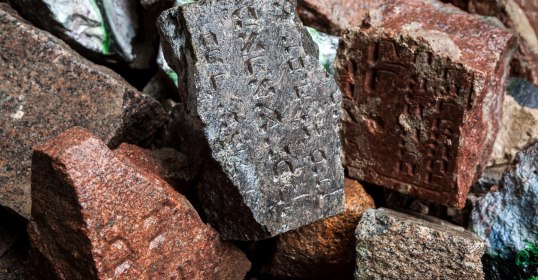
Fragments of Jewish headstones, removed from a transformer substation and other locations in Vilnius where they were used as construction material by the Soviets, have been returned to a Jewish cemetery in the Lithuanian capital. The city municipality this week ordered all fragments, both with legible fragments of inscriptions and without, to be removed to a clearing at the former Jewish cemetery on Olandų street. The move begun today was supervised by architects and representatives of the municipality, the Cultural Heritage Department, the Lithuanian Jewish Community and the Verkiai and Pavilniai Regional Park administration.

Photos by Martynas Užpelkis, heritage protection expert, Lithuanian Jewish Community

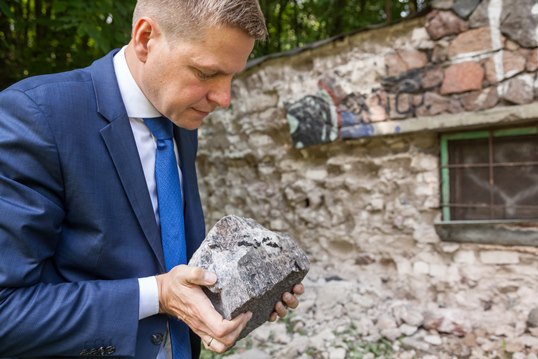
“It’s clear that it was time long ago to make sure Jewish gravestones be returned with dignity to the old Jewish cemetery and that such examples of the barbarism of the Soviet regime no longer remain in the city. Today I am glad that these thoughts have turned into concrete deeds: the city has renovated a vast territory of the old cemetery, and slowly alleys and paths have emerged there, and now the commemorative stones are being returned with dignity to the renovated territory. There has been exemplary and very constructive cooperation with the Jewish community and different institutions, and even though we haven’t had great resources, we’ve managed to find solutions which allow us to show due respect to the memory of the dead and testify to our values and culture,” Vilnius mayor Remigijus Šimašius said.
Šimašius Akmenys


Full story in Lithuanian here.
Rabbi Ben Tzion Zilber Visits Latvia and Lithuania

Rugpjūčio 15-16 Latvijoje ir Lietuvoje lankėsi rabinas Bentsiyonas Zilberis

Rabbi Ben Tzion Zilber, son of legendary Rabbi Yitzchok Zilber, visited Latvia and Lithuania August 15 and 16.

Rabbi Kalev Krelin of the Vilnius Jewish Community escorted Rabbi Zilber to locations where the latter’s ancestors lived. His father Rabbi Yitzchok Zilber belonged to a long line of scholars and suffered under Stalin, both at labor camps and under the atheist policies of the Soviet Union. Despite extremely difficult circumstances, Rabbi Yitzchok Zilber not only managed to hold steadfastly to his faith in the Creator and to keep His laws, but also to deepen his Torah study and teach others. After making aliyah to Israel Rabbi Yitzchok Zilber had hundreds of followers in whom he inspired faith in the Creator and adherence to the Torah.

Keeping the Faith in Vilnius

VilnaFaina
photo © Delfi/K. Cachovskis

Ellen Cassedy, author of We Are Here: Memories of the Lithuanian Holocaust (ellencassedy.com), has written about the Lithuanian Jewish Community and the Bagel Shop initiative.

Amit Belaite adores the long ode to the city of Vilna that was penned by writer and poet Moyshe Kulbak 90 years ago. Lines from the poem about Vilna’s stones and streets were running through her head on a warm summer afternoon as she led a walking tour through the narrow, winding streets of the city now known as Vilnius, the capital of the small Baltic nation of Lithuania.

Belaite, 23, heads the Lithuanian Union of Jewish Students. When she posted the announcement for the group’s tour of Jewish Vilnius, she expected a couple of dozen people to be interested. To her amazement, 400 signed up, many of them non-Jews.

“People know the city is rich in Jewish history,” she said. “They feel a big need to learn about it.”

Plaque to Honor Union of Jewish Soldiers in Kaunas

Kaune atsiras atminimo lenta, skirta Žydų karių sąjungai

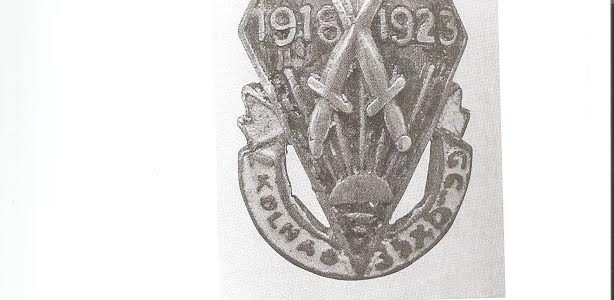
Work has begun to produce a memorial plaque to commemorate the pre-WWII Union of Jewish Soldiers Who Fought for Lithuanian Independence. The project was initiated by the Kaunas Jewish Community with support from Lithuanian Jewish Community chairwoman Faina Kukliansky, LJC cultural heritage expert Martynas Užpelkis and sculptor Gediminas Pašvenskas, who designed the plaque. The plaque is to be placed on the building formerly housing the Union at A. Mapu street no. 10 in Lithuania’s interwar capital.

Established in 1933, the Union of Jewish Soldiers Who Fought for Lithuanian Independence was originally based in Joniškis and moved to Kaunas in 1934. Besides fostering patriotism and loyalty to the state, the union also encouraged cultural cooperation between Lithuanians and Jews and operated throughout the country, with about 3,000 members in total. Twenty Jewish soldiers were decorated with the Order of the Cross of Vytis for bravery in battle and other orders and decorations were also bestowed on the veterans of the early Lithuanian struggle for independence following World War I. The union participated with its regalia at official events and ceremonies and publicly displayed their devotion and loyalty to Lithuania.

Clarification

To whom it may concern,

In light of Mr. Gary Eisenberg’s recent article about Lithuanian citizenship for Litvaks published in Israel and South Africa, the Lithuanian Jewish Community states for the record:

1. There is no special legislation or program for recruiting Litvaks for Lithuanian citizenship. This is disinformation. The existing legislation on applications for Lithuanian citizenship by prewar citizens of Lithuania and their offspring was only reworded slightly to prevent misinterpretations of the intent of legislators by public servants to the detriment of Jewish applicants and applicants of other ethnicities. As far as we are aware, there is no “Lithuanian Citizenship Programme” for Litvaks in Lithuania or anywhere else, despite what was written in Mr. Eisenberg’s article.

2. The Lithuanian Jewish Community and the Choral Synagogue in Vilnius with the Vilnius Religious Jewish Community are firm followers of the traditions of the Vilna Gaon and have nothing to do with Chabad Lubavitch or their rabbi. We have a rabbinate of two rabbis who are firmly within the mitnagedic tradition. Mr. Eisenberg’s statements he celebrated Sabbath with Chabad Lubavitch Rabbi Krinsky, followed by the statement he visited the Choral Synagogue, could mislead some readers into thinking the Choral Synagogue in Vilnius is a Chabad Lubavitch center, which it is not.

Sincerely,

Faina Kuklianskay, attorney,
chairwoman,
Lithuanian Jewish Community

New Torah Study Library at Choral Synagogue

We invite all our friends to the inauguration of our new Torah library at the Choral Synagogue in Vilnius.

Every synagogue is more than just a house of prayer–it’s also a house of learning. Even more so in Lithuania, where Torah study has always been of the highest priority. Now our synagogue will provide the opportunity to teach Torah in the classic way.

Thanks to the Šeduva Jewish Memorial Fund and their understanding of the importance of this library in Vilnius, the synagogue will now contain a classic Jewish library of more than a hundred books needed by everyone who wants to engage in serious learning.

The Torah (Pentateuch) and the Books of Prophets with all the classical commentaries, Mishnah, Talmud, Rambam, Tur and Shulchan Aruch–if the latter are missing it is impossible to study Torah, to prepare for lessons and to teach those who are resolved to make progress in their knowledge and Torah study.

The Šeduva Jewish Memorial Fund and the Lithuanian Jewish Religious Community invite you to share in our joy and to make a small l’chaim at 7:00 P.M. on August 24 at the Choral Synagogue.

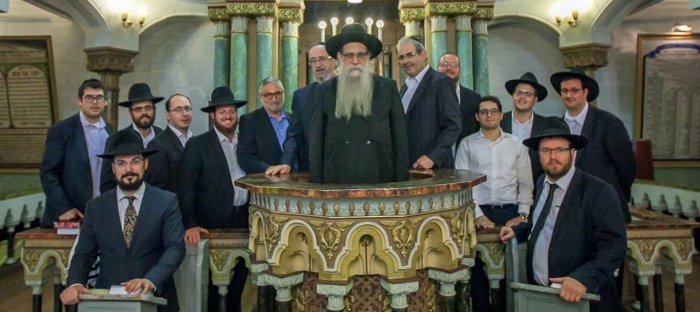
Important Delegation of Rabbis

smaller synagogue group

Rabbi Kalev Krelin reports on an important delegation who visited Lithuania last week.

“I had the honor to host a group of rabbis and philanthropists from the US. At the head of the group were R. Yeruham Olshin, head of biggest yeshivah in the world in Lakewood, New Jersey, and R. Reuven Desler, businessman and philanthropist, grandson of famous Rabbi Eliyahu Desler.

“The group visited the tomb of the Gaon and R. Chaim Ozer in Vilnius, and also the gravestone of Rabbi Boruch Beer Leibovitz at the Užupis cemetery. They visited the grave of Elchonon Spektor in Kaunas, prayed at the 7th Fort on the date when R. Elchonon Wasserman from Baranovichi Yeshiva was killed there, and also visited another cemetery.

“After that the group returned to Vilnius and prayed an evening prayer at the Choral Synagogue in Vilnius.

LJC Statement about the Seventh Fort in Kaunas

Statement by the Lithuanian Jewish Community concerning Cnaan Liphshiz’s article “This Lithuanian Concentration Camp Is Now a Wedding Venue” published at http://www.jta.org/2016/07/24/news-opinion/world/lithuanian-concentration-camp-is-now-a-wedding-venue

The Lithuanian Jewish Community thanks the author of the article and the news agency who have again brought attention to the problematic situation at the Seventh Fort in Kaunas. We also feel it is our duty to explain and add to some of the facts and circumstances brought up in the article.

In June and July of 1941 a concentration camp was set up at the Seventh Fort where up to 5,000 people were murdered, mainly Jews resident in Kaunas. During the Soviet era the fort was used for military purposes and the exact location of the mass grave was unknown and inaccessible to the wider public. In 2009 the Lithuanian State Property Fund, which had ownership of the complex, allowed it to be privatized. The Lithuanian Jewish Community never approved of this decision and numerous times wee expressed our position that this was a huge mistake which couldn’t be allowed to happen at similar sites. In any event, after the fort buildings were privatized, the new owner, Karo paveldo centras [Military Heritage Center], received the right to lease the land around the buildings, which belongs to the state. The mass grave site, whose exact location was not known then, thus fell within territory controlled by a private corporate entity.

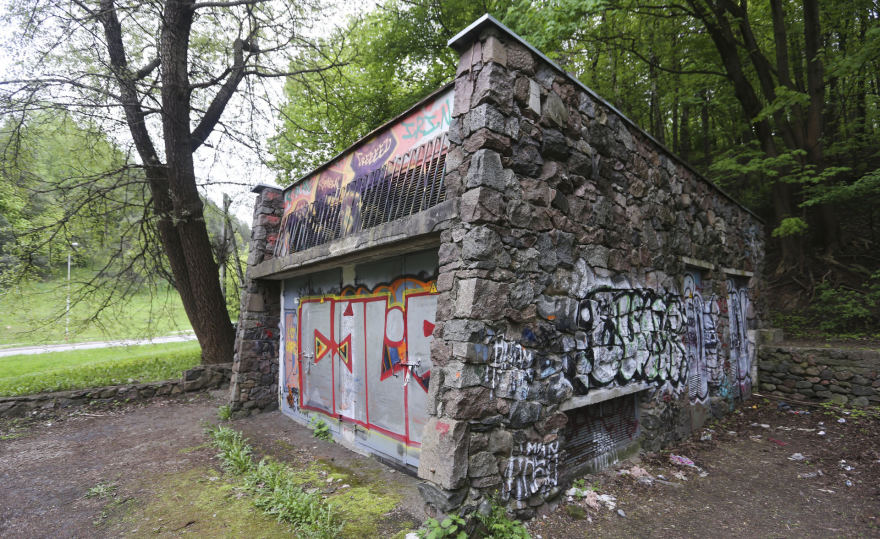
Work Continues to Remove Jewish Headstones from Power Station

transformatorine-olandu-gatveje-5550721510382
The transformer substation before removal work began. Photo by Lukas Balandis, courtesy 15min.lt

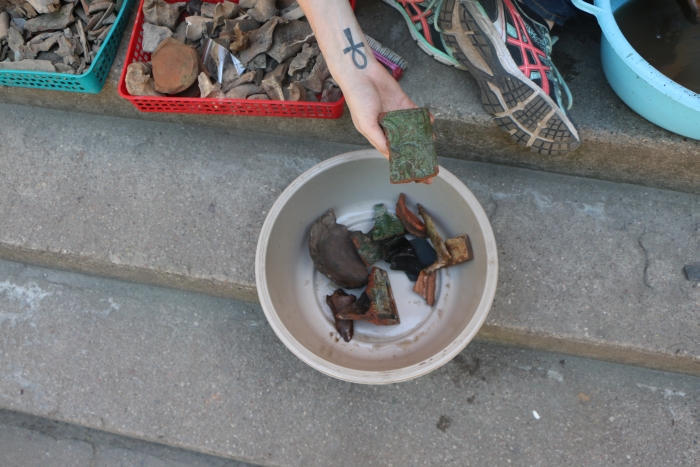
More than a year after a Vilnius resident reported his discovery an electric substation on Olandų street was constructed using Jewish gravestones, and following the announcement this June removal work had begun, the site is now littered with bits of headstones partially surrounded by a simple wire fence and some plastic tape. Most of the fragments are marked with graffiti on at least one surface, and several piles of larger pieces contain partial inscriptions in Hebrew characters, see pictures below.

Israeli Media Report on Parties at Seventh Fort in Kaunas

7thfort

Vilnius, July 25, BNS—Parties held at the Seventh Fort in Kaunas have received attention by the media in Israel following efforts last year to resolve conflicts between the fort’s owners and Jews concerned about the Jewish mass grave discovered there several years ago.

Cultural heritage protection specialists say there haven’t been any complaints recently about unethical activities at the Seventh Fort, and Lithuanian Jewish Community chairwoman Faina Kukliansky said the Israeli press was just bringing up “old stories.”

Discussion of entertainment events at the Seventh Fort came up last year when the Cultural Heritage Department sent the fort’s owners a letter calling upon them not to hold celebrations, games or similar events there.

An article in the Jerusalem Post Monday told the story of the fort’s privatization, the fee charged visitors to the museum territory there and parties held there despite the discovery there in 2011 of a Jewish mass grave.

The article said the Seventh Fort is a popular venue for graduation parties and wedding receptions and the space is available to be used for parties, for cooking on campfires and to host summer camps for children.

This Lithuanian Concentration Camp is Now a Wedding Venue

CROP2-1
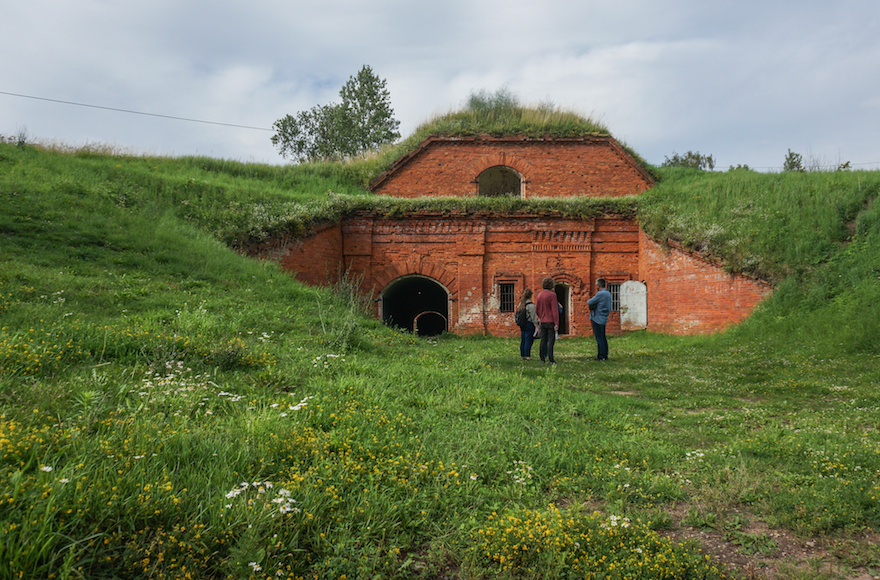
A film crew preparing to record at the former concentration camp known as the Seventh Fort in Kaunas, Lithuania, on July 12, 2016. (JTA/Cnaan Liphshiz)

KAUNAS, Lithuania (JTA) — In this drab city 55 miles west of Vilnius, there are few heritage sites as mysterious and lovely looking as the Seventh Fort.

This 18-acre red-brick bunker complex, which dates to 1882, features massive underground passages that connect its halls and chambers. Above ground, the hilltop fortress is carpeted with lush grass and flowers whose yellow blooms attract bees and songbirds along with families who come here to frolic in the brief Baltic summer.

It’s also a popular venue for graduation parties and wedding receptions, complete with buffets and barbecues, as well as summer camps for children who enjoy the elaborate treasure hunts around the premises.

Most of the visitors are unaware that they are playing, dining and celebrating at a former concentration camp.

Israeli Antiquities Authority Reports Major Finds in Lithuania

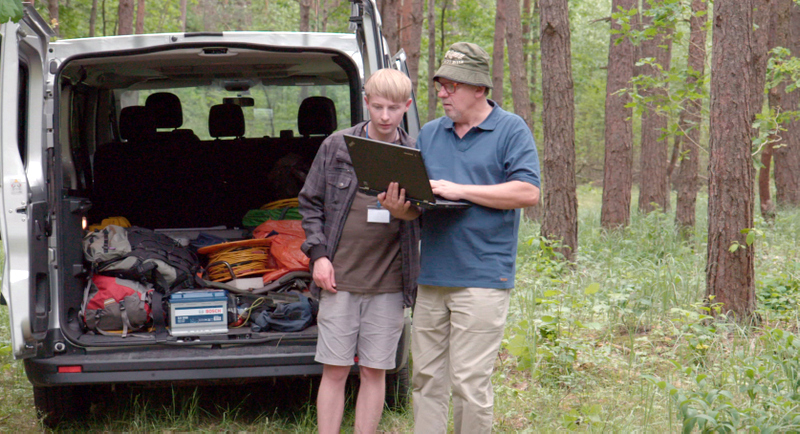
2.Historical with team
Photo: Ezra Wolfinger/NOVA

Historical Discovery in Lithuania: The Escape Tunnel of the “Burning Brigade” in Ponar (Paneriai) Has Been Rediscovered

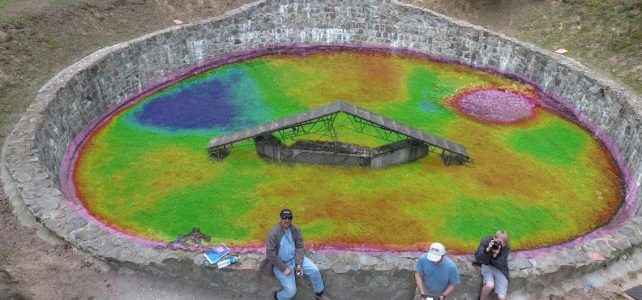
For the first time since the Holocaust the famous tunnel used by the prisoners of Ponar to escape from the Nazis has been located using new technologies for underground predictive scanning.

In an exciting new discovery using electric resistivity tomography at the Ponar massacre site near Vilnius in Lithuania, the escape tunnel used by the so called “burning brigade” to elude captivity and certain death at the hands of the Nazis has been pinpointed.

Some 100,00 people, of whom 70,000 were Jews originating in Vilna and the surrounding area, were massacred and thrown into pits in the Ponar forest near the Lithuanian capital during World War II. With the retreat of the German forces on the eastern front and the advance of the Red Army, a special unit was formed in 1943 with the task of covering up the tracks of the genocide. In Ponar this task was assigned to a group of 80 prisoners from the Stutthof concentration camp.

At night the prisoners were held in a deep pit, previously used for the execution of Vilna’s Jews, while during the day they worked to open the mass graves, pile up the corpses on logs cut from the forest, cover them with fuel and incinerate them. All the while their legs were shackled and the worked in the full knowledge that on the completion of their horrendous task, they, too, would be murdered by their captors. Some of the workers decided to escape by digging a tunnel from the pit that was their prison. For three months they dug a tunnel some 35 meters in length, using only spoons and their hands. On the night of April 15, 1944, the escape was made. The prisoners cut their leg shackles with a nail file, and 40 of them crawled through the narrow tunnel. Unfortunately they were quickly discovered by the guards and many were shot. Only 15 managed to cut the fence of the camp and escape into the forest. Twelve reached partisan forces and survived the war.

Ponar Escape Tunnel Found

Mokslininkai Lietuvoje rado tunelį, kuriuo žydai bėgo nuo nacių

An international group of scholars has completed nearly two weeks of archaeological digging at two sites of importance to Lithuanian Jewish history. They looked for a tunnel known from Holocaust testimonies and attempted to confirm information about the Great Synagogue and surrounding buildings in Vilnius. They used new non-invasive techniques: ground-penetrating radar and electrical resistivity tomography. The international group of scholars included scientists from Israel, Canada, the US and Lithuania. Project leader Dr. John Seligman is the head of the archaeological digging department of the Israeli Antiquities Service. US student volunteers helped at the sites. Some were in Eastern Europe and Lithuania for the first time.

Full story in Lithuanian on Vilnius University’s web site.

Simnas Synagogue to Get New Life

Simno sinagogą bus bandoma prikelti naujam gyvenimui

Dzukija logo

The Alytus regional administration will look for ways to use the synagogue located in Simnas for cultural activities. The head of the regional administration discussed the issue with representatives of the Lithuanian Jewish Community, the Ministry of Culture and the Cultural Heritage Department.

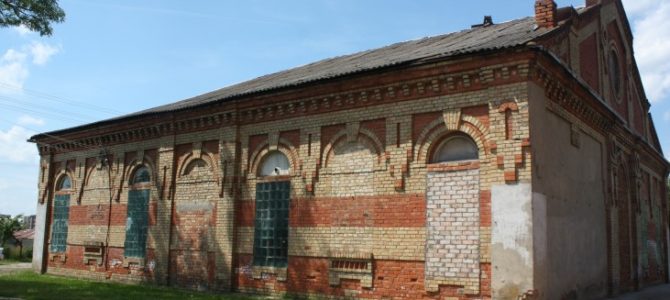
The synagogue was built in 1905 to replace the old wooden synagogue at the same site and was reconstructed in the mid-20th century. In 1952 it became a palace of culture, and later a school athletics gymnasium. Currently it belongs to the Alytus regional administration.

Judah Passow Thanks LJC Chairwoman Faina Kukliansky for Celebration for Return of Torah

Juda Passow dėkoja LŽB ir pirmininkei F.Kukliansky už Toros sugrįžimo šventę

“I just want to thank you once again for making possible such a moving and memorable day with the Lithuanian Jewish community,” Judah Passow said in the note.

“It was an honour and a privilege to be with all of you. I’m especially grateful to you for the time and effort you put into making what began as an idea a year ago into a reality,” he wrote.

Judah Passow’s father, professor David Passow at Philadelphia University, received a Rockefeller Foundation grant to commemorate Jewish life behind the iron curtain in 1960. When he went to Vilnius that same year, local Jewish leaders asked him to take away with him one of two Torah scrolls which were used in the Vilnius ghetto and survived the Holocaust intact, saying they were unsure what the future held for Jews in the Soviet Union. The Passows protected the Torah ever since then, for 56 years, and used it for three bar mitzvahs in the family. When he came to Vilnius last year for a showing of his photography work, Judah Passow met Lithuanian Jewish Community chairwoman Faina Kukliansky and the idea was fleshed out of returning the scroll to Vilnius. Just last week Passow returned the Torah dating from the time of Vilna Gaon, with a silver decoration his mother Aviva Passow made for the scroll.

Picking Up the Pieces

top
by Geoff Vasil

“Don’t get too close!” an attractive and sunburned young Lithuanian warned at the edge of a large pit just behind what was the Great Synagogue of Vilnius. He’s friendly and it quickly becomes clear he’s the lead archaeologist on the dig, but he’s just as quick to point out he’s formally the lead archaeologist, but Dr. Richard Freund of the University of Hartford in Connecticut is the real force behind the whole initiative.

Mantas Daubaras is doing his doctoral thesis at the Lithuanian Institute of History on a Neolithic site far to the west in Lithuania. He has no personal connection to Jewish Vilna and approaches it as he would any site, dispassionately.

“Yesterday we found what we think is the ritual bath,” he explains, pointing to a small hole in the top of what looks like a vaulted brick ceiling. They sent a camera in to take a look and found a large space terminated by rubble and fill. Does it connect to the Great Synagogue? He doesn’t know yet, but it looks as if it extends right up to the line where they think the back wall of the synagogue once stood.

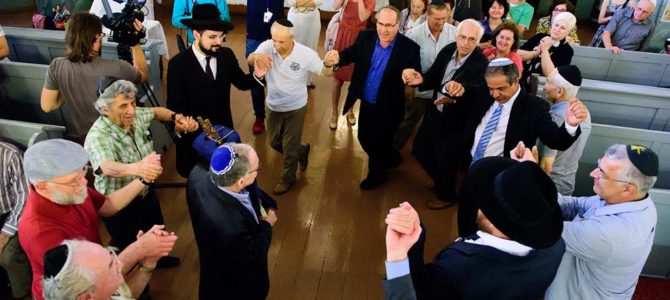
Celebration to Welcome Torah Scroll at Choral Synagogue

Toros įnešimo šventė Vilniaus choralinėje sinagogoje vyko birželio 27d.

The Lithuanian Jewish Community is tremendously grateful to Judah Passow for his initiative in bringing the 350-year-old Torah scroll back to Vilnius.

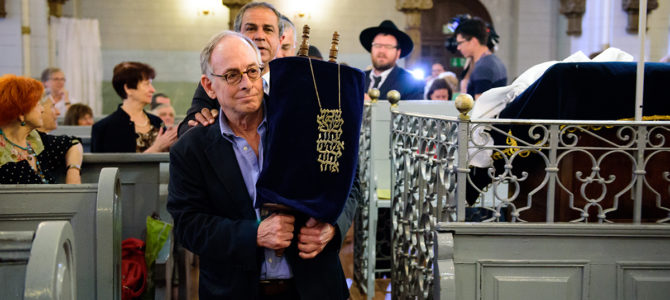
Those assembled at the Choral Synagogue in Vilnius June 27 waited in anticipation of something extraordinary: for the carrying in of a 350-year-old Torah scroll, from the period when the Vilna Gaon walked among us, a witness to the Vilnius of the 17th century, experiencing all the passages and changes together with the Jews, used for innumerable bar mitzvah ceremonies until it ended up in the Vilnius ghetto during World War II, and miraculously survived the Holocaust.

In 1960 professor Passow of the University of Philadelphia in the United States came to Vilnius after receiving support from the Rockefeller Foundation to commemorate Jewish communal life behind the iron curtain. Jews in Vilnius asked him to take with him one of two Vilnius ghetto Torah scrolls to survive the Holocaust, uncertain about the future of Jewish life in the Soviet Union. That’s how the Torah entered into the Passow family and was used in three bar mitzvahs. The family protected the scroll for 56 years. Last year the professor’s son, London-based photojournalist Judah Passow, came to Vilnius for an exhibition of his photographic works and spoke with LJC chairwoman Faina Kukliansky. This year he’s come back with the Torah scroll with a silver ornament his mother made.

Gaon-Era Torah Scroll Returns to Vilnius

350 m. skaičiuojatis toros ritinys grįžta į Vilniaus choralinę sinagogą

Vilnius, June 27, BNS–A 350-year-old Torah scroll used in Jewish religious services in the Vilnius ghetto has returned to Vilnius. British photojournalist Judah Passow decided to turn the scroll over to the Lithuanian Jewish Community for use in the Choral Synagogue in Vilnius.

“What’s important is not the [scroll itself], but that he decided to give the Torah to our synagogue. The Torah belonged to his family, it was safeguarded during the war and the entire time. Boys became men during bar mitzvah in front of this Torah and began to read from this Torah, so it is a great honor for us,” Lithuanian Jewish Community chairwoman Faina Kukliansky told BNS. According to Jewish religious tradition, Torah scrolls must be written by hand. Kukliansky said this Torah will replace the one currently being used, which is worn out.

Passow, whose roots are in Ukraine and Poland, told how Lithuanian Jewish community representatives gave the scroll to his father, a professor at an American university in Philadelphia, almost six decades ago when he visited Vilnius in 1960.