Dear friends,
The Lithuanian Jewish Community wishes you peace, strength and an inscription in the Book of Life this Yom Kippur. Gmar chatima tova.



Dear friends,
The Lithuanian Jewish Community wishes you peace, strength and an inscription in the Book of Life this Yom Kippur. Gmar chatima tova.
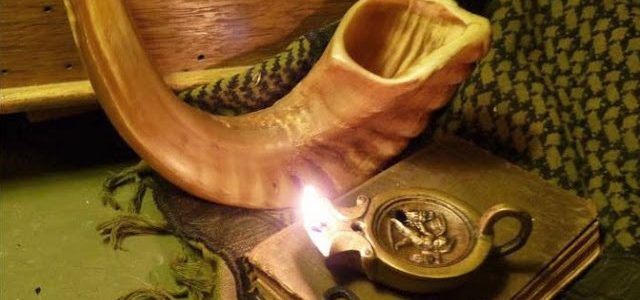
The Lithuanian Jewish Community and the Bnei Maskilim progressive Judaism association invite you to come mark Yom Kippur together at the Lithuanian Jewish Community in Vilnius. Cantor Daniel Zekhry from the rabbinical studies program of the Abraham Geiger College will lead the services. Everyone is welcome but registration is required by sending an email to viljamas@lzb.lt.
Schedule:
October 1
6:30 P.M. Kol Nidre
October 2
10:00 A.M. Torah reading
5:00 P.M. Yizkor
5:15 P.M. Neila
6:30 P.M. Shofar
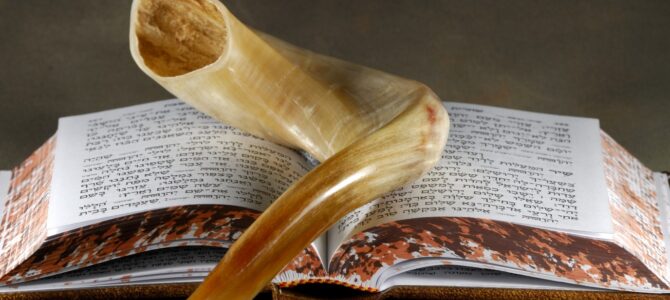
This Wednesday the Choral Synagogue in Vilnius begins observing Yom Kippur, the Day of Atonement.
Prayer services:
October 1
6:30 P.M. Kol Nidre
7:00 P.M. Maariv
October 2
10:00 A.M. Shacharit
12:00 noon Yizkor
12:30 P.M. Musaf
5:45 P.M. Mincha
6:30 P.M. Neila
7:45 P.M. Maariv
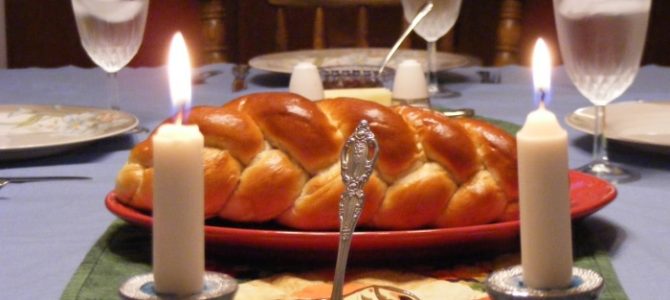
While the café is undergoing reconstruction and will change its name to its address, Pylimo 4, when it reopens, the kitchen is still operating and many have enjoyed its special Sabbath menu. Now the café is offering challa to order for pickup on Fridays. The regular price is 7 euros per loaf, and if you want to donate to the operation, then 10 euros. Your donation will insure an earlier opening of the venue. Orders should be placed by 8:00 P.M. on Thursday each week. Payment and pickups can be done at the café from 4:00 P.M. till 7:00 P.M. on Fridays. To place your order, send an email to gut.shabbos.vilnius@gmail.com. A gut shabes!

For the fifth time now the International Nehama Lifshitz Song Contest will bring together highly talented young performers from around Lithuania and the world. The contest named after the songstress from Lithuania called the Jewish nightingale encourages young perfomers to popularize Jewish song, to discover diverse musical compositions and to spread artistic cooperation internationally.
The competition is open to people from the age of 10 to 35 with performances over four evenings of classical Jewish melodies, works in Hebrew and Yiddish imparting centuries of stories, emotions and culture. This year the organizers are doing something new, with vocal mastery lessons provided by professor Claudia Visca of the Vienna Music and Performance Arts University and voice teacher Sofia Mazar from the Jerusalem Music and Dance Academy.
The public is invited to attend the performances. The Yiddish song contest takes place starting at 3:00 P.M. on October 26 at the Lithuanian Jewish Community in Vilnius. The Lithuanian Academy of Music and Theater will host the remaining evenings as well as voice lessons from October 27 to 30. Audience members will be treated to a concert by the finalists as the jury decides on a winner. All performances will be free and open to the public. Stay tuned for more information.
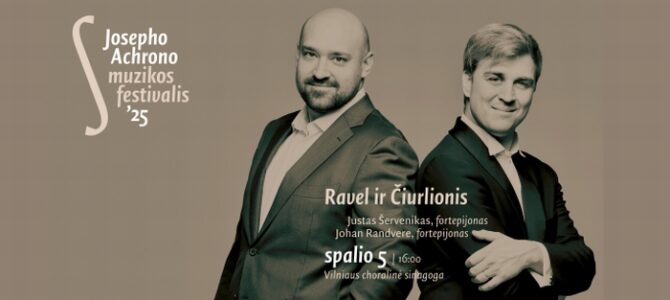
As part of the on-going Joseph Achron music festival, the piano duet of Justas Sherveniko ir Johan Randvere will perform a musical homage to the composers Mikalojus Čiurlionis and Maurice Ravel on the 150th anniversary of their births at the Choral Synagogue in Vilnius starting at 4:00 P.M. on Sundaym October 5. The program includes works by Čiurlionis, Ravel, Schubert and Mendelssohn.
For more information and to purchase tickets, click here.
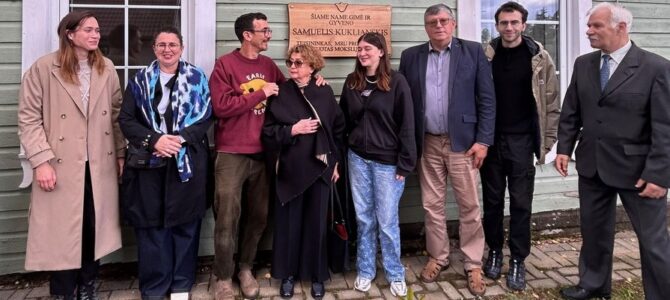
A plaque commemorating Samuel Kukliansky, attorney and professor of law, was unveiled on the outside of the house in which he lived until the Holocaust in the village of Veisiejai in the Lazdijau region of Lithuania last week.
His daughter and Lithuanian Jewish Community chairwoman and attorney Faina Kukliansky attended the unveiling ceremony with other members of the family, as well as the person who initiated the plaque, Zenonas Sabaliauskas, and a large contingent of local residents.
“Veisiejai is a special place for me. My grandfather Saulius Kuakliansky, a chemist and pharmacaist, lived here. Here stands the home to which my grandmother, doctor Zisle Kukliansky,, never returned. That made today, when a plaque is being unveiled commemorating my father, law professor and attorney Samuel Kukliansky, one of excitement as well as mixed feelings. I want to thank my children and grandchildren for being there for me on this day of difficult memories and experiences, and for holding dear our family history and dor, I hope, passing it on to their children. I am very grateful also to alderman Zenonas Sabaliauskas for the beautiful idea of commemorating the footsteps left by the Kukliansky family in Veisiejai, and I am grateful to the many people who gathered here for this. Seeing them, the hope returns that those dark times perhaps will not return again,” Faina Kukliansky said.
Following the ceremony, attendees travelled to the Kuktiškės Jewish cemetery about 20 kilometers outside Veisiejai to visit the mass grave there. In November of 1941 Germans and Lithuanians murdered 1,535 Jews there.
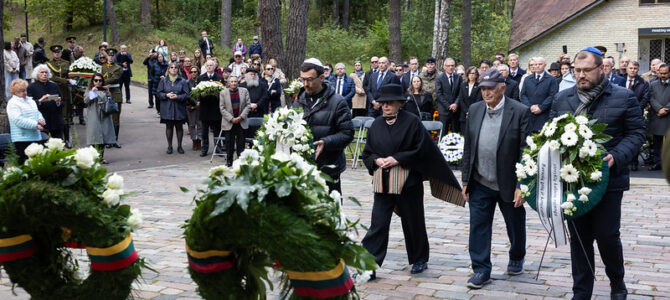
Members and staff of the Lithuanian Jewish Community, representatives from the Lithuanian parliament and government and foreign diplomats observed the Day of Remembrance of Lithuanian Jewish of Victims of Genocide at Ponar on Thursday, September 25. German Bundeswehr rabbi Elisch Mendel Portnoy joined Choral Synagogue cantor Shmuel Yaatom in saying prayers for the dead.
LJC chairwoman Faina Kukliansky read the contents of an open letter she co-autyhored with Jewish Lithuanian MP Emanuelis Zingeris addressed to president Gitanas Nausėda cautioning against the latter’s decision to allow a member of an anti-Semitic party to occupy the post of Lithuanian minister of culture.
KJC chairwoman Kukliansky quoted a facebook post she received that day calling for the murder of Jews.
“If we don’t stop it, this will happen. So I ask all of you gathered here not just to honor those who were murdered and lie buried here–we are standing on blood-soaked soil–but also to think about the future of our country, and what we must do to insure this never happens again,” Kukliansky said.
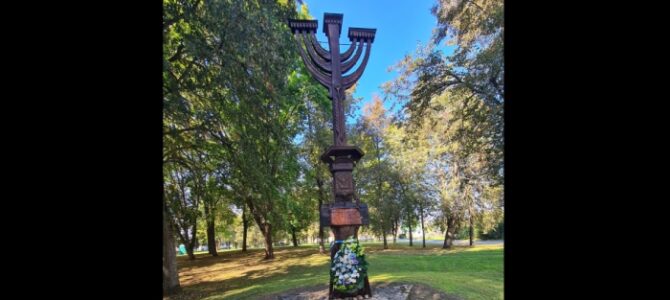
As on every first Sunday in October, people will gather to commemorate those who were incarcerated in the ghetto and murdered during the Holocaust in the Švenčionys region in southwest Lithuania. The gathering takes place at the city park where the ghetto once operated, and at the mass grave in Platumai village in the Švenčionėliai aldermansjip at what is generally called the polygon. You are invited to attend at 11:00 A.M. on Sunday, October 5.
Program:
11:00 A.M. – 11:30 A.M. Commemoration of victims at the Menorah statue in the city park;
12:30 P.M. Commemoration at the monument to the victims at the mass murder site in Platumai village.
Moshe Shapiro, chairman
Švenčionys Regional Jewish Community
The Sabbath begins at 7:07 P.M. on Friday, September 26, and concludes at 7:58 P.M. on Saturday in the Vilnius region. Sabbath candles should be lit at 6:49 P.M. and completed before sunset at 7:07 P.M. Thursday, September 25, is Tzom Gedaliah, the day of fasting. Yom Kippur begins at 6:36 P.M. on Wednesday, October 1, and ends at 7:45 P.M. Thursday, October 2.
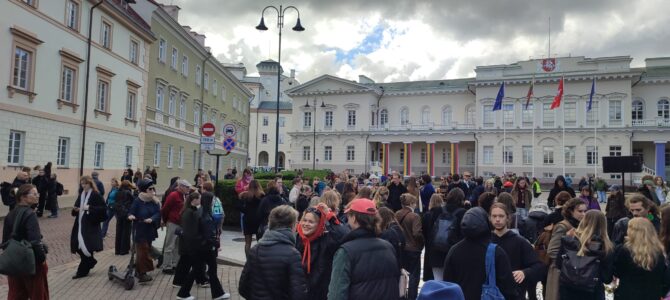
A group of protestors gather at the Office of the President in Vilnius Thursday to protest the formation of a new government with a candidate from the Nemuno Aušra party proposed for minister of culture.
Ignotas Adomavičius has been put forward by Remigijus Žemaitaitis’s Nemuno Aušra party as a new government coalesces following real estate scandal which enveloped Gintautas Paluckas’s ruling coalition earlier this year. Žemaitaitis rose to prominence in early 2023 by making a series of facebook and other posts questioning the Holocaust in Lithuania and criticizing Jews and Israel. Lithuania’s Constitutional Court found his statements were a violation of his oath to uphold the Lithuanian constitution as a member of parliament. The comments have been widely recognized as anti-Semitic.
Adomavičius has been described as a pasta maker, whether that’s a hobby or a profession, and a graduate of an art school in Vilnius. In Lithuanian pasta is called macaroni, a synonym for nonsense He told Lithuanian state radio and television one of his priorities as culture minister will be to rebuild the “Old Synagogue,” presumably meaning the Great Synagogue in Vilnius, whose reconstruction no Jewish or Lithuanian heritage group is seeking currently. There was talk of this in the early 2000s by Lithuanian government officials, but the idea was rejected by the various Lithuanian Jewish communities at the time as a boondoggle without a congregation to serve. Jewish reporter and newspaper editor Milan Cheronskis called the proposal one for a Jewish Disneyland in Vilnius. Lithuanian state radio and television interview in Lithuanian here.
The Lithuanian Jewish Community, the umbrella organization for 31 Jewish organizations in Lithuania and abroad, calls upon Lithuanian president Gitanas Nausėda not to approve Ignotas Adomavičius, the candidate submitted by the anti-Semitic Nemuno Aušra party and its leader, Remigijus Žemaitaitis, whom the Constitutional Court found had violated grossly his oath of office and the constitution of Lithuania.
The Lithuanian Culture Ministry is in charge of maintaining the material cultural heritage, restoration of synagogues, Jewish cultural centers and historical commemoration, and to entrust this ministry to the member of an openly anti-Semitic party would be a desecration and public derision of the memory of the victims of the Holocaust, and an insult to Lithuanian citizens of Jewish descent.
Moreover, this person’s participation in the actions of the next Government would discredit Lithuania in front of our foreign partners, whose support to our country and to us, the citizens of that country, is so vitally important at this complicated time in geopolitics.
We would like to remind the president and the public that organizations such as IHRA, FRA (the EU agency on fundamental rights) and the OSCE have all recognized anti-Semitism as a crime. Lithuania has signed cooperation agreements with these international organizations and is obligated to adhere to these agreements.
Therefore we call upon the president to maintain his oath he took during his inauguration and to defend the interests of all citizens of Lithuania, including Jews, as spelled out in the Lithuanian constitution.
Executive board, Lithuanian Jewish Community
Leaders of the Lithuanian Jewish Community Emanuelos Zingeris, the only Jewish member of the Lithuanian parliament and signatory to the Act of the Restoration of Lithuanian Independence, and Lithuanian Jewish Community chairwoman Faina Kukliansky uniting 31 organizations across Lithuania and abroad have addressed an open letter to His Excellency Gitanas Nausėda, president of Lithuania, urging him not to appoint a representative of the anti-Semitic party Nemuno Aušra as minister of culture, citing several reasons outlined in the letter below.
OPEN LETTER
In recent days, following the decision to place the Ministry of Culture of the Republic of Lithuania under the influence of Mr. Remigijus Žemaitaitis, we have developed profound concerns regarding the preservation of democratic values in the Republic of Lithuania.
In our considered view, Mr. Žemaitaitis incited hatred during the electoral campaign and fomented ethnic discord. The Constitutional Court of the Republic of Lithuania has found his actions to be in violation of the constitutional order of the Republic. He therefore obtained parliamentary mandates by means of incitement to hatred.
The legacy of Lithuanian Jewry–mass murder sites, our cemeteries, museum heritage, the organization of commemorations–is being entrusted to a person who would employ it as a cover for his previously pursued anti-Semitic policies. Lithuania must not become the only state in Europe where the memory of the 94% of Lithuanian Jews who perished is subjected to such desecration.
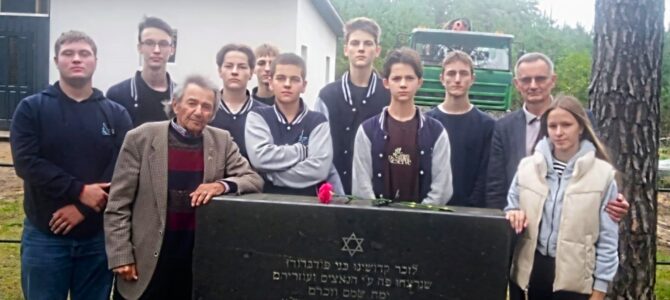
Sophomore students from the Žeimena high school in Pabradė and their history teacher Mr. Stundza visited a Holocaust memorial to the Jews of Pabradė on September 23, the Day of Remembrance of Lithuanian Jewish Victims of Genocide. Švenčionys Jewish Community chairman Moishe Shapiro was invited to tge commemoration and spoke to the students.

The following protest is being called by people who describe themselves as the cultural community of Lithuanian for tomorrow, September 25, to protest the minister of culture proposed and delgated by the Nemuno Aušra party. Details and petition link below.
Dear people of culture,
We are protesting. We categorically oppose the Government’s shocking decision to hand the post of minister of culture over to the Nemuno Aušra party.
We believe that:
Culture cannot be used a tool for political deal-making. The Lithuanian Culture Ministry is not a token which can be exchanged for short-term political gain;
Culture is our memory, the foundation of democratic values, society’s guarantor of resilience to propaganda;
To give this ministry over to a political force characterized by populism, anti-Semitic and pro-Russian rhetoric is dangerous, both to the cultural sector and to society as a whole.
We urge:
.

.
.

.

The Lost Shtetl Museum, after several years of construction and preparation and missed opening dates, finally opened its doors to the public in Šeduva, Kithuania on September 20.
According to visitors and experts, the museum is unlike any other in Lithuania. A large collection of authentic objects tells the story of the Jewish shtetl Šeduva, but also of all shtetls in Lithuania and the region. Some of the texts and exhibits are funny, and portray situations, trials and tribulations from daily life, love letters, immigration plans and excitement for upcoming holidays.
The museums thematic sections and exhibit items are complemented by tactile and olfactory details which might be ignored at first but provide an overall impression, according to one visitor.