Yiddish

Abi Men Zet Zich Club Celebrates 24th Birthday

Abi Men Zet Zich Club Celebrates 24th Birthday

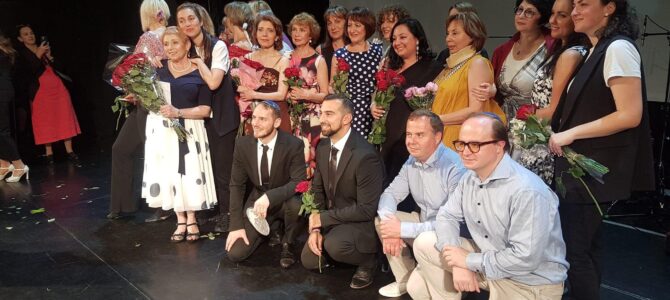
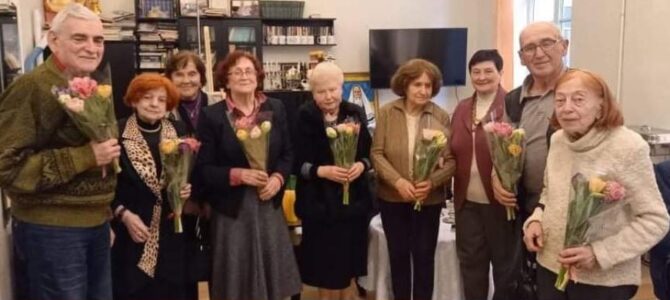
The club for senior citizens was set up by Lithuanian Jewish Community chairman Simonas Alperavičius and deputy chairwoman Maša Grodnikienė on April 26, 1998, and was later named Abi Men Zet Zich, Yiddish for “just to see you again.” The name was the idea of the late Milan Cheronski. We wish club coordinator and social services director Žana Skudovičienė and all our seniors a very happy anniversary.

Historian Ruth Leiserowitz to Present New Publication on Jews from Klaipėda

Historian Ruth Leiserowitz to Present New Publication on Jews from Klaipėda

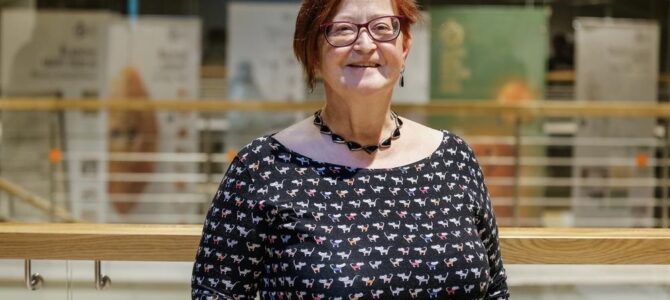
Ruth Leiserowitz, an historian from Germany, has researched the dramatic forced migration out of Klaipėda, also known as Memel, before World War II. She will present her newest book on the subject called “Žydai Klaipėdoje (Mėmelyje)” [Jews in Klaipėda (Memel)] at the Ieva Simonaitytė Public Library in Klaipėda at 5:00 P.M. on April 29.

The publication is intended to coincide with the 770th birthday of the port city.

Leiserowitz’s father came from Memel and she worked at Klaipėda University after Lithuanian independence, and helped organize the Thomas Mann festival in Nida, Lithuania. She got interested in her research topic because of her Jewish father-in-law who was born in Šilutė, then known as Heydekrug. In 1923 his family left Memelland when it was annexed by Lithuania. She decided to look into the fate of Jewish families forced to leave the region. She says her research is often something like a detective novel.

A Physicist of Whom Lithuania Can Be Proud

A Physicist of Whom Lithuania Can Be Proud

Original article: obzor.lt, 2022-03-22

Translated from Russian to Lithuanian by Irena Miškinienė, and from Lithuanian to English by Geoff Vasil

My Teacher Joshua Levinson Would Have Turned 90 Today

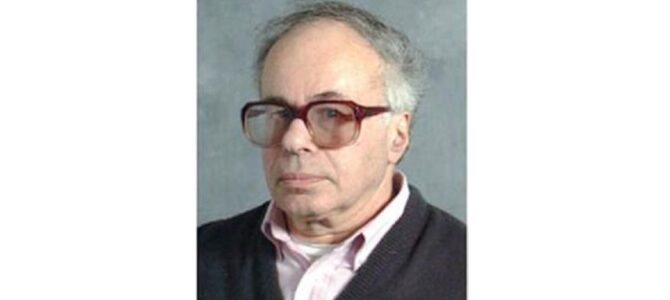
by professor Pinchos Fridberg,
Vilnius


Joshua Levinson

In the place of an introduction

When you have reached the 80-year mark and have become an old and tired horse who can barely lift his hooves, and they take you funem yarid (Yiddish, “from the fair,” a formulation by the Yiddish writer Sholem Aleichem), the faces of your dearest and most beloved people appear before you ever more often, those who have left this world before you. My parents who gave me life. My Teachers who were sent by destiny.

* * *

Snapshots of Last Friday’s Kabbalat Shabat

Snapshots of Last Friday’s Kabbalat Shabat

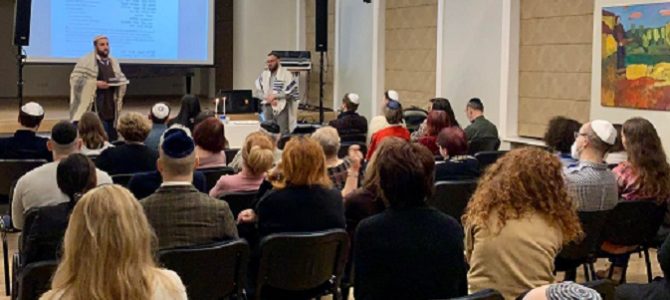
Progressive Rabbi Nathan Alfred from Israel led a Kabbalat Shabat ceremony with about 50 members of the Lithuanian Jewish Community including our seniors and families with children. In the afternoon prior he attended the LJC Seniors Club Abi Men Zet Zich and sang the hymns to usher in the Sabbath. One of our oldest members, Libė Britaniskina, lit the Sabbath candles and the meeting concluded with songs in Hebrew and Yiddish. He led the prayer service and delivered the weekly Torah portion.

Happy Birthday to Aleksandras Rutenbergas

Happy Birthday to Aleksandras Rutenbergas

Aleksandras Rutenbergas celebrated his 75th birthday Monday.

We wish our always active member a very happy birthday, good health and good times. Aleksandras, your contribution to maintaining Jewish heritage is great. You helped build the Tolerance Center of the Vilna Gaon Museum at the site of the former theater there. You were always there in the middle when there was work to be done. You introduced Europe to Litvak heritage, organizing two exhibitions of Vilnius ghetto posters in Padua and Strasbourg.

We would like to express our great respect for your good work and your tolerance.

Mazl tov. Bis 120!

Moshe Kulbak’s Mesiekh ben Efrayim Translated and Published in Lithuanian

Moshe Kulbak’s Mesiekh ben Efrayim Translated and Published in Lithuanian

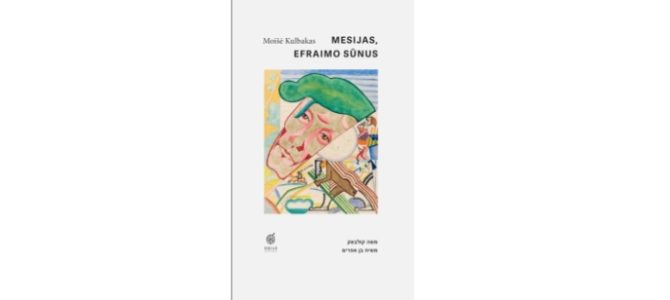
Lithuania’s Odilė publishing house has translated and printed a Lithuanian translation of Yiddish writer Moshe Kulbak’s book Mesiekh ben Efrayim under the title Mesijas, Efraimo sūnus. The description by internet vendor knygynas.biz says:

Classic of Lithuanian and world Jewish literature Moishe Kulbak (1896-1937) is known to Lithuanian readers as the author of the wonderful poem Vilne. Finally for the first his prose has appeared in Lithuanian, the novel Messiah ben Efraim. This is one of the most famous and most original of Kulbak’s Yiddish works. It was written in Berlin in 1922 and is suffused with magical realism, something which hadn’t been seen before. The author’s vital and innovative imagination connects surrealistic and expressionistic images here with the oral tradition and strong mystical spirit of Lithuanian Jews. This ensemble recalls the impressive paintings of Marc Chagall.

The novel Messiah ben Efraim is based on a Jewish legend which comes from the Talmud that there are always 36 hidden just men living in the world without whose unseen actions the world would pass away [lamed-vavnik tzadikim or lamed-vavniki]. Kulbak creates a story about these holy people living in historical Lithuanian [Grand Duchy] lands–in Belarus and Žemaitija. Elderly miller Benya, Simkha the rabbi who ran away from his community, the philosopher-bum Gimpel, Christian sauna operator Kiril–these souls trapped in the world seeking the light, guided a strange unease embark on a journey without any explicable destination. During this fantastic trip filled with humor and mystical experiences the cause of this unease driving on the travellers gradually comes into focus: it’s the impending advent of the Messiah to the land of Lithuania.

YIVO Vilna Collection Online

YIVO Vilna Collection Online

Dear Faina,

Today, I am delighted to announce that The YIVO Institute for Jewish Research (YIVO) completed the Edward Blank YIVO Vilna Online Collections Project (EBYVOC), a historic 7-year, $7 million international initiative to process, conserve and digitize YIVO’s divided prewar library and archival collections.

These materials, divided by World War II and located in New York and Vilnius, Lithuania, have now been digitally reunited for the first time.

Comprising approximately 4.1 million pages of archival documents and books, the EBYVOC Project is an international partnership between YIVO, the Lithuanian Central State Archives, the Martynas Mavydas National Library of Lithuania, and the Wroblewski Library of the Lithuanian Academy of Sciences.

The completion of the EBYVOC Project is an epic milestone in the preservation of Eastern European Jewish history and culture. It was completed on schedule and within budget, providing a global audience access to these treasures through a dedicated web portal free-of-charge. We invite you to explore this remarkable collection at https://vilnacollections.yivo.org/.

Chaim Grade: Facts of a Life

Chaim Grade: Facts of a Life

Photo: Jung-Vilne literary group: Chaim Grade is stand­ing in the top row to the left, the poets Shmerke Kacz­er­gin­s­ki and Abra­ham Sutzkev­er are seat­ed in the mid­dle. YIVO archives

by Susanne Klingenstein and Yehudah DovBer Zirkind, In Geveb, December 15, 2021

INTRODUCTION

When on May 2, 2010, Inna Hecker Grade passed away at the age of eighty-five, a sigh of relief, unkind and hard-edged, coursed through some corners of the Yiddish literary world and a small circle of scholars and archivists tensed with expectation. For twenty-eight years, since the passing of her husband Chaim Grade on June 26, 1982, the literary legacy of one the most important Yiddish prose-stylists and documentary story­tellers to emerge from the ashes of Vil­na, had lain concealed in the couple’s Bronx apartment, guarded by his angry widow who deemed the world unworthy of her husband’s genius. After a brief foray into the publishing world, she had withdrawn into a tomb filled with her husband’s treasures.

The sepulchral metaphor was first used by Ralph Speken, the psychiatrist who had taken care of Inna Grade during the last months of her life. On the eve of breaking the seal, Speken pleaded: ​“They should take over that apartment as if they were taking over King Tut’s tomb.” Scholars and readers expected the discovery of manuscripts in drawers and closets that would speedily be published, perhaps in critical editions, and bring Grade back to literary life. No new work, no critical edition or biography has yet appeared.

Remembering Documentary Photographer, Author, Screenwriter Alter-Sholem Kacyzne

Remembering Documentary Photographer, Author, Screenwriter Alter-Sholem Kacyzne

Photo: Alter Kacyzne. “Green Fields” theater still. ca. 1921. Museum of the City of New York.

text by Yitskhok Niborski, translated from Yiddish by Yankl Salant

Kacyzne, Alter-Sholem (May 31, 1885-July 7, 1941)

(1885–1941), Yiddish writer and critic; photographer. Born in Vilna to a working-class family, Alter-Sholem Kacyzne (Yid., Katsizne) attended heder and also a Russian-language Jewish elementary school. At 14, after his father’s death, he stopped his formal studies. Kacyzne was an autodidact and remained an avid reader not only of literature in Russian, Yiddish, and Hebrew, but also of Polish, German and French works. For about 11 years he lived in Ekaterinoslav where he learned to be a photographer and was married.

In 1909, Kacyzne first published two Russian stories in the periodical Evreiski mir (Jewish World), edited by S. An-ski. In 1910, attracted by the work and reputation of Y. L. Peretz, Kacyzne settled in Warsaw, where he opened a photography studio. He grew very close to Peretz, who became a literary mentor, but did not begin publishing in Yiddish until after Peretz’s death in 1915. Kacyzne’s first Yiddish texts appeared in collections in Vilna and Kiev. In 1919 and 1920 his first two books were published in Warsaw, the dramatic poems Der gayst der meylekh (The Spirit, the King) and Prometeus (Prometheus). He was also a consistent contributor to (and sometimes co-founder and co-editor of) a series of literary periodicals, most of them short-lived, in Warsaw and Vilna, in which he published novellas and stories that in 1922 appeared in book form as Arabeskn (Arabesques).

YIVO Director Thanks LJC on Milestone Achievement

YIVO Director Thanks LJC on Milestone Achievement

Dear Faina,

Today YIVO announces the completion of the Vilna Collection Project–4.1 million pages of documents and books online for people around the world–and you have been such a tremendous part of it. You introduced me to so many people, helped shepherd our grant through the Goodwill Foundation and advised on so many things. Thank you. This project truly opens new doorways for millions of people around the world. Without your support and enthusiasm I am not sure we would have been successful. I hope that when I am in Vilnius … we will be able to celebrate together.

Here is a link to the website: https://vilnacollections.yivo.org/
With my warmest good wishes for a healthy, happy, peaceful New Year,

Jonathan

Jonathan Brent
Executive Director/CEO
The YIVO Institute for Jewish Research

Joint Lithuanian-YIVO Digitization Project Complete

Joint Lithuanian-YIVO Digitization Project Complete

New York-based YIVO has announced the completion of a joint project to digitize the Edward Blank collection in what is known as the Edward Blank Vilna On-Line Collections Project. The historic initiative took seven years and $7 million to complete. The goal was to sort, conserve and digitize pre-war collections from the YIVO library and archives, and to make them available to everyone online.

The project was carried in concert with the Lithuanian Central State Archive, the Martynas Mažvydas Lithuanian National Library and the Vrublevskiai Library of the Lithuanian Academy of Sciences.

Ruth Levine, the director of the board of YIVO, called the completion of the project a new phase in the modern history of the YIVO institute and part of their main mission. She said heroes and martyrs gave their lives to preserve the books and documents in the collection, and expressed gratitude to the Lithuanian partners in the project.

Lara Lempertienė Awarded Prize by Lithuanian Foreign Ministry

Lara Lempertienė Awarded Prize by Lithuanian Foreign Ministry

Jewish scholar and head of the Lithuanian National Library’s Judaica Center Lara Lempertienė, PhD, was awarded the Star of Lithuanian Diplomacy prize Friday, according to a press release from the Lithuanian Foreign Ministry. Lithuanian foreign minister Gabrielius Landsbergis personally presented her the prize at the ministry in recognition of her work fostering research into Litvak history and cultural heritage, and for her significant contribution to commemorations of the 300th birthday of the Vilna Gaon and 700 years of Litvak history.

“You have made a remarkable contribution in strengthening foreign policy and carrying out our shared mission to spread knowledge of Lithuanian Jewish history and culture,” minister Landsbergis said. The Lithuanian Foreign Ministry has been awarding the Star of Lithuanian Diplomacy since 2010 in recognition of contributions to spreading knowledge of Lithuania internationally and to improving and celebrating international relations.

Plans to Revive Shelved Legislation on Ethnic Minorities

Plans to Revive Shelved Legislation on Ethnic Minorities

Lithuanian MP Rita Tamašunienė, a representative of the Polish Electoral Action/Union of Christian Families party and the alderwoman of the Lithuanian Regions faction in parliament, Thursday announced plans to reintroduce legislation for a Law on Ethnic Minorities drafted back in 2013. It met with disapproval from the Lithuanian parliament’s Legal Department and Law and Order Committee earlier for possibly violating the Lithuanian constitution.

The legislation attempts to define basic principles for protecting the rights and freedoms of ethnic groups, to regulate protection of ethnic minority education, use of languages and cultural values, and to regulate NGO activities.

The draft law provides: “in administrative territorial units where a given ethnic minority lives closely together, local institutions and organization use the (local) language of that ethnic minority along with the state language.” It also says street signs in such areas may include ones in the local minority language alongside Lithuanian signs.

Vilna Gaon Museum Launches Kalmanovich Book

Vilna Gaon Museum Launches Kalmanovich Book

The Vilna Gaon Jewish History Museum is launching two editions of YIVO linguist Zelig Kalmanovich’s diary written in the Vilnius ghetto, in Lithuanian and English, titled Hope Is Stronger than Life. The book will be presented at 5:30 P.M. on Wednesday, November 24, at the Samuel Bak Museum, aka the Tolerance Center, at Naugarduko street no. 10 in Vilnius.

Kaunas Jewish Community Celebrates Minkowski Brothers with Concert

Kaunas Jewish Community Celebrates Minkowski Brothers with Concert

The Kaunas Jewish Community is pleased to invite you to a concert called “Born in Kaunas, Renowned throughout the World: A Concert in Memory of the Brothers Oskar and Hermann Minkowski” at 6:00 P.M. on Monday, November 22, at the Kaunas State Philharmonic located at E. Ožeškienės street no. 12 in Kaunas.

Actor and director Aleksandras Rubinovas will tell the story of Oskar and Hermann Minkowski.

The concert will feature compositions by Litvaks and contemporary Israeli composers performed by the Vilnius St. Christopher Chamber Orchestra.

If you’d like to attend, please fill out this form: https://forms.gle/modjciNNQ1eaixHt7

LJC Donates 1,000 Rudashevski Diaries to Lithuanian Schools

LJC Donates 1,000 Rudashevski Diaries to Lithuanian Schools

The Lithuanian Jewish Community has delivered 1,000 copies of Yitzhak Rudashevski’s “Vilnius Ghetto Diary” in Lithuanian translation to the Lithuanian National Education Agency for distribution to almost all primary school libraries across the country.

At the hand-over ceremony several days ago, LJC chairwoman Faina Kukliansky said the gift will contribute to Holocaust education in Lithuania and that Rudashevski’s diary provides a personal perspective which children are able to grasp more easily. Rudashevski wrote the diary as a teenager from Vilnius. She presented one copy of the book personally as a symbolic gift to Lithuania’s education and athletics minister Jurgita Šiugždinienė on the occasion.

“While we provide the book to the schools, it’s important to remember there were thousands of Rudashevskis,” chairwoman Kukliansky said.

Children’s Cooking Workshop at Community

Children’s Cooking Workshop at Community

It was quite a Sunday afternoon at the Lithuanian Jewish Community. We were not able to count the number of children in attendance nor the abundance of food made. We cooked, we baked, we sampled and we did it all over again numerous times. This was the fourth round of the Kinder Tish Sunday school activities. The chicken bullion–Jewish penicillin–was cooking in the pot since 8 in the morning. We’ll be meeting again in two weeks for the Miracle of Hanukkah. #BalabostaRiva

Alanta Synagogue Renovated

Alanta Synagogue Renovated

The synagogue in the town of Alanta in the Molėtai region stands on slight hill side a little bit away from Ukmergės street on the right-hand side of the Alanta-Molėtai road. It is unique in Lithuania and Europe. It is one of only seventeen surviving wooden synagogues spread across Lithuania. Judging from its shape, it is thought it was built in the late 19th century. The Alanta synagogue is the only surviving synagogue from the Romantic period with an intact interior and interior stairs left in Lithuania.

The renovated synagogue will be handed over to the Molėtai regional administration for managing public use of the state-protected heritage site for cultural, educational and tourism activities including exhibits and tours teaching local Jewish history.