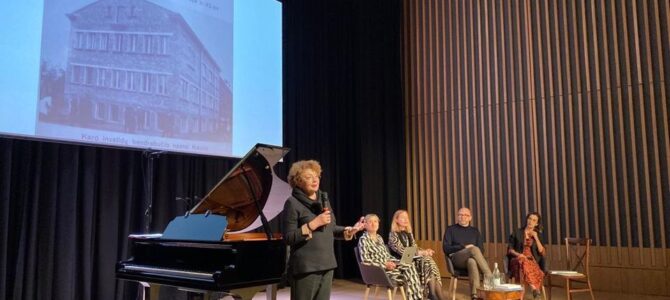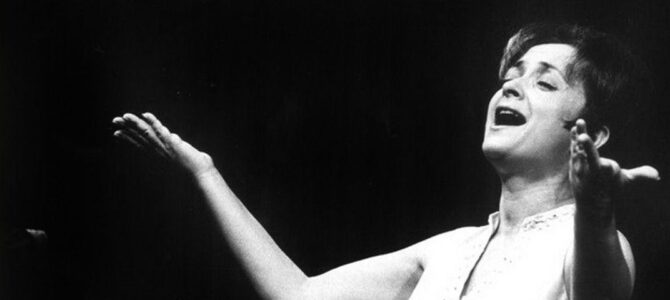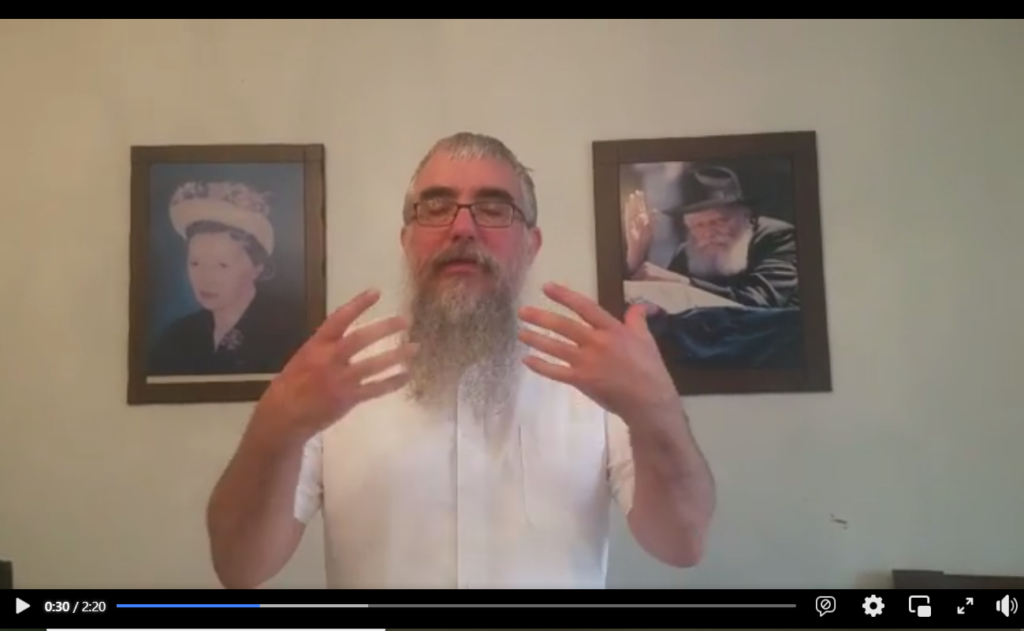


The Lithuanian state radio and television website has an extensive interview with Litvak musician Arkadijus Gotesmanas on music, life and upcoming appearances in Lithuania.
Full article and interview in Lithuanian here.

The Lithuanian state radio and television website has an extensive interview with Litvak musician Arkadijus Gotesmanas on music, life and upcoming appearances in Lithuania.
Full article and interview in Lithuanian here.
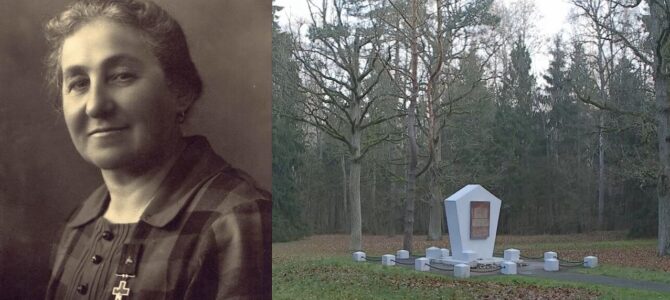
We extend our deepest condolences on the death of Polina Zingerienė at the age of 101 to her sons Markas and Emanuelis and her many friends and relatives.
She was born in Kaunas where she was graduated from high school. Her adolescence was cut short by World War II. She was imprisoned in the Kaunas ghetto and later sent to a concentration camp. After the Allies liberated the camp, Polina returned to Kaunas.
Her painful experiences and struggle to survive the Holocaust led her to go into medicine. She received in diploma in natal and developmental nursing. She worked in her field of medicine till the age of 76.

Come to celebrate the last sabbath of the summer at the Cvi Park Israeli food kiosk with Israeli dancing. The event starts at 6:00 P.M. on Friday, August 26. The event is free and open to the public.

The Jerusalem Theater Archive and Museum is hosting an exhibit to mark the 100th anniversary of the staging of S. An-sky’s “Dybbuk” at the Habima Theater in Moscow. The exhibit opened August 8 at Hebrew University on Mount Scopus in Jerusalem, according to Birobaidzhaner Shtern.
An-sky’s “Dybbuk, or, Between Two Worlds” was written in Yiddish. The Moscow production was translated to Hebrew by Evgeny Vakhtangov and Haim-Nahman Bialik. The Vilner Troupe presented the play in Yiddish in Warsaw in 1920, directed by Dovid Herman. The Polish film “Dybbuk” directed by Michał Waszyński was shot in 1937 and marks the birth of Yiddish cinema. The Hebrew-language production in Moscow, however, is considered special because its success became a kind of calling card for Habima, which in turn eventually became the National Theater of Israel.
Full article in Yiddish here.

Photo: Attorenys Maxim Dyatlov (center) and Andrey Grishaev (right) at the trial on the liquidation of the Sokhnut agency in Russia. Photo by Sergey Karpukhin courtesy TASS.
The Jewish Agency for Israel, commonly known as Sokhnut, asked the Moscow court trying the case to postpone proceedings in order to study evidence submitted by Russia’s Justice Ministry. This came after the court rejected Sokhnut’s motion for a two-month period of reconciliation in order to remedy the situation, to which the Justice Ministry objected. The trial will now resume September 19.
Russian authorities claim Sokhnut has violated personal data privacy laws. The Israeli television channel 13Reshet is now saying Russia fears a new brain-drain, since Sokhnut actively works to repatriate Jews to Israel. Russian officials deny that is the case. Russian presidential spokesman Dmitri Peskov told the media it was purely a matter of compliance to Russian law. President of the Russian Federation Vladimir Putin and Israel’s president Isaac Herzog discussed the case by telephone and decided the relevant courts and government agencies in both countries should deal with the issue. Sokhnut has said they might leave Russia completely and work remotely via telephone and internet there.
Information from RBK television.

The International Festival of Jewish culture “Shalom in All The World” returns to Klaipėda.
This year, the International Festival dedicated to learning about the history, culture, art, and traditions of the Jewish society will be held for the second time and is part of the program of events dedicated to the 770th anniversary of the city of Klaipėda. During the events of the Festival, the aim will be to emphasize the historical roots of the Jewish society in Memel, specifically the contribution of the Jewish residents to the development of the city in that time
Full of events, an enthralling and significant Festival will again invite everyone, regardless of their nationality, religion, beliefs, to meet at the concerts, talks, movie screenings, exhibitions, creative workshops, traditional Jewish dance lessons, excursions.
Youth, adults, families, regardless of age, education, interests are very welcome! All events are free of charge! Be with us and among us!
Full program here.

Every month the Panevėžys Jewish Community celebrates its members’ birthdays and anniversaries. In July and August we congratulated Diana Narevič and Rimantas Rimkus and Jurijus and Svetlana Grafman on their anniversaries.
We also provided and provide material support to our members.
Despite summer vacations, cultural and athletic events are being held and members are participating in Panevėžys regional events and scouting activities.
In the summer we usually have a large number of guests who care about their family histories. They often talk about their families over a cup of tea at the Panevėžys Jewish Community. One of the newer stories is about a family who emigrated to South Africa, then later between 1900 and 1910 they went their separate ways to Canada, China, England and Israel. They came back to Lithuania to learn about the former shtetl where their forebears once lived.

We wish a very happy milestone birthday to Semionas Finkelšteinas, modern founder and president of the Lithuanian Makabi Athletics Club and head of Lithuanian Makabi delegations abroad. We wish you great health, happiness and a continued sharp wit. Mazl tov. Bis 120!

Pakruojis Synagogue is a Monument to All the Jewish Houses of Prayer Which Stood in Lithuania
15min.lt, reprinted from a facebook user
It’s believed there were about 500 or 600 different Jewish houses of prayer in our country, although no one knows the exact number. There might have been more than 100 synagogues in Vilnius alone.
Most of Lithuania’s synagogues were wooden, but today we only have about a dozen. On the other hand, no other European state has so many surviving wooden synagogues.
The question of restoring these historically and culturally very valuable wooden buildings is coming up more and more. One wonderful example of a restored wooden synagogue stands in the town of Pakruojis. After walking through its interior and getting a closer look at its careful restoration, I was pleasantly surprised at what had been returned from the ravages of time, people’s neglect and even fires.
Full text in Lithuanian here.

I’d like to present a person who, as Lithuanian Makabi president Semionas Finkelšteinas says, performed a small miracle at the recently finished World Maccabiah Games in Israel.
Daniel Šer is the silver medal winner in the junior chess competition. Daniel is 13, but he was playing against 16, 17 and 18-year-olds. A silver medal which just missed becoming gold by a hair, since Daniel collected the same number of points with the gold medal winner from the USA, and according to the rules, a tie like that means other indicators are taken into account, something is always kind of a lottery, and this time it wasn’t in our favor.
It was a great competition, very good results and a very high assessment not just for the medal won, but also because news reached us that the organizers of the competition and the chief referee sent the final results to the International Chess Federation along with the request to present Daniel the title of candidate master for his excellent playing in the competition.

Photo: “Sun & Sea,” the beachside opera that spotlights climate change, winner of the 2019 Venice Biennale Golden Lion, will be performed at the 60th Israel Festival, September 15-19, 2022
60th year of annual Jerusalem event aims to break down walls between performers and audiences
by Jessica Steinberg
It’s the 60th year of Jerusalem’s iconic Israel Festival, and, befitting such a milestone event, this year’s celebration will look, sound and appear different from previous iterations.
For starters it will take place in September rather than its perennial June date, and over the course of 10 days, September 15 to 22, instead of the three weeks over which the event was formerly held.
Rather than hopping between spaces throughout the city, nearly all performances will take place in the environs of the Jerusalem Theater, the historic location for early Israel Festivals, befitting an event that once set the standard for all Israeli cultural events, said Itay Mautner, the new co-artistic director of the festival.
Full story here.


The Jerusalem of the North youth orchestra camp will take place from August 15 to 25 at the Preila Library in Preila on the Curionian Spit in Lithuania under the tutelage of renowned Lithuanian conductor professor Donatas Katkus, Martynas Švegžda von Bekker, Dalia Dedinskaitė, Gleb Pyšniak and Darius Mažintas. The 10-day orchestra workshop will conclude in a joint concert with Vilnius’s St. Christopher Orchestra and the new orchestra made up of young participants, performing a jointly-prepared program of Jewish music.
“The Jewish culture of education means the book, music and sports. It’s not for nothing that the Jewish people have been literate for more than 5,000 years. The Lithuanian Jewish Community is happy the orchestra convened at this camp will perform Jewish music. That there aren’t many Jewish children attending the camp this year is, I think, a tourism mistake. Israeli families would love to vacation in Nida while their children attend camp and learn. There should be greater state support brought to these sorts of private and NGO initiatives. The children and adults who will prepare this concert will learn about Jewish composers. We all know how to talk about tolerance, but not all of us know how practice tolerance through deeds. The LJC and the orchestra are doing tolerance, which is what the state institutions should be doing,” Lithuanian Jewish Community chairwoman Faina Kukliansky explained.
The Lithuanian Jewish Community has received a request from a teacher and vice-principal from the Dniepropetrovsk Jewish school in the Ukraine. She is in Lithuania at the current time with her 28-year-old son. They are looking for a place to live either for free or at a small cost. They will have no place to live on September 1. If you can help or know who can, please contact Ruth Reches by email at ruthreches@gmail.com.

We wish a very happy milestone birthday to our long-time member and WWII veteran Tatjana Archipova-Efros. Mazl tov. Bis 120!

Litvak descendant and artist Jenny Kagan has opened an exhibit telling her family’s story during the Holocaust. The “Out of Darkness” exhibit’s main motif is that of a box, the one in which her parents Joseph and Margaret hid, among the few survivors of the Kaunas ghetto. Through interactive objects and audio/video installations the exhibit tells her family history. She told BNS she wanted to provide exhibit goers with a real emotional experience. She added that while the story is a narrative, she comes from a theatrical background and decided to make the experience a theatrical one. The exhibit was first installed in the atmospheric Viaduct Theatre in Halifax, Nova Scotia, in 2016.
Full story in Lithuanian here.

The Jewish mini-holiday of Tu B’Av
Our sages proclaimed the 15th of Av [Friday, August 12 in 2022] as one of the two greatest festivals of the year, yet they ordained no special observances or celebrations for it . . .
The 15th of Av is a most mysterious day. A search of the Shulchan Aruch (Code of Jewish Law) reveals no observances or customs for this date, except for the instruction that the tachanun (confession of sins) and similar portions should be omitted from the daily prayers (as is the case with all festive dates), and that one should increase one’s study of Torah, since the nights are beginning to grow longer, and “the night was created for study.”
The Talmud tells us that many years ago the “daughters of Jerusalem would go dance in the vineyards” on the 15th of Av, and “whoever did not have a wife would go there” to find himself a bride. And the Talmud considers this the greatest festival of the year, with Yom Kippur a close second!
Full article here.

Lithuanian Archive reference LCVA R683, aprašas 2, byla2 lapas 80
“Memory Wars” are fought worldwide. The United Nations and Jew-haters everywhere appear to have reasonable certitude that Jews do not have much of any historical link to Israel, and should not “occupy” Israel. History is a tool of propagandists, able to be rewritten to fight any current conflict and to re-frame a national identity. Soviets did it, North Korea does it, Putin does it, Lukashenko in Belarus does it. But no government in the world has developed historical revisionism into the art form that Lithuania has. They have created an entire government agency to rewrite history, called “The Genocide Center.”
Lithuanian Government
The following is an excerpt from a text by the Center for the Study of the Genocide and Resistance of Residents of Lithuania (the Genocide Center) titled “On Accusations against Jonas Noreika (General Storm), March 27, 2019, Vilnius”:

Efraim Zuroff
Accusing Russia of rewriting the Holocaust for its current propaganda is fair, but not when you’ve always whitewashed the Holocaust for your own purposes
Several days ago I was shocked to learn that five heads of state from Lithuania, Romania, Estonia, Latvia and Poland, all post-Communist Eastern European countries, had recently beseeched the leaders of the European Union to step up efforts to “preserve historical memory.” It was addressed to the European Council president, European Commission president and the Czech prime minister, whose country currently holds the rotating EU presidency.
For the past three decades since their transition to democracy, these countries have excelled in grossly distorting their own respective histories of the Holocaust. Yet the quintet of leaders now maintains that the Kremlin “is seeking to rewrite history and use it to justify its aggression against sovereign states.” Thus they urge the bodies of the EU to take a leadership role in “preserving historical memory and preventing the Russian regime from manipulating historical facts.” They contend that this concern “is particularly relevant in light of Russia’s intensive use of history for propaganda purposes in the context of the war in Ukraine.”
Full editorial here.

Tisha b’Av, the 9th day of the month of Av on the Hebrew calendar, falls on Saturday, July 6 this year.
Tisha b’Av commemorates the destruction of the First Temple of Solomon ca. 587 BCE and the Second Temple in 70 CE in Jerusalem and is traditionally a day of fasting and mourning. Observance includes five prohibitions, the main one being a 25-hour fast. The Book of Lamentations is read in the synagogue followed by the recitation of kinnos, liturgical dirges for the Temple and Jerusalem. Since the day has become associated with other major Jewish tragedies, some kinnos recall other events, including the murder of the Ten Martyrs in ancient Rome, pogroms against medieval Jewish communities and the Holocaust.
According to tradition, the sin of the Ten Spies is the real origin of Tisha B’Av. In the Book of Numbers, 13:1-33 when the Israelites accepted their false report of the Promised Land, they wept, thinking God could no help them. The night the people wept and wailed was the ninth day of Av, which then became a day of weeping and misfortune for all time, according to tradition, following which the Jews were made to wander the desert for 40 years.