Learning

Book about Lithuanian Public Figure Irena Veisaitė Launched in Paris

Paryžiuje pristatyta knyga apie Lietuvos visuomenės veikėją I. Veisaitę

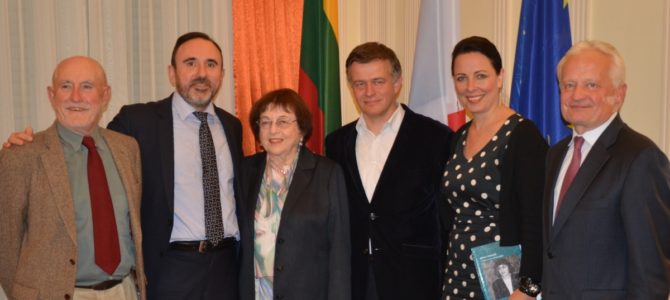
The Lithuanian embassy in Paris hosted the launch of Yves Plasseraud’s new biography in English, “Irena Veisaitė: Tolerance and Involvement,” October 3. Lithuanian ambassador to France Dalius Čekuolis spoke and said he was happy to have the opportunity to present a French author’s book in English about a noble Lithuanian person who has inspired and set an example of tolerance, and who is an active champion of European values.

The presentation was followed by a discussion with the author, academic and attorney Yves Plasseraud, and the guest of the evening, Irena Veisaitė herself, professor of literature, drama critic and human rights activist. The discussion was moderated by professor Šarūnas Liekis, dean of the Political Science and Diplomacy Faculty at Vytautas Magnus University in Kaunas. Veisaitė’s daughter Alina also attended with her son and friends.

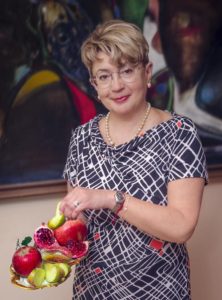
Veisaitė, born in Kaunas in 1928, is a well-known public figure in Lithuania, a celebrated scholar of the theater, a professor of literature, one of the founders of the Lithuanian Open Society Fund and a member of the Lithuanian national UNESCO commission from 1999 to 2007. She is a member of numerous international and national NGOs and has received many awards and distinctions in Lithuania and other countries. Veisaitė has consistently emphasized the need for dialogue and tolerance even in the most difficult situations life has to offer in all her work.

Rules for the Vilnius Jewish Religious Community’s Taharat ha’Kodesh aka Choral Synagogue

Vilniaus žydų religinės bendruomenės Taharat ha‘Kodeš sinagogos taisyklės

Adopted by a meeting of the executive board of the Vilnius Jewish Religious Community on September 22, 2016, act no. 06

Introduction

The rules have been put in place in light of ever-more-frequent attacks against Jews in Europe and the growing danger posed by terrorism around the world. These rules must be followed strictly and are aimed at insuring the physical safety and spiritual dignity of those who pray at the Taharat ha’Kodesh aka Choral Synagogue.

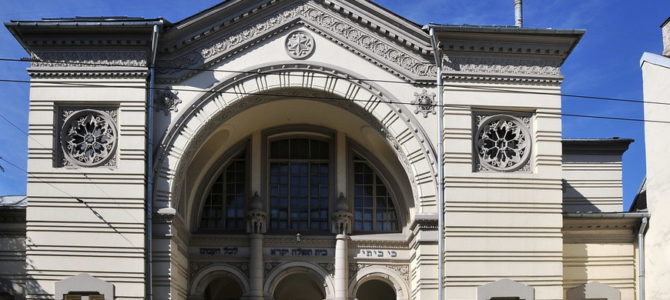
The mitnagedim Taharat ha’Kodesh synagogue, built in 1903 and belonging to the Vilnius Jewish Religious Community, is the only synagogue in Vilnius which has survived the Holocaust and the Soviet occupation.

Every Jew has the right to visit and pray at the Taharat ha’Kodesh synagogue on the condition she or he follow the rules provided below.

Rules of Behavior at the Taharat ha’Kodesh Synagogue

1. The synagogue is public place of worship where the proper human respect for the site and the congregation is shown.

2. All synagogue activities, prayer and services are based on mitnagedic traditions.

3. Public order must be maintained during all prayer services and afterwards in the synagogue. Public order means the general rules of public behavior operating in society based on principles of morality and mutual respect.

4. Adherence to these rules insures the normal course of life in society, tolerant communication, civilized manners of resolution of conflicts arising between people and abstinence from aggression in pursuing individual interests. The following are banned in the synagogue: rude or belligerent behavior, issuing threats, demonstrating disrespect to those around you or the location itself through mockery or acts of vandalism, disturbing the public order and peace, use of profanity or lewd behavior, disrupting services, making noise or otherwise disturbing prayer.

5. Prayer services are performed exclusively in one of the halls, rooms and spaces of the synagogue.

6. A person who wants to make a public address at the synagogue must receive permission to do so from the rabbi working at the synagogue.

7. Personal arguments as well as arguments over the performance of prayers and other religious rites are banned in the synagogue. Suggestions on the performance of prayers and other religious rites may be discussed with the rabbi only when prayer and other religious rites are not happening. These rules also apply to the Kiddush and lecture room.

8. The opening and closing times of the synagogue are set by the executive board of the Vilnius Jewish Religious Community and are publicly announced. Security and technical personnel are hired and their working hours are set based on these times. In special circumstances they may be subject to the discretion of the chairman of the Vilnius Jewish Religious Community.

9. The person reading the Torah, leading the prayer service, is designated and hired by the chairman of the Vilnius Jewish Religious Community with the approval of the executive board of the Vilnius Jewish Religious Community. All people in the synagogue during that time must adhere to this established order.

10. People visiting the synagogue must be dressed appropriately. For men, that means wearing a yarmulke (kippah), a hat or a scarf to cover their head. Mobile or cell telephones are prohibited during prayer.

11. People armed with firearms or other weapons, or items which could be used as weapons, are not allowed to enter the synagogue (except for security guards). Also, intoxicated people or people arousing suspicion are not allowed to enter. It is also forbidden to bring in bags containing food products and larger packages (backpacks, purses, suitcases, luggage or other packages). These must be left with the person on duty at the entrance.

12. Without permission from the chairman of the Vilnius Jewish Religious Community, it is forbidden to hold meetings, protests and rendezvous in the synagogue, or to set out a table with food, or to engage in commercial activity.

13. Members of the congregation and visitors to the synagogue are required to obey the directions of the chairman, elder and security personnel operating in the name of the executive board of the Vilnius Jewish Religious Community.

14. People who violate these rules are asked to leave the synagogue and might be barred from entry in the future. Violation of public order and other actions prohibited by the laws of the Republic of Lithuania could also incur legal accountability.

15. The keys to the synagogue and entry to all communication are protected and managed by the chairman of the Vilnius Jewish Religious Community.

16. All people inside the synagogue must obey the orders of security personnel. The security guard is equivalent to the person in charge of performing the functions of public administration.

Shmuel Levin, chairman
Vilnius Jewish Religious Community
Greater Security Measures in Vilnius Following Terrorist Attack at Moscow Synagogue

maskvos-sinagoga

The Lithuanian Jewish Community is alarmed by the armed terrorist attack at a synagogue in Moscow on October 1 and in order to insure greater security has announced a set of rules for the Choral Synagogue in Vilnius, in light of ever-more-frequent attacks against Jews in Europe and the increasing danger posed by terrorism around the world. These rules must be followed strictly and are aimed at insuring the physical safety and spiritual dignity of those praying at the Taharat ha’Kodesh (aka Choral) Synagogue in Vilnius. The rules may be found here: http://www.lzb.lt/en/2016/10/07/rules-for-the-vilnius-jewish-religious-communitys-taharat-hakodesh-aka-choral-synagogue/

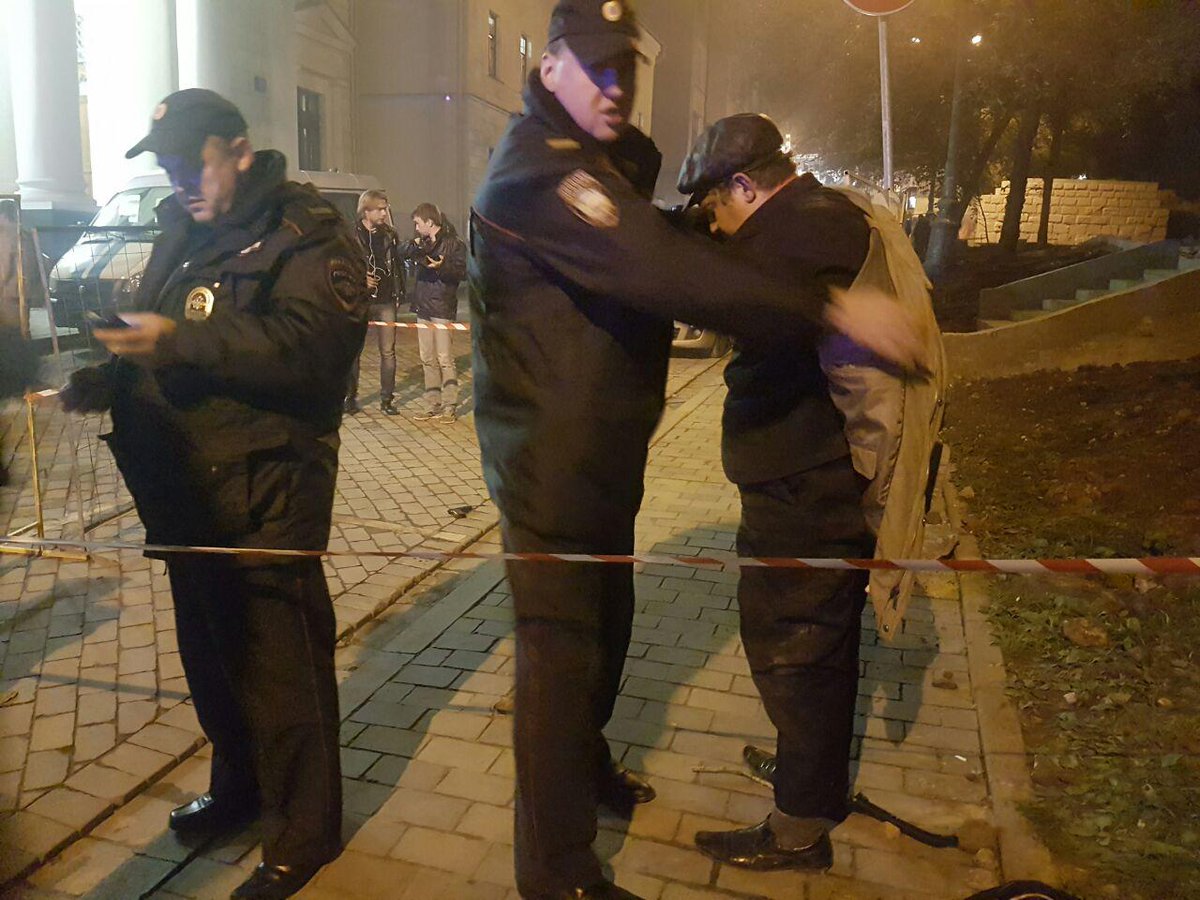
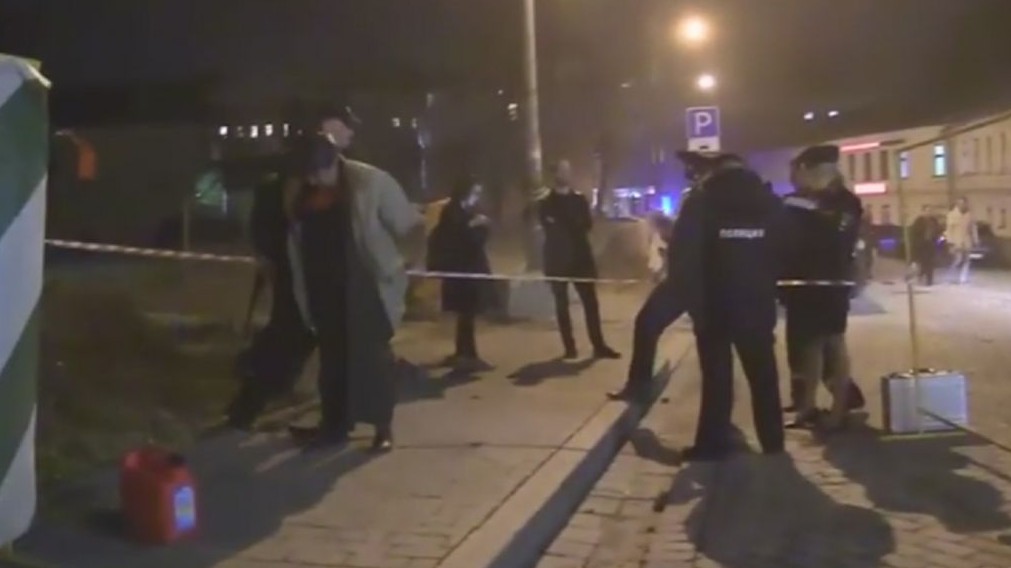
On October 1 a synagogue in Moscow was attacked. A security guard was wounded during the attack. There are reports the attacker might have been suffering mental illness. He has been arrested. Armed with a gun, the attacker stormed the synagogue with a canister of flammable liquid as well and threatened to burn down the Jewish house of prayer. He shot the security guard in the head and chest after he tried to refuse the attacker entry.

maskvos-sinagoge

The attacker has been arrested but the police are not reporting any motive for the attack or further details, except that he has been identified as Ivan Lebedev, aged 40, and has been hospitalized for mental illness in the past. About 150 people were gathered at the synagogue for Sabbath services. The attacker reportedly demanded to meet with Moscow’s Chief Rabbi Pinkhas Goldschmidt.

Anti-Semitic attacks of this nature have been rare in Russia and are more often committed in Western European countries with large Jewish communities such as Great Britain and France.

Happy 85th Birthday to Markas Petuchauskas

The Lithuanian Jewish Community wishes professor habil. Markas Petuchauskas a happy 85th birthday! The doctor of art history has written many books on theater and drama over many years.

We wish him continuing health, continuing creativity and hope for another of his wonderful books. Let’s all wish him inspiration, success and love.

Today Markas Petuchauskas is the only person who can speak with real authority about the Vilnius ghetto theater which operated in 1942 and 1943. He was a ghetto prisoner and miraculously survived, as did his mother, after being rescued by good people. For many years he has sought to renew the interrupted dialogue between Lithuanians and Jews, which, he says, is best understood through art.

Happy Birthday! Mazl tov! May you live to 120!

Holocaust Commemoration in Švenčionys

Spalio 2 d. Švenčionyse vyko renginiai, skirti atminti 75 m. sukakčiai nuo Holokausto pradžios

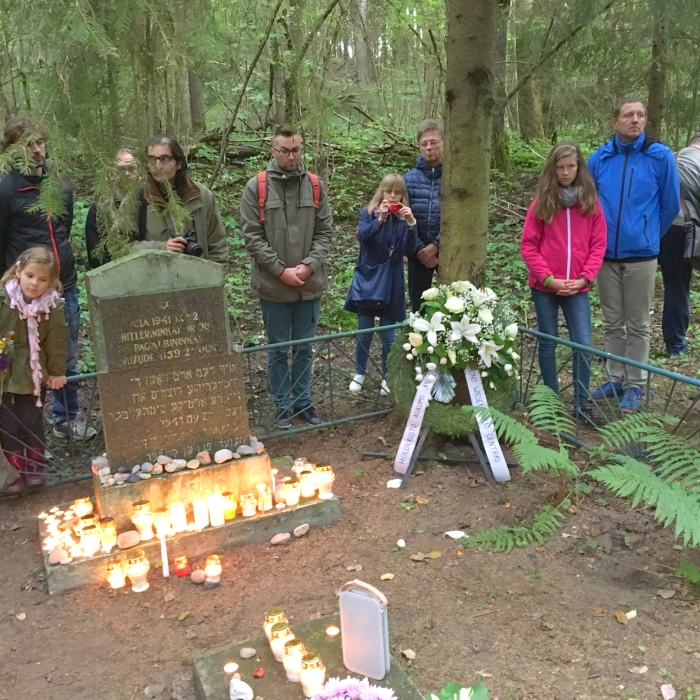
The tradition of gathering and remembering the Jewish victims of the mass murder in Švenčionys on the first Sunday in October has been followed for many years. Jews from around the world and local residents gather to mark the tragic occasion and bow before the mass grave. Israeli ambassador to Lithuania Amir Maimon was there this year on October 2, as were Švenčionys regional administrator Rimantas Klipčius, Ethnic Minorities Department to the Lithuanian Government senior specialist Aušra Šokaitienė, Vilnius Sholem Aleichem ORT Gymnasium principal Miša Jakobas, Švenčionys regional administration commissioners, members of the Jewish community and students.

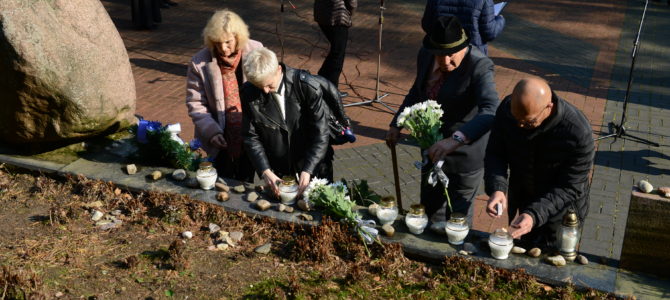
Wreaths were laid and candles lit at the Menorah monument to the victims of the Švenčionys ghetto at 11:00 A.M. in the Švenčionys city park. The victims were then remembered at the military base where they were massacred in the village of Platumai in the Švenčionėliai aldermanship.

The Holocaust Wound That Never Heals in the History of the World

by Algis Jakštas, Švenčionių kraštas

We will probably never find an answer to why expressions of mass genocide [sic] keep repeating in human history, why people are murdered for their ethnicity, race and religion. A few years ago as I watched the film Salt of the Earth (2014) about the photographer Sebastião Salgado who has spent many years photographing genocide committed around the world at the end of the 20th and in the early 21st century, I recalled the Holocaust carried out by fascists against the Jewish people as well. I have spoken many times with Moise Preis who lives in Švenčionys and who passed through all the brutality of the ghettos and concentration camps and through a miracle survived. Sometimes as I listened to his stories I found it hard to even imagine how a person could bear such atrocities and survive, and preserve his humanity.

Aerial Daredevil Senior Rescued Jews in Youth

Sparnuotas senjoras, jaunystėje gelbėjęs žydų gyvybes

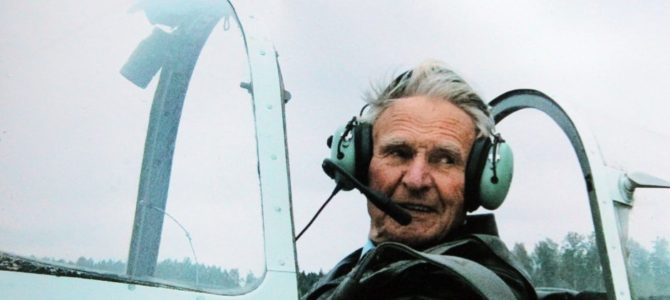
Vladas Drupas, a Kaunas resident who saved ten lives during the Holocaust, doesn’t consider himself a hero at all. It was like pulling teeth to get him to remember the events of 1943 and 1944 in Šiauliai and the surrounding area where a battle took place in secret from the Germans for the survival of individual Jews and their families.

Rescuer and Pilot

This year as the 75th anniversary of the Holocaust in Lithuania was marked there were many events, monuments were unveiled, mass murder sites were marked, rescued Jews and their rescuers were interviewed and 50 people were honored at the President’s Office (most of them posthumously). There are lists in the archive of the Department of the Righteous at the Vilna Gaon State Jewish Museum of hundreds of well-known teachers, doctors, attorneys, writers, musicians, professors, servants, priests, monks, farmers and people from other professions. These include Šiauliai gymnasium student Vladas Drupas who rescued ten Jews from destruction.

This 94-year-old Kaunas resident even now is surprising for his courage. As Lithuania’s oldest aerobatic pilot, several weeks ago he spent a half hour at the Pociūnai airport diving in the sky with his one-seat airplaine.

Full story in Lithuanian here.

LJC Camp Counselor Seminar in Dubingiai

LŽB Vadovų (madrichų) seminaras Dubingiuose

The recreation and conference center ORO Dubingiai hosted a seminar of LJC camp counselors in September. The seminar was intended to raise the qualifications of counselors and better coordinate the Ilan, Knafaim and Regional Clubs. Attendants were the team of counselors and experienced coordinators who shared their knowledge with the young group directors.

The counselors were able to demonstrate their leadership characteristics and other talents and abilities, revealing themselves as good people capable of working in a team. They demonstrated that teamwork playing group games and preparing a program for period until the next season, the winter children’s camps. The coordinators were able to come up with interesting programs for children and adolescents to make this season a memorable one and attract more participants next year.

Kaunas Jewish Community Celebrates Rosh Hashana

Kauno žydų bendruomenė švenčia Roš ha Šana

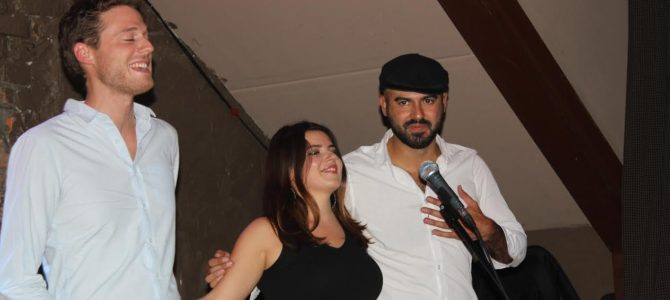
A large contingent of Kaunas Jewish Community members came out to ring out the old and usher in the new year, 5777, wishing one another harmony, health, positive changes and good ideas. The evening of celebration was unusually warm, cozy and family-like. The Levita group of young musicians from France contributed with some great music performed extraordinarily well. The vocalist Vita Levina is the daughter of long-time Kaunas Jewish Community member Leonidas Levinas and began her musical career in Kaunas.

Greetings from LJC Chairwoman Faina Kukliansky for New Jewish Year 5777

faina-ros-hasana2

Happy New Year to all members of the Community, young and old! We are ushering out what was a successful year, and we have reason to be happy and proud of it, and now we look forward to an even better year. I wish everyone strong health and a sweet and successful year ahead for you and your families. I invite everyone to do at least on good deed for the community over the coming year, and I especially invite those to do this who believe there are things that aren’t right within the community. Do what you think is right, don’t be afraid to do good deeds and let’s not fear the consequences. I wish you love of the country in which you live, to love Israel, and to raise your children as Jews, the future members of our community.

שנה טובה ומתוקה

How Much Can Happen in Seven Seconds: Rosh Hashana 5777

portrait_of_determinism_by_relaxeder
by Andrés Spokoiny

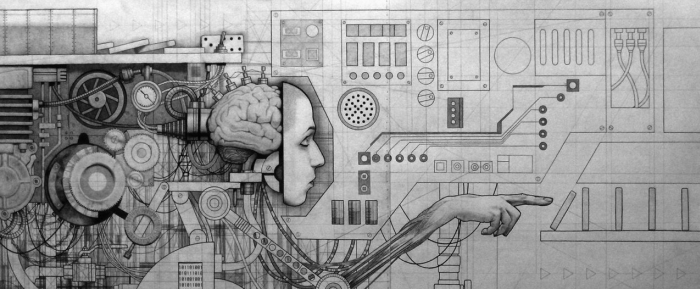
In 2007, at Bernstein Center for Computational Neuroscience in Berlin, scientists conducted a troubling experiment. They put people into an MRI machine and asked them to press one of two buttons in front of them. The subjects were told to do this several times, and to choose freely which button to press.

One part of the results was nothing new: around a second before the button was pressed, the parts of the brain associated with conscious decision-making lit up. But looking more carefully, the scientists noted that there was a pattern of neural activities around six or seven seconds before the decision was actually taken. That pattern predicted with great accuracy the decision that the person ended up taking.

The researchers were shocked, because these findings suggest that decisions are not really conscious. Rather, they are subconscious neural processes that are complete before our “command and control” functions ever activate. We may think that we’re about to consciously decide something, but in fact, our subconscious has already (and irrevocably) decided.

Fifteen Ways Being Jewish Is Meaningful

by David Harris

Surveys reveal a disturbingly large number of American Jews who feel disconnected from their Jewish identity. How painfully sad! In response, and with the High Holy Days just around the corner, let me share, as I have on occasion in the past, what being Jewish means to me.

1. It means championing what is arguably the single most revolutionary concept in the annals of human civilization—monotheism—introduced to the world by the Jews, and its corollary, the inherent belief that we are all created in the image of God (in Hebrew, B’tzelem Elohim).

2. It means embracing the deep symbolic meaning the rabbis gave to the story of Adam and Eve. Since all of humanity descend from the “original” couple, each of us, whatever our race, religion, or ethnicity, shares the same family tree. No one can claim superiority over anyone else.

3. It means entering into a partnership with the Divine for the repair of our broken world (in Hebrew, Tikkun Olam), and recognizing that this work is not to be outsourced to a higher authority, or to “fate,” or to other people, but that it’s my responsibility during my lifetime.

4. It means affirming life – “I have set before you life and death, blessing and curse, therefore choose life, that both you and your descendants may live” (Hebrew Bible) – and the moral choice that lies in the hands of each of us to bring a little closer the Jewish prophetic vision of a world at peace and in harmony.

5. It means celebrating the fact that Jews were early dissidents, among the very first to challenge the status quo and insist on the right to worship differently than the majority. Today, we call this pluralism, and it is a bedrock principle of democratic societies. It also ought to be an essential component of Jewish communities everywhere.

6. It means welcoming the pioneering Jewish effort to establish a universal moral code of conduct and seeking to act as if that code of conduct were my daily GPS—to pursue justice, to treat my neighbor as I would wish to be treated, to welcome the stranger in our midst (and, I might add, the newcomer to the Jewish people), to be sensitive to the environment, and to seek peace. It’s not by accident that America’s Founding Fathers chose words from the Hebrew Bible for our nation’s Liberty Bell: “Proclaim liberty throughout all the land and unto all the inhabitants thereof.” Or that the Ten Commandments continue to be an ethical guidepost for so many around the world.

LJC Youth Programs in September

Ilan Club and their youngest group leaders opened the club for fall. Children returning from the summer camps were full of emotion, and the counselors were filled just as much with enthusiasm and new ideas.

On September 18 the Ilan club officially opened for the fall and about 30 of our youngest friends turned out for the event. The first activity was getting to know the new club members and the counselors. During the activities session the children participated in skits where children’s favorite things were showcased–cartoons, music, games, etc. During play the children had the chance to introduce themselves to the group and to play as teams. After the skit there was our weekend ceremony and a symbolic dinner with many delicious items.

Lithuanian Jewish Community Chairwoman Pays Last Respects to Shimon Peres in Jerusalem

VILNIUS, September 30, BNS – Lithuania on Friday is paying last respects to late Israeli president Shimon Peres.

Lithuanian president Dalia Grybauskaitė and foreign minister Linas Linkevičius attended his funeral in Jerusalem, and Vilnius residents and guests can express their condolences at the Israeli embassy.

“We bid farewell to a great man of the world, a man of peace, an example of tolerance, a man important to all, including Lithuania, because he considered Lithuania, this region, his birthplace and called himself a Litvak,” Grybauskaitė said.

“His visit several years ago marked a significant improvement in the relationship between our states, which is very important for us not only as we look to the future, but also as we reflect on our painful past,” she said.

Lithuanian Jewish Community chairwoman Faina Kukliansky also attended his funeral in Jerusalem.

Peres was born only 100 kilometers from Vilnius in a small town in what then was Poland in 1923.

Lithuanian Jewish Community Position on the Reconstruction of the Great Synagogue in Vilnius

The following is an official letter sent by the Lithuanian Jewish Community to concerned government agencies.

September 27, 2016

To:
Remigijus Šimašius
mayor, city of Vilnius

Alminas Mačiulis
Government chancellor

Šarūnas Birutis
minister of culture

Linas Linkevičius
minister of foreign affairs

Diana Varnaitė
director, Cultural Heritage Department under the Ministry of Culture

On the Reconstruction of the Great Synagogue

As public interest has grown recently in the history and cultural legacy of Lithuanian Jews (Litvaks) and specifically regarding artifacts uncovered at the site of the Great Synagogue in Vilnius, we feel it our duty to again present our view, that of the Lithuanian Jewish Community, regarding the issue of the conservation of surviving parts and the possible reconstruction of the Great Synagogue, a building with extraordinary significance to the Lithuanian and the global Jewish community.

As we have said before many times, we support all meaningful initiatives to preserve, protect and commemorate the legacy and heritage of the Jews of Lithuania, but we do not support unreasonable projects to rebuild non-existing buildings which are carried out in the name of Jews. It seems that is what we are facing again in the idea developing over many years by certain government institutions and possibly including hidden business structures to rebuild the Great Synagogue complex in Vilnius.

In 2015 the municipal government enterprise Vilniaus Planas was commissioned by the municipality’s Urban Development Department to prepare draft construction proposals for a memorial to the Great Synagogue under pre-project proposals submitted by the architect Tzila Zak. The terms of reference of the planning task itself revealed the client’s attitude towards the rebuilding of the Great Synagogue as an attractve real estate development project: the primary task presented to planners was to submit a list of the buildings proposed for rebuilding, to name the rooms and premises slated for reconstruction and to calculate floor space.

Israeli Dance Lessons

Israeli dance lessons with Karina and Valerija, beginners’ group from 11:00 A.M. to 12 on Sundays, advanced group Sunday from 12:15 P.M. to 1:15 and Wednesdays 6:00 P.M. to 7:30 P.M. at the Lithuanian Jewish Community, Pylimo street no. 4, Vilnius.

For more information write karina.semionova@gmail.com

News from the Interwar Period in Jewish Lithuanian Newspapers

lit060

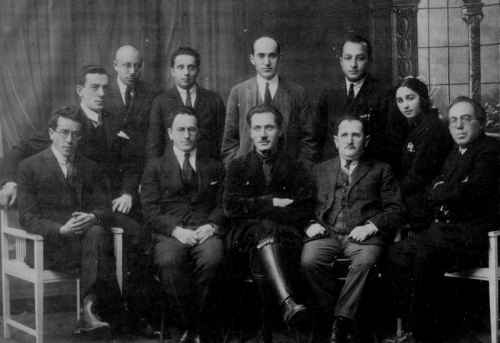
Editorial board of Di Yiddishe Stime, 1924. Sitting, right to left: Nathan Goren, Roza Khazan-Feigin, Moshe Cohen, David Cohen, Reuven Rubinstein, Moritz Helman, Rafael Khasman. Standing, right to left: Ya’akov Feigin, Israel Zhufer, Moshe Rabinowitz, Eliezer Shibolet. Photo courtesy jewishgen.com

Jews were the largest ethnic and religious minority in Lithuania in the period between the two world wars. The Jewish culture of Lithuania, just like that of Eastern Europe as a whole, was multifaceted and diverse, and the Yiddish language was an important vehicle of communication. When Isaac Bashevis Singer received the Nobel Prize for Literature in December of 1978, he wasn’t just speaking in vain when he said: “There are some who call Yiddish a dead language, but so was Hebrew called for two thousand years. It has been revived in our time in a most remarkable, almost miraculous way. … It is a fact that the classics of Yiddish literature are also the classics of the modern Hebrew literature. Yiddish has not yet said its last word. It contains treasures that have not been revealed to the eyes of the world. It was the tongue of martyrs and saints, of dreamers and Cabbalists—rich in humor and in memories that mankind may never forget.

Shimon Peres: An Exceptional Intellect and a True Litvak

Sh.Peresas buvo išskirtinio intelekto žmogus ir tikras litvakas – F.Kukliansky

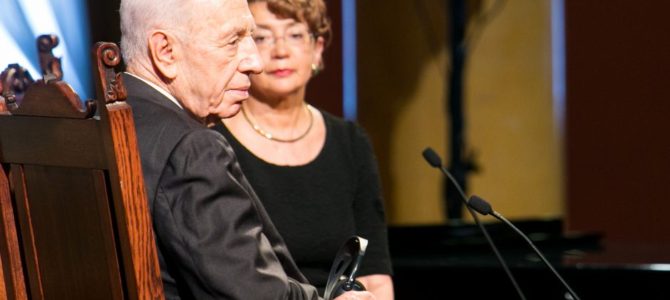
Lithuanian Jewish Community chairwoman Faina Kukliansky says late Israeli president Shimon Peres was a person of exceptional intellect and always stressed his ties with Lithuania.

“It’s important for us, for Lithuanian Jews, that he was one of our own, we always considered him a Litvak and he considered himself a Litvak. After all, he came from Vishnev, a village 70 kilometers from Vilnius in what is now Belarus but which was Lithuanian territory then. It was so nice for us that our countryman was so intelligent, so educated, such an erudite, and could speak on any and every topic even at a venerable age. Our entire community is in mourning. We know human life has an end, but when you encounter death, great sadness overtakes you,” Kukliansky said.

Peres visited Lithuania three years ago and Lithuanian president Dalia Grybauskaitė met him when she visited Israel last year. This last spring he was decorated with the Lithuanian order of the Great Cross “For Contributions to Lithuania.”

Jewish Holocaust Victims Were Neighbors and Fellow Citizens

img_1142_700_700

The project is based on the fact that there are 227 Holocaust mass murder sites in Lithuania scattered all across the country.

I had never heard of Vėliučionys, a small village on the outskirts of Vilna (Vilnius) before Lithuanian author Rūta Vanagaitė and I set out in the summer of 2015 to visit sites of Holocaust mass murders for a book we wrote on Lithuanian complicity in Shoa crimes.

Our original list of destinations was compiled based on our biographies.

I chose the birthplaces of my maternal grandparents Samuel and Bertha Sar, and the towns in which they had grown up and studied, as well as the presumed site of the murder of my great-uncle Rabbi Efraim Zar, for whom I am named, his wife and two sons. Rūta chose the places where her grandfather Jonas Vanagas and her aunt’s husband Antanas Stapiulionis had played a role in the murder of Jews.