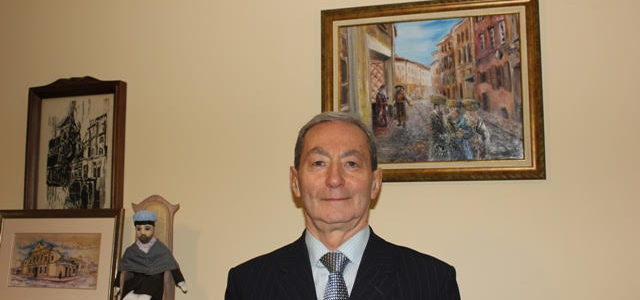
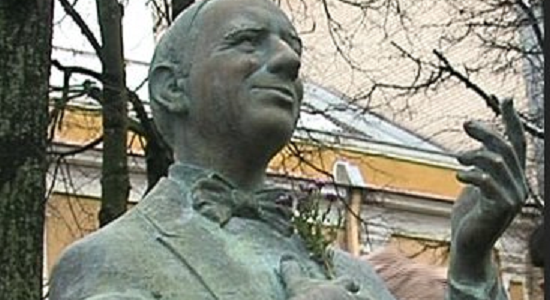
Maestro Eugejijus Paulauskas whose 90th birthday we celebrated one year ago in the Jashca Heifetz Hall at the Lithuanian Jewish Community has passed away. He shared his memories with us then and we want to share some of ours about him as well. Paulauskas was a violin virtuoso and a wonderful teacher. The Lithuanian Jewish Community sends sincere condolences to his family for their loss.
Born September 6, 1927, Paulauskas began his musical career more than 70 years ago. The talented musician went on to become one of Lithuania’s most notable violinists. He began studying music in Šiauliai and completed violin class under professor J. Targonskis at the Vilnius Conservatory in 1949. Last year at the birthday celebration Eugenijus Paulauskas said: “My teachers were very good, all of them were Jewish. After all, the best violinists in the world are Jews because this is a talented people. Chamber music is one of the subtlest, most profound and most intellectual forms of music and performance. I am convinced no other genre of music has so many pearls, so many masterpieces, as the quartet does. All the musical geniuses compose quartets. These compositions are made in such a way that as you perform them you forget the musical fabric, the architectonics of form, because you enter into the very depths of emotion from which emerge as if cleansed, enlightened. This sort of rebirth isn’t something just we musicians need. Everyone who comes to a concert needs it,” the master violinist said.
Paulauskas’s solo concert activity was greatly limited by his deep engagement with the Lithuanian Quartet and his pedagogical work, which have become an important part of his activities. He had innate talent, the characteristics of a solo virtuoso which was developed very early, passion to perform and passion for communicating with people of all ages and experience in his audience. Paulauskas’s rich solo repertoire was dominated by music from the Baroque, classical and romantic ages. His performance on the violin was exquisite and full of style, and his duets were subtle. His violin duets with piano met with great approval from audiences and critical acclaim.
Rest in peace, Eugenijus Paulauskas, beloved and respected by all.


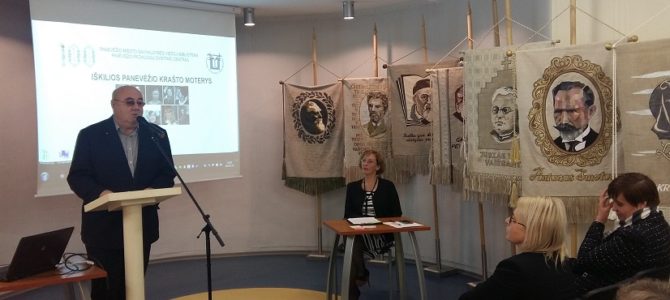
Professor Rita Aleknaitė-Bieliauskienė, formerly a resident of Panevėžys, invited the Panevėžys Jewish Community to attend an event to present her book “Iškilūs XX a. Lietuvos atlikėjai ir pedagogai Aleksandras Livontas ir Olga Šteinberg” [“Notable 20th Century Performers and Teachers Aleksandras Livontas iand Olga Šteinberg”], a screening of the documentary films “Žmogus su laiko žyme” [“Person Marked by Time”] and “Dainos galia” [“The Power of Song”] and a discussion of other remarkable 20th century performers and teachers. The professor’s book has real historical value, presenting the cultural inheritance and the past through contemporary eyes to readers. Not everyone is able to do this, but Rita Aleknaitė-Bieliauskienė has succeeded, as she always does. Panevėžys poet Elvyra Pažemeckaitė helped organize this cultural event.
It’s impossible to picture Lithuanian cultural life and the Lithuanian past without the Jewish contribution to cultural evolution. In her book the professor describes longevity in the words of the writer Grigory Kanovitch: the development of the individual begins with the number of books he’s read.


Kaunas ghetto inmate, legendary Litvak and US military officer major general Sidney Shachnow has passed away. He was born in 1934.
He survived the Holocaust in Lithuania and went on to become a legendary member of US military special forces. After spending three years in the ghetto, he escaped and later resettled in the United States.
His military career there was impressive. He did two tours in Viet Nam and served as a highest-ranking US military officer in West Berlin as the Cold War was grinding to a halt. US Special Forces, the Green Berets, are said to venerate Shachnow to the point of hero worship. He retired in 1994. He passed away at the age of 83 on Friday, September 28. His autobiography is called Hope and Honor.
More information in Lithuanian available here.

by Agnė Narušytė
Two photography exhibits which don’t exist provoked me to write this article. One was supposed to open next week, but will not, and the other ran for just one day in a synagogue full of construction platforms. Neither artist was born in Lithuania but they live here now. Both exhibits concerned ethnic groups who were victims of the Holocaust: Jews and Roma.
British photo-journalist Richard Schoefeld came to Vilnius in 2001 and lived there until 2013 when he moved to Kaunas to work on a project connected with Litvaks. Since then Litvak culture has been his main theme. In 2015 he established the International Centre for Litvak Photography, an NGO which seeks to make Jewish history and culture topical and especially for young people to learn about Litvak culture using photography, art installations, workshops and other means. For several years now he has been trying to convince the intellectuals and government of Kaunas of the need to restore the Šančiai synagogue which is falling into ruin. He hasn’t succeeded.
So then Schofield drew up a list of about one hundred Lithuanian synagogues and set for himself the task of visiting each one. He hitchhiked for 12 days, kept a diary and used his mobile phone to record some of the people he met and the surviving and ruined synagogues. Only a very few had any signs of restoration work: bags of cement, bricks, tools. Many are simply falling down, although they are protected by the Lithuanian state as “monuments of great cultural, historical and architectural value.” As an example, the entry in his diary about the synagogue in Žemaičių Naumiestis reads: “Trees and bushes are growing in the middle of the building. Rays of sunlight shine through holes in the roof. Someone needed some flooring so they just stole it.”
The Destinies series of events invites you to come mark the 90th birthdays of the late Simonas Alperavičius and the maestro Saulius Sondeckis.
Program:
Discussions and recollections
Piano trip Musica Camerata Baltica
Screening of film “Aš kažkaip laimingas” (“I’m Happy Somehow,” 2014) by Berznitski and Gintarė Zakarauskaitė
Special television program “Svyatoslaw Belza Interviews Saulius Sondeckis”
6:00 P.M., October 18, Jascha Heifetz Hall, Lithuanian Jewish Community, Pylimo street no. 4, Vilnius
Initiated and moderated by Maša Grodnikienė
We will visit the graves of Saulius Sondeckis and Simonas Alperavičius, Z”L, in the morning on October 11.

This year the Panevėžys Jewish Community and the Šiauliai Regional Jewish Community celebrated Sukkot together. According to tradition, during Sukkot, the Feast of Tabernacles (or more simply “tents”), everyone sets up a sukka, a booth or tent, together in which the ancient holiday associated with the annual harvest is celebrated. It recalls the sojourn of the Jews in Sinai when the people lived in tents. The usual practice is to make a sukka according to one’s means. This year in Panevėžys a buffet table stood next to the sukka featuring fruit and vegetables grown by community members. The main feature of the Sukkot table is the four species, the lulav, hadas, aravah and etrog, bound in palm fronds.
Panevėžys Jewish Community chairman Gennady Kofman said Sukkot is a continuation of the Jewish high holidays Rosh Hashanah and Yom Kippur.
Many of the older participants spoke about how their families used to celebrate Sukkot when they were children. They used to make the sukka out of green wicker and put the table next to the sukka, where the whole family sat. The children received gifts rare at the time: bananas, oranges and tangerines. They also recalled the times of difficulty for the Jewish people when they wandered in the deserts of Sinai.

Maria Krupoves performed Vilnius ghetto songs in Yiddish accompanied on piano by Artūras Anusauskas at the Jascha Heifetz Hall at the Lithuanian Jewish Community September 27. Krupoves holds a PhD and is a scholar and folklorist as well as an outstanding musician. A polyglot, her repertoire include songs from across Central and Eastern Europe sung in Yiddish, Polish, Lithuanian, Belarusian, Romani, Karaïte, Tartar and a number of other languages. Her performance this time included the songs Es is geven a sumer-tog; Vilne, Vilne, undzer heymshtot; Unter dayne vayse shtern; Zog nit keynmol and others.

Everyone is invited to come learn some Hebrew or improve the Hebrew skills they already have. On Sundays the long-awaited lessons for children will be held as well. To register contact teacher Ruth Reches by email at ruthreches@gmail.com
Sunday
9:30-11:00 A.M. Hebrew for adults, level 2 (continued, conference hall at the LJC)
1:00-2:30 P.M. Hebrew for adult beginners (conference hall)
2:45-4:15 P.M. Hebrew for adults, level 1 (continued, conference hall)
Sunday school for kids
10:00-11:00 A.M. English lessons by English teacher Viačeslav Mlynkovskij (Ilan Club)
11:15-12:00 noon Hebrew (conference hall)
12:00-12:45 P.M. Traditions (conference hall)

The Panevėžys Jewish Community held an event to commemorate Holocaust victims with long-term community partners the Saulėtekis gymnasium, the J. Balčikonis school, the V. Žemkalnis school, the J. Miltinis gymnasium and the M. Rimkevičaitė school of business and services.
In the first part of the event teachers and students from the schools participated in a quiz about history, Jewish culture and the Holocaust. Many displayed a deep knowledge while others heard for the first time about the ghettos in Vilnius, Kaunas, Šiauliai, Panevėžys and other towns.
Next, participants presented posters they had made on the theme of “never again.” Teachers who head tolerance centers at their schools judged the pictures full of pain and suffering.
Every school was awarded prizes, trophies, thank-you letters and souvenirs for the knowledge, initiative, creativity, tolerance, bravery and artistry they displayed. Students from the Balčikonis school won the quiz.

Former ghetto prisoners, members of the Lithuanian Jewish Community, members of international Jewish organizations, ambassadors from Israel and other countries, Government ministers, parliamentary speaker Viktoras Pranckietis and Vilnius mayor Remigijus Šimašius were among those attending a commemorative ceremony at Ponar September 23, 2018, the 75th anniversary of the final destruction of the Vilnius ghetto.
“Nine hundred Righteous Gentiles testify that 75 years ago people had the choice not to commit murder. The only ones without a choice were those selected for death. Even after 25 years of independence, Lithuania continues to bear the burden of that choice. I would like to ask one question: who is a Lithuanian hero today? Is it Škirpa, Noreika or the citizens who rescued Jews in Lithuania, who fought for their independence, worked for the benefit of their country, who risked their lives and saved their fellow citizens from death?” Lithuanian Jewish Community chairwoman Faina Kukliansky asked the audience.
Arie Ben-Ari Grodzensky, chairman of the Association of Jews from Lithuania in Israel, said: “It’s impossible to forget the tragedy of the Holocaust, and we must exert all efforts to make sure the Shoah never happens again. I want to add that our organization, made up of more than 1,500 Litvaks around the world, has officially joined the Lithuanian Jewish Community this year. We are very happy and very supportive of LJC chairwoman Faina Kukliansky.”
Mickey Kantor, president of the Beit Vilna Association of Vilnius and Vilnius Region Jews in Israel, remembered her relatives murdered at Ponar with great emotion, and told the story of her mother who was rescued.

With sadness we report the death of professor Adolfas Bolotinas, an honored member of the Lithuanian Jewish Community who served two terms as chairman of the Vilnius Jewish Community. He was a doctor of physics and mathematics, a professor, recipient of the Republic Prize and an accomplished Lithuanian teacher and a member of the Israeli and New York Academies of Sciences. He was 93. Most of his life was centered around Vilnius University. He wrote his dissertation on theoretical and quantum physics. He was the author of more 250 academic articles and “raised” more than 20 other PhDs as professor. He is survived by his two children and wife.
Our sincere condolences go to his family and friends in this painful time. Your loss is all our loss as well.

by Sergejus Kanovičius
They no longer have a voice. Although, as my father says, they speak to us without stop. From the pits on the forest’s edge. Marked and unmarked. From both those somewhat maintained and those littered with trash. They speak to us and our conscience. The handful who possess a conscience respond, some with respectful silence, some, as in the forests of Šeduva and a few other places, quietly carrying and lighting a candle at that dismal site, some uttering something not very popular about the state of our memory which has become oblivion.
Those who are offended by this constant remembrance of two hundred thousand lives laid down in the pits also respond: after all, how much can you continue to appeal to our conscience, how much can you blame us for being apathetic about what happened, how much can you remind us that you still lie and will lie eternally there where the garbage of our memory swirls? Then there will appear those who express their annoyance with intellectual cynicism, who will remind us of the Jewish ghetto police, of Jacob Gens, who will argue that so many of you died because you didn’t know how to run away (yes, there are those, too). These people, calling themselves journalists or some sort of PhDs or even attorneys will speak cynically about the victims’ responsibility in their becoming victims. They’re the guilty ones. Do you hear that, you who lie under layers of garbage and moss? You’re the guilty ones.

On September 23, the Day of Remembrance of Lithuanian Jewish Victims of Genocide, we will again walk the path of the condemned in Ponar. Everyone we lost has a name, each one of them is important, those whose lives were extinguished during the mass murder of the Jews. Seventy-five years having passed since the destruction of the Vilnius ghetto, which has become the symbol of the Holocaust in Lithuania, we have come to the conclusion that now everyone who can witness to the story of the Holocaust is just as important.
Even now, under democratic conditions, it still takes courage, wisdom, will and fundamental human understanding to witness to historical truth. We can only imagine and wonder at what set of values was held by those people who found in themselves the courage and resolution to rescue those condemned to death, Jewish men, women and the children who were completely helpless in the face of war.
We, the Jewish people, are marked by the agony of the Shoah, and are obligated by it as well: we would trample upon the memory of our forefathers if we forgave those who intentionally became the executors of Nazi policies who are now still often presented as Lithuanian heroes. But we have inherited the experience of the Holocaust, and the fundamental understanding of what a priceless gift life is. While we are not able to forget those who deprived us of this gift, we also will always remember those who, like second parents, granted it to us anew.
About 900 Lithuanians made the fateful decision during World War II to oppose officially sanctioned hate. Their only weapon was their conscience, whose decision to remain human led them, non-Jews, to become an eternal, spiritual part of our people. Our gratitude cannot be expressed in words, it cannot be measured, it is impossible to comprehend and immeasurable and it is as if it has become the light of God’s being in the corrupt grey of the ghetto or the daily life in a forest hideout. These are people thanks to whom we were reborn to new life, thanks to whom our energies were restored for the old faith.
These brave Lithuanians built eternal bridges between nations and generations, they became true goodwill ambassadors representing hope, humanity and faith. The time has come for Lithuania to remember the names of the nation’s heroes, their names and stories should be recorded in textbooks, their names should adorn streets and schools and statues should be erected in their honor.
Today, twenty-eight years after independence, celebrating the centennial of statehood, a commemorative marker to the Righteous Gentiles will adorn the courtyard of the Church of the Missionaries in Vilnius, reminding the state of its duty to remember its heroes. I bow my head to all the known and unknown people who rescued Jews, to all those here today and to all those whom time has taken. Thank you, all of you. You were there for us, the Jewish people, you are there and you will always will be.

A stele was unveiled to commemorate those who rescued Jews from the Holocaust in the Tymas neighborhood of Vilnius September 21. The stone marks the future site of a larger monument to rescuers.
This milestone event was achieved only after many years of requests by the Lithuanian Jewish Community to the city of Vilnius for a site for such a statue, without response. Discussions on a monument commemorating Righteous Gentiles continued for several years with the institutions responsible criticizing one another.
The LJC asked for a commemoration site near Ona Šimaitė street, named after the Righteous Gentile Ona Šimaitė, at the intersection of Misionierių and Maironio streets in Vilnius. The courtyard of the Missionaries Monastery was the site of the final selection on the last day of the liquidation of the Vilnius ghetto, September 23, 1943. Thousands of Jews from Vilnius were forced to undergo the selection and several members of the ghetto resistance were hung in the courtyard.
LJC chairwoman Faina Kukliansky, who initiated the idea for a statue to the rescuers, spoke at the ceremony and personally thanked the Žukauskas, Matukevičius, Daugevičius and Lukaševičius families for rescuing her relatives from death.

WJC and Lithuanian Jewish community mark 75 years since liquidation of Vilnius Ghetto: “We must continue to strengthen Jewish life in Lithuania”
WJC President Lauder praises Pope’s participation in commemoration: “Pope Francis is a true friend of the Jewish people”
NEW YORK–The World Jewish Congress and its affiliated community in Lithuania marked the 75th anniversary of the liquidation of the Vilnius Ghetto, alongside Pope Francis and other notable personalities.
“Seventy-five years ago, the Germans and local Lithuanian accessories nearly obliterated one of the most vibrant Jewish communities in Europe, a hub of cultural and intellectual Jewish life for thousands of years,” WJC President Ronald S. Lauder said. “But they did not succeed entirely. From the ashes of the Holocaust, the broken community is slowly rebuilding itself and working to ensure the future of Jewish life in Lithuania.”

Photos: Robertas Dačkus
Pope Francis has returned from Kaunas to Vilnius and prayed silently at a monument to victims of the Vilnius ghetto in the Lithuania capital’s Old Town.
According to representatives, the silent prayer meant it was impossible to say anything of significance in the face of the Shoah. The Pontiff stood before a small monument at the edge of Rūdininkų square in the former ghetto, knelt and prayed. Vatican watchers note the Pope always pays his respects to the Jewish communities in countries he visits.
The Vilnius ghetto was established originally in two parts in the Vilnius Old Town on September 6, 1941. The small ghetto was liquidated almost immediately.


Photo: Saulius Žiūra
by Vytautas Budzinauskas, BNS
A star of David was composed of stones on Rūdninkų square in Vilnius Sunday to mark the 75th anniversary of the final destruction of the Vilnius ghetto. Pope Francis is expected to say a prayer in memory of Holocaust victims at the square on Sunday as well, the final day of his visit to Lithuania. More than 50 people turned to wait for the Pope and slowly filled a metal frame with stones in line with the Jewish tradition of placing stones on grave markers. The crowd included entire families and visitors from around Lithuania and from abroad.

Photo: Vytautas Budzinauskas

Press Service of the Office of the President of the Republic of Lithuania
September 21, Vilnius–Lithuanian president Dalia Grybauskaitė decorated Lithuanian citizens who risked their lives and those of their families to save Jews during the Holocaust with the Order of the Life Saver’s Cross Friday.
This year is the 77th anniversary of the Holocaust and on September 23 it will have been exactly 75 years since the final destruction of the Vilnius ghetto. On the occasion of the Day of Remembrance of Lithuanian Jewish Victims of Genocide, 39 Jewish rescuers were recognized. Most of them are no longer among the living, so their descendants and other relatives attended the ceremony and received the awards.
The Lithuanian head of state said every time we remember the victims of the Holocaust we also remember those who rescued Jews, and that this is a great lesson in sacrifice and courage for humanity. She said those attending the ceremony were a living bridge between today and those times of brutality and extraordinary altruism.
Full text here.
A Lithuanian internet petition is circulating for the immediate removal of a plaque commemorating Jonas Noreika from the side of the Lithuanian Academy of Sciences building in central Vilnius.
The petitioners on the webpage say:
“After new facts have surfaced regarding Jonas Noreika’s, aka General Vėtra’s role in establishing the Šiauliai ghetto, organizing the ‘isolation’ of Jewish Lithuanian citizens, the appropriation of their property, their imprisonment and other collaboration with Holocaust perpetrators during World War II, we call for the immediate removal of the plaque commemorating Jonas Noreika from the building of the Vrublevskiai Libary of the Lithuanian Academy of Science.”
Lauded earlier as a freedom fighter during the Nazi and Soviet occupations and even awarded posthumously and by presidential decree one of the highest distinctions of the Lithuanian state, Noreika’s role in the commission of Holocaust crimes has come under increasing scrutiny recently and has even attracted international media attention.
According to the website, the petition was initiated by B. Ušinskaitė on September 20, 2018, and is addressed to the Lithuanian Academy of Sciences, the mayor of Vilnius, the Vilnius municipality, the Government of the Republic of Lithuania and the Lithuanian Foreign Ministry.
Petition website here.