Let’s come together to remember the Holocaust, oppose discrimination and put a stop to hatred.


Let’s come together to remember the Holocaust, oppose discrimination and put a stop to hatred.
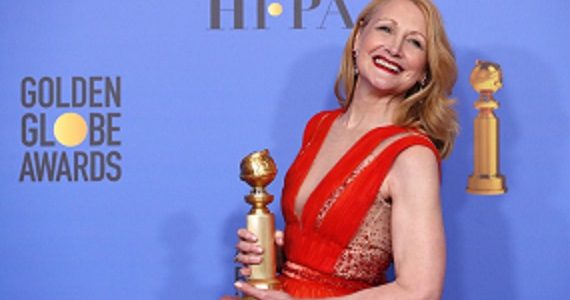
Patricia Clarkson, winner of the Golden Globe award for best supporting actress in a series, miniseries or television film in 2019 for her role as Adora Crellin in the HBO series Sharp Objects, says Lithuania is part of her, and she grew up with stories of her baba, the great-grandmother who came from Lithuania and died before she was born, according to the Lietuvos Rytas newspaper.
Born in New Orleans in 1959, Clarkson was graduated from the Yale School of Drama with an MFA.
Clarkson’s great-grandmother Sophie Bass-Berengher was born in the Kaunas guberniya in 1886. Her daughter Sophie (née Berengher) and Johnny Brechtel had daughter Jacquelyn Brechtel Clarkson. born in New Orleans on January 17, 1936. She served as a councilwoman on the New Orleans city council and has been the honorary counsel of the Republic of Lithuania in New Orleans since late 2014. She is also Patrica Clarkson’s mother.
Full story in Lithuanian here.
One of several Lithuanian Jews to have received the Nobel prize, Aaron Klug passed away November 20, 2018, at the age of 92.
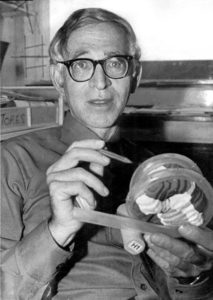
Klug was born in Želva (aka Zelva, Zelvas) near the town of Ukmergė (Vilkomir) in the Vilnius region of Lithuania on August 11, 1926, to Lazar and Bella (née Silin) Klug. Lazar Klug received both a secular and Jewish religious education, and raised and sold cattle as his father did. Aaron Klug wrote he remembered nothing of his place of birth, and the family moved to Durban, South Africa, when Aaron was about two. Aaron Klug was graduated from the University of Witwatersrand in Johannesburg with a bachelor’s degree in physics, chemistry and biology. He married dancer and choreographer Liebe Bobrow in 1948. Klug received a master’s degree from the University of Cape Town where he did work on X-ray crystallography. He then went to the UK, where he received a PhD in solid state physics at the University of Cambridge in 1952. Klug then worked with X-ray crystallographer Rosalind Franklin at Birkbeck College, University of London, exploring the structure of the tobacco mosaic virus. The nucleoproteins of the virus were at that time too big for imaging with X-ray crystallography but too small to see with optical microscopes. Electron microscopes could only provide two-dimensional images, and Klug pioneered a method for making 3-D images, called crystallographic electron microscopy, for which he received the Nobel prize in chemistry in 1982. He was knighted by Queen Elizabeth II in 1988. Besides his many other contributions, he and his colleagues were responsible for mapping about one third of the human genome in the Human Genome Project. He taught at Cambridge and served as the president of Britain’s Royal Society from 1995 to 2000. He also worked with Francis Crick, who received the Nobel prize with Watson for discovering the helical structure of DNA.
Roza Bielauskienė will speak about the time of the Book of Judges in Jewish history at 1:00 P.M. on Sunday, January 13, 2019, at the Lithuanian Jewish Community.
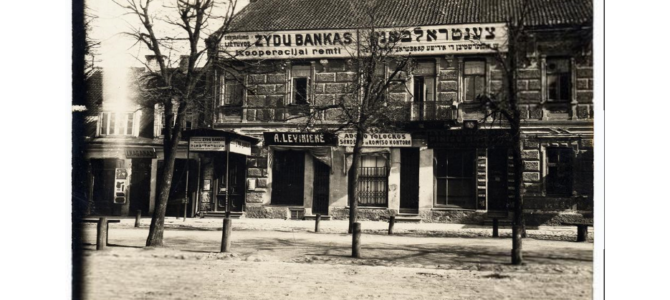
by Ona Biveinienė
Lithuanian Jews since olden times engaged in lending at interest. The charter of rights Vytautas the Great granted the Jews of Brest-Litovsk in 1388 included the right to loan money at interest, a rather new thing in the Grand Duchy at that time, along with the right to practice Judaism. According to the charter, “a Jew may accept any object brought him as collateral, no matter what the item is called, without question, except for bloodied or wet clothing and Church clothing and vessels, which he should in no way accept.”
For several centuries Jews were the main lenders, saving neighbors fallen on hard times by loaning them money, at interest, of course.
Lithuania’s declaration of independence on February 16, 1918, provided a favorable environment for Jews living here to expand customary and create new businesses. The Jewish people, as no other, seized upon the opportunity; they attempted to restore and expand the shops, workshops and factories they had before World War I. Many courageously started new businesses and in many cases were the first in Lithuania to engage in little known or unprecedented enterprises.
Full story in Lithuanian here.
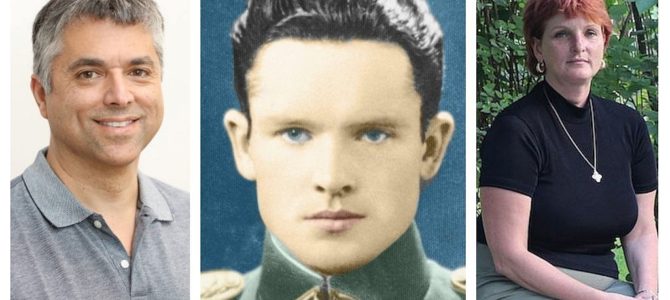
War Hero or Nazi Collaborator? Family Partners with Victim’s Kin to Expose Truth
Vilnius trial will see whether Jonas Noreika was whitewashed by Lithuania’s Genocide and Resistance Research Center; his granddaughter says he did his best to help Nazis kill Jews

by Robert Philpot
LONDON–Seventy years after he was shot by the Soviets, the reputation of Jonas Noreika goes on trial in Lithuania next week.
Noreika–a hero to many in the Baltic state for resisting Communist subjugation of their country–stands accused of being a Nazi collaborator complicit in the Holocaust.
The case before the Vilnius Regional Administrative Court charges the state-funded Genocide and Resistance Research Center of Lithuania with intentionally distorting the role of Noreika in the murder of Jews.
It has been brought by Grant Gochin, a Lithuanian citizen living in the US whose relatives were among Noreika’s victims.
In an extraordinary twist, Gochin’s effort is being actively supported by Noreika’s granddaughter. Silvia Foti has spent more than two decades investigating “General Storm,” as her grandfather is known to many in his former homeland. Her conclusion is brutal: “Jonas Noreika willingly played a role in cleansing Lithuania of Jews. He did everything in his power to help the Nazis kill Jews, and nothing to stop them.”
Full story here.
Note: The trial was postponed by the court, allegedly at the Government’s request, until March 5.
A meeting of the board of the Goodwill Foundation has resolved to fund the most significant Lithuanian Jewish projects, approved spending limits for 2019 and planned the 2019 budget for administrative costs for the foundation.
One of the more interesting projects is on-going archaeological exploration of the Great Synagogue site in Vilnius. There is also a project to commemorate the Jurbarkas synagogue with a statue by the sculptor Dovydas Zundelovičius. The foundation will also remember conductor, teacher and professor Saulius Sondeckis with the publication of a monograph.
The Goodwill Foundation board also addressed the issue of ownership of the former Tarbut gymnasium building at Pylimo street no. 4 in Vilnius, the headquarters of the Lithuanian Jewish Community.
Full text here.
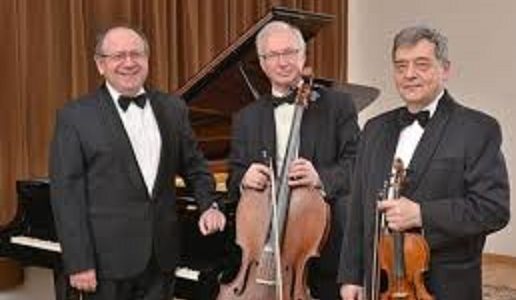
The Lithuanian musicians support fund and association Atgaiva held a concert at the Church of Sts. John January 7, 2019, and the audience filled the church.
Excellent and well-known musicians performed: the trio Musica Camerata Baltica with Leonidas Melnikas, Boris Traub and Valentinas Kaplūnas, and solo vocalist Judita Leitaitė.
The wonderful acoustics of the church, the high level of performers and the program of works selected for the concert all cast a spell upon the audience. The applause endured for a long period as the audience thanked the performers for this unique, enchanting and sublime classical music concert.
Lithuanian Jewish Community chairwoman Faina Kukliansky sincerely thanks the concert organizers and performers.
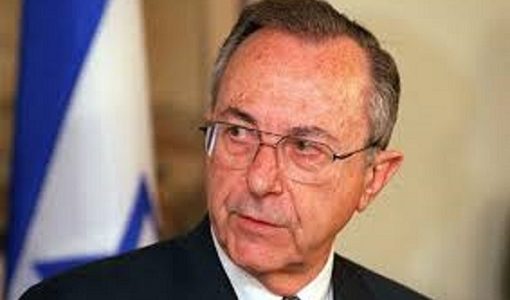
by Sergejus Kanovičius
The internet didn’t exist yet, and the way to connect from Israel with parents and friends left in Lithuania was by fax or telephone. There wasn’t a surplus of money and both means were very expensive, so hearing the voice of a loved one was the greatest gift; letters are fine, but human nature it seems is such that we need living emotion, moments which dissolve in the past… When you hear the voice of your Father, or Mother, or grandfather, it feels as if you are with them, much more than reading a letter which has been in transit for a long time. Sometimes the people who helped us in so many ways in saving our son knew the longing for loved ones, they knew what longing means, because they themselves had experienced these separations and knew what they meant. The independency of Lithuania was going slowly, so it was expensive to call from Israel to Lithuania and from Vilnius to Tel Aviv. As I remember it, from Vilnius you longer had to wait for a previously ordered international call, all you had to do was dial 8, wait for the tone and then enter the number. But it wasn’t raining and isn’t raining money anywhere, neither there where rivers of milk flow along banks of honey, nor there where pack-ice gently caresses the banks of the Neris. Sometimes the worst thing you could pull out of the mail box was a nostalgic numerical reminder for some month, sometimes the telephone bills were such that you wanted to take that apparatus to a bank and lock it in the safe.
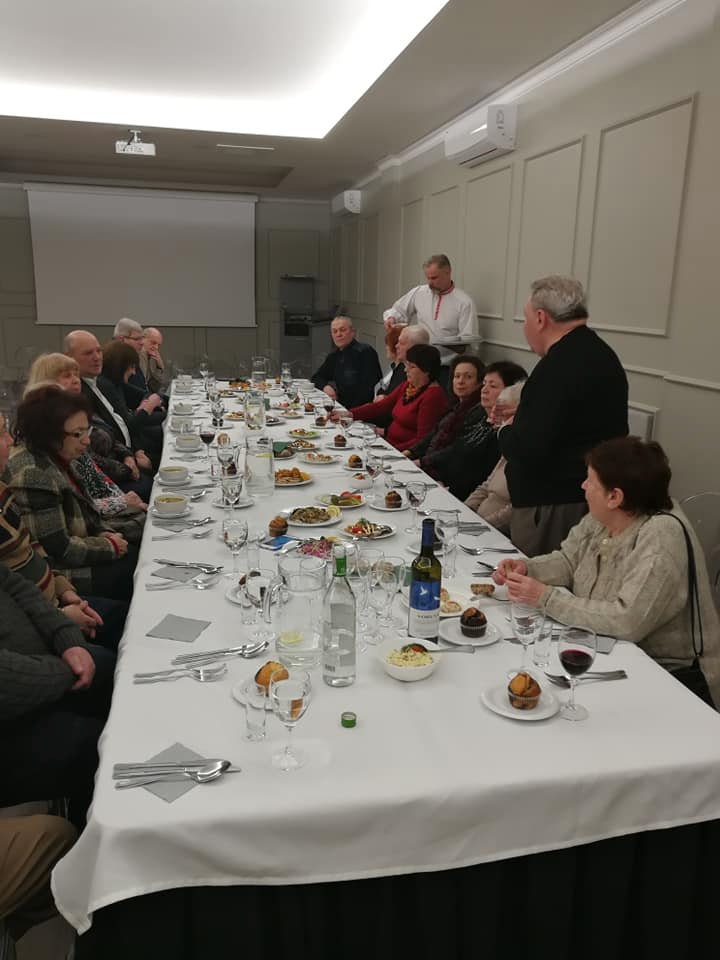
Senior citizens of the Šiauliai Regional Jewish Community and friends met December 27 to talk and watch the film “Dėdė Chackelis” together, ushering out the old year and preparing for 2019.
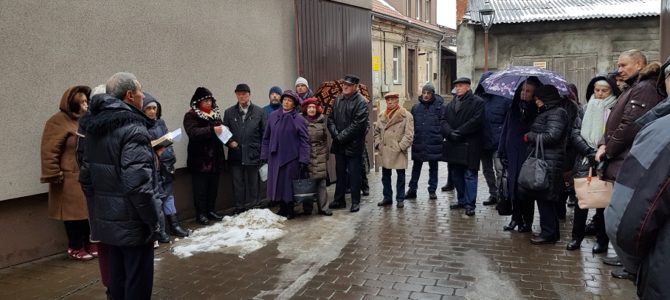
The Kaunas Jewish Community and the Russian meeting club Nadezhda held a commemoration of Litvak poet Osip Mandelshtam (aka Osip Mandelstam, 1891-1938) at Palangos street no. 1 in Kaunas, where the poet lived as a child, on December 27, 2018.
For many years it wasn’t known Mandelshtam died en route to his second deportation, the gulag in Kolyma, just as it wasn’t known he was a Lithuanian Jew and both parents were Litvaks: his father Emil Mandelshtam was from the town of Žagarė and his mother Flora Verblovskaya was from Vilnius. Many of the relevant documents in the life of Osip Mandelshtam are still unknown to literary experts.
The public release of these documents began relatively recently. Even so, even in the newest articles about Mandelshtam, for example, in Pavel Nerler’s “Osip Mandelshtam: Life and Family” (Znamya no. 12, 2016), the claim is made that Mandelshtam’s vital records have never been located. This is no longer true: Geršonas Taicas from Vilnius has found the record of Mandelshtam’s birth in Warsaw.
Taicas did further research and discovered the reason why Osip Mandelshtam (and his father, mother and their other son Aleksander) lived in Kaunas in 1896. Taicas also believes the surname, Mandelshtam, might not mean exactly what the accepted interpretation says it does, namely, “almond tree.”
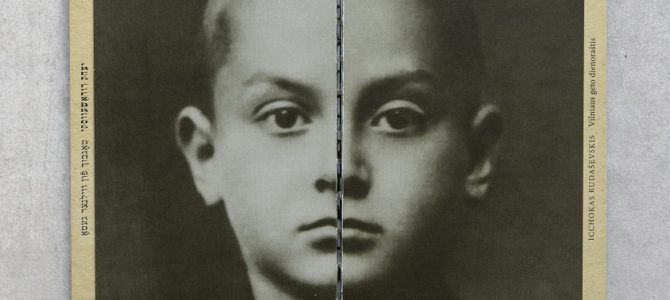
Yitzhak Rudashevski’s ghetto diary published in Lithuanian by the Lithuanian Jewish Community was compiled and translated by Dr. Mindaugas Kvietkauskas. The unusual design of the book itself was the creation of Sigutė Chlebinskaitė. The Tokyo Type Directors Club has recognized the book design as worthy to be nominated along with another 2,860 books for their annual award in 2019, in the design category.
From the organizers of the Tokyo TDC Annual Awards 2019:
Dear Sigute Chlebinskaite,
Thank you very much for your entry to the Tokyo TDC Annual Awards 2019. We received 2,860 works from around the world. Among the entries, we are pleased to inform you that your entry below has been selected for our annual book. We hope the year 2019 will be a fruitful year for you.
Tokyo Type Directors Club
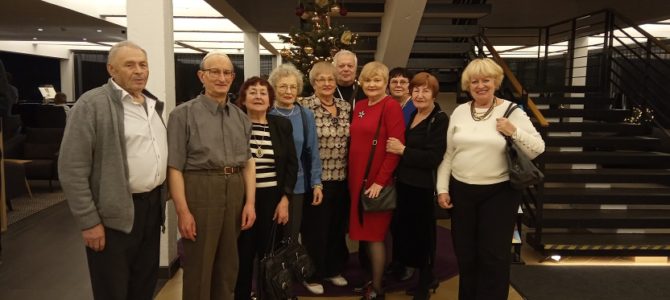
Senior clients of the Social Programs Department of the Lithuanian Jewish Community spent December 13 to 17 at the Gold Age Camp by the sea in Pärnu, Estonia. The seniors spent several wonderful days at the Tervis Medical Spa where they underwent health procedures, did morning exercises, walked in the fresh air, were consulted by experienced doctors, took part in educational activities, attended lecture/discussions with interesting lecturers, did art therapy and discussed their experiences with members of the delegation. They also played a game aimed at improving memory. Evening programs included Israeli dance, watching films, a talent show, and a play performed by actors from the Youth Theater in Tallinn. They also celebrated Sabbath.
The Golden Age Camp is held annually with seniors from Lithuania, Latvia and Estonia attending.
Amos Oz (aka Amos Klausner) passed away December 28, 2018, following a battle with cancer. He was born in Jerusalem on May 4, 1939. His father was a Litvak from the Vilnius area who studied comparative literature. Our condolences to his friends, family and many fans.
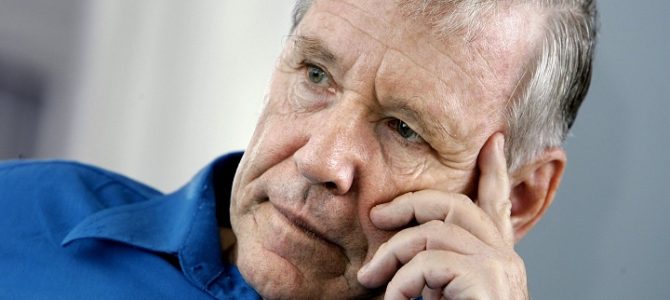
(JTA)–Amos Oz would often speak in the kind of tossed-off epigrams that come only with a lot of practice. But just when you wanted to smack him for his breezy erudition, he would redeem himself with a flash of spot-on–and hilarious–self-awareness.
In 2011, speaking at the 92nd Street Y about the novel he’d just published in English, “Scenes from Village Life,” Oz said that 99 percent of the typical media coverage of Israel involves extremist settlers, ultra-Orthodox fanatics and brutal soldiers “and one percent saintly intellectuals like myself.”
Oz died Friday at age 79, having won nearly every literary prize short of the Nobel and having become perhaps Israel’s most widely translated author. If Jews were in the canonization business, Oz would have earned his wings (halo? robe? my theology is shaky) on the basis of “A Tale of Love and Darkness,” his 2002 novel cum memoir. Like so much of what he wrote, the book is not just autobiographical, but a biography of Israel itself. Although his story ends before he is out of his teens, the young Amos bears witness to the destruction of European Jewry, the height of the British mandate, a Hebrew renaissance in Jerusalem, the great Zionist debates (and debaters) of the day, the rise of the kibbutz movement and the birth of the state.
Full text here.
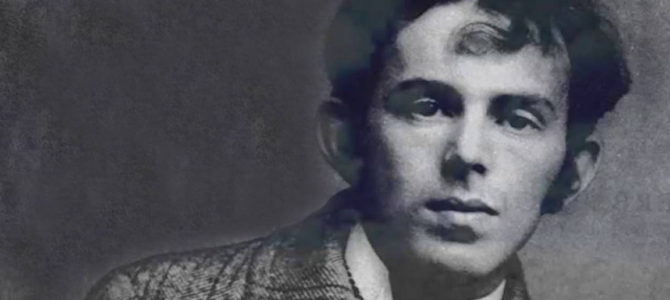
The Kaunas Jewish Community and the Lithuanian-Russian Meeting Club Naderzhda invite the public to a commemoration of the 80th anniversary of the death of famous Litvak poet Osip Mandelshtam at 12 noon on December 27 outside the house where he spent his youth, located at Palangos street no. 1. Similar commemorations are to take place simultaneously in Riga, Kiev, Warsaw and Paris.
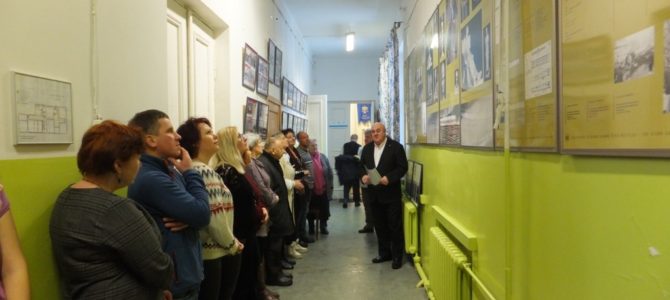
The Panevėžys Jewish Community opened an exhibit of works by famous 19th century Litvak sculptor Mark (Mordechai) Antokolski to mark the 175th anniversary of his death at the Panevėžys Jewish Community headquarters in cooperation with the Vilna Gaon State Jewish Museum.
Antokolski was born in the Antakalnis neighborhood in Vilnius in 1843 to a religious Jewish family. From childhood he liked to draw and he learned to carve wood. He matriculated at the St. Petersburg Art Academy in Russia in 1862, was graduated in 1871 and thereafter embarked on a series of works on Jewish and other themes. His bas-relief “Jewish Tailor” won a silver medal. His works were much heralded in artistic and cultural circles in St. Petersburg.
His works reflect a variety of subjects, including scenes from antiquity and Christian, historical and ethnic themes. The sculptor passed away in 1902 and is buried in St. Petersburg. A small street in the Vilnius Old Town was named in his honor following his death.
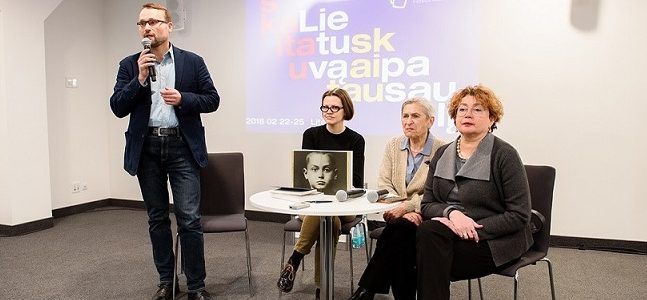
The Lithuanian Jewish Community sincerely congratulates Dr. Mindaugas Kvietkauskas on his selection as Lithuania’s new minister of culture.
Dr. Kvietkauskas will be the first member of the Lithuanian Government to speak Yiddish in many years. Likely the last was Jewish affairs minister Jokūbas Vygodskis who left the post when the interwar Republic of Lithuania annulled official Jewish autonomy in the country.
Kvietkauskas has translated a number of Yiddish works into Lithuanian. After completing Lithuanian literature and language studies at Vilnius University, he studied at Oxford’s Centre for Hebrew and Jewish Studies. He also acquired skills in Yiddish from Fania Brancovskaja, the Jewish partisan and Vilnius ghetto inmate.
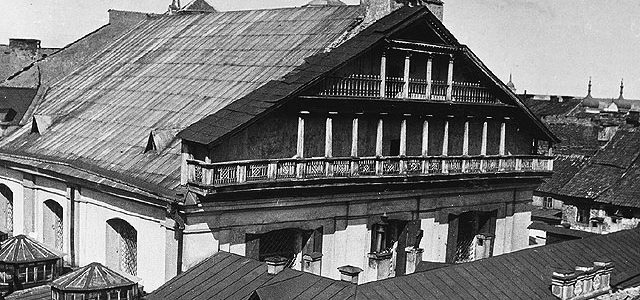
At the behest of the Lithuanian Jewish Community an international Heritage Advisory Group consisting of renowned global experts on Jewish heritage was formed, including:
Barbara Kirshenblatt-Gimblett, advisor to the director and senior curator of main exhibits at the POLIN Polish Jewish History Museum; Assumpció Hosta, general secretary of the European Association for the Preservation and Promotion of Jewish Culture and Heritage (AEPJ); Sergey Kanovich, founder of the Maceva NGO and project manager of the Šeduva Jewish Memorial Fund; Lyudmila Sholokhova, PhD, director, YIVO archive and library; Sergey Kravtsov, senior research correspondent, Jewish Art Center, Hebrew University; the Lithuanian Jewish Community was represented by LJC heritage conservation specialist Martynas Užpelkis and architect and designer Victoria Sideraitė-Alon.
The expert group now has issued a set of recommended guidelines for the memorialization of the Great Synagogue of Vilna.
Since it is basically clear that attempts to rebuild the Great Synagogue would send a false message, they instead recommended emphasizing the uniqueness of the site’s history and its current state. Commemoration should pursue the objectives of conserving what remains and proper education. The project should focus on recovering and expressing the centrality and unique meaning of the site in Lithuanian Jewish history and memory.
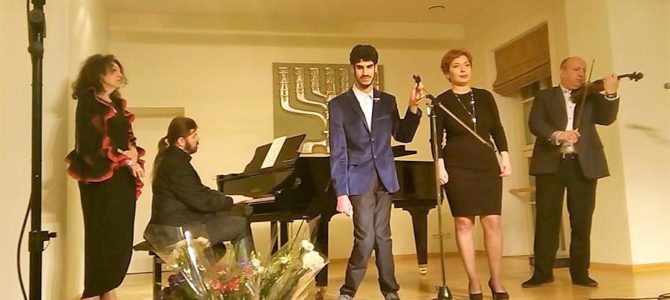
The Lithuanian Jewish Community ushered out 2018 with a concert Monday called Heart to Heart with Markas Volynskis and Marija Drukshna on vocals, Jurijus Sukhanovas on piano and Boris Kirzner on violin.
Shmuel Yatom, the cantor at the Choral Synagogue in Vilnius, opened the concert by reminding the audience the synagogue is celebrating its 115th anniversary currently. His words and songs, some solo, some with Markas Volynskis, created a warm and comfortable atmosphere in the hall. Well-known Lithuanian mezzo-soprano Judita Leitaitė MCed the concert and sang to a great response from the audience. Her warm and funny introductions of the other performers also contributed to the entertainment. Musical works by Kern, Pakhmutov, Dunayevsky and Olshanetsky, classical Russian favorites and old-time Jewish favorites elicited much applause.