
Learning, History, Culture

Lithuania Marks International Holocaust Remembrance Day

img1
VILNIUS, January 27, BNS–Lithuania paid tribute to victims of the Holocaust Wednesday, reading names and recalling the stories of rescues of Jews during International Holocaust Remembrance Day.

The Vilnius synagogue is hosting a reading of the first and last names of Holocaust victims, followed by prayers and memories shared by Holocaust survivors.

Meanwhile, a gymnasium in Ariogala in the Raseniai district organized a national conference of school students to present dramatic rescue stories and share memories shared by representatives of Jewish communities from across Lithuania.

Finally Telling It Like It Is

by Geoff Vasil

Rūta Vanagaitė presented her new book, Mūsiškiai [Our Own People], about Lithuanian Nazi collaborators, Holocaust complicity, Jewish victims and contemporary attempts to wriggle out of it to a packed room mainly filled with Lithuanian reporters Wednesday morning.

ruta strange truth
Rūta Vanagaitė (courtesy National Geographic Channel)

The venue was extremely strange: a small cafe called Submarine. Vanagaitė chose the location as the site where the murderous Ypatingasis būrys unit [Special Unit, often called simply Ypatingasis or Ypatingas in Holocaust literature in English] had their headquarters during the Holocaust. Vanagaitė said she would lead the audience up to the second floor after the book presentation to the main offices where Ypatingasis once planned the mass murder of the Jews of the region.

Estera Klabinaitė Grobman, 95, Survivor of the Kaunas Ghetto and Stutthof Concetration Camp, Remembers Everything

Arono mama
photo by Milda Rūkaitė

Estera Klabinaitė Grobman was born in November of 1920 in Kaunas to a well-to-do Jewish family who lived in their own home on Vaisių street. She had two brothers and there were three generations living under one roof: grandparents, parents and children. Her grandfather often said he was the Golden Miller because he had light hair and owned a mill. The place where the mill stood was called Klabiniai, so the family’s name was Klabinas. Estera says it was close to Širvintos, Lithuania. She calls herself a Kaunas native and her mother and father owned a small bakery in Kaunas. Fresh-baked bread was delivered by horse each morning in covered containers. They baked delicious bread and the business thrived. They delivered to several shops in the city. Estera remembers her grandmother, the daughter of a rabbi who wrote very neatly. She can’t forget that she was never able to equal her grandmother. According to family tradition her father should have been a rabbi as well and he studied for the rabbinate, but as a child he used to secretly read secular books, and he read much, educating himself. Estera inherited her love of books from her father and to the present reads in four languages: Yiddish, Lithuanian, Russian and German. She is interested in everything.

International Holocaust Remembrance Day at the Choral Synagogue

zvake
We invite you to mark International Holocaust Remembrance Day at 3:00 P.M. on January 27 at the Choral Synagogue in Vilnius at Pylimo street no. 39.

There will be readings of the names of Holocaust victims, brief testimonies of survivors and a prayer for the dead.

January 27 was the date in 1945 when Auschwitz was liberated. On November 1, 2005, the General Assembly of the United Nations adopted a resolution making January 27 as International Holocaust Remembrance Day. The resolution condemned Holocaust denial and discrimination and violence based on religion and ethnicity.

Oldest Man in the World Likely 112-Year-Old Holocaust Survivor

yisrael kristal
Yisrael Kristal, photo courtesy of family

The old phrase “may you live to 120” is becoming a real possibility for more and more people around the world, and one man, a Holocaust survivor, seems to be having the last laugh.

The Jerusalem Post reported last week the Gerontology Research Group reached out to a grandson of Yisrael Kristal this week following the death of Yasutaro Koide in Japan, who was also 112. According to the organization, Kristal is now the oldest living man on record, although this still has to be validated by his documentation.

He has in his possession his marriage certificate from the 1920s but it is unclear as yet if this will suffice to formally register him as the oldest man in the world.

Kristal was born in 1903 in the town of Zarnov in the Lodz province of what is now Poland to a religious family. His father was a Torah scholar and Kristal himself went to heder, or religious primary school until the age of 11.

Full story here.

Hundredth Anniversary of Birth of Vladas Varčikas, Rescuer of Jews, Teacher, Violinist

fa094381-1734-477d-8407-eee257e1537b

The Kaunas Jewish Community and the Sugihara Foundation “Visas for Life” invited friends who knew Vladas Varčikas and all who wanted to pay their respects to this gigantic figure, a rescuer of Jews, humanitarian, teacher and violinist, to celebrate hsi 100th birthday with a concert in the Grand Hall at Vytautas Magnus University in Kaunas. The hall was filled to capacity and overflowing despite the frozen weather.

Kaunas Jewish Community member Stasys Makštutis began to tell the story of Varčikas and the story was continued by his grandmother, Elena Andriuškevičienė, who was rescued from the Kaunas ghetto by Varčikas and survived to later become his colleague. Varčikas’s students, students of his students and their children performed music and shared their memories of the man. Actress Kristina Kazakevičiūtė, whose daughter was a student of Varčikas, read out director Kama Ginkas’s recollections of Varčikas, the man who saved him. She also read passages from Reinhard Kaiser’s book about Edwin Geist, whose compositions were rescued for posterity by Varčikas.

A Special Experience on Gastronomical Tour: Sabbath Dinner in Israel

TMP_003

Sometimes it happens that you fall in love with a country at first sight. You want to go there every year, to discover new places and experiences and new tastes there. That’s what happened to the wife of Lithuanian ambassador to Israel Darius Degutis, the passionate cook Nida Degutienė. After her return from a recent culinary tour of her favorite country, Nida said this kind of tourism provides visitors with the opportunity of entering local homes, experiencing daily life firsthand, sitting down at the same table with hosts and listening to their stories.

Full story in Lithuanian here.

Three-Day Seminar for Teaching Holocaust Opens at Vilna Gaon Museum

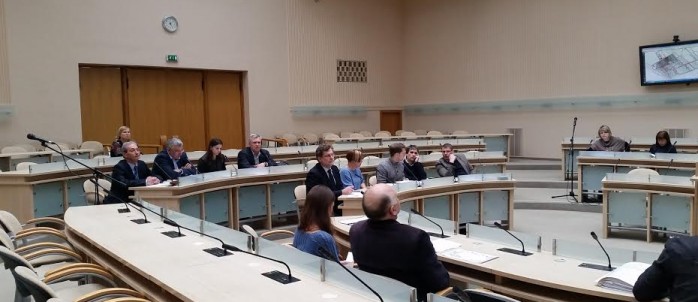
The Vilna Gaon Jewish State Museum Wednesday kicked off a three-day seminar with speakers from around the world for sharing ideas with Lithuanian teachers teaching the Holocaust.

Museum director Markas Zingeris welcomed the audience and said the Holocaust has become topical in the news media again because of a convergence of events: Islamic fascists carrying out acts of terror on European streets and the response by right-wing extremists to the influx of refugees and others from Middle Eastern countries.

Danius Junevičius, roving ambassador-at-large from the Lithuanian Ministry of Foreign Affairs, said the history of Lithuanian Jews is inseparable from general Lithuanian history, and the lessons of the Holocaust are needed now more than ever, and that history must not repeat itself.

Vilna Gaon Museum to Hold Three-Day Holocaust Seminar

Tol muziejus

To mark International Holocaust Remembrance Day on January 27, the Vilna Gaon Jewish State Museum is hosting three days of seminars on the Holocaust featuring a panel of speakers from Lithuania and Western Europe. Speakers are to include Philippe Boukara and Georges Bensoussan from Mémorial de la Shoah, the French co-sponsor of the event with the International Commission for the Assessment of the Crimes of the Nazi and Soviet Occupational Regimes in Lithuania from Lithuania.

The seminars are called “The Holocaust, Collaboration and Mass Murder in Lithuania” and will run from January 20 to January 22.

Events to Mark Holocaust Day in Panevėžys at Noon, January 26

On November 1, 2005, the General Assembly of the United Nations Organization adopted a resolution to mark International Holocaust Remembrance Day on January 27. Remembering the Holocaust is inseparable from studying the causes of this tragedy which rocked civilization to its core and inseparable from teaching and inculcating tolerance and human respect. Lithuania is a member of the International Holocaust Remembrance Alliance and an active participant in international programs to fight anti-Semitism.

The mass murder of Jews began even before the Nazis occupied Lithuania in 1941. Over a few months the majority of the Lithuanian Jewish community were murdered. Survivors were sent as slave labor to the ghettos set up in the cities and towns. The Nazis “liquidated” most of the ghettos after a few short months while the remaining ghettos in Vilnius, Kaunas and Šiauliai operated for another two to three years. The Vilnius ghetto was liquidated on September 23, 1943. Most of the inhabitants were shot to death at Ponar while others were transferred to concentration camps. The Panevėžys ghetto was liquidated on August 15, 1941. Thirteen and a half thousand Jews were shot. More than 200,000 Jews were murdered in Lithuania during World War II, accounting for approximately 95 percent of the Lithuanian Jewish community. There are more than 200 mass murder sites in Lithuania and about the same number of old Jewish cemeteries.

The Jewish community in Lithuania formed near the end of the 14th century. They were a thriving ethnic community in Lithuanian towns and cities by the beginning of the 20th century. In the period between the last half of the 19th and early 20th century, Jews accounted for between a quarter and a half of the population in many cities and towns. They were citizens of Lithuania with their own individual daily cares, worries and joys. Compared to other ethnic communities, the Jewish community was one of the largest in Lithuania.

Lithuanian President and Wife Recognized as Righteous Gentiles

January 17, BNS–Lithuanian interwar president Kazys Grinius and his wife Kristina have been recognized posthumously as Righteous Gentiles for rescuing Jews during the Holocaust by Yad Vashem in Jerusalem.

Grinius and his wife took in Kaunas ghetto prisoner Dmitri Gelpern during the Nazi occupation. The Vilna Gaon Jewish State Museum report they were informed of the recognition in December. The contributions of Kazys Grinius and wife Kristina to saving Jews was recognized by Lithuania in 1993 when they were posthumously awarded the Life Saver’s Cross.

Lithuanian Jewish Community chairwoman Faina Kukliansky told BNS Sunday the commission’s work in Israel took so long because none of the witnesses are still alive and Yad Vashem has strict requirements.

Interwar Lithuanian President and Wife Recognized as Righteous Gentiles

Kazys ir Kristina Griniai. B-168

The Righteous among the Nations recognition commission at the Yad Vashem Memorial and Institute in Jerusalem has recognized interwar Lithuanian president Kazys Grinius and his wife Kristina as Righteous Gentiles based on testimony by Dmitri Gelpern, an anti-Nazi partisan.

Grinius served as prime minister of Lithuania from June of 1920 to February, 1922. He was elected president by the Lithuanian parliament in June, 1926, and served in the post until mid-December that year when he was removed in a coup d’etat by Antanas Smetona.

Grinius refused to collaborate with the Nazis and was opposed to any foreign occupation of Lithuania. He fled to the West when the Soviet army reoccupied Lithuania in 1944 and emigrated to the United States in 1947.

Deputy chairman of the Kaunas ghetto partisan organization Dmitri Gelpern gave testimony to the Spielberg Foundation that he tried to flee to the East when the Nazis attacked the Soviet Union (including Lithuania), but the Germany army caught up to him, so he had to return to Kaunas. On the way back Gelpern met Chaim Yelin and his family. Before the Kaunas ghetto was set up, the Yelin family hid with one of Gelpern’s relatives. Gelpern’s relative was a schoolmate of Kristina Griniuvienė, now Kazys Grinius’s wife. Kristina was also well acquainted with Gelpern because both were stamp collectors and they sometimes traded stamps between them. Gelpern’s relative ran into Kristina in the city one day and told the latter Dimitri was also in Kaunas. Kristina told her to pass on the message that if Dmitri Gelpern needed help, she was prepared to give it. Gelpern entered the ghetto with the rest of the city’s Jews, but decided to take Kristina Griniuvienė up on her offer after the Great Action. They welcomed him into their home and provided him his own room. Dmitri ate in common with the Grinius family. When their friends came over, the Grinius family didn’t attempt to hide Gelpern because none of their friends were anti-Semites. Gelpern stayed with them for several months, but sometimes went into town and mingled in with a column of Jews being used as slave labor to enter the ghetto. The Grinius family provided medicine to Gelpern as well and provided him with vital information.

Kaunas ghetto partisan Sarah Ginaitė recalls Gelpern spent the entire first winter of the Nazi occupation with the Grinius family, until Kazys Grinius was deported.

Kazys Grinius died in Chicago on June 4, 1950. His wife died on May 2, 1987.

For the Love of Yiddish

Sara Ziv, chairwoman of the National Authority for Yiddish Culture, is optimistic about the future of the mama-loshn in Israel.

When Eliezer Ben Yehuda was reviving the modern Hebrew Language a century ago, Yiddish was the lingua franca for the majority of Europe’s Jews and even further afield as the great waves of migration spread Yiddish culture and language to the America’s and even to Palestine.

In 1939, around 11 million of the world’s Jewish population of 16 million spoke Yiddish, but then the Holocaust decimated the great Yiddish speaking masses and in the nascent state of Israel, Yiddish ran up against the emergence of Hebrew culture and was sidelined and even frowned upon.

Full story here.
jpost

Houses That Talk: A Book about Vokiečių Street in Vilnius

You’re invited to the presentation of the book “Houses That Talk: Sketches of Vokiečių Street in the Nineteenth Century” by Dr, Aelita Ambrulevičiūtė at 6:00 P.M., January 22, at the Jewish Culture and Information Street at Mėsinių street no. 3 in Vilnius.

The book provides a picture of the commercial life of the street in the 19th century. It details in English and Lithuania the history of 32 former buildings on the street, their owners and the commercial enterprises which operated in them. There is a presentation of stores and store owners and goods, banks and other businesses. The book is full of photographs from the late 19th and early 20th century.

The author and Sigita Pūkienė, director of the publishing house Aukso žuvys, are scheduled to attend the event.

Israeli Embassy Photo Exhibit of Pope in Israel Opens in Panevėžys

panpop4

A photo exhibit of Pope Francis’s visit to Israel in 2014 was unveiled in Panevėžys on January 14, 2016. The exhibit was the initiative of the Israeli embassy and ambassador Amir Maimon spoke at its Panevėžys opening, thanking organizers including the Panevėžys Jewish Community, the Panevėžys Catholic bishopric and the Panevėžys municipality, as well as the audience for coming.

Echoes of Memory Photo Exhibit by Irena Giedraitienė Opens

DSC_0344

The ceremonial opening of an exhibition of photo albums and photography by photography artist Irena Giedraitienė called “Echoes of Memory” was held at the Lithuanian Jewish Community on January 14. The exhibit features images of survivors of ghettos and concentration camps in Lithuania and abroad, and of rescuers of Jews.

Lithuanian Jewish Community chairwoman Faina Kukliansky introduced the artist and her work to the international audience at the event. Israeli embassy deputy chief of mission Yehuda Gidron commented the faces in the portraits on exhibit not only captured moments in time and the personalities and characters of the people, but also showed some of them smiling, conveying optimism and hope. Tobias Jafetas, a representative of the Union of Former Concentration Camp and Ghetto Prisoners, thanked the artist for her work commemorating Holocaust survivors in photos which will inform future generations. Other speakers spoke about the artist’s work and life as well.

Lithuanian Jewish Cookbook Wins Award in South Africa

taste o israel

Lietuvos rytas, Lithuania’s largest daily newspaper, reported the English translation of Nida Degutienė’s book “Izraelio skoniai: šventės ir kasdiena” has been awarded the title of best Jewish cookbook in South Africa for 2015. The translation was published as “A Taste of Israel: From Classic Litvak to Modern Israel” by Struik Lifestyle, a division of Penguin Random House South Africa, in 2015. The Lithuanian book was published by the author in 2014.

The newspaper didn’t specify who issued the award, but said the cookbook would compete as a South African entry at World Cookbook Awards 2015 ceremony to be held May 28 in Yantai, China.

Nida Degutienė is the wife of former Lithuanian ambassador to Israel Darius Degutis. She presented her cookbook at the Lithuanian Jewish Community on Friday, April 24, 2015, as the final speech at a celebration of the 67th anniversary of Israeli independence.

Kaunas Jewish Community Invites You to a Concert

Location: Great Hall, Vytautas Magnus University, Gimnazijos street No. 7
Time: 3:00 P.M., January 17, 2016

The Kaunas Jewish Community and the Sugihara Foundation “Diplomats for Life” have the pleasure of requesting your attendance at a concert. The concert dedicated to the 100th anniversary of the birth of Vladas Varčikas will feature his students, including:

professor Petras Kunca (violin),Vilija Vitkutė Pranskienė (violin), Kristijonas Venslovas (violin), Daiva Valentaitė (alto), Andrius Pleškūnas (alto), Benas Ulevičius (vocals, guitar),

Pre-War Cookbook Becomes Best Seller

Did you know Fania Lewando operated an extremely popular vegetarian restaurant between the two world wars in Vilnius, a city which had few vegetarians? Diners included Marc Chagall and Itzik Manger, the Yiddish writer, who also left their impressions in the restaurant’s guest book.

The restaurant owner also had a cooking school and kept her healthy and tasty vegetarian recipes in her personal recipe book. It was long thought that book was lost following her death, but it unexpectedly resurfaced at an antiquarian book sale and became an international best seller. Now it has appeared in Lithuanian as well.

TMP_001

Lithuanian Jewish Community Webpage Adds Academic Section to Mark 25 Years of Lithuanian Independence

Many scholars and academics took part in the early days of the Lithuanian Jewish Community during the period when Lithuania was reestablishing national independence. They formed their own Union of Scholars. This organization is no longer active. The Community would like to revive the Union of Scholars in the name of its noble founders who did so much for Lithuania and the Jewish Community, including historian and sociology professor Izraelis Lempertas; physics professor Adolfas Bolotinas; philologist, lexicographer and Lithuanian language reformer Chaceklis Lemchenas; and many others. The time has come to continue the Union’s work. We, members of the Lithuanian Jewish Community, are not just citizens of the Republic of Lithuania and consumers, we are creators. Scholarship and research is of utmost importance to us. We can set learning against the ignorance of anti-Semites. A new generation of productive scholars has matured in the Jewish Community. Although learning knows no communal boundaries, academic studies provide us with more self-confidence and significance, and therefore we will support in multiple ways scholarship and research in all fields. We begin our new Learning section with an introduction to the psychological and other effects of the Holocaust. Mazl tov!

Academic Insight into the Holocaust Experience