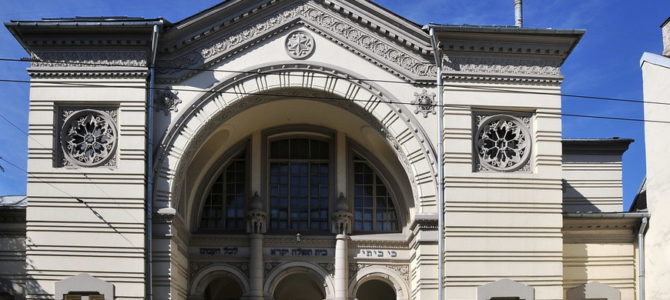
Adopted by a meeting of the executive board of the Vilnius Jewish Religious Community on September 22, 2016, act no. 06
Introduction
The rules have been put in place in light of ever-more-frequent attacks against Jews in Europe and the growing danger posed by terrorism around the world. These rules must be followed strictly and are aimed at insuring the physical safety and spiritual dignity of those who pray at the Taharat ha’Kodesh aka Choral Synagogue.
The mitnagedim Taharat ha’Kodesh synagogue, built in 1903 and belonging to the Vilnius Jewish Religious Community, is the only synagogue in Vilnius which has survived the Holocaust and the Soviet occupation.
Every Jew has the right to visit and pray at the Taharat ha’Kodesh synagogue on the condition she or he follow the rules provided below.
Rules of Behavior at the Taharat ha’Kodesh Synagogue
1. The synagogue is public place of worship where the proper human respect for the site and the congregation is shown.
2. All synagogue activities, prayer and services are based on mitnagedic traditions.
3. Public order must be maintained during all prayer services and afterwards in the synagogue. Public order means the general rules of public behavior operating in society based on principles of morality and mutual respect.
4. Adherence to these rules insures the normal course of life in society, tolerant communication, civilized manners of resolution of conflicts arising between people and abstinence from aggression in pursuing individual interests. The following are banned in the synagogue: rude or belligerent behavior, issuing threats, demonstrating disrespect to those around you or the location itself through mockery or acts of vandalism, disturbing the public order and peace, use of profanity or lewd behavior, disrupting services, making noise or otherwise disturbing prayer.
5. Prayer services are performed exclusively in one of the halls, rooms and spaces of the synagogue.
6. A person who wants to make a public address at the synagogue must receive permission to do so from the rabbi working at the synagogue.
7. Personal arguments as well as arguments over the performance of prayers and other religious rites are banned in the synagogue. Suggestions on the performance of prayers and other religious rites may be discussed with the rabbi only when prayer and other religious rites are not happening. These rules also apply to the Kiddush and lecture room.
8. The opening and closing times of the synagogue are set by the executive board of the Vilnius Jewish Religious Community and are publicly announced. Security and technical personnel are hired and their working hours are set based on these times. In special circumstances they may be subject to the discretion of the chairman of the Vilnius Jewish Religious Community.
9. The person reading the Torah, leading the prayer service, is designated and hired by the chairman of the Vilnius Jewish Religious Community with the approval of the executive board of the Vilnius Jewish Religious Community. All people in the synagogue during that time must adhere to this established order.
10. People visiting the synagogue must be dressed appropriately. For men, that means wearing a yarmulke (kippah), a hat or a scarf to cover their head. Mobile or cell telephones are prohibited during prayer.
11. People armed with firearms or other weapons, or items which could be used as weapons, are not allowed to enter the synagogue (except for security guards). Also, intoxicated people or people arousing suspicion are not allowed to enter. It is also forbidden to bring in bags containing food products and larger packages (backpacks, purses, suitcases, luggage or other packages). These must be left with the person on duty at the entrance.
12. Without permission from the chairman of the Vilnius Jewish Religious Community, it is forbidden to hold meetings, protests and rendezvous in the synagogue, or to set out a table with food, or to engage in commercial activity.
13. Members of the congregation and visitors to the synagogue are required to obey the directions of the chairman, elder and security personnel operating in the name of the executive board of the Vilnius Jewish Religious Community.
14. People who violate these rules are asked to leave the synagogue and might be barred from entry in the future. Violation of public order and other actions prohibited by the laws of the Republic of Lithuania could also incur legal accountability.
15. The keys to the synagogue and entry to all communication are protected and managed by the chairman of the Vilnius Jewish Religious Community.
16. All people inside the synagogue must obey the orders of security personnel. The security guard is equivalent to the person in charge of performing the functions of public administration.
Shmuel Levin, chairman
Vilnius Jewish Religious Community



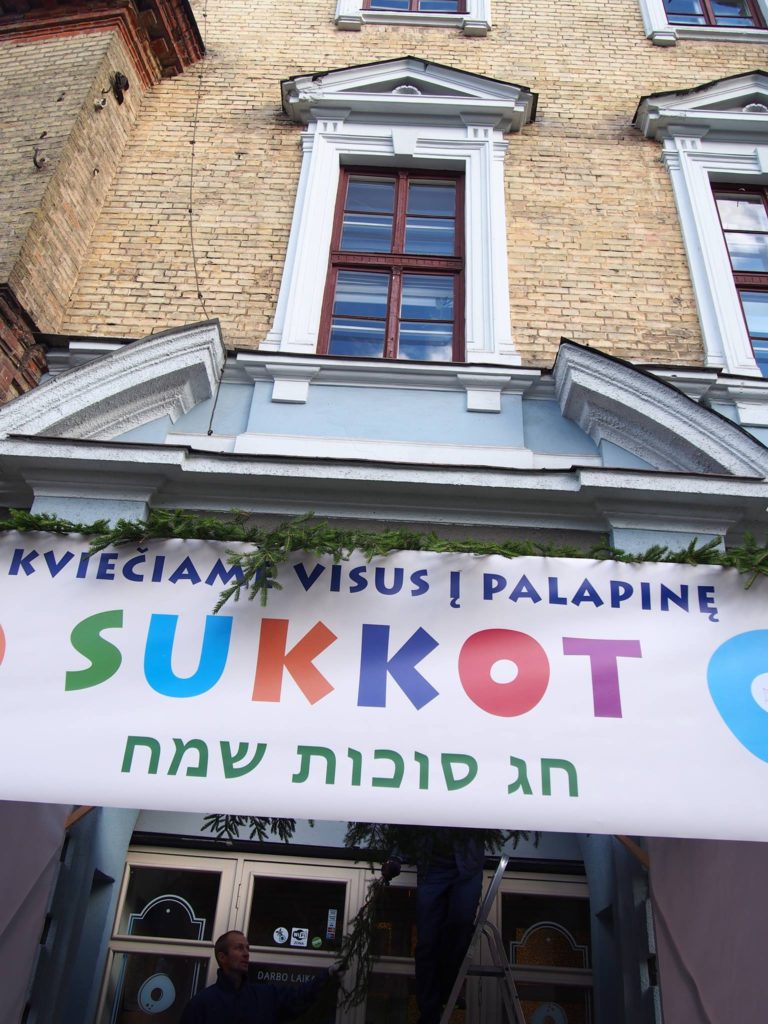 Sukkah at Bagel Shop Café on central Pylimo street in Vilnius