Learning, History, Culture

Movement at the Shulhoyf

Movement at the Shulhoyf

For the last two weeks a Lithuanian crew of diggers have been uncovering new archaeological strata at the site of the Great Synagogue or Gros-Shul in Vilnius. No Israeli Antiquities Authority archaeologists have been seen this summer, although they were always in charge during past summers. Several teams of mostly young men were seen digging at the bimah and northern wall of the synagogue, but not at the mikvot which remain under a make-shift shed. The young men were wearing t-shirts identifying them as working for Lithuania’s Cultural Heritage Protection Department. They used shovels to pile mounds of debris on the western side of the synagogue and appeared to collect bricks at the northeast corner inside a gate next to the Vilna Gaon statue. No archaeological sieves were visible during several visits to the site. The dig at the eastern side of the complex appeared to reveal a descending staircase made of stone and an eastern wall of the synagogue just to the west of the staircase.

Tour of Choral Synagogue in Vilnius Thursday

Tour of Choral Synagogue in Vilnius Thursday

Jewish educator Natalja Cheifec will lead a tour of the Choral Synagogue in Vilnius this Thursday, July 9, at 6:00 P.M. She’ll tell the story of the only traditional synagogue still operating in Vilnius and explain its architectural secrets, symbolism and storied traditions. Cantor Shmuel Ya’atov will also be on hand to offer his extensive knowledge of the edifice and to talk about his work there as cantor. The tour will be followed by an informal discussion with questions and answers. Natalja asks participants to make a 5 euro donation to the synagogue. To register, click here.

Time: 6:00 P.M., Thursday, July 9
Place: Pylimo street no. 39, Vilnius, around the corner from the Conti Hotel and the egg statue, across the street from the Leonard Cohen statue

Šiauliai District Jewish Community News

Šiauliai District Jewish Community News

Last weekend Goodwill Foundation co-chairpeople Rabbi Andrew Baker and attorney and Lithuanian Jewish Community chairwoman Faina Kukliansky visited the Šiauliai District Jewish Community, where they discussed the local LJC affiliate’s activities and on-going projects, and shared ideas for future cooperation.

The Law Lithuania Froze in 2000

The Law Lithuania Froze in 2000

by Grant Arthur Gochin

In 2000 the Lithuanian parliament or Seimas voted to make the 1941 declaration a legal act of the state, then reversed itself within a week. In 2026 the demand to finish the job is back.

On June 19, 2026, the Lithuanian parliament hosted a conference which reconstructed June of 1941 without the Jews murdered during it. I documented that event in They Rewrote History before Our Eyes. The conference was the visible, scholarly face of a longer project. Its legislative face is older, quieter, and now on the move again.

On September 12, 2000, the Seimas adopted a law recognizing the Provisional Government’s June 23, 1941 declaration, Restoration of Independence, as a legal act of the Republic of Lithuania. The vote was 48 in favor, none against and three abstentions, and the official record lists it among laws adopted rather than draft legislation (Seimas record, September 12, 2000).

The declaration that law would canonize carries a list of signatory ministers. One of them is the minister of communal economy, the architect Vytautas Landsbergis-Žemkalnis–father of Vytautas Landsbergis, who chaired the Seimas in 2000.

They Rewrote History before Our Eyes

They Rewrote History before Our Eyes

by Grant Gochin, June 24, 2026

Lithuania condemns Russian falsification of history. On June 19, its own parliament provided the screen for another falsification.

Holocaust revisionism was not whispered in a corridor of the Lithuanian parliament. It was projected onto the wall of the Hall of the Act of 11 March.

On June 19, 2026, the Seimas hosted an international conference marking the eighty-fifth anniversary of the 1941 Lithuanian uprising. The official announcement promised a discussion based on “sources and historical analysis,” rather than later stereotypes. The program listed the speaker of the Seimas, senior politicians, members of parliament and historians. This was not a private gathering in a rented hotel room. It carried the location, publicity and institutional prestige of the Lithuanian legislature. (Seimas conference program)

One presentation was delivered by Roman Kuzmyn of Lviv Polytechnic National University. Its subject was the supposed similarities and differences between the 1941 uprisings in Lithuania and Western Ukraine.

Remembering the Garage Pogrom 85 Years On

Remembering the Garage Pogrom 85 Years On

On Monday the Kaunas Jewish Community held a public commemoration for the victims of the Lietūkis Garage massacre in Kaunas. Although the exact number of victims remains unknown to this day, it’s believed around 50 Jewish men were rounded up and then tortured to death at the automobile repair cooperative before the German army had taken control of Kaunas, Lithuania’s provisional capital.

The mass murder attracted spectators, mainly Lithuanians but also Wehrmacht soldiers and officers. It happened on June 27, 1941. Firehoses were forced down the throats of many of the victims, bursting their stomachs and intestines, leading to death. Those who survived the various tortures were murdered with crowbars. The corpses were piled up in the parking lot and one of the perpetrators climbed on top and played a Lithuanian song. Some witnesses said it was the Lithuanian national anthem.

The commemoration took place at the site in Kaunas with a commemoration in the evening at Vytauts Magnus University there. Both commemorations featured live music, including accordion music at the mass murder site.

Kaunas Jewish Community chairman Gercas Žakas spoke at the commemoration at the site, as did Israeli ambassador to Lithuania Shelly Hugler Livne. The latter decried the world turning its collective back on the lessons learned from the Holocaust. Also attending were the American, German, Estonian and French ambassadors.

Keeping Memory Alive

Keeping Memory Alive

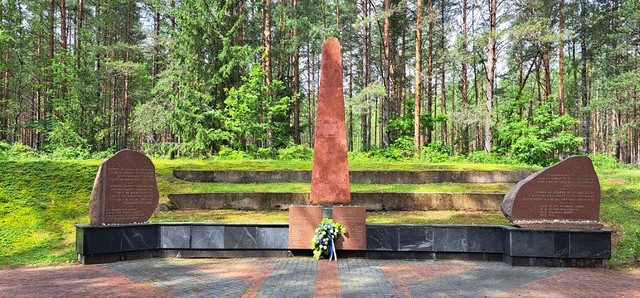
A small group marked the 85th anniversary of the beginning of the Holocaust in Lithuania at the Ponar Memorial Complex yesterday.

The Holocaust began in late June of 1941. Withing a few months about 95% of all Jews in Lithuania had been murdered.

Writer and director of the Vilna Gaon Museum Sergejus Kanovičius said: “Words can never express our respect for those who were murdered as well as prayer does. Their memory will always live in our hearts.”

Lithuanian Jewish Community chairwoman Faina Kukliansky said: “Those gathered here today are the people who don’t need salutes from an honor guard or ceremonies planned in the finest detail in order to understand that the massacre of Jews begun 85 years ago was a tragedy for all of Lithuania, not just for our people.”

Israeli ambassador to Lithuania Shelly Hugler Livne said it was horrible people hadn’t learned from the painful lessons of history. She said the ever-growing anti-Semitism around the world happening today was the best proof of that. Hugler Livne said it was said to see the world going down the same road again.

The Tragedy in Palanga 85 Years Ago Must Not Be Forgotten

The Tragedy in Palanga 85 Years Ago Must Not Be Forgotten

by Mindaugas Surblys

Today we commemorate the men and young men of the Palanga Jewish community who were murdered in Birutė Park in Palanga in 1941. Palanga Jewish Community chairman Vilnius Gutmanas, Palanga deputy mayor Rimantas Mikalkėnas, Palanga municipal culture department director Robertas Trautmanas and members of the community lit commemorative candles and placed commemorative stones.

The army of the Third Reich occupied Palanga on June 22, 1941, and by June 26 all of the town’s Jews had been locked up inside two synagogues, mothers, children and the elderly in one and men and young men in the other. The 106 males were taken on June 27 to Birutė Park and murdered, along with 5 Lithuanians accused of collaborating with the Soviet government. The remaining 300 or so women, children and elderly were murdered on October 11 and 12, 1941, in the Kunigiškiai forest.

The males were exhumed in July of 1958 and moved to the Palanga city cemetery, where a single marker marks the mass grave.

Memory lives so long as we remember.

Chairman Gutmanas said: “Eighty-five years have passed but time is powerless to erase our pain. People who had families, dreams and lives were silenced forever. They were murdered because of their origin. It is our duty today not just to commemorate them, but not to allow their stories to be forgotten.”

Holocaust Testimonies in Palanga

Holocaust Testimonies in Palanga

The Palanga Jewish Community and the Jonas Šliūpas Museum invite you to attend Lithuanian-American historian and journalist Ina Navazelskis;s presentation “Voices from the Blood-Lands” which includes eye-witness testimonies of the Holocaust and World War II. Ina worked at the US Holocaust Museum in Washington, D.C., for 25 years, soliciting oral testimonies from over three hundred witnesses and Holocaust survivors. She focused on Eastern Europe and especially the Baltic republics in her work, even writing a book about the period between 1990 when Lithuania declared independence from the Soviet Union and the attempted coup in Moscow in the fall of 1991. The presentation includes testimonies from Poles, Jews, Lithuanians, Germans and others. The presentation is free and open to the public, but the organizers ask that you register beforehand by calling +370 612 86114 or by sending an email to j.sliupo.muziejus@lnm.lt. Palanga Jewish Community chairman Vilius Gutmanas will also speak at the event. A discussion is planned after the main presentation.

Time: 5:00 P.M., Wednesday, July 15
Place: Jonas Šliūpas Museum, Vytauto street. no 23a, Palanga

Basketball Club Director and Vice-President Visit Panevėžys Jewish Community

Basketball Club Director and Vice-President Visit Panevėžys Jewish Community

Panevėžys basketball club Lietkabelis director Jonas Mačiulis and club vice-president Sigitas Gailiūnas visited the Panevėžys Jewish Community and spoke about cooperation between the club and the Community, including initiatives to get youth involved in sports and fostering understanding and tolerance between ethnic groups.

There was talk of Ramla, Panevėžys’s sister city in Israel, and of meeting the Israeli ambassador to Lithuania to talk about future avenues of cooperation.

The guests signed the guest book at the Community and said it was a great honor to meet Community chairman Gennady Kofman at Community headquarters, expressing hope for future cooperation.

Happy Birthday

Happy Birthday

Lithuanian Jewish Community member Aleksandras Asovskis just turned 105. His life spanning entire eras is an inspiration to all of us. We wish him good health, the love of family and friends, much joy and many happy moments to come. Mazl tov. Bis 120.

Condolences

Julija Zibuc has died. She passed away June 18. Born in 1936, she was a member of the Lithuanian Jewish Community and a client of the Saul Kagan Welfare Center. We extend our deepest condolences to her family and friends.

The Wreath and the Knife

The Wreath and the Knife

by Grant Gochin

On June 27, 2026, the eighty-fifth anniversary of the Lietūkis Garage massacre will be marked in Kaunas and by Lithuanian diplomats in Israel and the USA.

Expect the wreaths. Expect the candles, the bowed heads, the violin music, the brief and dignified statement. Expect a Lithuanian official, perhaps a diplomat, to speak of the Jews who “perished,” who were “lost,” whose world “vanished.” I have set out elsewhere, in What Lithuania Means When It Says “Vanished,” “Lost,” or “Perished,” what that vocabulary is built to hide. The short version is that none of those words contains a killer. They are the grammar of a state that has learned to mourn the Jews it cannot bring itself to say were murdered by Lithuanians.

Watch closely this June, because the commemoration is the knife.

United States Holocaust Envoy Visits Shnipishok

United States Holocaust Envoy Visits Shnipishok

Ellen Germain, the special envoy for Holocaust issues at the United States Department of State, visited the old Jewish cemetery in the Shnipishok or Šnipiškės neighborhood of Vilnius last week, spoke with representatives of the Lithuanian Jewish Community about the site housing the ruins of the Soviet Palace of Sports complex and discussed plans for the site.

Lietūkis Garage Commemoration

Lietūkis Garage Commemoration

The Kaunas Jewish Community is inviting the public to mark the 85th anniversary of the Lietūkis Garage massacre on Monday, June 29. The ceremony will take place at the commemoration to victims at Miško street no. 3 in Kaunas at 4:00 P.M., followed by a concert in the Great Hall at Vytautas Magnus University, Gimnazijos street no. 7, Kaunas, at 6:00 P.M.

Solomon: King and Wise Man

Solomon: King and Wise Man

Natalja Cheifec continues her lecture series and discussion club Thursday at 6:00 P.M. with a presentation on King Solomon, both on his monarchy considered a time of peace and plenty, and on his renowned wisdom. To receive zoom credentials and participate, click here.

Jewish Life in the Baltic Countries, 1917-1945

Jewish Life in the Baltic Countries, 1917-1945

Vytautas Magnus University in Kaunas in cooperation with the US Holocaust Museum, the Sugijara House Museum in Kaunas and the Ninth Fort Museum in Kaunas is holding a conference called “Jewish Life in the Baltic Countries, 1917-1945: from June 9 to June 11. The conference marks the 85th anniversary of the beginning of the Holocaust in the Baltic states with presentations on Jewish life including art, music, literature, education, languages, religion, government, land and nature, emigration, resistance, the rescue of Jews and commemoration. The Kapela Kotra trio will perform Litvak music and documentary films by Saulius Beržinis will be screened.

The conference will be held in the Senate Hall at Vytautas Magnus at Donelaičio street no. 28 in Kaunas. The program begins at 9:00 A.M. on Tuesday, June 9. It begins at 11:00 A.M. on June 10 and at 9:30 A.M. on June 11.

How Israel Should Respond to Trump

How Israel Should Respond to Trump

by Geoff Vasil

Last night the Israeli-American relationship was cast into doubt when Trump told the press he was about to call Israeli prime minister Benjamin Netanyahu and “tell” him not to respond to Iranian missile attacks on Israel.

Trump has gone back and forth for weeks now claiming he’s close to “a deal” with some group of Iranians on a peace plan. It’s fairly obvious the gangsters in the Islamic Republic have been goading and cajoling him on into some sort of idea of a peace plan, but that’s what Iran is best at, endless negotiations on a set of untenable principles.

It should be obvious to everyone watching that the best way to end the impasse with Iran is through military victory. They’re claiming some sort of sovereignty over the choke-point on world commerce, the Strait of Hormuz. They want Israel to stop bombing Hezbollah. They want war reparations from America. There are no common points for negotiation, but Trump keeps pretending there are. Even regarding nuclear enrichment.

More Visitors in Panevėžys

More Visitors in Panevėžys

A delegation of three guests from Israel visited the Panevėžys Jewish Community last week. Mordechai (Moudi) Ben Shach’s father and grandparents had lived in Panevėžys and ran the former Kommerts Hotel there. His grandfather Yaacov Chachvich from the Tuch family came to Panevėžys in 1890 from the town of Gedera in what is now Israel.

The rabbi accompanying the other two visitors was looking at the Community’s photography exhibit and was surprised to see a photograph of his great-grandfather, also a rabbi. He said it was a great honor to visit Panevėžys, one of the most important Jewish religious and cultural centers in the world.

Moudi Ben Shach said the foundation for the life of the community is not just various activities and projects, and that meeting and talking to people, keeping in contact and working together for the good of the community are just as important if not more so.

Congratulations

Congratulations

Congratulations to Community member and Lithuanian Makabi athlette Rafael Gimelstein who won three medals at the 52nd Lithuanian Table Tennis Veterans Championship last week. Gimelstein took bronze in the men’s 45-49-year-old group, silver in doubles with Vidas Stašauskas and silver in mixed-doubles play with Jurgita Jucytė. Well done!