Litvaks

Binyamin Netanyahu Visits Lithuanian Jewish Community at Choral Synagogue

A long queue of Lithuanian Jews and friends of Israel eager to hear Israeli PM Binyamin Netanyahu crowded the sidewalk outside the Choral Synagogue in Vilnius Sunday. Scheduled to start at 11:00 A.M., Netanyahu arrived about an hour and a half late, which only seemed to increase the audience’s anticipation, with applause when he and his wife entered. The main hall and the balcony were full to capacity as Israeli and Lithuanian security scanned the crowd during the first visit ever by an Israeli prime minister to Lithuania.

Netanyahu appeared very natural at the podium, thanked everyone for coming and singled out Lithuanian foreign minister Linas Linkevičius, MP Emanuelis Zingeris, Israeli ambassador to Lithuania Amir Maimon and his wife and Lithuanian Jewish Community chairwoman Faina Kukliansky for special recognition.

In his brief address Netanyahu said he was a Litvak on both sides of his family, that he was returning to Lithuania as the prime minister of a powerful and innovative state and that he took two lessons from the Holocaust: that brutality and extremism need to be stopped as soon as they appear, and that Jews need to be able to defend themselves. He said the state of Israel was that defense. He also said Israel has many friends in the world, none greater than the United States, but that Israel has many more friends than people know, including in the Arab world. He mourned the passing of US Republican senator John McCain of Arizona. Lithuanian Jewish Community executive director Renaldas Vaisbrodas introduced the prime minister and provided an accurate synchronous translation of his words in Lithuanian.

Rafaelas Karpis performed the Partisan Hymn in Yiddish and several other songs, after which Choral Synagogue cantor Shmuel Yaatov sang a biblical passage about the loss of Israel. Rabbi Ber Krinsky thanked the prime minister for coming and expressed special support for Israel, for the prime minister and for his family. The event ended with the Israeli national anthem.

Israeli PM at Ponar


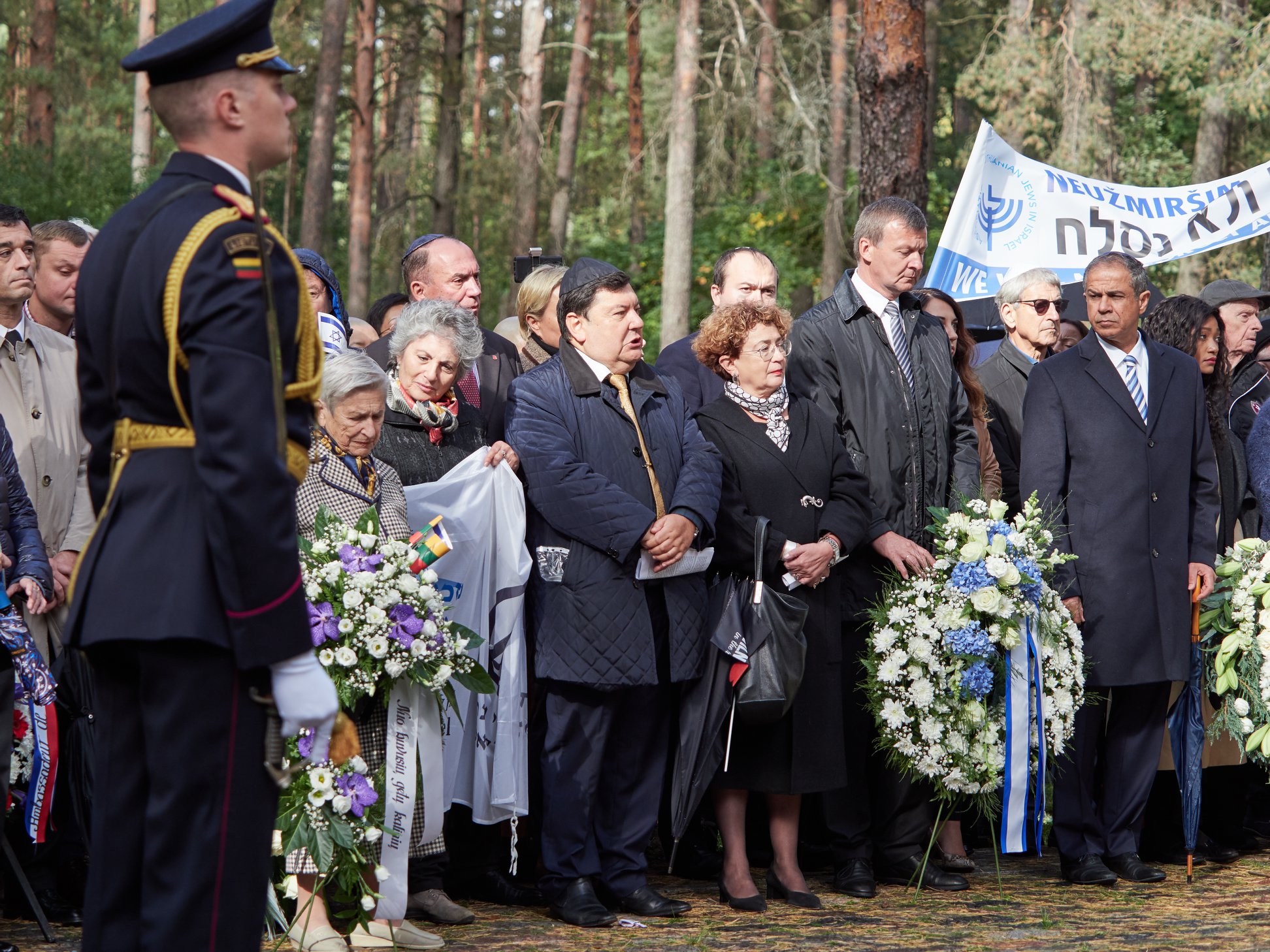
VILNIUS, August 24, BNS–Israeli prime minister Benjamin Netanyahu visited Ponar Friday, part of Vilnius where over 100,000 people, mostly Jews, were killed during World War II.

After laying a wreath at the Ponar memorial, Netanyahu said that his grandfather had been severely beaten near what he called “a forest of death.”

The Israeli prime minister said that he had learned two lessons from the Holocaust.

“First, we must fight barbarism or it will burn all of us. The second for us, Jews, is that we must never be defenseless again,” Netanyahu said.

“I want to say to my grandfather today: saba, I am back here today and this is a forest of death. As the prime minister of Israel. We will never be defenseless again,” he said.

“We have a state, we have an army and we are capable of defending ourselves by ourselves”.

Netanyahu’s grandmother Sarah Mileikowsky, née Lurie, was born in Šeduva, a town in Lithuania, and his grandfather Nathan Mileikowsky was born in Kreva in what is now Belarus.

Netanyahu: I Would Like to Balance EU’s Unfriendly Stance on Israel


Prime minister Benjamin Netanyahu and wife Sarah depart Ben-Gurion Airport for Lithuania, August 23, 2018. (photo credit: AMOS BEN GERSHOM, GPO)

During his stay, Netanyahu will participate in a memorial ceremony for Jewish Holocaust victims, an award ceremony for the Righteous Among the Nations, among others.

Prime minister Benjamin Netanyahu is flying Thursday to Lithuania for a three-day trip to hold bilateral diplomatic meetings with the heads of the Baltic states, who will also be arriving in the European country.

“I would also like to balance the EU’s unfriendly stance towards the State of Israel in order to achieve a more fair and genuine relationship with the State of Israel,” Netanyahu said before he boarded the plane. “I have achieved this through cooperating with groups of countries within the EU, Eastern Europe and now with the Baltic countries and of course, with other countries,” he added.

During his stay Netanyahu will participate in a memorial ceremony for Jewish Holocaust victims, an award ceremony for the Righteous among the Nations and additional events.

He will return to Israel on Sunday.

Israeli PM Netanyahu to Arrive in Lithuania


VILNIUS, August 23, BNS–Israeli prime minister Benjamin Netanyahu is arriving in Lithuania for an historic visit Thursday.

Netanyahu’s four-day visit is aimed at securing greater support from the Baltic countries for pressure on Iran and paying tribute to the Jewish heritage in Lithuania.

Lithuania would like Israel to take a tougher stance toward Russia.

“We need to better understand each other’s security policy challenges, because security is indivisible, and problems in one region can move to other regions, too,” Government vice-chancellor Deividas Matulionis told BNS.

Lithuanian prime minister Saulius Skvernelis and Netanyahu are scheduled to meet for talks Thursday evening before being joined by Latvian and Estonian counterparts Friday. Netanyahu is also to meet Lithuanian president Dalia Grybauskaite Friday.

Endowment Fund of the Good Will Foundation

By a decision of the Board of Directors of the Good Will Foundation, funds that have been set aside from the annual payments by the Government to the GWF will now be invested as allowed under the law and according to the recommendations of the Good Will Investment Committee. The Investment Committee (Daiva Gerulytė, Harold Paisner, Krzysztof A. Rozen and Rokas Grajauskas) has proposed equally dividing these funds (now approximately 9 million Euro) between passive, long-term investments and an active investment portfolio managed by a reputable financial advisor. The goal of this Endowment Fund is to provide for the continued support of Lithuanian Jewish communal life once the annual payments have ceased. The Investment Committee will continue to monitor the progress of this investment strategy and recommend changes when and if necessary.

Events to Commemorate the 75th Anniversary of the Destruction of the Vilnius Ghetto


Programme

September 18

2:00 P.M. Reading of the names of prisoners of the Šiauliai ghetto, library of the Lithuanian Academy of Sciences, Žygimantų street no. 1 (time subject to change)

September 21 

3.00 P.M.  Ceremony to unveil memory stones commemorating Lithuania’s Righteous                   Gentiles, Garden of the Missionaries, Mairono street.

September 22

6:00 P.M. Premiere of the play Ghetto, Kaunas National Drama Theater, Laisvės prospect no. 71

September 23

10:00 A.M. Reading of the names of Vilnius ghetto prisoners, Choral Synagogue, Pylimo street no. 39
12 noon Readings from the diary of Yitzhak Rudashevski in the former ghetto (location to be announced)
2:00 P.M. Commemoration ceremony at the Ponar mass murder site, Ponar Memorial Complex, Agrastų street
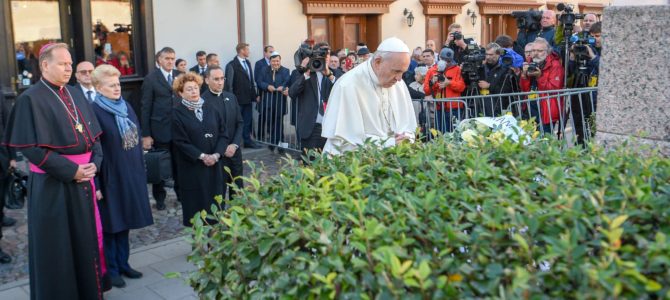
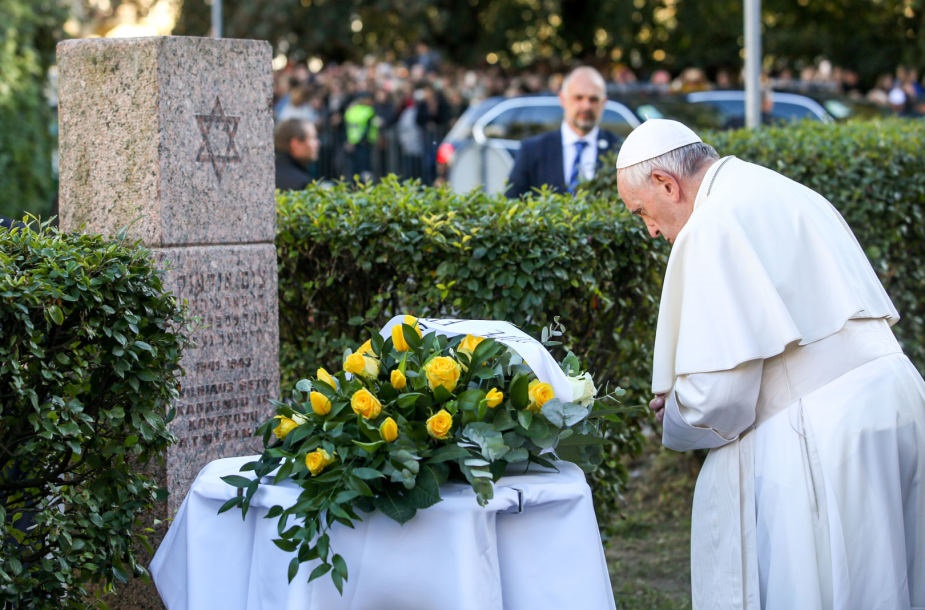
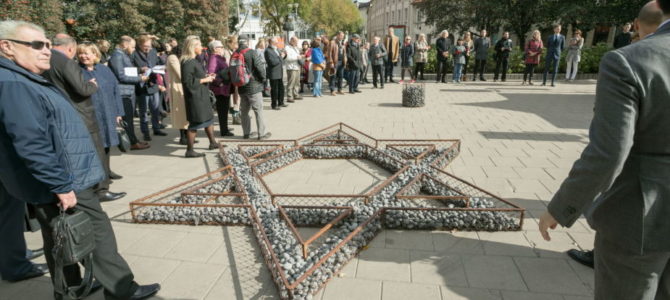
* Pope Francis to honor Holocaust victims in ghetto territory in Vilnius Old Town
6.00 P.M. World Premiere by Giedrius Kuprevičius “Under David’s Star”, Vaidila Theatre, A. Jakšto street no. 9

September 26

6:00 P.M. Tenor Rafailas Karpis, pianist Darius Mažintas and poet Sergejus Kanovičius present “Embrace the Past Tense.” Can Yiddish and Lithuanian meet under one roof? Is it possible to recognize a lullaby if it is sung in unknown words? Is dialogue possible between those singing in Yiddish and those reading their work in Lithuanian? Can love, longing and shared grief meet in memory? The Old Arsenal, Arsenalo street no. 3

September 27

6:00 P.M. Evening of Vilna Ghetto songs by Marija Krupoves, Lithuanian Jewish Community, Pylimo street no. 4

September 28

Commemorative Sabbath, Lithuanian Jewish Community, Pylimo street no. 4

October 4

6:30 P.M. “Heroism against Destruction,” an evening of creativity by Nechama Lifshitz Ensemble (Israel) dedicated to the memory of the victims of the Holocaust. Theater Hall, Vilnius University, Universiteto street no. 3

For more information write info@lzb.lt or call +370 672 40942

Tunklgold Concert a Rousing Success

Jascha Heifetz Hall on the third floor of the Lithuanian Jewish Community in Vilnius was filled Thursday for a concert concluding the summer course of the Vilnius Yiddish Institute at Vilnius University.

Vocalist Regina Hopfgartner with Gregor Unterkofler on piano and backup vocals performed a program of old Yiddish favorites to the audience of staff and students from the summer course and staff and members of the LJC as well as interested members of the public.

The duo performed in Yiddish but the introduction to each song was given in English. Both the Yiddish and the English had a hint of German, and in “Bei Mir Bisttu Shane,” the culmination of the concert, there was no separating the accents. The audience gave a long standing ovation and came out to give their personal congratulations to the performers in the foyer.

Irena Giedraitienė, Panevėžys Jewish Community Member and Photographer

Long-time member of the Panevėžys Jewish Community Irena Giedraitienė won wide renown and a number of prizes for her photography in the 1970s but hasn’t appeared much lately at exhibits and in the press. Happily, the city newspaper Sekundė has printed an article featuring this wonderful artist with such a surprising biography.

This photographer who has left a real mark in Lithuanian photography has held more than 40 exhibits of her work, took part in another 100 group exhibits around the world and has won dozens of coveted awards.

She still has something to say and something to show, so she’s preparing for more exhibitions, putting her archive in order, taking new series of photographs and thinking about interesting projects for the future.

Right now she’s focusing on the upcoming Fotoskrynia exhibition which is being partially financed by an art grant from the city municipality.

Full story in Lithuanian here.

Lithuania Pays Tribute To a Genocidal Monster


Jonas Noreika from the private collection of his granddaughter, Silvia Foti

Jonas Noreika, whose granddaughter confirms he murdered more than 14,000 Jews, is honored as a national hero

Silvia Foti, the granddaughter of one of the worst genocidal monsters in history, has published an explosive expose of her grandfather, Jonas Noreika, showing that he was indeed responsible for the murder of more than 14,000 Lithuanian Jews. Foti identifies the Lithuanian Government’s odious attempts to revise history as “one of the greatest cover-ups of the 20th Century.”

First exposed by the German magazine Der Spiegel in 1984, it has long been known that Noreika was culpable in the murder of his Jewish neighbors in Northwestern Lithuania. Yet Noreika officially and legally remains one of Lithuania’s greatest national heroes, and is honored with a plaque on the Vilnius Library of the Academy of Science building. Over a decade ago, this incongruous adulation of a genocidal monster struck me, a Jewish Lithuanian citizen, as reprehensible. I immediately began my campaign to remove this monument. I had no idea that the official conversion of monsters into heroes was a deliberate Lithuanian agenda.

Full text here.

Gesher Club Visits Poland

Approximately 30 members of the Lithuanian Jewish Community’s Gesher Club from Vilnius, Kaunas and Šiauliai toured Warsaw and Cracow in late July on an educational and site-seeing journey. Most were already familiar with Warsaw with its unique architecture, wide boulevards and skyscrapers puncturing its centuries-old skyline. Club members said their deepest impressions came from the POLIN Museum of Polish Jewish history.

In historic Cracow the visitors toured the Kazimierz old Jewish quarter there and attended a klezmer concert.

Long-time LJC member and professional tourist guide Markas Psonikas organized and the trip.

Eli Rabinowitz from Australia and Israelis Visit Panevėžys

The Panevėžys Jewish Community had the unexpected pleasure of a visit by several guests this week. Daniel Veid and his wife Eti and their son Shmuel from Israel visited and Daniel said he was researching his family’s roots. His great-great-grandfather Solomon Veid was born and lived in Panevėžys and his great-great-grandmother Shaike Levine was also born there. Solomon and his family moved to South Africa in the early 19th century.

On July 31 Eli Rabinowitz, who grew up in Cape Town and now lives in Perth, Australia, also visited. He spoke about his project to help teach the Holocaust to young people around the world.

Panevėžys Jewish Community chairman Gennady Kofman spoke with Rabinowitz about Community projects with local schools which also teach young people about the Holocaust.

Paul Packer, New Chairman of the United States Commission for the Preservation of America’s Heritage Abroad, Visited Lithuania in July

Paul Packer, chairman of the United States Commission for the Preservation of America’s Heritage Abroad, visited Jewish heritage sites including the Ponar Memorial Complex and the old Jewish cemetery in Šnipiškės with representatives from the Lithuanian Foreign Ministry, the US embassy, the Cultural Heritage Department and the Lithuanian Jewish Community, and discussed Jewish heritage topics and directions with representatives of the Lithuanian Government and Vilnius municipality.

The chairman of the United States Commission for the Preservation of America’s Heritage Abroad and Lithuanian Jewish Community chairwoman Faina Kukliansky visited Jewish heritage sites together in Kaunas, Kėdainiai, Pakruojis and Joniškis. Packer praised efforts by the LJC and local municipalities to preserve authentic Litvak heritage and especially maintaining authentic synagogues and old Jewish cemeteries.

Packer visited the Great Synagogue archaeological site and learned about the dig there. He was keenly interested in possibilities for commemorating the sacred and symbolic historical site. The LJC plans to continue active cooperation with the chairman of the United States Commission for the Preservation of America’s Heritage Abroad who has taken a firm position on the control of the Great Synagogue. He said the Great Synagogue should be under the Lithuanian Jewish Community. A resolution protocol was adopted by the Lithuanian Government on June 29, 2018, tasking the LJC with drafting a study for ways to restore fragments of the Great Synagogue in Vilnius.

Questions by Pinchos Fridberg regarding the LJC Statement on Noreika

I’ll say right away I’m not a diplomat, I am a person “rough and unrefined,” but I am a member of the Community and that means this statement was written in my name as well. I will quote:

“The Lithuanian Jewish Community asks the institutions responsible to take quick action to solve this political, ethical and legal problem and to pay due respect to the victims of the Holocaust. We are asking for the plaque to Noreika to be taken down before the Lithuanian Day of Remembrance of Jewish Victims of Genocide on September 23.”

I would like to ask the authors of this statement several clear and not very pleasant questions. I hope my questions will be posted without delay and I won’t have to look for another place to post it. Note the references are just to the original document.

1. Do the authors of the statement know Jonas Noreika (General Vėtra) received decoration (posthumously), the Great Cross of the Order of the Cross of Vytis?

Note: The award number and date of the decree is easy to find on the presidential webpage.

Then-president Algirdas Brazauskas signed this decree but I was unable to find the text of the decree, the official presidential webpage only covers decrees promulgated between 2009 and 2018.

2. Do the authors of this “statement” understand the status of this award?

Note: this is article 57 of the text:

“The order of the Cross of Vytis is awarded to people who have demonstrated remarkable heroism, bravery and resolution in defending the freedom and independence of the Republic of Lithuania.”

3. Do the authors of this “statement” understand that it’s not possible to “turn the four screws” on the commemorative plaque without the president first rescinding the Great Cross of the Order of the Cross of Vytis by decree?

4. Do the authors of the “statement” believe this sort of resolution might really be signed, and moreover, by September 23, 2018?

P.S. I don’t need a response. I will be satisfied if you post these questions, but without editing, please.

Pinchos Fridberg, average Community member

Markas Zingeris Wins Liudas Dovydėnas Literary Prize

Writer Markas Zingeris has won this year’s Liudas Dovydėnas prize for best new Lithuanian novel for the book “Aš sėdėjau Stalinui ant kelių” [I Sat on Stalin’s Knees] published in 2017 by the Lithuanian Writers’ Union.

Zingeris is the director of the Vilna Gaon State Jewish Museum but is an accomplished and prolific writer who has won a number of literary prizes previously. Some of his books have been translated to other languages.

Full story in Lithuanian here.

Three Weeks of Digging Culminate in Discovery of Bima at Great Synagogue

On July 26 reporters were invited to get a better look at the results of this year’s archaeological digs at the site of the former Great Synagogue in Vilnius.

An international team of Israel, American, Canadian and Lithuanian archaeologists made a number of discoveries this year, the third summer in a row digging has been conducted in and around the Soviet-era school built in 1952 on top of the former synagogue. Under one classroom the edge of the bima, the raised platform where the Torah is read, and the base of a column in the elaborate design of the bima were discovered. Lead archaeologist from the Israeli Antiquities Authority Dr. Jon Seligman explained to reporters the aron kodesh, or ark where the Torah is kept, would like be just under the fence bordering the street in the front of the school. He said the street had slightly shifted in location since the pre-war period. The bima and the ark form the main axis around which activities take place in the main hall of the synagogue.

Digging resumed in the playground and uncovered the men’s mikve next to the women’s discovered last year and suspected the year before. The mikvot constituted a two-storey building behind the synagogue from the side of the street still called Jewish street. A mikve is a bathing facility used for ritual purification. Two areas uncovered displayed what appeared to be almost new, slightly over-sized ceramic bathroom tiles, alternating squares of white and an orangish-red color.

Adjacent to the mikve building archaeologists determined the exact location of the outer wall of the synagogue proper this year.

Sabbath with Yiddish Summer Course Students

Friday evening students from the Yiddish and Yiddish Literature program of the Vilnius Yiddish Institute at Vilnius University celebrated Sabbath at the Lithuanian Jewish Community.

LJC chairwoman Faina Kukliansky spoke about the importance of these types of courses, saying: “Yiddish is an inseparable part of Jewish culture, Jewish identity. Yiddish isn’t just Jewish songs and a rich folklore. There is an abundance of very interesting literature in Yiddish. I hope Yiddish classes will become just as popular as Hebrew classes are in our community. Yiddish is a living language and it is continuing to develop.”

This year the summer courses are being attended by about 30 students from Poland, Sweden, Germany, Israel, the United States and other countries. Most have Jewish roots and want to learn the language of their forefathers, and to learn more about Litvak culture.

There are also students who say they need to learn Yiddish for work. Philip from Germany said he doesn’t have any Jewish blood but needs Yiddish because he is studying the Holocaust in Byelorussia. Even so, he’s become a Yiddish enthusiast, and said the Yiddish language preserves the philosophy of the Talmud.

Thomas from Stockholm also says he needs Yiddish for his work. He works for Swedish International radio and several years ago they decided to start a broadcast in Yiddish. Thomas was selected to lead the program because he’s Jewish. Although he understands Yiddish, so far he’s been posing questions to guests in English and Swedish. Now he hopes to be able to do this in Yiddish.

Yiddish summer course teachers include professor Anna Verschik from Estonia, professor Abraham Lichtenbaum from Argentina, professor Dov-Ber Kerler, professor Vera Szabó from Israel and this year Canadian stand-up comedian, writer and linguist Michael Wex, author of the best-selling “Born to Kvetch: Yiddish Language and Culture in All Its Moods,” New York, 2005.

The summer course of the Vilnius Yiddish Institute at Vilnius University began in 1998.

Great Synagogue Site Compared to Acropolis and Vilnius Castle

15min.lt

Last week the Lithuanian Jewish Community confirmed archaeologists had discovered the bimah, or speaking platform, one of the most important elements of the Great Synagogue. Experts say this gives real stimulus to the digs at the site which have been going on for three years now. The Great Synagogue in Vilnius was one of the most important Jewish centers from the end of the 16th century to World War II. Damaged during the war, the Soviets razed what was left to the ground in the 1950s and built a school there. The green and brown Baroque bimah built in the 18th century was found under the school.

Call to Get Rid of Noreika Commemorations

Lithuanian Jewish Community chairwoman Faina Kukliansky thanked the archaeologists who studied historical descriptions and blueprints as well as digging for sharing their finds. “We are in the former ghetto, and this find is comparable on Vilnius’s scale to discovering the Acropolis. Not the shopping center, the historical Acropolis,” Kukliansky said. She thanked the Vilnius municipality for the support and initiative in commemorating the former synagogue, and used the occasion to remind Vilnius city leaders commemoration of the Great Synagogue isn’t compatible with a public plaque commemorating Jonas Noreika. “I want to make this little observation that the Great Synagogue and a monument to Noreika don’t really go together in one city,” the LJC chairwoman said at press conference next to Vilnius mayor Remigijus Šimašius, asking for the issue to be solved..

Full story in Lithuanian here.

Archaeologists Find Holiest Part of Vilnius Great Synagogue Razed by Soviets


VILNIUS, Lithuania (AFP) — For decades, little did the principal of a kindergarten in Lithuania’s capital realize that her office stood on top of a sacred part of Vilnius’s 17th century Jewish temple, once famous across Europe.

An international team of archaeologists announced THursday the discovery of the most revered part of the Great Synagogue of Vilnius, Lithuania’s major Jewish shrine before it was destroyed by Nazi and Soviet regimes.

Installed in the 18th century, the Baroque bimah was found under the former kindergarten and primary school built by the Soviets on top of the demolished synagogue in the 1950s.

Following this discovery, Vilnius authorities pledged to demolish the school building in a couple of years and properly commemorate the synagogue by 2023.

Condolences

With sadness we report the death of Estera Klabinaitė Grobman who lived in Israel. She lived a long, interesting and difficult life. Born in November of 1920 to a well-to-do Jewish family in Kaunas, she always called herself a Kaunas resident. Her parents had a large bakery before the Holocaust. Imprisoned in the Kaunas ghetto and Stutthof concentration camp, Grobman, who passed away at the age of 98, was an avid reader and shared her memories right up to the time of her death. In May, 2018, the rector of Vilnius University travelled to Israel to present her an honorary diploma.

We share in the pain of her friends and family and send our deepest condolences to her son Aron, her daughter-in-law Ele, her grandchildren Daniel and Saul and too many more to name. Although we seem to know that death is an inevitability, it always hits us painfully and unexpectedly. Rest in peace, Estera.