
Holocaust

Lithuanian Jewish Community Position on Public Discussion of Writer Rūta Vanagaitė’s Statements Regarding Lithuanian Partisan Leader Ramanauskas “Vanagas”

The Lithuanian Jewish Community, or LJC, expresses concern over public discussion of writer Rūta Vanagaitė’s statements regarding the actions of Lithuanian partisan movement leader Adolfas Ramanauskas “Vanagas.” At this time the LJC knows of no reliable information based on extant historical documents confirming the accusations made against Ramanauskas implicating him in the Holocaust or the murder of Jews of Lithuania.

We call upon all sides to refrain from making rash statements leading to public discord and emphasize that discussion of complex questions of Lithuanian-Jewish history should be based on the principles of mutual respect, openness and honesty.

The LJC respects the right of the private publisher Alma Littera to carry out its own business plan as it sees fit. Nonetheless, the LJC considers the publishing house’s decision on how to utilize the works of Vanagaitė, recalling from stores all of her works, inappropriate, and that it could lead to conflict within society.

Adhering to the belief that historical justice and its restoration should be based on reasoned studies by professional historians using authentic documents, the LJC invites the public, professional historians and national leaders to take measures to halt the further division of society and the spread of hate.

PM Says Lithuania Doesn’t Need to Review Position on Holocaust Collaboration

Vilnius, November 2, BNS–Lithuanian prime minister Saulius Skvernelis says Lithuania doesn’t need to review its position on the role played by Lithuanians in the Holocaust.

“There’s nothing for us to review, as a state we have performed all actions and further have excellent dialogue with the Lithuanian Jewish Community and the world Jewish community. We aren’t saying that the painful issues which exist shouldn’t be discussed, and those discussions are taking place within the Government, their representatives and community representatives are visiting. So there’s nothing really to reconsider,” the head of the Government said on the Žinių radijas radio station Thursday.

He was commenting on the call by the European Jewish Congress for Lithuania to review fundamentally the role of Lithuanians during the Nazi occupation and to stop honoring those who collaborated with the Nazis and actively took part in the mass murder of Jews in Lithuania.

“If someone wants to reconsider something or go deeper, this is the work of historians, and historians must base their findings on very clear, systematic historical information and facts, not on the interpretation of facts, but on the totality of facts. Then one can discuss and speak,” the Lithuanian prime minister said. He also said Lithuania as a state has done everything to insure good relations between the state and the Jewish community.

Lithuanian Foreign Ministry Says Not to Set Jewish Genocide against Anti-Soviet Resistance

Vilnius, November 1, BNS–Lithuanian diplomats say the genocide of Jews and the Lithuanian armed struggle against the Soviet occupation shouldn’t be set against each other.

The Lithuanian Foreign Ministry Wednesday expressed regret over a statement from the European Jewish Congress condemning the Lithuanian publisher Alma Littera’s decision to halt sales of books by Rūta Vanagaitė and criticism of the Lithuanian public relations specialist and author for allegedly libeling partisan leader Adolfas Ramanauskas “Vanagas.”

“For many years now Lithuania has been working in Holocaust research and education in consultation with international Jewish organizations including the World Jewish Congress and the European Jewish Congress. Counterposing the Jewish genocide against the Lithuanian anti-Soviet resistance in this context is completely unacceptable,” a press release from the Foreign Ministry stated.

First Plaque Commemorating Rescuers in Lithuania

Panevėžys Is the First to Thank Jewish Rescuers
www.sekundė.lt

The first plaque commemorating those who rescued Jews during the Holocaust has been unveiled in Panevėžys, Lithuania. It honors nun, activist, nurse and teacher Marija Rusteikaitė of the Congregation of the Sisters of the Love of God and her fellow nuns. The stone plaque was unveiled at a ceremony at the intersection of J. Tilvyčio and Krekenavos streets in the Lithuanian city, close to where the Sisters of the Love of God monastery and hospital were located, according to historical documents.

“It was namely this spot, a few dozen meters away, which is the most important historical site of the monastery for us, because this is where Marija Rusteikaitė brought together the nuns, the first sisters of the Love of God, between 1925 and 1936. As soon as she completed the university of medicine in St. Petersburg, the mother superior from Žemaitija joined the St. Vincent de Paul society in order to help the poor people of the city of Panevėžys and surrounding areas. Before that she taught mathematics and geography at the Kražiai pre-gymnasium and Polish at another location,” sister Leonora Kasiulytė, who has long taken an interest in the historical figure, said of the founder of her monastery.

US State Department Holocaust Envoy Visits LJC

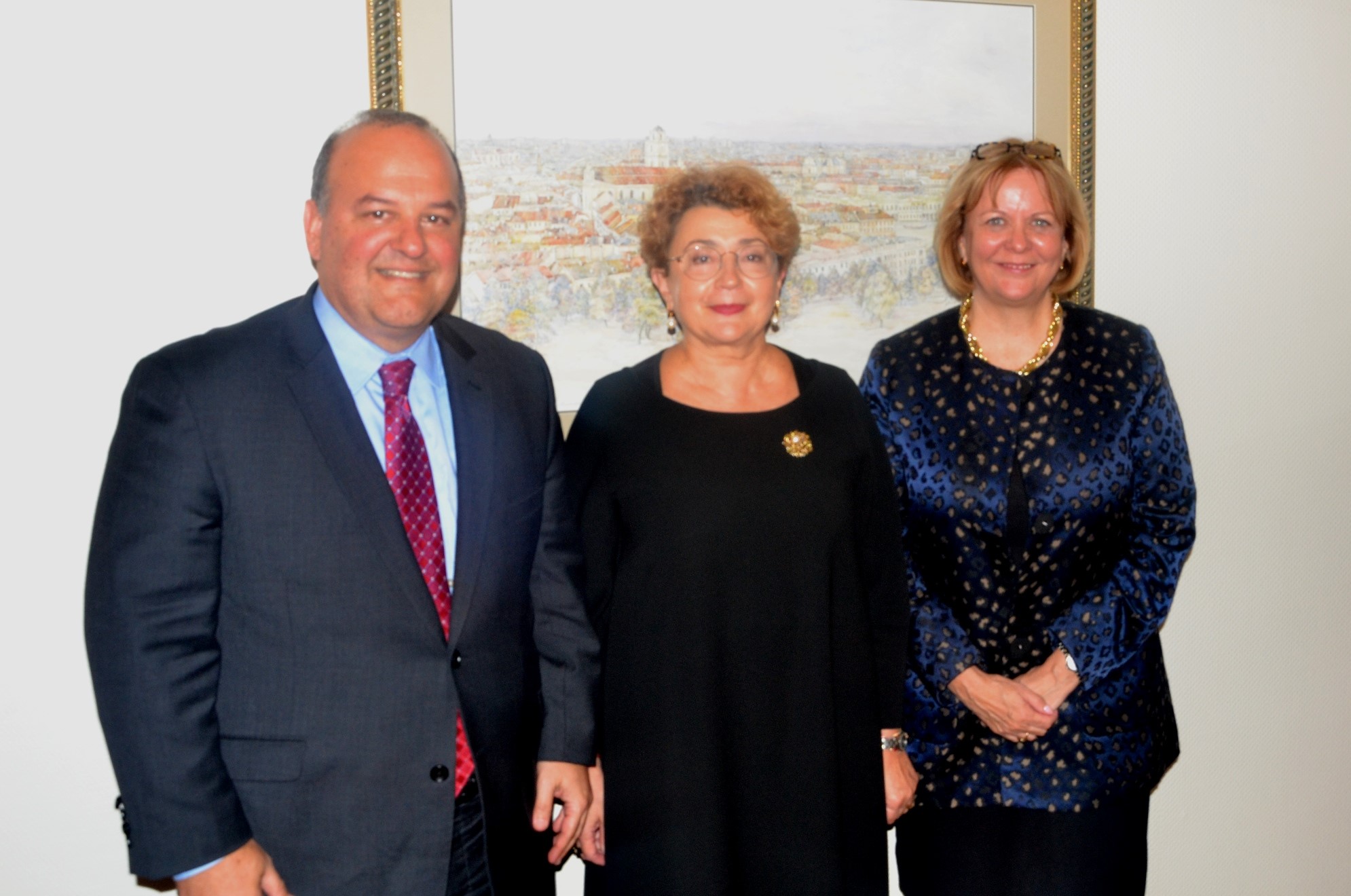
Special envoy for Holocaust issues in the European and Eurasian Bureau of the United States Department of State Thomas Yazdgerdi has visited the Lithuanian Jewish Community and met with chairwoman Faina Kukliansky.

They discussed progress and problems in Holocaust commemoration and the goals the LJC has set for itself and the Lithuanian state in entering a new stage of commemorating Holocaust victims, education and restitution.

The special envoy also heard about work the LJC is doing in human rights in general, including actively participating in a coalition of human rights organizations and a project for drafting and publishing recommendations at the Lithuanian and European level for fighting anti-Semitism and Romophobia.

Righteous Gentile Marija Rusteikaitė to Be Commemorated in Panevėžys

Dear members,

A ceremony to unveil a stele honoring Marija Rusteikaitė, rescuer of Jews, teacher, nurse, public figure and founder of the Congregation of the Sisters of the Love of God, will be held at 1:00 P.M. on Friday, October 27.

The ceremony will be held at the intersection of Tilvyčio and Krekenavos streets in Panevėžys. Bus transportation from Vilnius will be provided from the Lithuanian Jewish Community at Pylimo street no. 4 in Vilnius at 10:45 A.M. There are ten seats left at the time of this writing. Those wishing to take the bus should send an email to info@lzb.lt

Those riding by bus will be delivered back in Vilnius in time for the special Sabbath at the Choral Synagogue in Vilnius.

LJC Calendar for 5777 Wins Prize at Unusual Ceremony

A Jewish calendar published by the Lithuanian Jewish Community last year took first place in an annual Lithuanian calendar contest October 20.

The 28th annual Laurynas Ivinskis Prize ceremony was held in Kuršėnai, Lithuania with live Lithuanian folk music and a performance by the Fayerlakh ensemble.

The theme of the LJC calendar for 5777 was Lithuanian rescuers of Jews. It featured interwar president Kazys Grinius and wife Kristina on the cover, both Righteous Gentiles. Each month featured more than one story of rescue.

Laurynas Ivinskis (1810-1881) was a 19th century calendar maker whose agricultural calendars were also more text than calendar, and were for a period of time forbidden by Russian authorities because they were written in Lithuanian using the Latin rather than Cyrillic alphabet. His almanachs included stories and parables in pre-standard Lithuanian.

Khasia Shpanerflig Has Died

Khasia Shpanerflig (Chasia Španerflig) has died at the age of 97. She was a long-standing member of the Community and formerly a student at the Tarbut Gymnasium as well as a Jewish partisan under the Vytautas the Great Trakai brigade. As long as health permitted she devoted herself to the activities of the Union of Ghetto and Concentration Camp Prisoners, the Lithuanian Jewish Community and Holocaust education.

Our condolences to her son Volodia and daughter Sofiya and all her family and friends.

Will We Tell Students the Whole Truth, or Only What’s Useful to Us?


by Mečys Laurinkus, www.lrytas.lt

Toppling (taking down temporarily for restoration) the “idols” on the Green Bridge [in Vilnius] under natural field conditions with no special measures taken, I overheard the complaint: the topplers themselves name streets and hang memorial plaques to the “heroes” who took part in the shooting of Jews. The public is interested in history, reads, listens to discussions and judges the actions of the government. You cannot forbid this.

Virginijus Savukynas in his television show “Istorijos detektyvai” [History’s Detective Stories] returned to this often emotionally explosive topic. Kazys Škirpa, in whose honor a street is named in Vilnius, a noteworthy founder of the Lithuanian state and the organizer of the June, 1941, uprising against the Russians, while under house arrest in Berlin issued a statement about Jews which was totally contrary to his biography and likely his own views, one which was comparable to the spirit of the Gestapo. I will restate my thoughts again a bit later. Jonas Noreika, aka Generolas Vėtra, who had fought against the Nazis and the Bolsheviks and was shot by the latter, appointed head of the Šiauliai district administration by the Provisional Government of Lithuania in 1941, blessed with his signature the establishment of a ghetto for Jews in Žagarė, Lithuania.

General Vėtra (actually just a captain) has been honored with a commemorative plaque. Not somewhere marginal. On the building of the library of the Lithuanian Academy of Sciences. In an even more visible location there still stands the statue to Petras Cvirka, who brought back the sun of Stalin not at all because of any political manoeuvering to help Lithuania in the grindstones of time, but out of conviction that “Mother Russia” would take us in and protect us. Of course she did take us in, but only to a very cold place, where poets such as Kazys Jakubėnas, upon whom Cvirka informed to Soviet security, were sent.

Much Applause

“The project was conceived in 2014 when Zubin Mehta conducted the Israeli Philharmonic Orchestra in Vilnius. The person who runs the orchestra, Gintautas Kevisas, informed ambassador Laimonas that he was planning a visit to South East Asia with the Lithuanian Symphony Orchestra, and was wondering whether they could give a couple of concerts in Mumbai. The ambassador approached Khushroo Suntook and the two days, the 10th and 11th, were finalized,” says a spokesperson about the Lithuanian National Symphony Orchestra, wich performed to great acclaim at the NCPA this week, and which we had the pleasure of attending on Wednesday evening.

“Dr. Yusuf K. Hamied, chairman of CIPLA, whose mother was Lithuanian and who was born in Lithuania, came forward to make it happen.”

As was to be expected, the presence of this international group of acclaimed musicians was highly applauded, and the packed auditorium was witness to many shouts of “Encore” and “bravo,” especially when the dapper resident conductor and violinist of the Symphony Orchestra of India, Marat Bisengaliev, participated as a solo violinist. What’s more, we noted: it wasn’t just the usual suspects of well-heeled Parsis savoring the fare.

Lithuania’s ambassador to India Laimonas Talat-Kelpsa with Linas Antanas Linkevicius, minister of foreign affairs in Lithuania, along with the consul generals of Spain, Hungary, Argentina and Holland and minister of external affairs M. J. Akbar were in the audience.

(From the Friday, October 13, 2017, print edition of Mid-Day newspaper, Mumbai, India)

Litvak Sponsors Lithuanian National Symphony Orchestra Concert in India

Lithuanian Jewish Community chairwoman Faina Kukliansky at the invitation of the Lithuanian embassy to India attended a concert by the Lithuanian National Symphony Orchestra in Mumbai October 10 to celebrate the 100th anniversary of the restoration of Lithuanian independence.

Indian pharmaceutical magnate with Litvak roots Yusuf K. Hamied, a close family friend of the Kuklianskys and his wife Frida sponsored the concert through their foundation.

Photo: (from left) Indian minister of state for foreign affairs Mobashar Jawed “M. J.” Akbar, Lithuanian foreign minister Linas Linkevičius, LJC chairwoman Faina Kukliansky, Cipla Ltd. pharmaceuticals and biotech company director Yusuf K. Hamied.

Cipla’s Journey: How a Muslim-Jewish Romance Shaped One of India’s Biggest Pharma Firms

by Kenneth X. Robbins and John Mcleod

In 1992, the editor of the Times of India telephoned one of Mumbai’s most prominent businessmen–Yusuf K Hamied. The editor asked Yusuf “as a Muslim leader” his opinion on communal riots that were taking place in the city. “Why aren’t you asking me as an Indian Jew? Because my name is Hamied? My mother was Jewish,” Yusuf replied. His maternal grandparents perished in the Holocaust.

Yusuf, chairman of one of India’s largest pharmaceutical firms, is the son of an aristocratic Muslim scientist from India and a Jewish Communist from what is now Lithuania. Defined by his parents’ extraordinary marriage, he unites his father’s scientific skills, business acumen, and Indian patriotism with his mother’s compassion for the less fortunate. He charges the Western pharmaceutical industry with “holding three billion people in the Third World to ransom by using their monopoly status to charge higher prices.” And he has devoted himself to making life-saving inexpensive generic medications for the inhabitants of poorer countries.

NHK World Documentary Painting with Soul

Japan’s largest broadcast NHK invites you to watch their documentary “Painting with Soul.”

The “To-Kon Painters” add color to the lives of people who are short on cash. They’re volunteers who will travel anywhere for a good cause, painting buildings and playground equipment free of charge. Most are former social dropouts who once belonged to biker gangs or quit school. We follow them to Lithuania, where they repaint a memorial honoring Chiune Sugihara, a Japanese diplomat who helped 6,000 Jews flee the Holocaust during World War II. The painters must overcome cultural and linguistic challenges to get the job done.

Watch here.

LJC Hosts “Person with a Backbone” Discussion on Public Holocaust Awareness

The Lithuanian Jewish Community together with the Polish Institute in Vilnius, the Goodwill Foundation and the Czarne publishing house hosted a discussion September 27 called “Person with a Strong Backbone” on public awareness of the Holocaust and of Polish and Lithuanian Righteous Gentiles who rescued Jews from death. The guest of honor was Romuald Weksler-Waszkinel who was born in Švenčionys and escaped death due to the efforts of Righteous Gentiles.

The discussion was based on the book of the same name by Polish radio journalist Dariusz Rosiak who discovered a hero in Waszkinel (Człowiek o twardym karku. Historia księdza Romualda Jakuba Wekslera-Waszkinela, Wydawnictwo Czarne, Wołowiec 2013). The author and his book’s main character shared with the audience memories and reflections of Polish and Lithuanian Righteous Gentiles against the backdrop of Waszkinel’s moving story of his salvation by Polish rescuers and how they raised him as one of the family.

Vilnius Polish Institute director Marcin Łapczyński said: “The Holocaust is one of the greatest and most horrific tragedies in the history of humanity. Millions of Jews lost their lives because of the crime planned by the Germans. About half of Poland’s 6 million citizens who died during World War II were Jews. It’s worth recalling Poles constitute about 25 percent of all people awarded the title of Righteous among the Nations for the heroic rescue of Jews. They are in first place in the awards list. Likewise, Polish families in Lithuania helped Jews. Examples include Katarzyna and Ignacy Bujel from Vaidotai, Maria and Antoni Kruminis-Łozowski from i Jašiūnai and of course Emilia and Piotr Waszkinel from Švenčionys. Among the almost 900 Lithuanian citizens who are Righteous Gentiles, Poles form the majority.”

Well-known Vilnius teacher, bibliophile and proponent of multiculturalism Vytautas Toleikis led the discussion, after which Grzegorz Lindowski’s documentary film “Embedded in David’s Star, the Cross” (“…wpisany w gwiazdę Dawida – krzyżm,” 1997) was shown, in which Romuald Waszkinel shares his dramatic story, his dilemmas and thoughts which led him to inner peace and certainty.

Žiežmariai Synagogue One of a Handful of Surviving Wooden Synagogues in Europe

LRT TV News Service LRT.lt

When Lithuania joined the European Route of Jewish Cultural Heritage, the synagogue in Žiežmariai was chosen as the symbolic first site. The wooden house of prayer is a rare surviving example of wooden synagogues in Europe. Even so, it took more than a decade for reconstruction to begin. After work is done, the plan is for the small building located in a town along Lithuania’s main highway to host a museum.

About 500 Jews lived in Žiežmariai when the synagogue was built in the 19th century. Before the war there were up to a thousand. Now the synagogue is getting back its former face, with work on the façade, windows, walls and the already-finished roof.

Restoration experts working on the building say the synagogue succeeded in surviving because of daily care by local residents. They boarded up windows and removed garbage dating back to Soviet times, when the building was used as storage. Neighbor Liudvikas Markuntavičius said the synagogue serves more than just to remind the small town of a glorious past. During World War II the synagogue territory was used as a ghetto and the Jews of Žasliai and Kaišiadorys were imprisoned there.

Chabad Feuds with Jewish Leaders over Cozy Ties to Eastern European Autocrats


by Lili Bayer and Larry Cohler-Esses

In the former Communist states of Central and Eastern Europe, established mainstream Jewish groups are increasingly worried that Chabad, the international Hasidic movement, is allying itself with authoritarian governments.

In countries from Hungary to Russia, they say, Chabad is at times playing down anti-Semitism in a bid to compete with local Jewish groups and win access to financial resources and political influence.

Chabad, in turn, says that mainstream groups are too embroiled in secular and political issues, including polarizing disputes about democracy and civil liberties, at the expense of guarding core communal Jewish interests of physical security and Jewish religious freedom. In some cases, Chabad officials say, these establishment groups are also corrupt.

The increasing tensions between Chabad and more established Jewish groups are playing out in different ways in different countries. Each case is unique:

Survivor Yochanan Fein’s Memoirs Presented in Lithuanian in Kaunas


Photo courtesy Vincas Kudirka Public Library

The Lithuanian translation of Yochanan Fein’s memoirs called “Berniukas su smuiku” [Boy with a Violin] was presented at two locations in Kaunas: the Vincas Kudirka public library’s Panemunė branch and the President Valdas Adamkus Library and Museum. The author impressed audiences with his warmth, humor, humanitarianism and perfect Lithuanian and his story drew both laughter and tears.

Members of the Paulavičius family, who rescued Fein during the Holocaust, attended the book presentation at the presidential library, along with members of academia, Kaunas Jewish Community members, former ghetto prisoners and Fein’s son and daughter, who accompanied him throughout Lithuania on his book tour.

Recalling his life in the ghetto and his rescue as well as what led up to his writing the book, Fein said that although the book is written in blood, it contains no hatred, revenge or attacks. Fein even received some criticism from friends for that reason, so he explained he would never forget what happened and who did it, but he also discovered enlightened people during those dark days who preserved faith in humanity, risking their lives and those of their families. Fein said he didn’t like the word “everyone” and that there is no universal crime or guilt. He said we need to talk about the real heroes of the nation, the extraordinary people who adhered to Fein’s father’s life-long maxim “men darf zayn a mentsh,” one must remain a human being.