Holocaust

Lithuanian Jewish Community Statement on Proposed Amendment to Consumer Rights Law

The Lithuanian Jewish Community would like to bring the reader’s attention to amendments to the Law on the Protection of Consumer Rights currently being considered by the Lithuanian parliament which would ban retail sales of goods which “distort the historical facts of Lithuania or belittle Lithuania’s history, independence, territorial integrity or constitutional order.”

The LJC finds this expanded language for amending the consumer rights protection law raises real concerns about the possible suppression of the ability of members of society to make use of their basic right to self expression, and also raises questions about the likelihood of suppression of future attempts to restore historical justice. These amendments could exert a disproportionately large and negative influence on possible discussions regarding the role of Lithuanians in carrying out the Holocaust and would further lead towards a single “acceptable” judgment of the events of Lithuanian history, formulated at the state level, which would not serve the purpose of really learning and teaching history, but would instead become a censored interpretation.

The LJC believes the adoption of these amendments would give rise to conflict in society. The LJC calls for a consideration of the real need for these amendments and their objectivity, and calls upon legislators to realize anti-Semitism is not on the decline in Europe at the current time. On the contrary, the example of neighboring state which have adopted laws on “the appropriate” interpretation of history recall the era of institutionalized anti-Semitism. Many expressions of hate are encountered in Lithuania as well, and the LJC believes the adoption of these amendments poses the danger of increasing anti-Semitism in Lithuania.

The LJC points to a 2013 decision adopted by the Constitutional Court of the Republic of Lithuania in the case “On the Adherence of the Law of the Republic of Lithuania on Education to the Constitution of the Republic of Lithuania,” which stated that no specific position or ideology can be declared mandatory and forced on the individual, and that the state must remain neutral regarding beliefs and does not have the right to set some sort of mandatory belief system.

Openness and freedom of speech and expression must remain strong and unifying values in Lithuania. In our country insuring human rights and the battle against hate crimes must be our active concern, just as actively as the calls for fighting for the protection of consumer rights by adopting these amendments.

Commemorating Warsaw Ghetto Uprising, Lauder Appeals to Poles and Jews to Remember “Common Bonds” and “Truths”

Press Release
April 19, 2018

World Jewish Congress delegation travels to Poland to commemorate 75th anniversary of Warsaw Ghetto Uprising

In address at official state ceremony, WJC president Ronald S. Lauder appeals to Poles and Jews to remember “common bonds” and “the truth”

WARSAW–World Jewish Congress president Ronald S. Lauder spoke Thursday at Poland’s official state ceremony commemorating the 75th anniversary of the Warsaw Ghetto Uprising at the Monument to the Ghetto Heroes, following an address by Polish president Andrzej Duda. In his address, Lauder appealed to both Poles and Jews to remember “our shared history, our friendship, our common bonds, and the truth,” and to “stand together now to make sure that our children and our grandchildren never know the true horrors that took place right her, 75 years ago.”

In his address, Polish president Duda described the events of April 1943 as an “uprising of the people who decided to keep their dignity… Did they think they would become heroes…no for sure they were not thinking about that… But today all of us are bowing our heads very low to their courage determination bravery… They perished for dignity, they perished for freedom but they perished for Poland because they were Polish citizens… Poles and Jews deeply care about having one shared historical truth.”

Memorial Plaque Unveiled on Ninth Fort Mass Murder Field

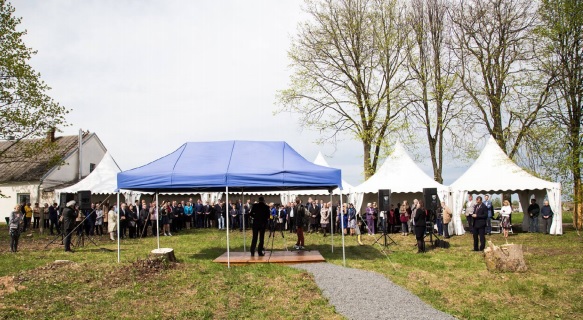
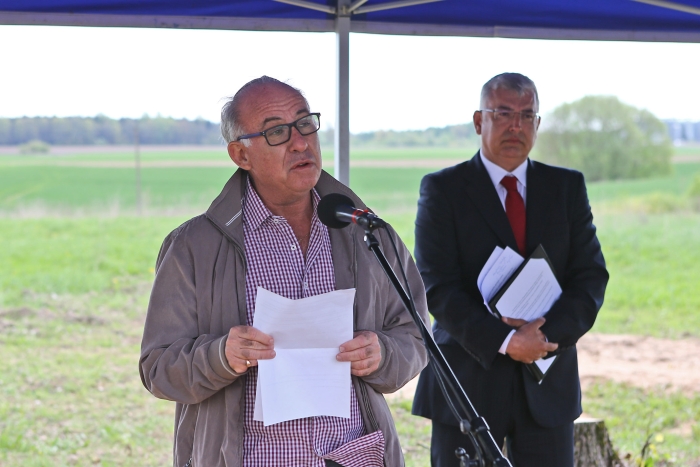
At the field of mass murder at the Ninth Fort in Kaunas a ceremony to unveil a memorial plaque took place April 13. The plaque commemorates the Jews deported from Frankfurt murdered on November 25, 1941, at the Ninth Fort.

Kaunas Jewish Community chairman Gercas Žakas, Israeli ambassador to Lithuania Amir Maimon, deputy Lithuanian foreign minister Darius Skusevičius, Kaunas municipality deputy director of administration Nijolė Putrienė, Frankfurt Administration Cultural Department director Johannes Promnitz and representatives of the Brueder-Schoenfeld Forum participated. The memorial plaque was the result of cooperation between the Kaunas Ninth Fort Museum, the Kaunas municipality, the Brueder-Schoenfeld Forum organization and the Frankfurt municipality.

Užupis Jewish Cemetery Commemorative Monument Proposal Approved by LJC Advisory Group


The heritage issues advisory group of the Lithuanian Jewish Community has learned of plans for renovating the Užupis Jewish cemetery tendered by the Vilnius municipality and a composition called Arch made of desecrated headstone fragments used as stairs during the Soviet era.

The international creative team behind the Arch are architect Viktorija Sideraitė Alon, creator/designer Albinas Šimanauskas and Israeli architect consultant Anna Perelmuter. The composition uses a symbol created by the Litvak American painter Samuel Bak.

The heritage issues advisory group of the Lithuanian Jewish Community helps solve outstanding Lithuanian Jewish heritage issues professionally and effectively. The group includes Barbara Kirshenblatt-Gimblett, POLIN Polish Jewish museum advisor to the director and senior curator of exhibits; Assumpció Hosta, general secretary of the AEPJ; writer Sergejus Kanovičius, founder of Maceva and the Šeduva Jewish Memorial Fund; professor James E. Young of University of Massachusetts, Near Eastern Studies, English, Judaism; Samuel Kassow, doctor of philosophy, POLIN senior researcher specializing in 19th century history and the history between the world wars; Lyudmila Sholokhova, PhD, YIVO director of archives and library; and Sergey Kravtsov, senior researcher, Jewish Art Center, Hebrew University.

Experts unanimously supported the artists’ idea for commemorating the Jewish cemetery and offered a number of useful suggestions and observations which will be taken into consideration.

This week members of the advisory group plan to discuss the project proposals with the mayor and city administration specialists.

Later the project ideas and visualizations will be presented to the public.

Study Shows Americans Forgetting Holocaust


Sonia Klein, now 92, survived Auschwitz and Majdanek concentration camps. “We are not here forever,” she said of the dwindling number of fellow survivors. Photo: Debbie Egan-Chin/NY Daily News via Getty Images file

A fifth of millennials aren’t sure they’ve ever heard of the Holocaust.

In 1945, Sonia Klein walked out of Auschwitz. Every day of the 73 years since she has been haunted by the memory of what happened there, and the fate of the millions who never made it out of the Nazi death camps.

But Klein wonders, once she and the few survivors still alive are gone, who will be left to remember?

“We are not here forever,” said Klein, now 92. “Most of us are up in years, and if we’re not going to tell what happened, who will?”

Klein’s worries are borne out by a comprehensive study of Holocaust awareness released Thursday, Holocaust Remembrance Day, which suggests that Americans are doing just the opposite.

Full story here.

Film “My Vilnius” at the LJC

The Lithuanian Jewish Community began marking Yom haShoa with a screening of the documentary film “My Vilnius” about centuries-old Jewish Vilna life snuffed out in the Holocaust.

Directors Saulius Beržinis and Vytautas Gradeckas and photographer Rimantas Dichavičius attended the screening on April 10. The soundtrack featured works by composer Anatolijus Šenderovas. At the same event an exhibit of works by graphic designer Ovidijus Talijūnas was also launched. Called “Manologas,” each picture features a letter of the Yiddish alphabet and an interpretation of the letter’s meaning.

The images of a lost world on screen with all the people, buildings, cemeteries and synagogues reminded the audience Vilnius was the Jerusalem of Lithuania before the Holocaust, sometimes called the spiritual center of Jewry. With that in mind, we listened intently on the eve of Holocaust Day, Yom haShoa, to photographer Rimantas Dichavičius who managed to capture something of what left after the Holocaust in Vilnius, namely, the Jewish cemetery on Olandų street destroyed in 1965.

Headstones were used as construction material and over the decades the approximately 10-hectare territory was overgrown with bushes and trees. The territory is currently being put in order and should feature a monument soon.

Yom haShoa Commemoration at the LJC

Yom Ha Shoa aukų pagerbimas Lietuvos žydų (litvakų) bendruomenėje

Holocaust Day or Yom haShoa was marked at the Lithuanian Jewish Community Thursday with the sound of a siren blaring and standing in silence in memory the victims.

LJC chairwoman Faina Kukliansky recalled the family members she lost to the Holocaust buried in Kaktiškės, Lithuania. She lit a candle and recited their names. Survivors Mina Frishman, Shapsai Kholem and Fania Brancovskaja also lit candles, as did Ruta Kaplinsky, the daughter of Shmuel Kaplinski who guided a group escaping the Vilnius ghetto through the sewer.

Israeli ambassador to Lithuania Amir Maimon lit a candle in honor of those who heroically opposed the Holocaust, those who rescued Jewish children and the brave fighters and partisans. The ambassador spoke of the Warsaw Uprising; Israeli president Reuven Rivlin was in Warsaw today to mark the 75th anniversary of the uprising.

About 240,000 Jews lived in Lithuania before the Holocaust. Almost every town and village had a Jewish community. There are about 250 Jewish mass murder and mass grave sites known in Lithuania.

Documentary Film on Righteous Gentile

As part of commemorating Holocaust Day, the Tolerance Center of the Vilna Gaon State Jewish Museum invites the public to attend a screening of a documentary film about Irena Sendlerowa, a Righteous Gentile. The Polish Institute in Vilnius and the embassy of the Republic of Poland are helping organize the event to be held at 5:30 P.M. Wednesday, April 11, at the Tolerance Center, Naugarduko street no. 10/2, Vilnius. The film is in Polish with Lithuanian subtitles.

Come Watch Meyn Vilne Film

You’re invited to a screening of the first part, “People and Stones,” of the documentary film “Meyn Vilne” at 6:00 P.M. on Tuesday, April 10, at the Lithuanian Jewish Community in Vilnius.

This Time We’ll Respond to the Anti-Lithuanian Hysteria, Ambassador to Israel Says


Lithuanian ambassador to Israel Edminas Bagdonas. Photo: Reuters/Scanpix nuotrauka
© 2018 Lietuvos žinios

“We usually decide not to react to these sorts of things. There’s no reason to keep telling the same people–[Efraim] Zuroff and [Dovid] Katz–the same thing over and over again. We don’t have the desire to do so, neither do we have the time, and there’s no rationality at play. But this time we will respond,” Lithuanian ambassador to Israel Edminas Bagdonas told Lietuvos žinios

When the Lithuanian parliament began considering banning the sale of goods which distort or belittle Lithuanian history or threaten Lithuanian statehood, there was a reaction in other countries. The Israeli press carried articles that this was allegedly aimed at books such as Rūta Vanagaitė’s “Mūsiškiai” about the Holocaust in Lithuania. This isn’t the first case in recent times where the shadow of anti-Semitism has been cast on Lithuania and Lithuanians. There was a report in March Lithuanians are the least favorable towards Jews in Eastern Europe. An American newspaper ran an article on March 30 accusing Lithuania of trying to hide the Holocaust.

Full story in Lithuanian here.

Condolences

Sara Ginaitė-Rubinson died April 2. She was born March 17, 1924. She joined the underground resistance in the Kaunas ghetto, fought as a Jewish partisan, married a fellow partisan and was a professor of political science at Vilnius University after the war. She moved to Canada with her two daughters in 1983 following the death of her husband. She was the author of numerous books and was an outspoken proponent of Holocaust education in Lithuania. Her book “Resistance and Survival: The Jewish Community in Kaunas, 1941–1944” was published in Canada and won the Canadian Jewish Book Award for Holocaust History in 2008. She wrote several books about the Holocaust and lost Lithuanian Jewish communities in Lithuanian, including “Žydų tautos tragedijos Lietuvoje pradžia” [The Beginning of the Tragedy of the Jewish People in Lithuania].

The Lithuanian Jewish Community sends its deepest condolences to Sara’s entire family in Canada and her many friends in Lithuania. Her deep commitment to the memory of those murdered lives on.

Kalvarija Municipality to Renovate Synagogue Complex

Vilnius, April 2, BNS–Leaders from the Lithuanian municipality of Kalvarija have decided not to break off an agreement on the utilization of the synagogue complex there as they had planned and are considering how to continue with renovation, following a meeting with the Lithuanian Jewish Community and the Lithuanian Cultural Heritage Department.

Financing pathways using EU structural funds were presented to municipal leaders at the meeting with discussion of financing from the Cultural Heritage Department as well.

Under the project drafted by the LJC several years ago, the total cost of work to fix the synagogue complex came to just under 2 million euros, but no funding was found.

The municipality and the LJC signed a use agreement in 2014, under which the municipality pledged to protect and utilize appropriately the buildings until financing was found to begin restoration to adapt the complex for public cultural, educational and academic use, for tourism and other uses.

“We really don’t have this kind of money, this is a small municipality and we can’t save up such sums or spend that much on synagogues,” Kalvarija mayor Vincas Plikaitis told BNS.

Lithuanian Jewish Community Responds to Proposed Legislation to Censor “Goods”

The Lithuanian Government has sent proposed amendments on the consumer-protection law to parliament for consideration which would ban sales of goods which “distort the historical facts of Lithuania or belittle Lithuania’s history, independence, territorial integrity and constitutional order.”

Proponents of the amendments say they’re needed to stop sales of toys which allegedly commemorate the incorporation of the Crimean Peninsula into the Russian Federation. Lithuanian legal, trade and consumer experts say the amendments aren’t specific and that anything which is sold is a “good,” meaning the law could be used to censor books.

Lithuanian Jewish Community chairwoman Faina Kukliansky has made the following statement regarding the matter:

“These kinds of amendments without precise explanation raise well-founded concerns and recall the dark times of government censorship. History and the writing of annual chronicles are two different things. Historical memory, especially concerning our country’s greatest historical tragedy, the Holocaust, is still in its beginning stages and probably won’t ever be final. These sorts of foolish, misguided attempts by the Government to protect consumer rights have given rise to anger, with foundation, in the international Jewish community. In Europe, where anti-Semitism is on the rise, and especially in Central and Eastern Europe, where laws are being passed on the ‘appropriate’ interpretation of history, Lithuania must remain open and democratic. Freedom of speech and human rights must be insured in our country just as actively as the calls to fight for the protection of consumer rights through these amendments.”

Tolreance Center Holocaust Commemoration Event

Dear friends of the Museum,

We kindly invite you to an event for Holocaust Remembrance Day (Yom ha-Shoah), a screening of the documentary film “The Story of Irena Sendler” and to meet historian Dr. Marcin Urynowicz on April 11 at 5.30 P.M. at the Tolerance Center (Naugarduko street no. 10/2, Vilnius). The event is being organized together with the embassy of the Republic of Poland and the Polish Institute in Vilnius.

Discovering Jewish Roots in Panevėžys

20180326_134846

For the second time a group of 18-and-under young people from Odessa, Kiev, Minsk, Gomel, Moscow, St. Petersburg, Kherson and Krasnoyarsk–85 people in all–have visited Panevėžys as part of a project called Return to Roots. The goal of the journey was to learn about the culture, heritage and history of Litvaks in Panevėžys and Lithuania. Visiting surviving cemeteries, the synagogue and the school, the students witnessed Jewish heritage with their own eyes. Panevėžys Jewish Community chairman Gennady Kofman told the story of the destruction of a Jewish cemetery in 1966 to exploit the headstones as construction material. He said the local Jewish community had gone to great efforts to have the stones returned to the cemetery where the “Sad Jewish Mother” monument now stands. The students showed keen interest in the history of the Jews in the city and World War II. The delegation visited the former Ponevezh yeshiva established by the famous rabbi, Josef Kahaneman. After touring the city the students visited the town of Subačius and the Jewish cemetery there, where rainfall prevented any clean-up work. Alderman Vidmantas Paliulis came to meet the students there. Paliulis has exerted enormous efforts to clean up and maintain the Subačius Jewish cemetery, nicknamed “Paris.” He explained it was called that because of the name of the small neighboring village Paryžius.

The students were then received warmly and fed at the Panevėžys Jewish Community.

Jewish Theater in Inter-War Lithuania

An event to launch the new book “Žydų teatras tarpukario Lietuvoje” [Jewish Theater in Inter-War Lithuania] by Dr. Ina Pukelytė will be held at 6:00 P.M. on the second floor of the Grand Dukes Hall in Kaunas on Wednesday, April 4.

All theater and book lovers are invited to attend to learn more about Jewish activities in Lithuania and other countries in the period between the two world wars, the place Lithuanian Jewish theater holds abroad and about the evolution of Lithuanian theater after the war.

Head of Vytautas Magnus University’s Theater Studies Cathedral Dr. Edgaras Klivis is to moderate the event.

Public Launch of Rudashevski Vilnius Ghetto Diary at LJC

The Lithuanian Jewish Community hosted a second, more public launch of the new Lithuanian translation of the Yitzhak Rudashevski Vilnius ghetto diary Tuesday, following last month’s and exclusive initial presentation at the Vilnius Book Fair.

Rudashevski was 14 when he and his parents were imprisoned in the Vilnius ghetto. He celebrated his 15th birthday there. The family hid during the ghetto liquidation, were discovered and then murdered, presumably at Ponar outside Vilnius. Over the last two decades Rudashevski’s diary has emerged as one of a handful of testimonies by children. It was initially published in extracts in the original Yiddish in Israel, and then in English in 1973. An older and newer French translation ha4xandra Zapruder’s books about children in the Holocaust and in a documentary on the same topic aired on MTV.