Holocaust

International Holocaust Remembrance Day in Panevėžys

International Holocaust Remembrance Day in Panevėžys

Since the United Nations adopted a resolution naming January 27 International Holocaust Remembrance Day in 2005, the Panevėžys Jewish Community has marked the day annually.

This year, on January 25, Albertas Savinčius and wife Virginija attended the conference “Stories of Jewish Children” in Ariogala, Lithuania, organized by the International Commission for Assessing the Crimes of the Nazi and Soviet Occupational Regimes in Lithuania and the Tolerance Center of the Ariogala Gymnasium and more than 20 such Tolerance Centers at educational institutions around Lithuania. The same day Panevėžys Jewish Community member Jurijus Smirnovas spoke at the Margarita Rimkevičaitė Business School in Panevėžys and shared his memories of being imprisoned in the concentration camps in Panevėžys and Šiauliai and his miraculous survival.

On January 25 as well Panevėžys Jewish Community chairman Gennday Kofman attended a Holocaust Remembrance Day conference in Vilnius.

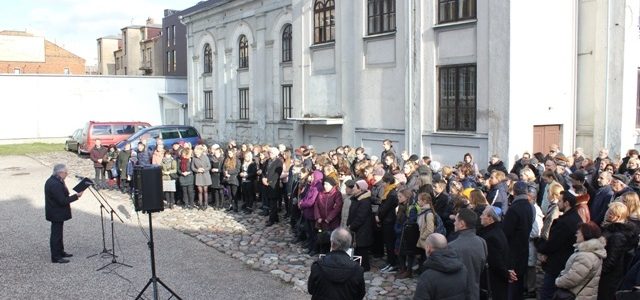
On January 27 commemoration began at 12 noon at the Sad Jewish Mother monument where members of the Panevėžys Jewish Community, representatives of the city municipality, mayor Rytis Račkauskas, city council member Alfonsas Petrauskas, Lithuanian MP Povilas Urbšys, school principals and teachers and the public gathered.

International Conference Held in Vilnius for Holocaust Day, Fighting Discrimination

International Conference Held in Vilnius for Holocaust Day, Fighting Discrimination

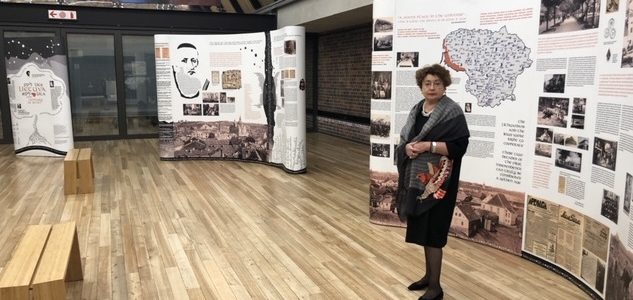
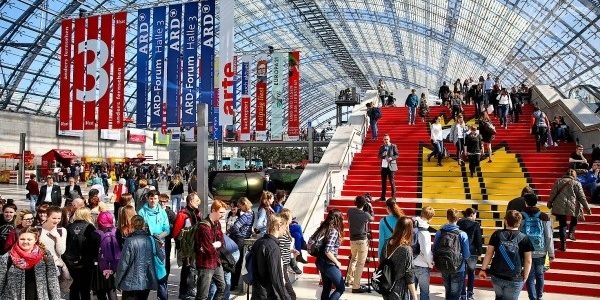
The Lithuanian Jewish Community and the Lithuanian Department of Ethnic Minorities held a conference in Vilnius January 25 both to commemorate International Holocaust Remembrance Day and to look at new ways of fighting discrimination and anti-Semitism in Lithuania. Speakers included Vytautas Magnus University professors, members of the Lithuanian Government, diplomats and academics from abroad. The conference concluded with a presentation of the exhibit “Lithuania, Lite, Lita: One Century of Seven.”
Lithuania’s foreign minister Linas Linkevičius, Ethnic Minorities director Vida Montvydaitė and LJC chairwoman Faina Kukliansky gave welcome speeches.

Foreign minister Linkevičius spoke to the significance of Holocaust Remembrance Day: “Anti-semitism, discrimination against Jews, is a scar on my country. Making apologies will no longer help make anything better. Discrimination led to the Holocaust. Currently in Lithuania there are many signs for Jewish mass murder sites which we can visit and say: never again. We have to remember the Righteous Gentiles, of whom there are about 900 [from Lithuania]. Each year as we honor the victims who were murdered, we cannot guarantee that similar mass murders will not be repeated in the world. In order to stop this, Jewish history and the Holocaust must be part of educational curricula,” he said.

Šiauliai Regional Jewish Community Commemorates Holocaust Day

Šiauliai Regional Jewish Community Commemorates Holocaust Day

Community members met with Aušra Museum employee Vilma Karinauskienė January 25 and listened to a lecture called “Fragments of the History of the Šiauliai Jewish Community” on the painful topic of the Šiauliai ghetto. On July 15 this year we will mark the 75th anniversary of the destruction of the Šiauliai ghetto.

Everyone attending supported the WJC campaign #WeRemember.

On January 27 community members gathered at the monument at the former gates of the ghetto and laid flowers, lit candles and observed a minute of silence for Holocaust victims. Among those in attendance wre community members and Šiauliai ghetto prisoners Ida Vileikienė and Romualda Každailienė. Later members attended a screening of a documentary film about the sonderkommando at Auschwitz followed by lunch and the sharing of memories, held at the Šiauliai Regional Jewish Community.

World Premiere of Night of the Holocaust on January 29

World Premiere of Night of the Holocaust on January 29

Four choirs, a symphony orchestra and a number of soloists will perform Jewish religious music composer Leib Glantz’s (1898-1964) Night of the Holocaust at 6:00 P.M. on Tuesday, January 29, at the Church of Sts. John at Šv. Jono street no. 12 in Vilnius.

American composer Joseph Ness arranged the work for the orchestra and choirs transforming 20 of Glantz’s compositions into a seamless monumental work. Extracts from Elie Wiesel’s Night will provide additional drama elements.

The project is the fruit of an international team, including conductor Arkady Feldman from Russia, cantor Daniel Mutlu from the US, soprano Helena Goldt from Germany, violinist Rita Schteinfer from Israel, celloist Girgoriy Yanovski from Israel, Ekaterina Bergstedt on oboe from Sweden, the Kaliningrad Symphony Orchestra and the Kalinigrad choir Cyrillica, the male a cappella group from the Moscow synagogue, the Vilnius choir and actress Elzė Gudavičiūtė.

International Holocaust Remembrance Day

International Holocaust Remembrance Day

Holocaust survivors remember the painful loss of their families on this day and usually go to the local Jewish community center or synagogue to light a candle in memory of the victims, calling them by name. The ceremony is often bitter and moving. Mina Frišman talked about it with us.

Mina Frišman was a child during the Holocaust and always lights a large candle in memory of her murdered family, recalling the Kaunas ghetto and the Stutthof concentration camp. When the Holocaust began in Lithuania, Mina belonged to a large family with six children. Both her parents worked at the Inkaras factory in Kaunas. She and her family along with all Jews in Kaunas were forced into the ghetto in the Slobodka neighborhood there and made to wear a Star of David. She’s now 86 but still remembers the transport of Jews to Stutthof.

“This year I’ll light a candle remembering the Stutthof concentration camp where my family and I were sent from the Kaunas ghetto. I remember my twin sister whom I loved very much. My sister died in the concentration camp. They murdered my brother and father there. I light a candle in memory of all my family members who were so dear to me, for my father, for my mother, for my brother. In my family there were five sisters and one brother. I was 9 when I ended up in the Kaunas ghetto. Before the war my father supported the family. He worked at the Inkaras factory designing models of shoes. My mother sewed leather at the same factory. They separated the men and women at Stutthof, and they separated the children and murdered them in the gas chamber. My littlest sister died there. Mother was with us. We worked hard and we starved. They gave us a metal bowl and poured what they called soup into it with a small piece of bread. My mother, sisters and I lived to see liberation.

Holocaust Remembrance Day at the Choral Synagogue

The Vilnius Jewish Religious Community invite you to commemorate International Holocaust Remembrance Day at the Choral Synagogue in Vilnius at 3:30 P.M. on Monday, January 28. The following survivors will talk about their Holocaust experiences: Mejer Zelcer, Jakov Mendelevsky, Chaim Nimirovsky, Isaak Markus and Roman Švarc.

Even if you can’t attend, you can take a selfie with a sign reading #WeRemember or #MesPrisimename and post it to social media.

Maushe Segal, the Last Jew of Lithuanian Kalvarija

Maushe Segal, the Last Jew of Lithuanian Kalvarija

Since 2005 we have marked International Holocaust Remembrance Day (officially “International Day of Commemoration in Memory of the Victims of the Holocaust” as designated by the United Nations) and have remembered the once-large Lithuanian Jewish community 78 years ago. There have been no Jews left in the shtetlakh for a long time now, although the Jewish legacy endures in the form of the old towns and synagogues they built, and the cemeteries and mass grave sites. We spoke with Maushe Segal (Maušius Segalis), the last Jew of the town of Kalvarija in western Lithuania, about his life and what Holocaust Remembrance Day means to him.


Maushe with grandson at the Kalvarija synagogue. Photo: Milda Rūkaitė

Segal: It’s important to me to remember, because this is a day commemorating the once-large community now dead. For many years we Jews gathered at the cemetery on September 1, since that’s the day all of the Jews of Marijampolė [Staropol] were murdered. That was before, now there are no Jews left in Kalvarija or Marijampolė.

What do you remember seeing as a child, or did your mother tell you?

They took my father and me to be shot on September 1, 1941. They shot him, but my mother grabbed me, I was small, from the pit in Marijampolė after the shooting.

Testament

Testament

The Pasaka movie theater in Vilnius and the Israeli embassy to Lithuania invite the public to a free screening of the film Testament at the movie theater located at Šv. Ignoto street no. 4 at 2:00 P.M. on Sunday, January 27 Entrance free. The film is in Hebrew, English, German and Yiddish (Lithuanian subtitles will be provided).

The Testament is a film about Holocaust historian Yoel Halberstam, who becomes involved in a legal battle over the brutal mass murder of Jews in the fictional town of Lensdorf, Austria, at the end of World War II. An influential industrialist family on whose land the massacre took place are planning a large real estate development at the mass murder site. Yoel suspects the goal of the construction is bury all memory of the event forever, but he needs proof to stop it from going forward.

Event supporters: Lithuanian embassy to Israel, Israeli embassy to Lithuania

Remember Raoul Wallenberg

Swedish ambassador to Lithuania Maria Lundqvist and the Lithuanian National Martynas Mažvydas Library’s Judaica Center invite you to attend the opening of the Swedish Institute exhibit Raoul Wallenberg: I Don’t Have Another Choice, at the library in Vilnius at 5:00 P.M. on January 30. The exhibit will run till February 10.

LJC Board Members: #WeRemember #MesPrisimename

LJC Board Members: #WeRemember #MesPrisimename

The agony of the Holocaust is known all to well to some members of the board of directors of the Lithuanian Jewish Community, it having affected them and their families deeply.

Preserve the memory of the past, don’t be apathetic, photograph yourself with a sign reading #WeRemember or #MesPrisimename.

We will spread the knowledge of memory together.

Events to Mark International Holocaust Remembrance Day

Events to Mark International Holocaust Remembrance Day

January 25 FRIDAY 10:30 A.M.-2:30 P.M, Artis Hotel, Totorių street no. 23, Vilnius
Holocaust Day conference on fighting discrimination

Presentation of exhibit “Lithuania. Lite. Lita. One Century our of Seven”
Registration: www.lzb.lt, info@lzb.lt [in Lithuanian and English with translation]

Organizers: Lithuanian Jewish Community, Department of Ethnic Minorities under the Government of the Republic of Lithuania

January 27 SUNDAY 2:00 P.M., Pasaka Cinema, Šv. Ignoto street no. 4
Screening of the film Testament aka haEdut (2017). Entrance free. Film is in Hebrew, English, German and Yiddish (Lithuanian subtitles will be provided).

The Testament is a film about Holocaust historian Yoel Halberstam, who becomes involved in a legal battle over the brutal mass murder of Jews in the fictional town of Lensdorf, Austria, at the end of World War II. An influential industrialist family on whose land the massacre took place are planning a large real estate development at the mass murder site. Yoel suspects the goal of the construction is bury all memory of the event forever, but he needs proof to stop it from going forward.

When You Save a Life, You Save a World

The exhibit When You Save a Life, You Save a World and the accompanying catalog will be presented at the Tolerance Center of the Vilna Gaon State Jewish Museum in Vilnius at 3:30 P.M. on January 24 to mark Holocaust Remembrance Day.

Litvaks, Jews in Lithuania and Anti-Semitism: Lithuania’s Jews Persevere

Litvaks, Jews in Lithuania and Anti-Semitism: Lithuania’s Jews Persevere

You don’t have to be born in Lithuania to call yourself a Litvak. There were many years in which Lithuania’s borders kept changing, so that many Jews born in any of Lithuania’s neighboring countries or in any of the countries that had ruled or occupied Lithuania, consider themselves to be Litvaks – especially if they can also speak Yiddish.

At meetings in Vilnius this past November, the first question put to the journalist from Jerusalem Post by both Faina Kukliansky, the chairwoman of the Lithuanian Jewish Community, and Fania Brancovskaja, Vilna’s last Holocaust survivor [sic], was “Do you speak Yiddish?” The interview with Brancovskaja, 96, was entirely in Yiddish, even though she is fluent in a half-dozen languages, including English. Kukliansky is also multilingual and even though the interview with her was conducted in English, every now and again, when she wanted to emphasize a point, she reverted to Yiddish.

Full story here.

Motke Chabad’s Best Joke

Motke Chabad’s Best Joke

Motke Chabad and His Best Joke* (Jewish humor)

by Pinchos Fridberg,
[an old Jew who was born and raised in Vilnius]

<Rebe>, will there ever come a time when the words <Vilne un Yidish> [Vilne and Yiddish] will be inseparable again?”
“<Saydn nor mit Meshiekh’n in eynem> [Not unless it comes with the Messiah].”

§§§

Would you like to know what an old Jew does after a delicious and satisfying lunch?
I’ll tell you: he lies <af a sofke> [<a sofke> – diminutive of sofa] <un khapt a dreml> [and grabs a nap].

And then what?

And then he dreams that …

A few days ago I received an e-mail from motke.chabad@xxxxx.com containing an incredible proposal: the author asked me to prove to him that I really am an old Vilna Jew <an alter vilner Yid>. I wouldn’t tell you these <bobe-maise> [old wives’ tales] if not for the way he suggested proving this.

Panevėžys Jewish Community Invites Public to Commemorate Holocaust

Panevėžys Jewish Community Invites Public to Commemorate Holocaust

The Panevėžys Jewish Community invites all people of good will to attend a Holocaust commemoration on January 27. Event program:

12 noon: Gathering at the Sad Jewish Mother statue, Atminties square, Vasario 16-osios street.

12:30 P.M. Gathering continues at the Ghetto Gate statue, corner of Klaipėdos and Krekenavos streets.

1:30 P.M. Discussion about Holocaust history, causes and perpetrators at the Panevėžys Jewish Community, Ramygalos street no. 18). Screening of film on Auschwitz-Birkenau concentration camp complex, the largest camp during the Holocaust where 1.5 million people were murdered.

Event supported by:

Conference Dedicated to International Holocaust Remembrance Day and Combating Discrimination

Conference Dedicated to International Holocaust Remembrance Day and Combating Discrimination


CONFERENCE DEDICATED TO INTERNATIONAL HOLOCAUST REMEMBRANCE DAY AND COMBATING DISCRIMINATION

Artis hotel, Vilnius, Totorių street no. 23, Vilnius, Lithuania
January 25

[10:30 – 11:00 A.M. registration]

11 A.M.

Welcome speeches:
Lithuanian Minister of Foreign Affairs, H.E. Mr.  Linas Linkevičius
Faina Kukliansky, President, Lithuanian Jewish Community
Vida Montvydaitė, DIrector, National Ethnic Minorities Department
Julius Meinl, World Jewish Congress Commissioner for Combating Antisemitism

11:15 A.M. – 12:15 P.M. PART I:

Jews, Lithuanians and the Greatest Tragedy of the 20th Century. Lessons for Future Generations.

Snowball Rolled South: A Documentary on Litvaks in South Africa

Snowball Rolled South: A Documentary on Litvaks in South Africa

Ieva Balsiūnaitė, one of the producers of the film The Snowball Rolled South about Litvaks in South Africa, gave an interview to Lithuanian public television on the eve of its Lithuanian premiere on Lithuanian TV. The film will be screened at the Tolerance Center of the Vilna Gaon State Jewish Museum, Naugarduko street no. 10/2, Vilnius, at 6:00 P.M. on January 17, 2019, to be followed by a discussion. The film contains Lithuanian and English passages and Lithuanian subtitles will be provided at this screening. The running time is 52 minutes. Entrance is free.

§§§

The majority of Jews living in South Africa come from Lithuania, and many of them are celebrated artists, businesspeople, public figures. A few have been Nobel prize winners and famous actors, even an Oscar nominee. Journalist, documentary maker and one of the makers of the film The Snowball Rolled South Ieva Balsiūnaitė told Lithuanian public television about this. Some of the film’s heroes were born in Lithuania, others in South Africa, so their connections with Lithuania are varied. The older generation still finds it hard to believe how all the warm and nice stories became the Holocaust, and the main characters speak about this excitedly, emotionally and frankly, Balsiūnaitė said.

You’d probably agree that few people in Lithuania know there are so many Litvaks in South Africa. How did this topic attract you and your colleagues and what made you make a documentary film about it?

We made the film as a team with Jonas Jakūnas and Sofija Korf, and we developed the concept with two journalists and documentarians, Viktorija Mickutė and Lukas Keraitis.

This topic first grabbed my interest a long time ago when I read an article about how almost all Jews living in South Africa have Lithuanian origins. That immediately raised a great many questions: why did so many people come from Lithuania specifically, and not from neighboring countries? What is the Litvak experience in the Republic of South Africa, and is there still some connection with Lithuania?