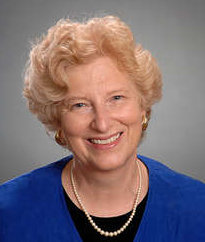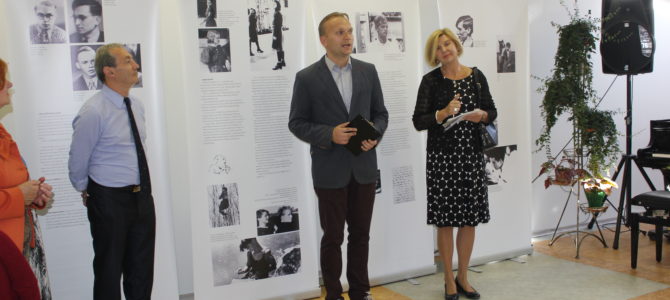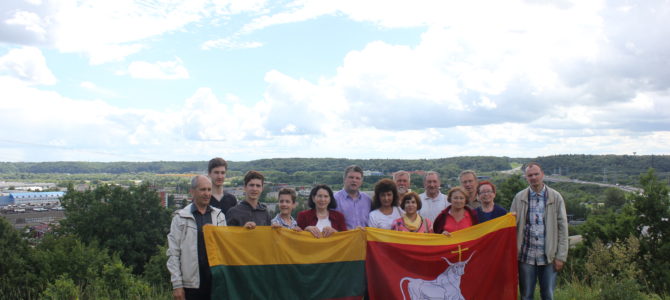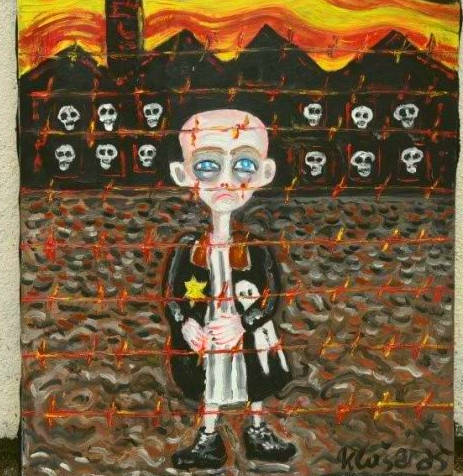

Exhibit opens 6:00 P.M., July 5, 2016 at the Kaunas Multicultural Center, Šv. Gertrūdos street no. 58, Kaunas. Speakers to include Kaunas Jewish Community chairman Gercas Žakas, German ambassador to Lithuania Jutta Schmitz and others. Wine will be served after the formal launch of the exhibit.
Global Media Carry Discovery of Escape Tunnel at Ponar
News of the discovery of the tunnel used by the burners’ brigade to escape from the mass murder site of Ponar near the Lithuanian capital has been picked up by media around the world. The Lithuanian Jewish Community received a report from the Lithuanian ambassador to India that Indian media are reprinting an article about it from the Washington Post.
A team of experts from Israel, Lithuania, the United States and Canada found the escape tunnel, new killing pits, overgrown paths taken by the victims to the execution site and the distribution of human ashes and crushed bone at the site.
The burners’ brigade was formed by the Nazis to exhume the corpses of Jews shot at Ponar, burn them in large piles and crush to dust whatever bones or teeth survived the fire. They knew they were condemned to death and over a period of time excavated a tunnel from their place of confinement.
White Rose Exhibit to Open in Kaunas

The White Rose was the only organized youth resistance group at universities in Nazi Germany (the Edelweiss Pirates and the Swingjugend weren’t specifically university groups and weren’t as organized), established by students and a professor in Munich in June of 1942. Gradually the White Rose movement has come to symbolize all German resistance to Naziism, although it is still not widely known outside Germany.
In their final leaflet distributed in February of 1943, the White Rose society wrote:
“Der deutsche Name bleibt für immer geschändet, wenn nicht die deutsche Jugend endlich aufsteht, rächt und sühnt zugleich, ihre Peiniger zerschmettert und ein neues geistiges Europa aufrichtet. Studentinnen! Studenten! Auf uns sieht das deutsche Volk!”
Remembering Lietūkis Garage

Events to commemorate the victims of the Lietūkis garage massacre took place in Kaunas on the last, very hot weekend in June. Seventy-five years have passed since this atrocity. On June 24 we remembered and honored the victims of the mass murder before a monument set up at the site of pogrom by the Kaunas Jewish Community 10 years ago. A commemorative concert was held at the Kaunas State Philharmonic on June 26 with a special program by the male vocal artists Quorum. Members of the Kaunas Jewish Community were joined at the events by Kaunas residents and representatives of social organizations, the municipality and the Catholic Church. Raimundas Kaminskas and Julija Iskevičienė, representatives of the Kaunas section of Sąjūdis [Lithuanian independence movement] expressed sorrow, solidarity and the hope the brutality and the mass murders would never happen again. The priest Robertas Pukenis and deputy mayor of Kaunas Vasiliy Popov expressed the same sentiments. Scouts from the Kaunas area honored the victims with a Lithuanian folk song.
Remembering Elie Wiesel: A Tribute from a Friend and Disciple
Dear Friends,
Together with the entire Jewish people and, indeed, the world, we are in mourning today for one of the greatest writers, teachers, and human rights activists of our age. Elie Wiesel not only survived the Shoah–he transcended its horrors and became the voice first of its survivors and then of the conscience of humankind.
Below are my recollections of, and tribute and farewell to, my friend and mentor for more than 55 years, published in Tablet Magazine. The link is:
May his memory be a blessing and a source of strength to his beloved wife Marion, his son Elisha, daughter in law Lynn, his grandchildren, his stepdaughter Jennifer, the entire Jewish people and to us all.
Menachem Rosensaft
Picking Up the Pieces

by Geoff Vasil
“Don’t get too close!” an attractive and sunburned young Lithuanian warned at the edge of a large pit just behind what was the Great Synagogue of Vilnius. He’s friendly and it quickly becomes clear he’s the lead archaeologist on the dig, but he’s just as quick to point out he’s formally the lead archaeologist, but Dr. Richard Freund of the University of Hartford in Connecticut is the real force behind the whole initiative.
Mantas Daubaras is doing his doctoral thesis at the Lithuanian Institute of History on a Neolithic site far to the west in Lithuania. He has no personal connection to Jewish Vilna and approaches it as he would any site, dispassionately.
“Yesterday we found what we think is the ritual bath,” he explains, pointing to a small hole in the top of what looks like a vaulted brick ceiling. They sent a camera in to take a look and found a large space terminated by rubble and fill. Does it connect to the Great Synagogue? He doesn’t know yet, but it looks as if it extends right up to the line where they think the back wall of the synagogue once stood.
New Issue of Bagel Shop Newsletter
Celebration to Welcome Torah Scroll at Choral Synagogue

The Lithuanian Jewish Community is tremendously grateful to Judah Passow for his initiative in bringing the 350-year-old Torah scroll back to Vilnius.
Those assembled at the Choral Synagogue in Vilnius June 27 waited in anticipation of something extraordinary: for the carrying in of a 350-year-old Torah scroll, from the period when the Vilna Gaon walked among us, a witness to the Vilnius of the 17th century, experiencing all the passages and changes together with the Jews, used for innumerable bar mitzvah ceremonies until it ended up in the Vilnius ghetto during World War II, and miraculously survived the Holocaust.
In 1960 professor Passow of the University of Philadelphia in the United States came to Vilnius after receiving support from the Rockefeller Foundation to commemorate Jewish communal life behind the iron curtain. Jews in Vilnius asked him to take with him one of two Vilnius ghetto Torah scrolls to survive the Holocaust, uncertain about the future of Jewish life in the Soviet Union. That’s how the Torah entered into the Passow family and was used in three bar mitzvahs. The family protected the scroll for 56 years. Last year the professor’s son, London-based photojournalist Judah Passow, came to Vilnius for an exhibition of his photographic works and spoke with LJC chairwoman Faina Kukliansky. This year he’s come back with the Torah scroll with a silver ornament his mother made.
Romanian Mazel Tov Klezmer Band Concert Big Hit
The concert by klezmer band Mazel Tov from Cluj, Romania, June 29 at the Lithuanian Jewish Community was a great success with a large turnout and heavy applause. Romanian ambassador to Lithuania Dan Adrian Balanescu welcomed the audience and noted Romania’s current presidency of the International Holocaust Remembrance Alliance. In May IHRA member-state representatives met in Bucharest and adopted a definition of anti-Semitism. The ambassador said Romania’s presidency will continue to focus on fighting Holocaust denial and anti-Semitism.
The concert in Vilnius was held on the 75th anniversary of the massacre of Jews in Iaşi, Romania, the largest mass murder of Jews in Romania. About 14,000 Jews were murdered. Before World War II some 800,000 Jews lived in Romania. After the war there were 400,000. Today there are 4,000.
Happy Birthday to Levas Jagniatinskis on His 90th!

May he live in health to 120!
Levas Jagniatinskis and his family were active participants in the reestablishment of the Lithuanian and Vilnius Jewish Communities around the time of Lithuanian independence from the Soviet Union. In 1992 he was elected to the Community’s Council of World War II Veterans and worked with recompense, putting finances in order and organizing events with the veteran’s council and the executive board of the Lithuanian Jewish Community. Those first years were financially hard for the Community, and so he donated his car three times per week winter and summer, parking it in the courtyard of the LJC for use by the Community. He was very active in preparing documents for the Claims Conference and tried to find greater funding for the Community. His son was one of the organizers of the Community’s union of scholars, Vilnor, and later became its director. When he left, the union stopped operating. The family’s third generation, his granddaughters, began attending children’s events put on by the Community, and now, in adulthood, continue their activities, trying to mitigate the losses from the Holocaust.
June Uprising Insurgents: Heroes and Murderers at the Same Time?

“If we want to comprehend why some Lithuanians actively aided the Nazis in murdering Jews, we must first understand instead of condemning, moralizing or getting carried away by emotion.” This statement by Alfredas Rukšėnas, an historian studying the Holocaust in Lithuania and a researcher at the Center for the Study of the Genocide and Resistance of Residents of Lithuania, might shock you. But in the scientifici discipline of history, as in criminology, the most important problem is to understand the criminal’s motivations and external factors which give rise to the event. And the motivations which caused good-hearted young men to murder unarmed people, Jewish children, women and the elderly, could be horribly simple.
Full piece in Lithuanian here.

Gaon-Era Torah Scroll Returns to Vilnius

Vilnius, June 27, BNS–A 350-year-old Torah scroll used in Jewish religious services in the Vilnius ghetto has returned to Vilnius. British photojournalist Judah Passow decided to turn the scroll over to the Lithuanian Jewish Community for use in the Choral Synagogue in Vilnius.
“What’s important is not the [scroll itself], but that he decided to give the Torah to our synagogue. The Torah belonged to his family, it was safeguarded during the war and the entire time. Boys became men during bar mitzvah in front of this Torah and began to read from this Torah, so it is a great honor for us,” Lithuanian Jewish Community chairwoman Faina Kukliansky told BNS. According to Jewish religious tradition, Torah scrolls must be written by hand. Kukliansky said this Torah will replace the one currently being used, which is worn out.
Passow, whose roots are in Ukraine and Poland, told how Lithuanian Jewish community representatives gave the scroll to his father, a professor at an American university in Philadelphia, almost six decades ago when he visited Vilnius in 1960.
Let’s Remember Together: Steps for Life in Riga
The Shamir Association and the Riga Ghetto and Latvian Holocaust Museum are holding an event called Steps for Life on Holocaust Memorial Day in Riga. The event starts at 11:00 A.M. on July 3 at the corner of of Lomonosov and Ebreju streets in Riga. Participants will walk through the Riga ghetto area to the Great Choral Synagogue on Gogola Street. Shamir is inviting those able to come participate and remember, together.
Facebook event: https://www.facebook.com/events/545798345593250/
facebook.com/samir.latvija
facebook.com/rigaghettomuseum
The Significance of Holocaust Memorial Day in Latvia
Samuel Kukliansky Remembered at 25th Anniversary of Lithuanian University

Samuel Kukliansky, father of Lithuanian Jewish Community chairwoman Faina Kukliansky, has had a tree planted in his memory at a ceremony to mark the 25th anniversary of the founding of the Mykolas Romeris University in Vilnius (known as the Law University before 2004). Samuel Kukliansky, Lithuanian attorney, scholar of law, criminology expert, was also a professor at the university and a post-doctoral fellow in social sciences. He was born and raised in Veisiejai, Lithuania. After surviving the Holocaust, he was graduated from the Law Faculty of Vilnius University in 1953 with the qualifications of attorney. He was a life-long scholar and published more than 150 academic papers on different aspects of criminology.
On June 23 Mykolas Romeris University celebrated honored alumni and friends. The event to mark the 25th anniversary of the post-Soviet incarnation of the university included the release of a book including those who have contributed to the university along with the names of rectors, professors, teachers and students. An arboretum of Japanese cherry trees and ash trees was planted to honor past professors, alumni and friends of the university. Rector Dr. Algirdas Monkevičius said at the ceremony to open the garden it was intended as a gift from the university community to the founders and boosters of the university, to the neighborhood and to the city of Vilnius.
Lithuanian Jewish Community Chairwoman Kukliansky Comments on Baltic Pride 2016 March

A large crowd of upwards of 2,000 people turned out June 18 in Vilnius for the Baltic Pride march for equality. The marchers included several foreign ambassadors—Israeli ambassador Amir Maimon, Norwegian ambassador Dag Malmer Halvorsen and others—as well as Lithuanian and European politicians human rights activists, LGBT community members and supporters, social organizations and large delegation from Vilnius University. Marchers carried flags and banners identified with thr gay rights movement and different organizations as well as the national flags of Lithuania, Latvia, Estonia, the United Kingdom, Israel, Russia, the United States, Sweden and others.
Lithuanian Jewish Community chairwoman Faina Kukliansky also attended and said she believes the march is not about gay or lesbian rights, but basic human rights, the right to be who one is.
“There are those who protest, who don’t like this right, they are disgusted and they don’t like people who are different. I would advise such people to read some medical literature. Being gay or lesbian is not a disease. One doesn’t need to be cured of it, and these people don’t have to be fixed. We should accept them as they are,” Faina Kukliansky pointed out.
Alytus Regional Administration Sells Synagogue on Protected Heritage List as Sports Facility

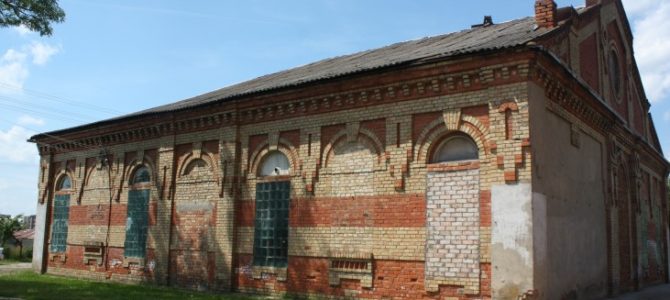
The Alytus regional administration in Lithuania might be on the verge of causing an international scandal. The synagogue in Simnas near the city of Alytus, registered as a cultural heritage treasure, is being put on the auction block for sale. The regional administration says the synagogue isn’t of any use even to Jews, while the Cultural Heritage Department is demanding an immediate halt to the planned sale. Regional authorities say they will sell the building anyway.
The Alytus regional administration is offering to sell the unique Jewish synagogue as a sports hall, although the former house of prayer enjoys legal protection. Public servants have even set an opening price for the building, 19,600 euros. The date of the auction has been as June 30, with tours of the property being made available next week.
Full story in Lithuanian here.
Discussion of Litvak Heritage Protection at Lithuanian Government

On June 23 a second sitting of the commission investigating issues associated with Litvak culture and history was held at the Lithuanian Government. Discussion included Litvak heritage, protection of Jewish cemeteries and mass graves, plans for the Ponar Memorial Complex, restoration of property and inclusion of the Lithuanian Jewish Community in centennial celebrations of the restoration of the Lithuanian state.
“Lithuania is proud of her rich history and opulent ethnic culture legacy. That includes synagogues, communal buildings, different documents and other heritage. I can say resolutely that it is very important to us to maintain existing Jewish heritage sites and to adapt them for public use,” first deputy chancellor and chairman of the commission Rimantas Vaitkus said.
Jewish Gravestones Removed from Electric Substation

VILNIUS, June 22, BNS–This week removal began of fragments of Jewish headstones used in the construction of an electric substation in Vilnius. The fragments will be removed to the Jewish cemetery on Olandų street to be used in a Jewish cemetery memorial to be erected there, the municipality informed BNS. “Currently work is underway to remove stones set in different walls,” Kęstutis Karosas, acting director of the city’s Heating and Water Department said. The plan is to remove all the stones by September 1.
The cost to the municipality is unknown so far. Karosas said payment will be made for work done. The electric substation on Olandų street was constructed during the Soviet period using headstones from the Jewish cemetery there. Jewish headstones, especially from the cemetery on Olandų street, were used all over Vilnius for construction during the Soviet era.
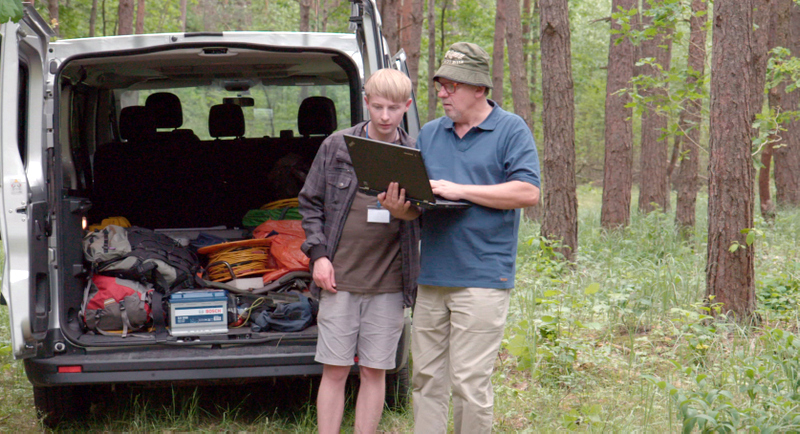
Archaeologists Find Burners Brigade Tunnel at Ponar

A team of archaeologists from the US, Canada, Israel and Lithuania have discovered the escape tunnel dug by the burners’ brigade at Ponar as well as new killing pits.
“New pits were discovered, overgrown paths were also found along which the victims were taken, and the ashes of burnt corpses distributed over the area. And also, the most important thing, the act of resistance, the escape tunnel, about which so much is said in the literature… Now without margins of error its length has been measured, about 30 meters, very exactly, Markas Zingeris, director of the Vilna Gaon State Jewish Museum told Lithuanian Radio and Television Wednesday.
He said the findings at Ponar will lead to new information stands and exhibits. The tunnel might also become part of the new museum planned at Ponar.
Lithuanian Parliament Begins Consideration of Amendments to Citizenship Law
VILNIUS, June 21, BNS—The Lithuanian parliament Tuesday began consideration of amendments to ensure Lithuanian Jews and their descendants who left Lithuania between the two world wars would enjoy the right to restore their Lithuanian citizenship. After initial presentation of the draft amendment, 92 MPs voted in favor of further consideration, none voted against and one abstained. The decision was adopted to put the proposed amendment up for fast-track consideration Thursday. Conservative MP Andrius Kubilius, leader of the opposition and one of the authors of the amendment, said the law needed amending because the year before last and last year Migration Department officials and courts began demanding Litvaks provide proof they or their ancestors were persecuted in interwar Lithuania.