

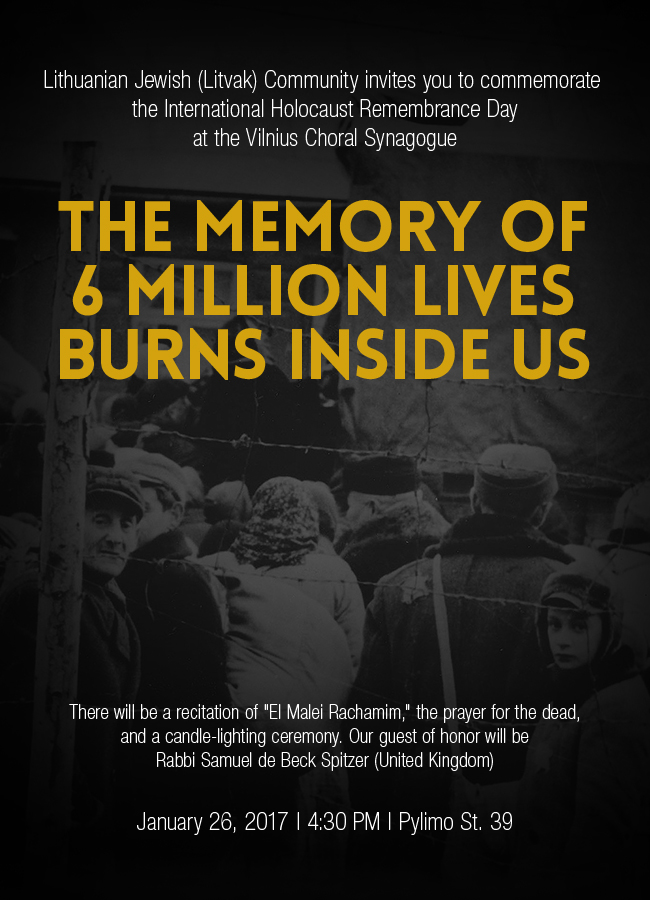
You’re invited today at 4:30 P.M. to attend a ceremony at the Choral Synagogue in Vilnius where candles will be lit in memory of the victims of the Holocaust and the El malei Rakhamim prayer will be sung. Afterwards all are invited to the Lithuanian Jewish Community at Pylimo street no. 4 in Vilnius to a discussion of Jewish history with professor Antony Polonsky, moderated by professor Šarūnas Liekis, at 6:00 P.M.
Scratch an Historical Lithuanian Town, You Might Get a Shtetl
The Lithuanian Cultural Heritage Department announced they are already planning for this year’s European Day of Jewish Culture and have selected a theme, “The Diaspora and Heritage: The Shtetl.” They characterized the choice as an intentional, mature and topical one for a country where the formerly large Jewish ethnic and religious minority thrived until the 1940s in shtetls.
They explained the word “shtetl” means small town in Yiddish. “When the Jerusalem Temple was destroyed in 70 C.E., Jews spread throughout the world, starting a new stage in the existence of the people, life in the Diaspora. Jews who settled in the Grand Duchy of Lithuania from the latter half of the 14th century and their descendants are called Litvaks. They are a branch of the Ashkenazi, Jews fleeing persecution in the German lands in the Middle Ages,” the department noted in a press release.
They continue: “It’s possible the origins of the shtetls reach back to the 18th century, but one shouldn’t get the mistaken impression that every historical Lithuanian Grand Duchy or Lithuanian town may be called a shtetl. Not so! Only a town where Litvaks comprised up to half, and often more, of the population and where the spirit of Litvak enterprise and intellectual ferment was felt can be called a shtetl without reservations.”
Vilna Gaon Museum Offers Free Tours, 2 Films and Discussion for Holocaust Day
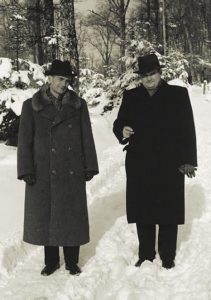
To mark International Holocaust Remembrance Day, the Vilna Gaon State Jewish Museum in Vilnius is screening two biographical films and opening a new exhibit about a remarkable friendship between a Pole and Hungarian which ended up saving thousands of lives. The events are open to the public at the museum’s Tolerance Center located at Naugarduko street no. 10/2, Vilnius.
On January 26 the museum debuts its exhibition called Sławik and Antall: The Great Rescuers. Heroes of Three Nations: Poles, Hungarians and Jews and screens the film Life on the Edge. Henryk Sławik, József Antall’s Senior (2014) with the film’s director Grzegorz Łubczyk participating. The film is being shown in cooperation with the embassies of Poland and Hungary and the Polish Institute in Vilnius.
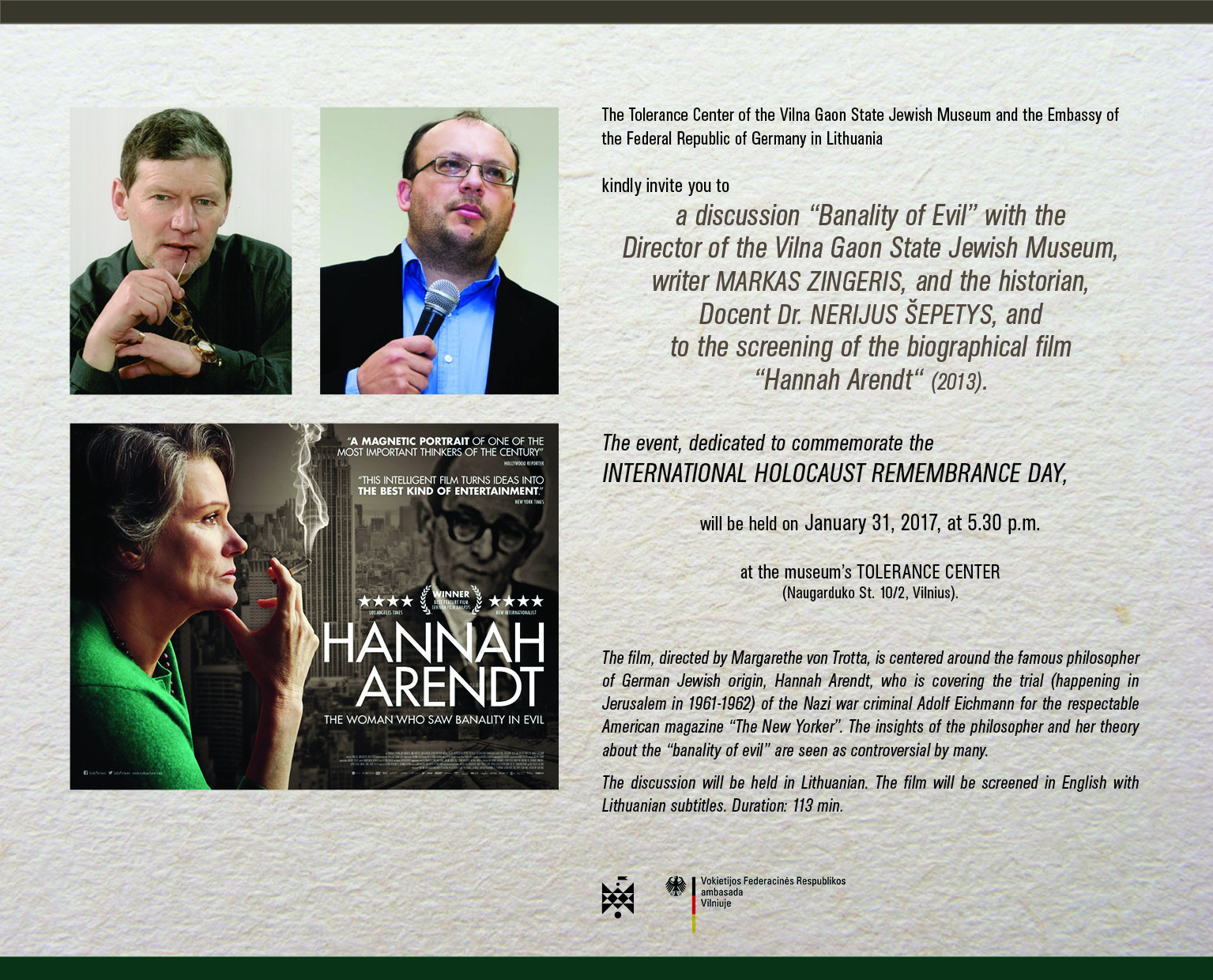
The museum will offer a different take on the Holocaust on January 31, with the discussion at the Tolerance Center at 5:30 P.M. called “The Banality of Evil” with museum director and writer Markas Zingeris and historian Nerijus Šepetys. The discussion is to be followed by a screening of the biographical film Hannah Arendt, to be shown in cooperation with the German embassy to Lithuania. The film is about Arendt who wrote about the Eichmann trial in Jerusalem for the New Yorker magazine and in her own book. Arendt’s ideas about what she called the banality of the evil at work among up-and-coming young Nazi professionals has been met with both criticism and acclaim since she wrote her groundbreaking work.
On January 27, the 72nd anniversary of the liberation of Auschwitz-Birkenau, the Holocaust Exhibit of the Vilna Gaon Jewish State Museum at Pamėnkalnio street no. 12, Vilnius, will offer to the public free guided tours in English or Lithuanian.
Lithuanians Rediscover Their Own Anne Frank
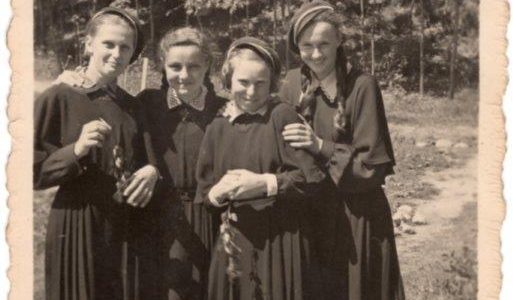
Estera Kverelytė second from left
Romualdas Beniušis writing in the newspaper Lietuvos žinios tells the story of Estera Kverelytė, a Jewish girl from Darbėnai (Drobyan or Dorbyan in Yiddish), Lithuania, who kept a diary in the months leading up to her murder at the hands of postman and policeman Vladas Jašinskas presumably in early July of 1941. Kverelytė’s diary has been lost but is known to have existed and was used in a documentary called “Nebaigtas dienoraščio puslapis” [Unfinished Page of a Diary] released by the Lithuanian Film Studio in 1964 and still available for viewing on the internet archive of Lithuanian National Radio and Television, according to the author. Beniušis is trying to locate the diary and is asking the public for help.
Full story in Lithuanian here.
We Remember

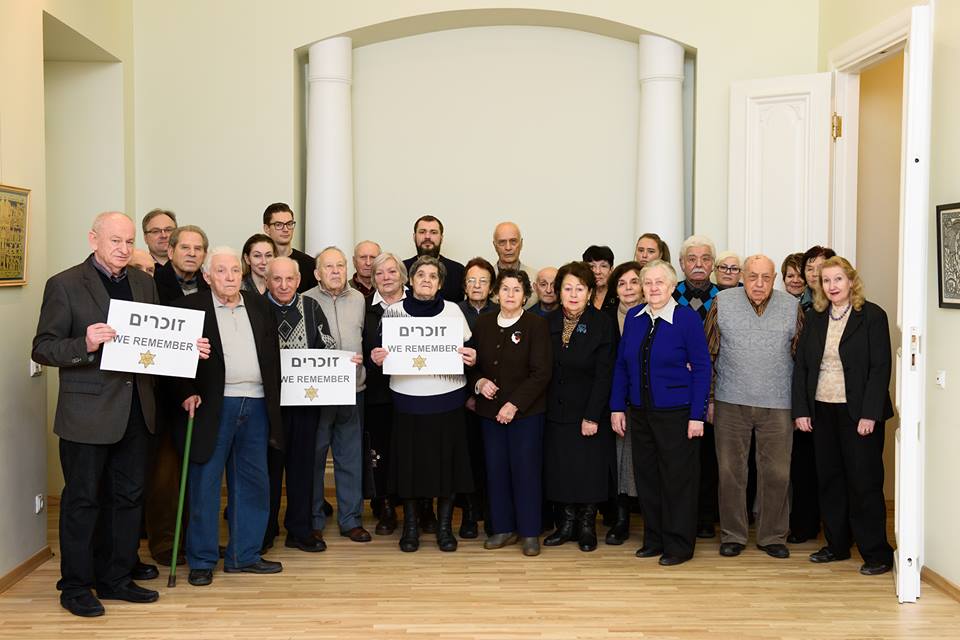
Jewish Community members including a number of Holocaust survivors
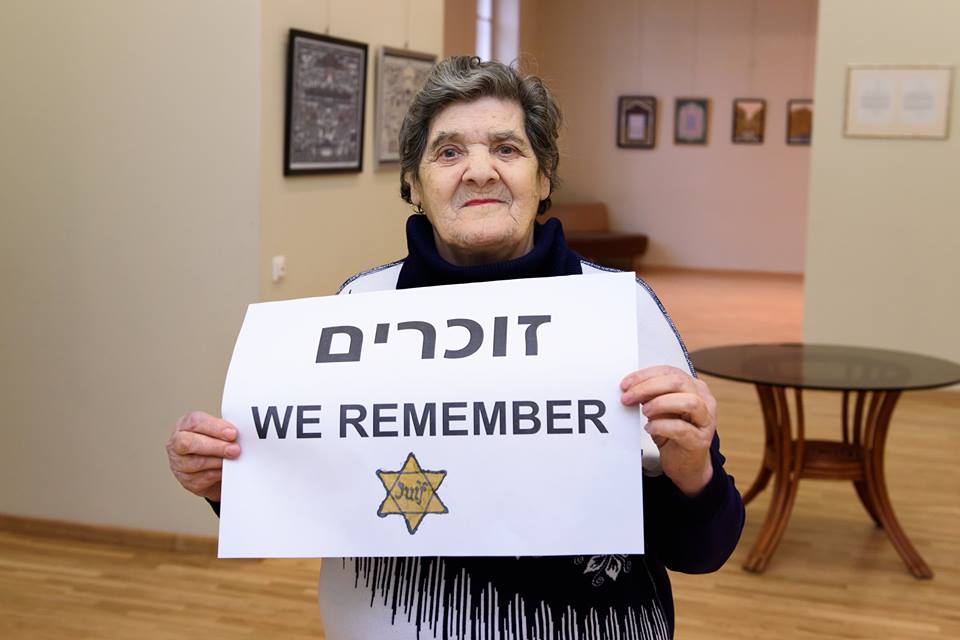
As International Holocaust Remembrance Day on January 27 draws near, the World Jewish Congress is inviting everyone to join the global campaign We Remember. Please try to make sure your Community and its leaders visit schools, churches, synagogues, youth organizations and other institutions to deliver the message. Ask your friends, students and teachers who consent to be photographed to hold homemade We Remember signs as their portraits are taken and sent directly to facebook, twitter and/or instagram, and send a link to weremember@wjc.org
Why now?
In 2017 we have to remember the Holocaust.
Because so many more of the survivors are leaving us…
Because Holocaust denial is not getting weaker,
Because genocide is still happening…
And because it is so important to educate the coming generations.
Together, we want to remind the world about all that happened.
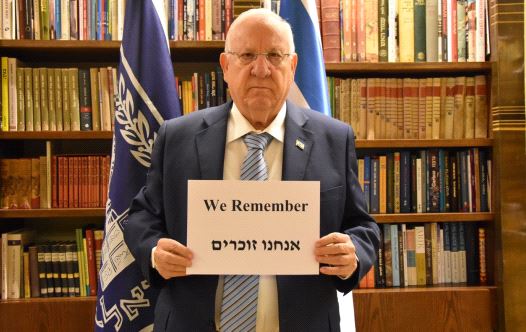 Reuven Rivlin, president of Israel
International Holocaust Remembrance Day at Choral Synagogue
Things Tell Stories: National Conference by Schools for Holocaust Day

Balbieriškis Primary School, Klevų street no. 10, Balbieriškis, Lithuania
January 27, 2017
Conference program:
10:00-11:00
arrival, registration
11:00-12:00
opening, principal Stasys Valančius and International Commission executive director Ronaldas Račinskas
Radio Documentary: Lost Traces of Vilkaviškis
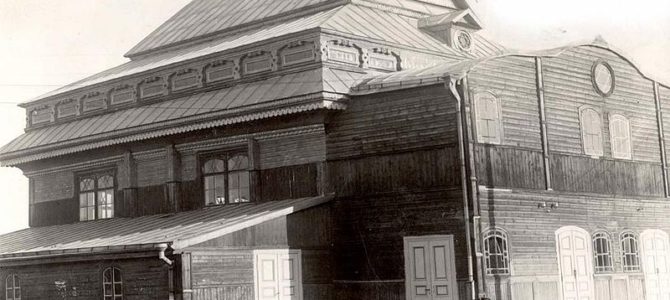
Vilkaviškis synagogue

The Lithuanian National Radio program Radijo Dokumentika aired the episode on at 11:05 A.M. on January 22. It is to be rebroadcast at 9:00 A.M. on January 24 just after the morning news program Ryto Garsai.
Feiga Koganskienė, who lived in the town in the Suvalkija region right up till World War II, says: “Vilkaviškis is only the name Vilkaviškis, it has nothing in common with the former Vilkaviškis.” When she returned to her home town after the war, the woman did not recognize it, and found none of her Jewish family or friends.
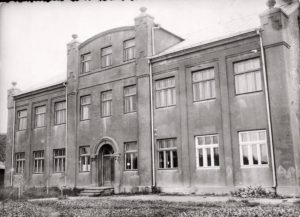
The modern Vilkaviškis Jewish Gymnasium between
the wars, now the city municipal building.
Before the war Vilkaviškis was one of the most ethnically and culturally diverse towns in the region, but now it’s perhaps the most Lithuanian town in the entire country. Today only a handful of people remember Vilkaviškis in the interwar period, and even fewer are prepared to look into the town’s Jewish history. In the Lost Traces of Vilkaviškis episode, Radijo Dokumentika reporters walk with residents for whom the Vilkaviškis of that time is not just a collection of faded facts from history.
Lithuanian Jews behind the Iron Curtain: An Exhibit in Tblisi
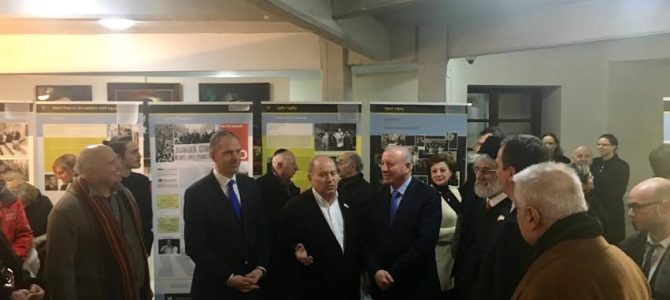
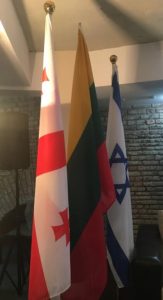
The David Baazov Museum of the History of the Jews of Georgia opened an exhibition January 18 called “Lithuanian Jews behind the Iron Curtain” about the Lithuanian Jewish community during the initial Soviet occupation of Lithuania in 1940. Members of the local Jewish community, diplomatic personnel and lovers of history were invited to attend the opening of the moving and historically informative exhibition of photographs and historical documents. Lithuanian ambassador to Georgia Giedrius Puodžiūnas and Tblisi Jewish Community chairman Jamlet Khukhashvili opened the exhibit and the Georgian minister of culture, the minister of reconciliation and civil equality and the Israeli ambassador spoke. The main focus of the exhibit was on individual efforts to resist restrictions on freedom, identity and historical memory. The exhibit is based on primary sources and items from the Vilna Gaon State Jewish Museum, documents from the Lithuanian Central Archives, the Lithuanian Special Archives and personal collections. The exhibit was prepared by the Vilna Gaon museum in Vilnius, Lithuania.
Lithuanian Political Illusions: The “Policy” of the Lithuanian Provisional Government and the Beginning of the Holocaust in Lithuania in 1941
The Lithuanian Jewish Community is publishing a series of articles by the historian Algimantas Kasparavičius, a senior researcher at the Lithuanian History Institute.
Part 3
As shown by rather abundant surviving archival sources, memoirs and historiography, the pro-German (more accurately pro-Nazi, since in principle there existed no other Germany at that time operating in the international arena as real geopolitical power) concept and strategy of liberation from Soviet occupation and annexation and restoration of the Lithuanian state [1] began to form during the first days of the Soviet occupation, i.e., the end of June, 1940, mainly at the initiative of Lithuanian diplomat in Berlin colonel Kazys Škirpa, who, for several years, had maintained good and even friendly relations with high Nazi Party figures [2]. The process accelerated immediately upon the annexation of Lithuania. As Stalinist repression growing into state terror and radical socio-political reforms took hold in Lithuania [sic]. An organized anti-Soviet resistance quickly began to coalesce by early October of 1940 in Kaunas. The main author of this strategy and its main ideologue, however, was none other than Lithuania’s long-time military attaché in Berlin, colonel Kazys Škirpa. [3] It was at his initiative and due to his efforts that the Lithuanian Activist Front was established in Berlin on November 17, 1940. The LAF established headquarters in Lithuania in Kaunas and Vilnius. Besides Škirpa, the main LAF figures in Berlin and Lithuania were E. Galvanauskas, Klemensas Brunius, Antanas Maceina and Karolis Žalkauskas, Leonas Prapuolenis, Vytautas Bulvičius, Juozas Kilius, Adolfas Damušis, Jonas Pajaujis, K. Antanavičius, J. Vėbra and others. [4]
In cooperation and consultation with German/Nazi political, military and diplomatic figures–field marshals Wilhelm Keitel and Walter von Brauchitsh, chief of the Abwehr admiral Wilhelm Canaris and Abwehr agent in charge of contact with Baltic anti-Soviet resistance organizations lieutenant colonel Herman Gräbe–a program began to be drafted for liberation from Soviet occupation and annexation. Methods, tactics and political strategy for Lithuanian partisan warfare and insurgency against the Soviets were developed. [5]
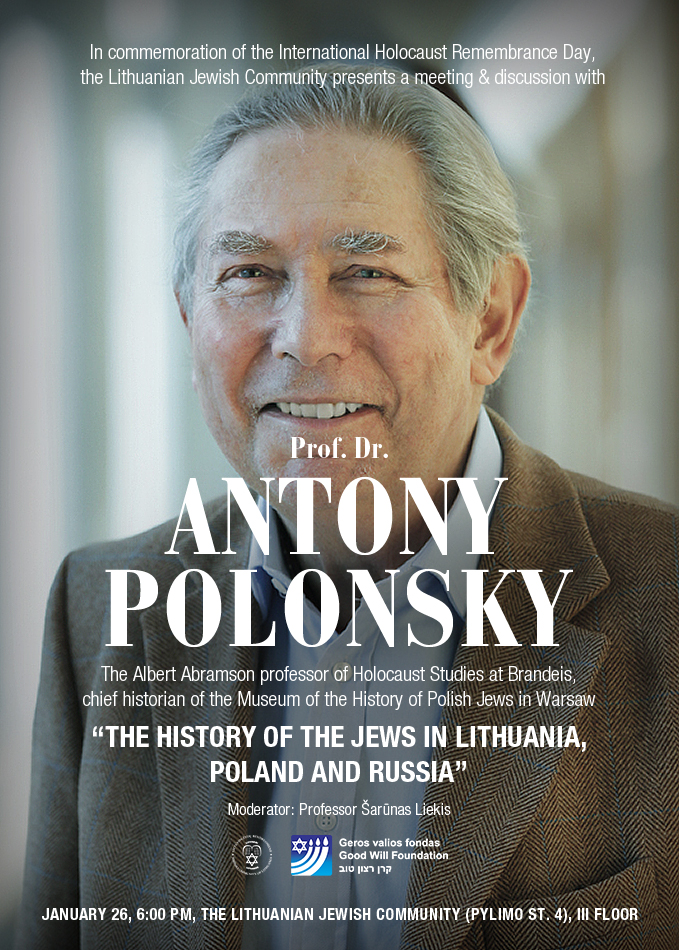
Holocaust Remembrance Day with Dr. Antony Polonsky
You’re invited to a public meeting and discussion with Dr. Antony Polonsky (the Albert Abramson professor of Holocaust Studies at Brandeis and the chief historian of the Museum of the History of Polish Jews in Warsaw) called The History of the Jews in Lithuania, Poland and Russia at 6:00 P.M. on Thursday, January 26, in the Jascha Heifetz Hall on the third floor of the Lithuanian Jewish Community (Pylimo street no. 4, Vilnius).
Moderator: professor Šarūnas Liekis.
Lithuanian National Radio and Television Hosts Exhibit on Righteous Gentiles
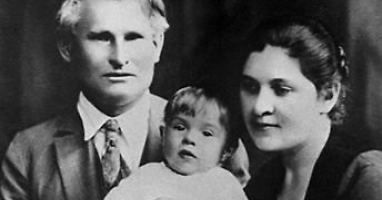
An exhibit of photographs of upstanding and courageous Lithuanian Righteous Gentiles who rescued Jews from the Nazis, performing the highest service to their nation, will open at the Lithuanian National Radio and Television Gallery at Konarskio street no. 49 in Vilnius at 3:00 P.M. on Thursday, January 19. The Yad Vashem Holocaust memorial authority and museum in Israel bestows the title Righteous among the Nations, or Righteous Gentile, on citizens of other countries who rescued Holocaust victims. This exhibition was shown earlier at the Lithuanian parliament. As readers will recall, the Lithuanian Jewish Community’s annual calendar features Lithuanian Righteous Gentiles this year as well, with a photograph of Lithuanian president Kazys Grinius and wife Kristina on the cover.
Writer Icchokas Meras, the winner of the Lithuanian National Prize for Art and Culture who was saved from the Holocaust by Lithuanians, wrote about the rescuers: “They were the blooms of the morality of the nation, the spiritual giants of the nation, no matter whether they were educated or simple people, whether they were illiterate, clergy who carried with them the true love of one’s neighbor or simple peasants broadcasting seed to the ground by hand. They, intentionally or unintentionally, opposed the destroying power of the Nazis and its tool: those who murdered. We should remember and honor their heroism based on conscience, goodness, love of one’s neighbor and simply human pity.”
Panevėžys Jewish Community to Mark International Holocaust Remembrance Day

January 27 marks the day in 1945 when the victims of the Auschwitz death camp were liberated. Auschwitz was the largest concentration camp set up by Nazi Germany where about 1.5 million people were murdered, including children, and approximately 1 million of the victims were Jews, according to the best estimates.
The Panevėžys Jewish Community will observe International Holocaust Remembrance Day on January 26 at the “Sad Jewish Mother” statue on Memory Square at Vasario 16 street next to the Vyturis Pre-Gymnasium.
Program:
2:00 P.M. Assembly, wreath-laying ceremony, speeches;
2:45 P.M. Wreath-laying ceremony at the statue “Ghetto Gate” (at the intersection of Klaipėdos and Krekenavos streets);
3:00 P.M. Forum dedicated to International Holocaust Remembrance Day at the Panevėžys Jewish Community (Ramygalos street no. 18). Documentary film about the Holocaust.
Let’s remember the heroic rescuers.
Event supporters:

Lithuanian Political Illusions: The “Policy” of the Lithuanian Provisional Government and the Beginning of the Holocaust in Lithuania in 1941
The Lithuanian Jewish Community is publishing a series of articles by the historian Algimantas Kasparavičius, a senior researcher at the Lithuanian History Institute.
Part 2
In the 20th century Lithuania without intermission lived through two bloody world wars and the psychological Cold War tensely lasting more than 40 years. The realities and outcomes of World War I corresponded with the political aspirations of the Lithuanians and set the groundwork for restoration of Lithuanian statehood. The confused ideology and daily horrors of World War II resulted in the loss of the Lithuanians’ nation-state, the de facto destruction of the first Republic of Lithuania. Hundreds of thousands of Red Army troops occupied Lithuania on June 15, 1940, And less than two months later, using the policy of total state terror and the services of local collaborators, the Stalinist Soviet Union annexed Lithuania along with her two northern neighbors.
Without going into all the factual trivia or fine details, or worse the political circumstances of alternate plans, looking at events in Lithuania generally and in the context of the entire political-ideological and geopolitical of Europe, we can say the Soviet occupation of the Republic of Lithuania and the forced, actual destruction of Lithuanian statehood in the summer of 1940 had two essential features.
Zygmunt Bauman is Dead
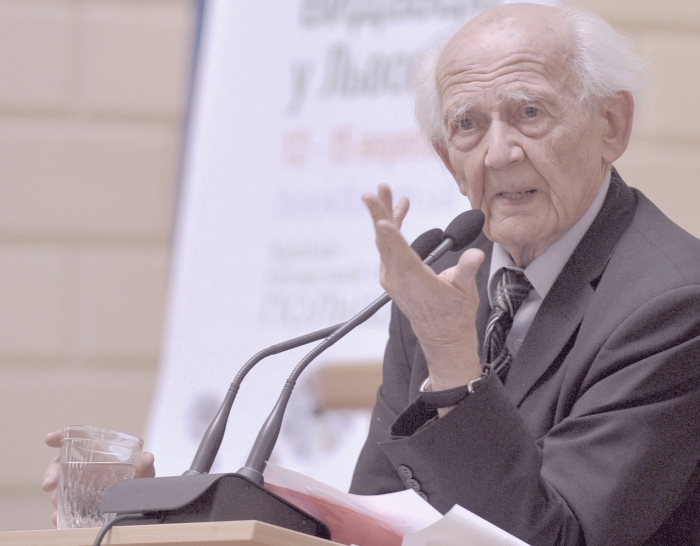
Polish philosopher Zygmunt Bauman passed away at the age of 91 surrounded by family at his home in Leeds Monday following illness. Bauman was born in 1925 in Poznan (Posen) and in 1939 fled Nazi-occupied Poland for Soviet-occupied Poland. In the Communist Polish military Bauman did political education, took part in the battles for Kolberg (Kołobrzeg) and Berlin and worked in Communist security and espionage institutions.
Bauman took up sociology at the Warsaw Social Sciences Academy after the war and then transferred to philosophy at Warsaw University. He published his first book in 1960. Born to a non-observant Jewish family, Bauman left Poland during the anti-Semitic wave of 1968 and moved to Israel, teaching at Tel Aviv University. He soon moved from there to Leeds where he taught at Leeds University. Since the move to Leeds he wrote in English.
Bauman authored about 50 books and more than 100 articles on the topics of globalization, modernity, post-modernism, consumerism, morality and the Holocaust. His views concerning the Holocaust were extremely nuanced and included at times denouncements of Western Holocaust commemoration as a culture of death and a new religion with its own list of martyrs, “the Names,” intended to act as a sort of surrogate Judaism for the non-observant and Gentiles, or as a completely new religion but offering nothing of value to the human soul. Bauman’s most famous book, Modernity and the Holocaust (1989), draws upon Hannah Arendt and Theodor Adorno’s books on totalitarianism and the Enlightenment. Bauman argues he Holocaust should not be considered exclusively an event in Jewish history nor a regression to pre-modern barbarism. Instead, the Holocaust is deeply connected to modernity and its attempts to impose order. Procedural rationality, the division of labor into smaller and ever more specialized tasks, ever more refined taxa for species and seeing obedience as morally good all played a role in making the Holocaust possible. He said for this reason modern societies have not fully grasped the lessons of the Holocaust. It is viewed, according to Bauman’s metaphor, like a picture hanging on a wall, static, without utterance or meaning.
The late Lithuanian philosopher Leonidas Donskis counted Zygmunt Bauman among his friends and greatly respected his work. In 2007 Vytautas Magnus University in Kaunas conferred an honorary doctoral degree upon Bauman.
Our condolences to his many friends and surviving family members.
Ponar Oratorio to Premiere at National Philharmonic
The premiere of Ponar Oratorio is to open at 6:00 P.M. on January 25, 2017, at the Lithuanian National Philharmonic in Vilnius. The new musical work was composed by Max Fedorov. The author of the libretto is Edward Trusewicz. Different parts of the oratorio are to be performed by Maciej Nerkowski, the Podlasie Opera and Philharmonic Choir and the Kaunas Symphony Orchestra. Martynas Staškus is to conduct.
“The motif of the oratorio is about the confession of a man who took the lives of many people at the Ponar forest. The executioner has kept silent for many years but has finally decided to show his blood-stained hands,” premiere producer Edward Trusewicz said.
The oratorio is to be performed in Polish with a running text translation in Lithuanian and English during the performance.
Reservations and tickets available here.
Defending a Murderer

by Grant Arthur Gochin
On December 16, 2016, I posted this about the efforts to remove the honors for the man responsible for the murder of my family in Lithuania – Noreika:
https://ggochin.wordpress.com/2016/12/16/noreika-monument/
The Cultural Heritage Department has responded; their response is attached to this post.
The Lithuanian Cultural Heritage Department will not do anything to remove the honors. They offer no explanations for how they come up with their decisions or why our facts were incorrect.
They say the plaque was installed in 1997 and belongs to the city, not the library. How do they know this when the city does not? Again they offer no backup.
Rimvydas Valatka: Domestic Television + Household Anti-Semitism = The Domestic Regime of the Baukutės and the Livers
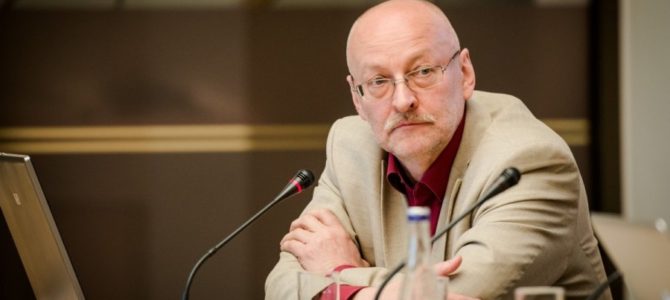
Can you imagine a television program where the MC is a former speaker of the House of Representatives and where a former democrat congresswoman screams “sieg heil?” No. The only one above the figures who have the mandate of the nation is Mr. God Himself. Despite that, your former elected speaker of parliament, the closes ally of then-prime minister Kubilius and the nighttime tax coup of the liberals, hosts a program where a former member of his Resurrection Party jumps up, gives the Hitler salute and screams: “Jew! Jew! Jew!” The former speaker of the very European parliament didn’t even bat an eyelash.
Full editorial in Lithuanian here.
Ona Šimaitė: Quiet Warrior for Life
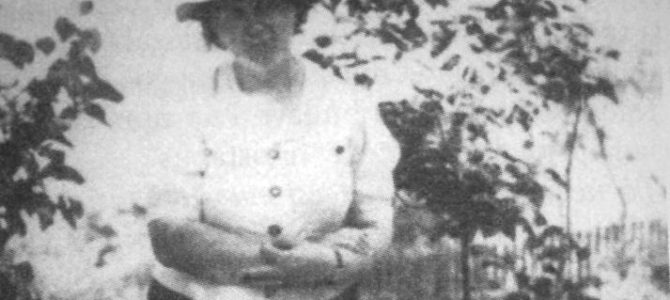
Ona Šimaitė in Israel. Courtesy Vilnius University Library
lzinios.lt
One hundred and twenty-three years have passed since the birth of Ona Šimaitė, who rescued dozens of Jews of Vilnius from death during World War II. Let’s recall the quiet heroism of this Righteous Gentile. Her name isn’t uttered often in Lithuania. Her commemoration consists of a plaque at Vilnius University and a small and narrow street named after her, winding from Kūdrų park at the edge of the Užupis district up, ending in steep steps leading to the Old Town. To the place which became the symbol of suffering and death to thousands of our fellow citizens 70 years ago who were fated to be born Jewish. To the Vilnius ghetto, where at the will of the Nazi occupier those condemned to die spent their final days. To the place whence the humble librarian Ona Šimaitė, without fear of death, rescued many who had lost hope.
Full story in Lithuanian here.
On the Position of Director General Siaurusevičius and Lithuanian National Radio and Television
lzb.lt
Lithuanian Jewish Community chairwoman Faina Kukliansky believes, as does the entire Lithuanian Jewish community, the position taken by Lithuanian Radio and Television director general Audrius Siaurusevičius and by the national broadcaster LRT in response to gestures depicting Hitler made by actress Asta Baukutė on the LRT television program “Atspėk dainą” is the right one and expresses the state’s position regarding its Jewish citizens. “I have to say Lithuanian National Radio and Television have demonstrated consistently and professionally their view on the centuries-long history of the Jews of Lithuania and have raised ‘uncomfortable’ Holocaust issues, something which even officials responsible for education haven’t done for many years. Also, LRT radio journalists are currently doing programs about painful historical events which to the present time influence life in the small towns after the destruction of the shtetls. I give them my gratitude for the work they’re doing and ask them to continue the radio series. No one should be afraid to say the word ‘Jew,’ but it’s important to understand and never forget what happened and how their Lithuanian fellow countrymen acted during the Holocaust, and why the Litvak community is so small today, and sensitive to all signs of anti-Semitism and Naziism,” chairwoman Kukliansky stated.