Holocaust

Yom haShoah, Holocaust Remembrance Day

Yom Hashoah: Holokausto atminimo diena
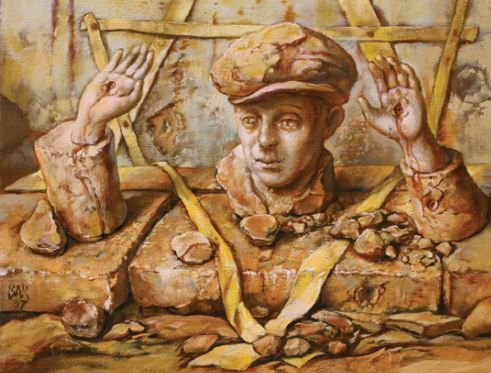
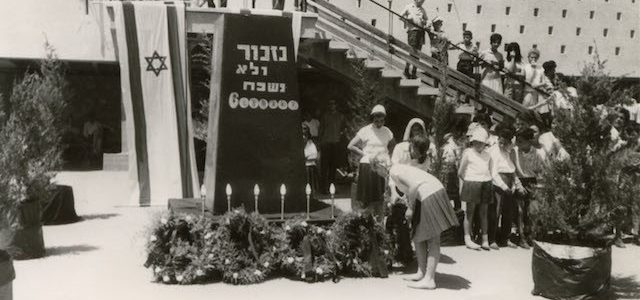
Photo: Yom haShoah ceremony at Kiryat Gat, Israel, 1963. Courtesy www.myjewishlearning.com

The full title of this day for the commemoration of Holocaust victims is Yom haShoah ve-laGevurah, or Day of the Holocaust and Heroism. It falls on the 27th day of Nissan on the Jewish calendar, a week after Passover and a week before Yom haZikaron, Israeli soldiers’ memorial day. If Nasan 27 falls on a day next to the Sabbath (it never falls on the Sabbath), then Yom haShoah is shifted a day away from the Sabbath.

In 2017 Yom haShoah is marked on April 24.

The Knesset, or Israeli parliament, chose this day to remember the Holocaust on April 12, 1951, but it is observed by individuals and Jewish communities world-wide.

In the 1950s Holocaust education focused on the suffering and murder of millions of Jews at the hands of the Nazis, but public opinion polls showed the younger generation of Israeli citizens found it hard to identify with the victims because they believed the Jews of Europe had behaved like “lambs led to the slaughter.” Israeli curricula began to shift to emphasize cases where Jews resisted the Nazis, differentiating “passive resistance,” the ability to preserve human dignity under the most insufferable conditions, and “active resistance,” armed struggle against the Nazis in the ghettos and partisan underground activities.

Siren

Beginning in the 1960s air-raid sirens across the state of Israel were sounded for two minutes to stop traffic for a moment of reflection on the victims. The sirens blast at sunset and again at 11 o’clock in the morning of the same day on the Jewish calendar (the day begins at sunset in the Jewish reckoning of time). All radio and television shows that day are connected in one way or another with the topic of the fate of the Jews in World War II, with many interviews of Holocaust survivors. Even music stations adapt their programming for the mood appropriate to Yom haShoah. Entertainment, drama theaters, movie theaters, bars and other public venues are closed across Israel on this day.

Nechama Lifšicaitė Has Died

The Lithuanian Jewish Community is sad to announce the death of Nechama Lifšicaitė (Nekhama Lifshits, נחמה ליפשיץ) and we send our condolences to her daughter Roza. The older Litvak generation remembers well Nechama’s enchanting voice and her lyrical-coloratura soprano song. As we express our condolences, we say: let the ground be soft for her, and recordings of her songs will remind us all of the wonderful songstress and her interesting personality for a very long time to come.

Nechama was born in Kaunas in 1927 and grew up in a traditional Jewish family. She attended a Jewish school where her father Yehuda Tzvi was principal from 1921 to 1928. He later became a doctor. During World War II Nechama and her family found shelter in the Soviet Union and lived in Uzbekistan. They returned to Kaunas after the war. From 1946 to 1951 she studied at and was graduated from the Vilnius Music Conservatory. She performed concerts of her songs in Yiddish beginning in 1956. According to Solomon Atamuk, “Both in Lithuania and throughout the [Soviet] Union, Lifšicaitė provided refreshing national and spiritual sustenance to the Jews thirsting for their culture. Nechama’s songs expressed the deepest experiences and aspirations of the Jews of the Soviet Union; they were moving and spiritualizing.”

Overcoming limitations on doing her repertoire was not a simple matter during the Soviet era, but Nechama Lifšicaitė was able to turn her concert tour across many Soviet cities into a wake-up call for cultural and ethnic identity. Despite the negative view taken by government agencies towards the ethno-cultural activities in which Nechama Lifšicaitė was engaged, she was recognized in 1958 for her exceptional artistic expression and vocal abilities with first prize in the Soviet music maestro competition, and was granted permission to tour abroad. She performed in Austria, Belgium and France. Her songs were released on two records in 1960 and 1961, which were reissued several times in later years.

Nechama Lifšicaitė and her family made aliyah to Israel in 1969 where two more records of her songs were released that same year. She performed in cities and villages, on the radio and on television. Her appearances were great successes. In the period from 1969 to 1972 she did concert tours of the United Kingdom, Canada, the USA, Mexico, Venezuela, Brasil and Australia. In 1976, without retiring from her musical career, she completed library science studies at Bar-Ilan University and became director of the historical archive of the Tel Aviv Municipal Music Library.

Unique Interior Design of Pakruojas Wooden Synagogue Restored

The administrators of the EEE and Norwegian Grants program and the Optus Optimum restoration group invite you take a look at the interior of the oldest wooden synagogue still standing in Lithuania in Pakruojas. The original paintings from the 19th century on the synagogue ceiling were restored according to surviving photographs and the original wallpaper was restored and recreated as well. Work on the interior is coming to a conclusion and the synagogue will be opened to the public again soon. EEE Grants and the Lithuanian state budget through the Lithuanian Ministry of Culture are carrying out the restoration program.

For more about the project see the Pakruojas Regional Administration webpage here.

More photographs of the restored interior are available here.

The Silenced Muses

Event: performance of the play Nutildytos Mūzos [The Silenced Muses]
Time: 5:30 P.M., April 21
Location: Juozas Miltinas Gymnasium, Aukštaičių street no. 1, Panevėžys, Lithuania

The Panevėžys Jewish Community invites you to a play by the Rokiškio teatras association called the Silenced Muses. The play was written based on real events recorded in the diary of the young Jewish girl Matilda Olkinaitė and the memories of her contemporaries.

Entrance is free upon presentation of an invitation (you may print this announcement and present it at the door).

Seven Lights

Event: Screening of the film Seven Lights
Time: 5:30 P.M., Thursday, April 20
Location: Tolerance Center, Naugarduko street no. 10/2, Vilnius

Seven Lights is a film about the stories of women who survived the Holocaust. Six Jewish women who were unbroken by the war, ghettoization, concentration camps and death marches. Women whose inner strength triumphed over the Nazi death machine. These are the heroines of Seven Lights, being screened for the first time in Lithuania. The Embassy of the Czech Republic and the Vilna Gaon State Jewish Museum invite you to come, watch the film and meet the director. This event is dedicated to Yom haShoah, Holocaust Day, coming up on April 24.

Meet the Actors from the Vakhtangov Theater in Moscow


Scene from the Vakhtangov Theater’s performance of “Nusišypsok mums, Viešpatie” [Smile upon Us, O Lord”]

Dear Community members and friends,

You have an exceptional opportunity to meet the actors from the Y. Vakhtangov Theater in Moscow at the Lithuanian Jewish Community in Vilnius at 11 A.M. on April 20, 2017.

These performers are the cast in Rimas Tuminas’s play Nusišypsok mums, Viešpatie” [Smile upon Us, O Lord”] based on the novels of Grigoriy Kannovitch.

For more about the play, see:
http://kultura.lrytas.lt/scena/j-vachtangovo-teatro-gastroles-lietuvoje-vytauto-sapranausko-atminimui.htm?utm_source=lrExtraLinks&utm_campaign=Copy&utm_medium=Copy

Tickets: http://www.bilietai.lt/lit/renginiai/teatras/jvachtangovo-teatras-nusisypsok-mumsviespatie-205800/

Never Give Up

There’s a song sung in Israel, and when the first bars ring out, most people stand. It’s called by several names–Zog Nit Keynmol, Don’t Say Never, We’re Still Here, the Partisan Hymn or Anthem–but the title isn’t important. The content is. And the content comes from the Vilna ghetto, a poem in Yiddish by the young Hirsh Glik, put to music by his friend Rachel Margolis, a young blonde, blue-eyed Jewish girl who joined the underground, survived, and spent much of the rest of her life engaged in Holocaust education.

Glik died during the Holocaust; Margolis passed away only a few years ago. According to Margolis, Glik read the poem to her on a cold winter day on a corner in the Vilnius ghetto where Rudninkų square is now located. She said there were buildings there then. As Glik read the poem, she began to hear music between the lines, from a Russian film she had seen. Both young people went to the FPO, the underground partisan organization in the ghetto, and asked permission to make the words and music the official anthem of the FPO youth section. The leadership agreed.

Now there’s a project for Jewish day schools around the world to teach the song to a new generation of young people. Eli Rabinowitz of Perth, Australia, is teaching children in Australia, Israel and South Africa and there are plans for new performances around Yom haShoah, Holocaust Day commemorated in Israel, this year on April 23.

The Jewish press in South Africa and Australia has done extensive coverage of the Partisan Hymn Project and the Vilnius ORT Sholem Aleichem Gymnasium in Vilnius is a pioneer in making the project happen. The World ORT organization is supporting the project and plans to post some video performances before Yom haShoah.

For more information, see here.

Benefits of Lithuanian Citizenship from the South African Litvak Perspective

by Claire van den Heever, the Lithuania Tribune

“South Africa is more Litvak than Lithuania itself,” Markas Zingeris, the Lithuanian playwright and novelist once remarked. And as one of very few members of Lithuania’s Jewish community to remain in the country he would know. The vast majority of Lithuanian Jews have found good reason to leave at one time or another in history, whether it was unrest in Europe between 1868 and 1914, or the economic hardship that characterized the period from Lithuania’s independence in 1918 until June 1940 when the Soviet army took control. It was during this time that thousands of Lithuanians came to South Africa in search of a more peaceful life. And it is here where many have remained.

“Today 80% of South Africa’s 70,000 Jews are of Lithuanian descent, making this country the third largest Lithuanian diaspora community in the world,” says Gary Eisenberg, an acclaimed immigration lawyer and Lithuanian citizenship specialist at Eisenberg & Associates.

In Lithuania, Jewish culture underwent decades of systematic destruction during both the Soviet and the Nazi regime. In South Africa it found space to breathe and fluoresce. Zingeris himself recognized this fact, remarking that “we see our culture and society have been preserved there.”

Full story here.

Holocaust Escape Tunnel

At ground zero for the final solution, scientists uncover a story of hope and bravery.
Airing April 19, 2017, at 9 P.M. on PBS

Program Description

For centuries, the Lithuanian city of Vilna was one of the most important Jewish centers in the world, earning the title “Jerusalem of the North” until World War II, when the Nazis murdered about 95% of its Jewish population and reduced its synagogues and cultural institutions to ruins. The Soviets finished the job, paving over the remnants of Vilna’s famous Great Synagogue so thoroughly that few today know it ever existed. Now, an international team of archaeologists is trying to rediscover this forgotten world, excavating the remains of its Great Synagogue and searching for proof of one of Vilna’s greatest secrets: a lost escape tunnel dug by Jewish prisoners inside a horrific Nazi execution site.

PBS program announcement here.

For more, see:
http://www.lzb.lt/en/2016/07/01/picking-up-the-pieces/
http://www.lzb.lt/en/2016/07/24/israeli-antiquities-authority-reports-major-finds-in-lithuania/
http://www.lzb.lt/en/2017/01/02/new-york-times-ponar-top-science-story-in-2016/

Aida’s Secrets

On the eve of Yom haShoah, the Israeli embassy to Lithuania invites you to the only screening of Aida’s Secrets on Sunday, April, 23, in the main salon at the Pasaka Theater at Šv. Ignoto street no. 4 in Vilnius. Entrance is free to the public, but the number of seats is limited, so in order to guarantee yourself a seat, please RSVP the embassy of Israel by April 20: e-mail press@vilnius.mfa.gov.il, phone (8 5) 2502510

About the film:

The two brothers Izak and Shepsel were born in a displaced persons camp after World War II. They lived their entire lives in the shadow of secrets kept from them by the people closest to them. The brothers were separated as babies, neither was told the other existed. An investigation into the mysterious history of their birth family led to an amazing reunion after six decades. The film offers a rare glimpse into the displaced persons camps in post-World War II Germany, showing the vibrant and sometime wild social life that flourished among the young survivors. This period has hardly been dealt with on screen until now.

AJC Delegation Tours Žiežmarai Wooden Synagogue


LJC chairwoman Fainia Kukliansky and Kaišiadorys mayor Tomkus, Žiežmarai, April, 2017

The ruined wooden synagogue in Žiežmarai, Lithuania, is being reborn for a new life. During the Holocaust it was used as a concentration point for imprisoning Jews awaiting execution. A large number of Jewish houses still stand near the synagogue, whose owners were murdered. The wooden synagogue is still an important heritage site, even if there is no one left to pray there. The Lithuanian Jewish Community contacted the mayor and council of Kaišiadorys about reconstructing the synagogue. Initially that request was denied, the council objected, and it took much effort to convince the local government the old synagogue really is a heritage site which besides holding interest to Jews around the world would also attract tourism and could be put to public use by the local population.

The Kaišiadorys city council approved the idea of adapting the building for public use in 2015 and applied for EU structural funds for renovation. A technical plan for renovating the Žiežmarai synagogue using funds from the Lithuanian state budget and the Goodwill Foundation was prepared and necessary studies conducted. After renovation the synagogue will serve as a monument to the murdered Jewish communities in Kaišiadorys and surrounding areas, and will be maintained to serve cultural functions for the local population.


An AJC delegation visiting Lithuania toured the synagogue site.

According to the Architecture and Urban Studies Center of Kaunas Technical University, the first synagogue in Žiežmariai might have appeared in 1690 following the granting of a charter of rights to the Jewish community there. This synagogue is mentioned in 1738. A 1782 description of the local church district and town says the synagogue was built under the grant of rights by Jan Casimir (noting it had to have been obtained before 1668) and that were two Jewish cemeteries. In 1868 Žiežmariai had a population of 1,190, of whom 604 were Jews, the majority. In 1897 there were 2,795 residents in Žiežmariai, of whom 1,628 were Jews. It is mentioned that all three synagogues in Žiežmariai suffered from the fire in 1918.

Europe Greatest Diplomatic Challenge for Israel

Israeli political veteran, deputy minister to Benjamin Netanyahu on diplomatic issues and former Israeli ambassador to the United States Michael Oren is considered by some to be one of the ten most influential—some even say one of the five most influential—Jews in the world. The Lithuanian magaine Veidas presented his views on the greatest challenges, threats and victories facing Israel.

by Rima Janužytė

You are rather critical of Europe. What are your greatest complaints against the continent, or more precisely, against its politicians?

Israel is undergoing a foreign-policy revolution. I view everything through the lens of history. Not just because I’m an historian, but also because I have seen so much with my own eyes. I was very young when the peace treaty with Egypt was signed. Back then we didn’t have diplomatic relations with Saudi Arabia and had almost no relations with Africa. No relations with China, India. We didn’t have a strategic relationship and weren’t friends with the USA. We had specific relations with the Soviet bloc, including Lithuania. Since then everything has changed completely. Now there are close relations with China, and our prime minister just visited China with the largest business delegation ever. India is now a close partner. With Russia it’s complicated, but I’ll come back to that.

Full story in Lithuanian here.

AJC Supports Idea of Jewish History Museum in Vilnius


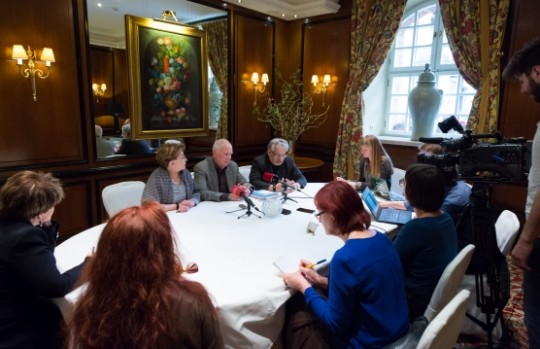
Vilnius March 31, BNS—The American Jewish Committee supports the idea of establishing a Jewish history museum in Vilnius, representative Sam Kliger says.

Speaking at a press conference Friday, the committee director of Russian affairs said his organization believes it is an important initiative which could become real with the Lithuanian Government’s help. He recalled his delegation’s visit to a museum in Warsaw a few days prior and called it impressive. A Jewish museum would be a good start or a good continuation of Lithuanian-Jewish relations, he told reporters. He also said Israeli ambassador to Lithuania Amir Maimon expressed support for the idea during a meeting Friday.

Chairwoman of the AJC board of directors Harrieta P. Schleifer said the museum should cover more than the Holocaust and include Lithuania’s rich Litvak legacy. It should include history from the beginning through the present to the future, not just the Holocaust, she said.

Vilnius Seniors Visit Panevėžys

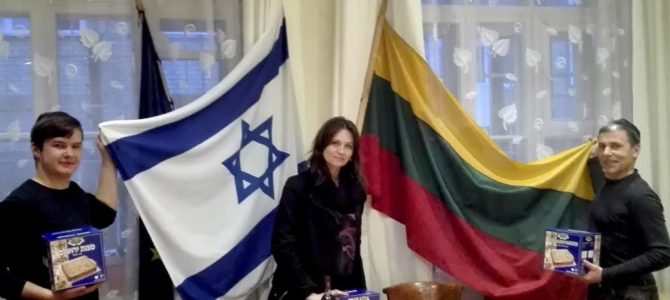
A group of members of the Vilnius Jewish Community’s Seniors Club, directed by Žana Skudovičienė, visited the Panevėžys Jewish Community. Panevėžys Jewish Community chairman Gennady Kofman spoke about the history and life of the Panevėžys Jewish Community in a pleasant setting, sipping tea around a table with fresh bagels brought from the Bagel Shop Café in Vilnius. Several of the Vilnius members’ parents had lived and worked in Panevėžys and were greatly interested in the Panevėžys Jewish Community’s Museum of History. Mutual interest led some of the seniors to tell about the life and fate of their parents in greater detail.

Guests visited the site of the Panevėžys Jewish cemetery and heard about its tragic destruction in 1966, and how headstones were used as decoration for the wall of the Juozas Miltinis Theater.

Žana Skudovičienė in the name of all club members expresses their gratitude for the warm reception.

Most Brutal Lithuanian Holocaust Mass Murder Operation Remembered

To never forget, to always remember and to seek to make sure it never happens again–these are our duties. We often repeat these words in commemoration Holocaust victims. We repeated them again in the afternoon on Friday, March 24, in Kaunas when we remembered the victims of the most horrific mass murder operation in the Kauinas ghetto, the Children’s Aktion.

Horrific also because, as Israeli ambassador to Lithuania Amir Maimon said at the commemoration, it is incomprehensible how a human being can turn into a murderer of innocent children, of babies who don’t even understand what is going on in the world around them. Horrific and painful because it impossible to imagine what the parents felt when they returned home to the ghetto after forced labor and found their only joy, their children, were missing. Administrative director of the Kaunas municipality Nijolė Putrienė cried speaking about the unrealized dreams of the murdered children, about the murder of their futures and about Lithuanian citizens who could have made a difference. Survivor of the Children’s Operation Ela Glinskienė spoke of her memories. Kaunas Jewish Community chairman Gercas Žakas led the event and long-time Kaunas Jewish Community friend, the daughter of a rescuer of Jews, actress Kristina Kazakevičiūtė and flautist Artūras Makštutis provided music and poetry.

Vilnius Synagogue Map Launched

“When we speak of Jewish cultural heritage, we don’t mean a foreign people who lived apart from everything and one day decided to move. We’re talking about what was in Lithuania, about the Lithuanian nation’s heritage, not just of the Jews,” Israeli ambassador to Lithuania Amir Maimon said Friday at the launch of map of the synagogues of Vilnius held at the ambassadorial residence. One of the goals of the map project was to show just how interconnected Jewish and Lithuanian history is.

Of 135 Synagogues, Only One Remains

The map contains a total of 135 sites of synagogues which operated before the Holocaust. Most of the synagogues were located in the Vilnius Old Town, around the Jewish area of the city centering on the Great Synagogue and spreading along Vokiečių, Gaono and Stiklių streets. There were more than 30 synagogues located in that compact area, but none of them remain. The synagogues were razed and other buildings built in their place, or the sites were used as public spaces.

Full story in Lithuanian here.

Vilna Gaon Museum on New Jewish Museum Proposal

The Vilna Gaon State Jewish Museum has issued a statement via press release about a recent proposal by Lithuanian officials to set up a Holocaust-free new Jewish museum in the Palace of Sports or next to it on land which contains the centuries-old historic Jewish graveyard of Vilnius.

Let’s Create a Strategic Strategy for Jewish Heritage, Not Disneyland

The Vilna Gaon State Jewish Museum was disappointed by information appearing in the press last week about plans by government institutions to establish another Jewish museum in the Lithuanian capital instead of assuring support for existing projects.

The Vilna Gaon State Jewish Museum, whose sections are housed in authentic buildings closely connected with the Jewish history of Vilnius, has recently been undergoing an intense and productive period. We host international events at the highest level, for example, the International Holocaust Remembrance Alliance conference held on March 22 and 23, and the number of visitors is constantly growing. New permanent exhibitions are being created for installation in our historic buildings, including the opening this fall of a new Samuel Bak Museum, showcasing the Litvak painter’s life and works, and in the near future we also intend to open the Museum of Lithuanian Jewish Culture, aka the Litvak Center and a dedicated Lithuanian Holocaust and Vilnius ghetto memorial museum, which has attracted the attention of international museum organizations including ICOM.

The latter museum is to be housed in the historical building on Žemaitijos street (former Strashun street) which was listed as a cultural treasure last month. This is the building which housed the Mefitsei Haskalah library before World War II and the Vilnius ghetto library during the war. which organized cultural events inside the ghetto and served as a secret meeting place for members of the ghetto resistance organization. In 1945 Holocaust survivors established the short-lived Jewish Museum in the building, quickly shut down by the Soviet government. The Vilna Gaon State Jewish Museum intends to reutilize the building for Holocaust education. After the museum has these additional sections, a unique route will be created for the visitor to explore Jewish Vilna.

Recovering Memory: Vilnius University Memory Diploma Graduation Ceremony

Event at 3:00 P.M. on April 3, 2017

Vilnius University will host a Memory Diploma Graduation Ceremony in the small auditorium at Universiteto street no. 3, Vilnius. The ceremony is intended to honor students, staff and members of the university community who were marginalized, thrown out, not allowed to finish their education or academic work and otherwise repressed because of the actions of the totalitarian regimes or local collaborators.

The university was compelled to rethink its relation with the past after receiving a letter from Israeli professor of medicine Moshe Lapidoth in the summer of 2016, requesting a symbolic commemoration of his uncle Khlaune Meishtovski who was a student at the Mathematics and Natural Sciences Faculty of Vilnius University before the war. After eight successful semesters studying chemistry and physics, he was expelled July 1, 1941 because he was a Jew.

In 2016 the university formed a commission to do a historical study and decide selection criteria for people who were unfairly deprived of an education there. A symbolic Memory Diploma was established to remember these people. It is hoped the graduation ceremony will become a university tradition.

After preliminary study, the university determined about 650 Jews and 80 Poles were forced out as well as a professor whose wife was Jewish during the beginning of the Nazi occupation. Several hundred Lithuanians were also deprived of university study and employment.

There will be a live-stream on facebook:

https://www.facebook.com/events/898366480305748/