Announcements

Israeli Dance Seminar with Ilai Szpiezak

Ilai Szpiezak of London will give a seminar about dance for the first time in Lithuania. Registration is required.

The event is for both accomplished dancers and beginners who have just started or danced in childhood and now want to renew their skills.

To register, send an email to karina.semionova@gmail.com and please indicate the participant’s name, email and telephone number.

Registration is open till February 20.

Ilai Szpiezak, half-Israeli half-Argentinian, started his career as a dancer and choreographer of Israeli dance in 2006, rapidly moving into choreography and the direction of performing troupes and artistic organizations in Argentina at the age of 16. He danced in the international Israeli Dance Company Agshama performing in different countries around South America while training as a professional ballet dancer and was graduated from the Ulpan of Rikudei Am with honors in 2017. He moved to London in 2011 to take on the role of dance development manager in the Israeli dance community. Since then he has been responsible for directing, organizing and managing annual classes, workshops and concerts in London and around the UK including Machol Europa and many other events in Europe. He is looking forward to seeing you all soon!

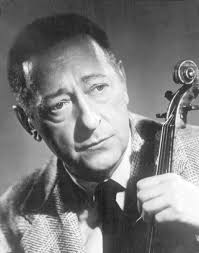
Fifth International Jascha Heifetz Violin Competition in Vilnius

The fifth annual Jasche Heifetz violin contest will take place in Vilnius February 13-19, 2017. The Jascha Heifetz contest is one of the most significant musical competitions held in Vilnius celebrating the enduring legacy of the great Litvak violin virtuoso.

Although the 20th century produced so many excellent violinists, Heifetz stands out as the star of the highest magnitude within that constellation.

He was born in Vilnius in 1901 to a Jewish family. Vilnius was home to many nationalities, and Heifetz preserved the memory of his multicultural hometown and the life and musical traditions of his home. He began the climb to greatness in 1907 in Kaunas as a six-year-old prodigy. In 1912 he received European recognition for his talent in Berlin, and in America, beginning in 1917, he achieved world acclaim. Heifetz’s mastery has become the template for all modern violinists. The scholar Yuri Grigoryev believes the essential feature which set Heifetz apart from all others was actually the inspiration he took from the architecture of Old Vilnius, manifesting in architectonic grandiosity, classical sensibility and variety of expression.

Once George Bernard Shaw, won over by Heifetz’s performance, warned the artist in a letter the next day: “If you provoke a jealous God by playing with such superhuman perfection, you will die young. I earnestly advise you to play something badly every night before going to bed, instead of saying your prayers. No mortal should presume to play so faultlessly.” But God was kind to the artist. His art became part of the eternal repertoire of Grand Music and Vilna has the honor to be remembered as his birthplace.

Profesorius Jurgis Dvarionas

Full story in Lithuanian here.

Lecture Series

Basia Nikiforova gives the lecture “Zygmunt Bauman: Life and Legacy” at 12 noon, Sunday, February 12 in the conference hall of the Lithuanian Jewish Community, Pylimo street no. 4, Vilnius.

Memorial to Lithuanian Jewish Holocaust Victims to Be Unveiled in Karl Jäger’s Home Town

church

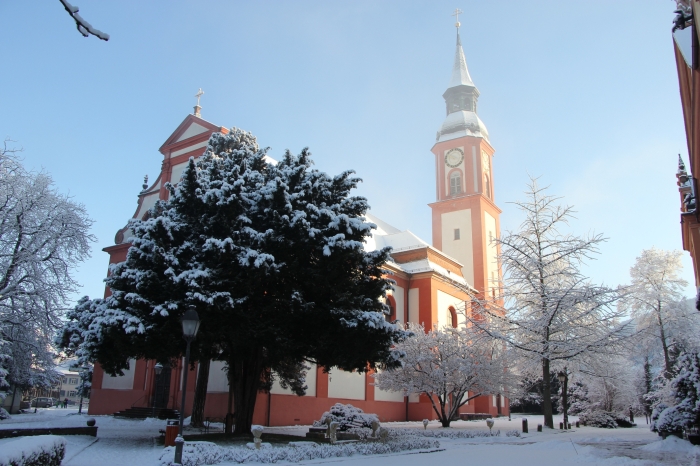
January 27 has been marked as an official day to commemorate Nazi victims since 1996. On this occasion the film “Karl Jäger und Wir – die langen Schatten des Holocaust in Litauen” [Karl Jäger and Us: The Long Shadow of the Holocaust in Lithuania], a multi-generational project, is to be screened in Waldkirch, Germany. A monument commemorating the Jews murdered in Lithuanian and Holocaust victims from 1941 and 1942 is also to be unveiled there on January 29.

The City of Waldkirch, the “Waldkirch in the Nazi Period” workshop and the Catholic pastoral care unit in Waldkirch are to unveil the new memorial on January 29. The public is invited to attend the unveiling.

The “Waldkirch in the Nazi Period” workshop initiated the idea for the memorial in October of 2011 and it was approved by city council in 2015. It will be located by the Church of St. Margarethen and the Elztal Museum. The opening begins at 6:00 P.M. at the museum and will feature Mike Schweizer accompanied on saxophone.

The second part of the event is scheduled to take place in the church and will feature Katharina Müther, who is renowned for Yiddish, Sephardic, Sinti and Roma songs from Eastern Europe. German MP Gernot Erler, who served as state minister in the foreign ministry from 2005 to 2009, will deliver a speech, as will historian Dr. Wolfram Wette and pastor Heinz Vogel, with possible discussion and reflection afterwards.

The film “Karl Jäger und Wir – die langen Schatten des Holocaust in Litauen” is to be screened at the church at 8:00 P.M. The film is the fruit of a multigenerational project by Black Dog eV.

Representatives of the Lithuanian Jewish Community plan to attend the commemoration which has caused some surprise in Lithuania. It’s important to note Karl Jäger lived in Waldkirch as a young man, although he was born in Schaffhausen, Switzerland. Jäger, an SS colonel, was the main force behind the Holocaust in Lithuania. His report, known in Holocaust studies as the Jäger Report, is a detailed account of Nazi mass murder operations against Jews in Lithuania, listing mass murders by date and location and breaking down the number of victims in the categories of males, females and sometimes children.

Jegeris

After the war Jäger evaded capture by the Allies using a false identity. He worked as a farm hand until his report was discovered in March of 1959. Jäger committed suicide in Hohenasperg prison near Stuttgart in the German state of Baden-Württemberg awaiting trial in June of 1959. The Soviet Union only released the Jäger Report to West Germany investigators in 1963 during the trial of Hans Globke in East Germany.

The Jäger Report is one of the primary documents witnessing to the scope of the Holocaust in Lithuania. The Jäger Report details the murder of 47,326 men, 55,556 woem and 34,464 children in Lithuania, for a total of 137,346 Lithuanian Jews murdered in the first months of the Nazi occupation of Lithuania in the summer and fall of 1941.

Full story in German here.

WJC on Holocaust Remembrance Day: Thousands of We Remember Photos at Auschwitz-Birkenau

WJClogo


Press Release 

January 24, 2017

Ahead of International Holocaust Remembrance Day on January 27:

Thousands of We Remember photos to be projected at Auschwitz-Birkenau as World Jewish Congress campaign reaches millions world-wide

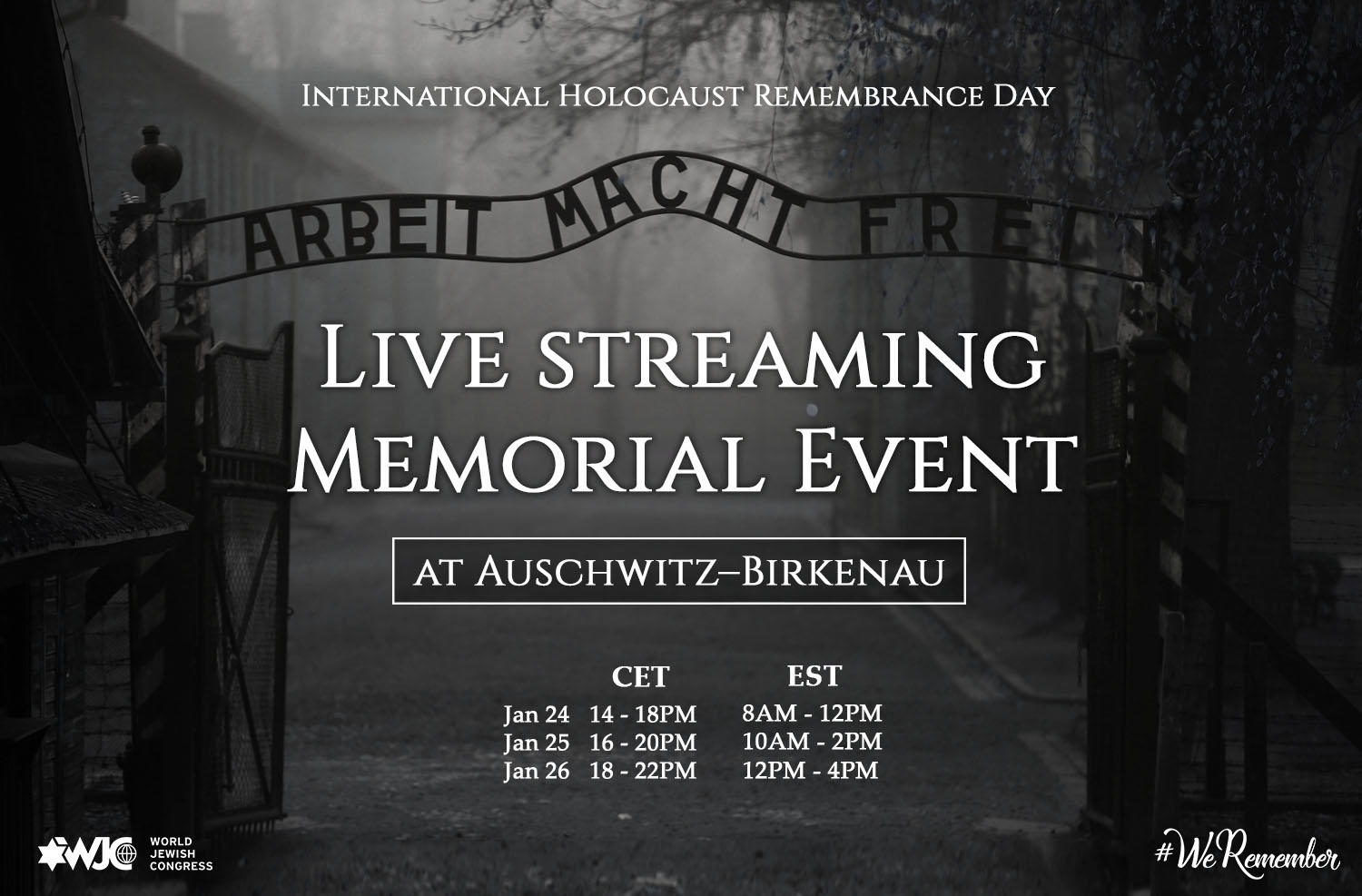
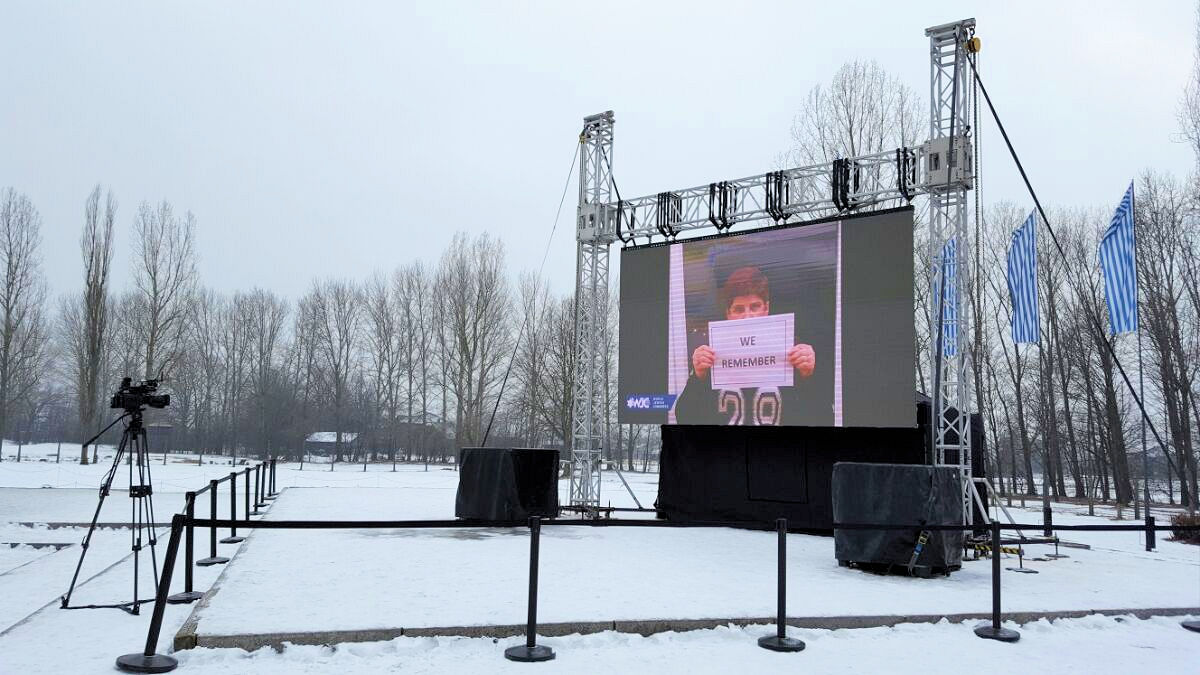
AUSCHWITZ-BIRKENAU – Thousands of photos of people holding “We remember” and “I remember” signs in honor of the victims of the Holocaust are on display on a giant screen at the former Nazi German death camp Auschwitz-Birkenau from January 24 to 26, 2017, ahead of International Holocaust Remembrance Day this Friday. The display next to the International Monument at Birkenau is part of a global social media campaign conceived and run by the World Jewish Congress whose aim is to raise awareness of the Holocaust.

More than 100,000 people from every continent have already taken part in the WJC’s campaign which calls on participants to post their photos to facebook, twitter and other social media sites along with the hashtag #WeRemember.

“The goal is to reach those who don’t know much about the Holocaust, or who might be susceptible to those who deny it, and to remind the world that such horrors could happen again. Using the tools of social media we hope to engage the next generation, because, soon, it will be their responsibility to tell the story and ensure that humanity never forget.

“Auschwitz-Birkenau was the Nazis’ biggest killing site and is the best-known symbol for the Shoah world-wide.

“We thank the Auschwitz-Birkenau Memorial and Museum for allowing the screening on the grounds of the former death camp, and for supporting our campaign,” said World Jewish Congress CEO Robert Singer.

A live stream of the screening is to be made available at the following link: https://www.facebook.com/WorldJewishCong/videos/vb.130945114804/10154953773549805/?type=2&theater&notif_t=live_video_explicit&notif_id=1485262793563023

e4a74295-c07e-4e29-8e21-c0945f611f7d

71b0f566-8831-40ce-8994-3d32a06f7b5d
Photo of the installation

Justice Magazine

ea60f96b-9d8f-488d-ada8-7e310c35d01d

Dear friends,

We are pleased to share with you this issue of our Justice Magazine (Number 58).

The timing of this issue is significant, since on January 27th we commemorate International Holocaust Remembrance Day. The articles from our Paris Conference are therefore particularly relevant .

You are also welcome to view some of the presentations from the Paris
Conference on our web: www.intjewishlawyers.org .

IAJLJ Staff

Reminder: International Holocaust Remembrance Day Events Begin Today

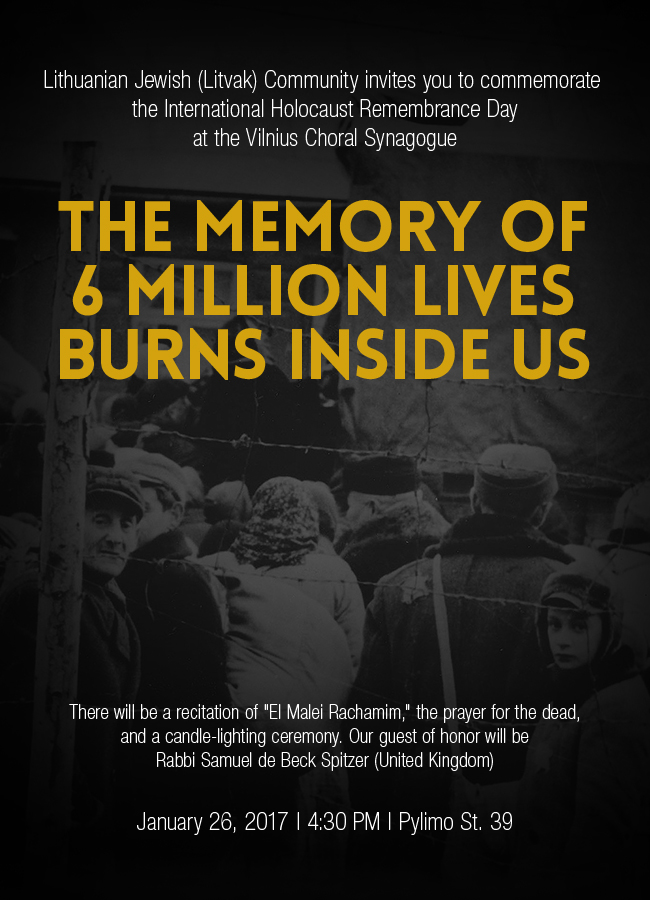
You’re invited today at 4:30 P.M. to attend a ceremony at the Choral Synagogue in Vilnius where candles will be lit in memory of the victims of the Holocaust and the El malei Rakhamim prayer will be sung. Afterwards all are invited to the Lithuanian Jewish Community at Pylimo street no. 4 in Vilnius to a discussion of Jewish history with professor Antony Polonsky, moderated by professor Šarūnas Liekis, at 6:00 P.M.

Scratch an Historical Lithuanian Town, You Might Get a Shtetl

The Lithuanian Cultural Heritage Department announced they are already planning for this year’s European Day of Jewish Culture and have selected a theme, “The Diaspora and Heritage: The Shtetl.” They characterized the choice as an intentional, mature and topical one for a country where the formerly large Jewish ethnic and religious minority thrived until the 1940s in shtetls.

They explained the word “shtetl” means small town in Yiddish. “When the Jerusalem Temple was destroyed in 70 C.E., Jews spread throughout the world, starting a new stage in the existence of the people, life in the Diaspora. Jews who settled in the Grand Duchy of Lithuania from the latter half of the 14th century and their descendants are called Litvaks. They are a branch of the Ashkenazi, Jews fleeing persecution in the German lands in the Middle Ages,” the department noted in a press release.

They continue: “It’s possible the origins of the shtetls reach back to the 18th century, but one shouldn’t get the mistaken impression that every historical Lithuanian Grand Duchy or Lithuanian town may be called a shtetl. Not so! Only a town where Litvaks comprised up to half, and often more, of the population and where the spirit of Litvak enterprise and intellectual ferment was felt can be called a shtetl without reservations.”

Vilna Gaon Museum Offers Free Tours, 2 Films and Discussion for Holocaust Day

du draugai

To mark International Holocaust Remembrance Day, the Vilna Gaon State Jewish Museum in Vilnius is screening two biographical films and opening a new exhibit about a remarkable friendship between a Pole and Hungarian which ended up saving thousands of lives. The events are open to the public at the museum’s Tolerance Center located at Naugarduko street no. 10/2, Vilnius.

On January 26 the museum debuts its exhibition called Sławik and Antall: The Great Rescuers. Heroes of Three Nations: Poles, Hungarians and Jews and screens the film Life on the Edge. Henryk Sławik, József Antall’s Senior (2014) with the film’s director Grzegorz Łubczyk participating. The film is being shown in cooperation with the embassies of Poland and Hungary and the Polish Institute in Vilnius.

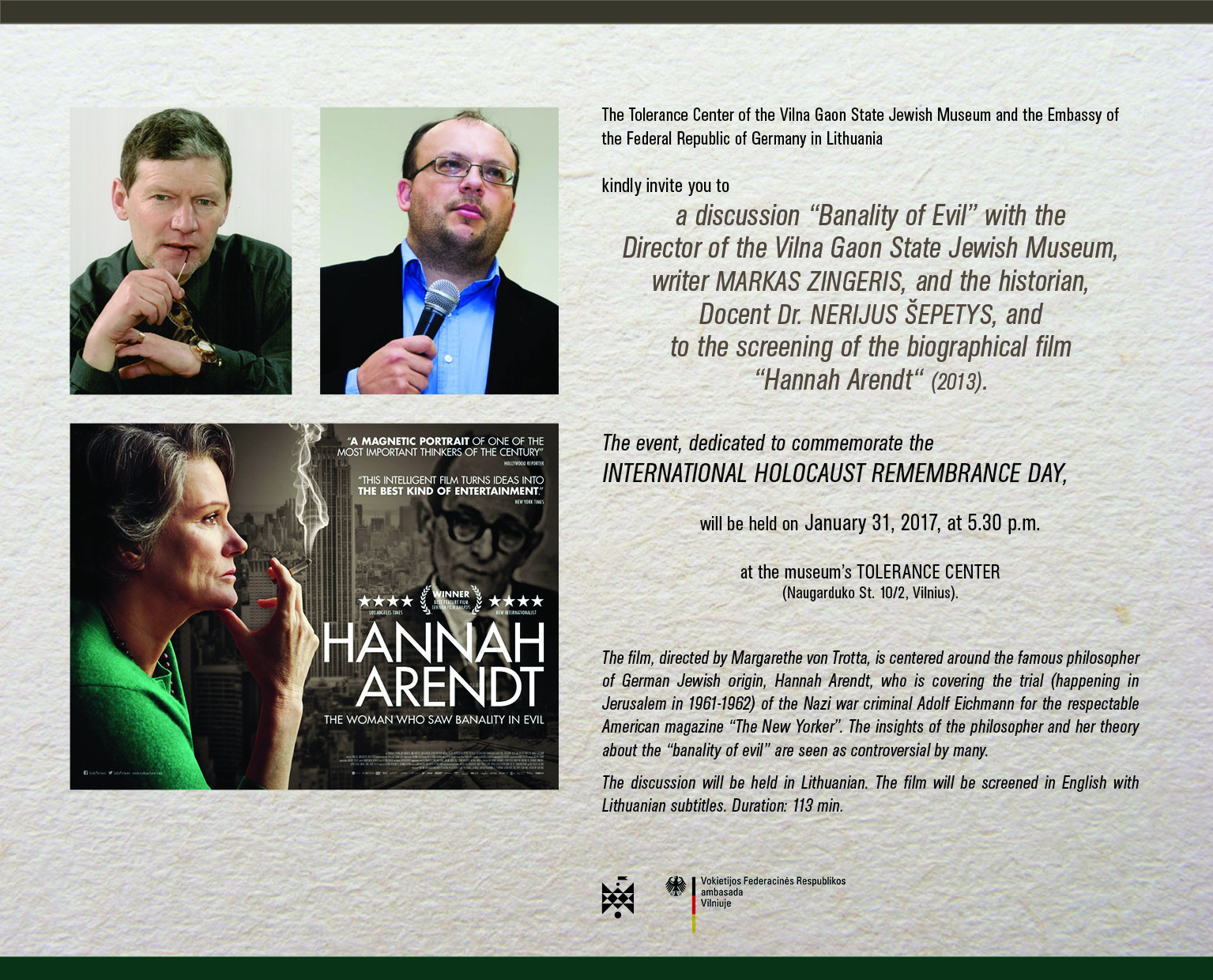
The museum will offer a different take on the Holocaust on January 31, with the discussion at the Tolerance Center at 5:30 P.M. called “The Banality of Evil” with museum director and writer Markas Zingeris and historian Nerijus Šepetys. The discussion is to be followed by a screening of the biographical film Hannah Arendt, to be shown in cooperation with the German embassy to Lithuania. The film is about Arendt who wrote about the Eichmann trial in Jerusalem for the New Yorker magazine and in her own book. Arendt’s ideas about what she called the banality of the evil at work among up-and-coming young Nazi professionals has been met with both criticism and acclaim since she wrote her groundbreaking work.

On January 27, the 72nd anniversary of the liberation of Auschwitz-Birkenau, the Holocaust Exhibit of the Vilna Gaon Jewish State Museum at Pamėnkalnio street no. 12, Vilnius, will offer to the public free guided tours in English or Lithuanian.

Kvietimas_EN

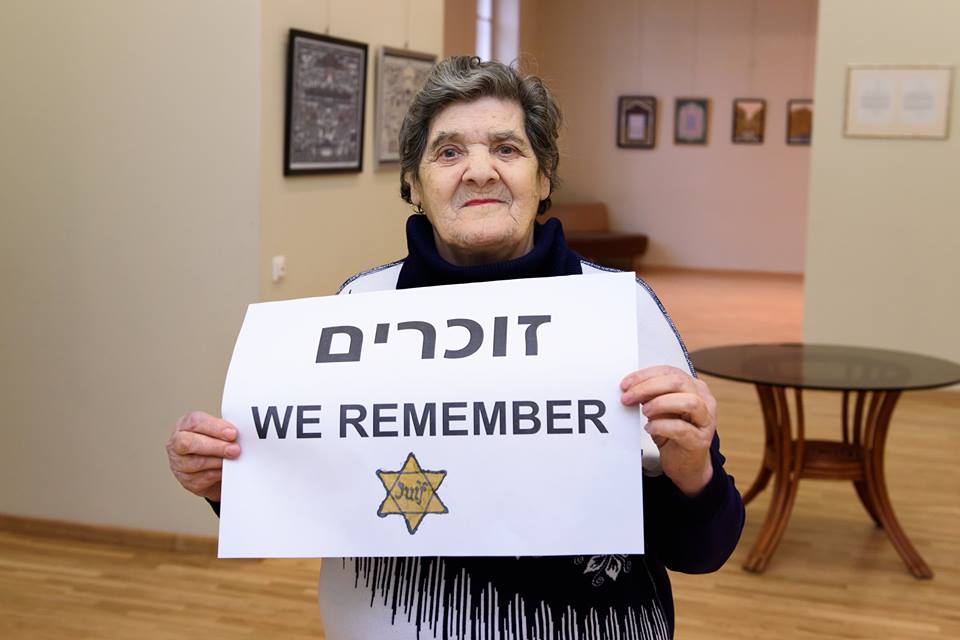
We Remember

weremember_website_banner3

Bendruomene We remember

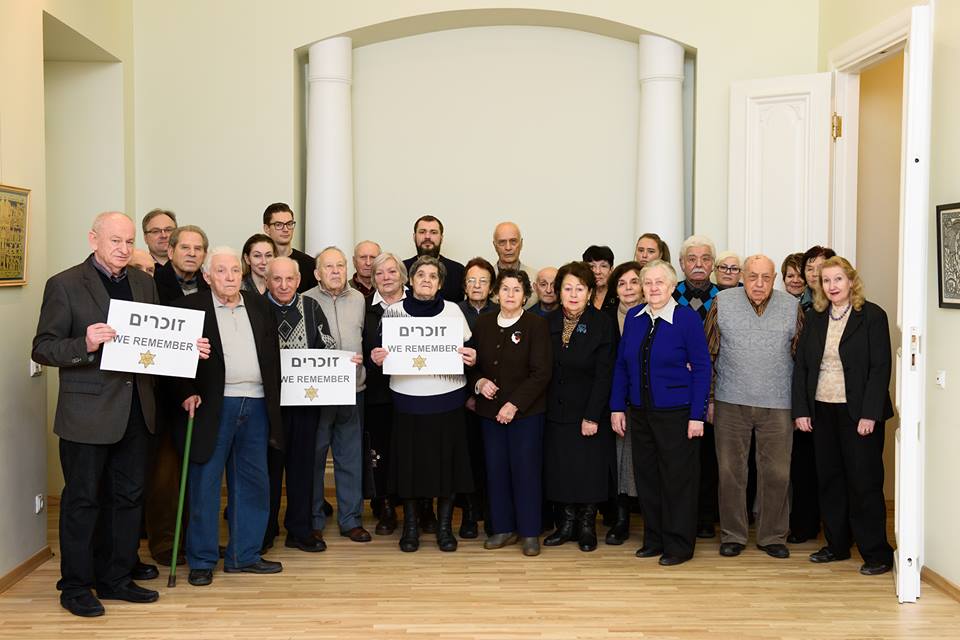
Jewish Community members including a number of Holocaust survivors

16113910_1393314054034017_8722848022136507426_n (1)

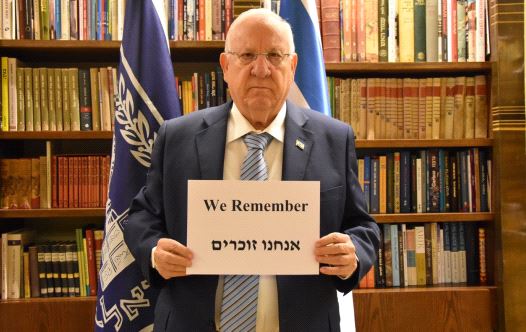
As International Holocaust Remembrance Day on January 27 draws near, the World Jewish Congress is inviting everyone to join the global campaign We Remember. Please try to make sure your Community and its leaders visit schools, churches, synagogues, youth organizations and other institutions to deliver the message. Ask your friends, students and teachers who consent to be photographed to hold homemade We Remember signs as their portraits are taken and sent directly to facebook, twitter and/or instagram, and send a link to weremember@wjc.org

Why now?

In 2017 we have to remember the Holocaust.

Because so many more of the survivors are leaving us…

Because Holocaust denial is not getting weaker,

Because genocide is still happening…

And because it is so important to educate the coming generations.

Together, we want to remind the world about all that happened.

R.Rivlin We rememberReuven Rivlin, president of Israel

Radio Documentary: Lost Traces of Vilkaviškis

„Radijo dokumentika”: dingusio Vilkaviškio pėdsakais
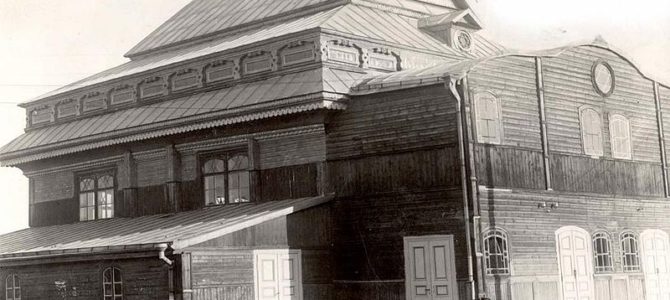
Vilkaviškis synagogue

lrtradijas

The Lithuanian National Radio program Radijo Dokumentika aired the episode on at 11:05 A.M. on January 22. It is to be rebroadcast at 9:00 A.M. on January 24 just after the morning news program Ryto Garsai.

Feiga Koganskienė, who lived in the town in the Suvalkija region right up till World War II, says: “Vilkaviškis is only the name Vilkaviškis, it has nothing in common with the former Vilkaviškis.” When she returned to her home town after the war, the woman did not recognize it, and found none of her Jewish family or friends.

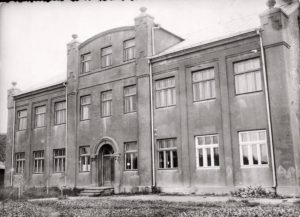
Vilkavišio ž buvusi gimnazija

The modern Vilkaviškis Jewish Gymnasium between
the wars, now the city municipal building.

Before the war Vilkaviškis was one of the most ethnically and culturally diverse towns in the region, but now it’s perhaps the most Lithuanian town in the entire country. Today only a handful of people remember Vilkaviškis in the interwar period, and even fewer are prepared to look into the town’s Jewish history. In the Lost Traces of Vilkaviškis episode, Radijo Dokumentika reporters walk with residents for whom the Vilkaviškis of that time is not just a collection of faded facts from history.

Holocaust Remembrance Day with Dr. Antony Polonsky

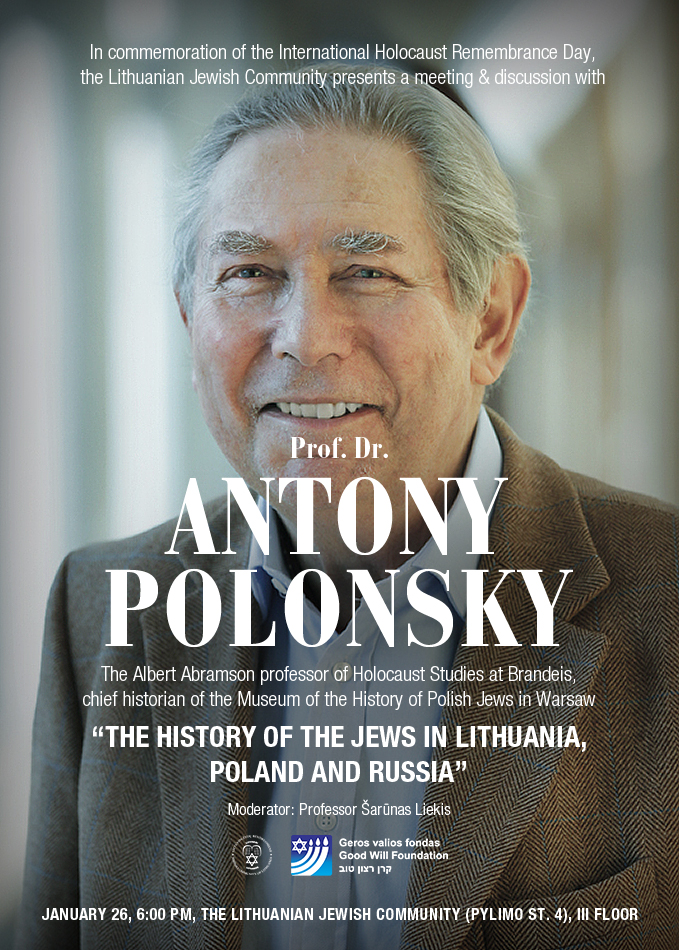
You’re invited to a public meeting and discussion with Dr. Antony Polonsky (the Albert Abramson professor of Holocaust Studies at Brandeis and the chief historian of the Museum of the History of Polish Jews in Warsaw) called The History of the Jews in Lithuania, Poland and Russia at 6:00 P.M. on Thursday, January 26, in the Jascha Heifetz Hall on the third floor of the Lithuanian Jewish Community (Pylimo street no. 4, Vilnius).

Moderator: professor Šarūnas Liekis.

Polonsky-2017-Web-EN-001

Statement in the December 2016 Newsletter of the Committee for the Preservation of Jewish Cemeteries in Europe

We feel it is important in this context to emphasize the major transformation that we have recently experienced in our work after so many years of campaigning and taking action to protect Jewish graves in Europe. This fundamental change is reflected in our experiences in Lithuania over the past month (as described at length in this issue). It is impossible to describe within the limits of this publication the range of difficulties, obstructions, obstinacy and deception which was faced by our representatives in earlier years when attempting to protect Jewish graves in Lithuania. Not only was there no sympathy and understanding for our efforts to save Jewish cemeteries and graves, but our representations were often faced with ridicule. Even after being convinced of our genuine concern for these matters, our appeals were not taken seriously and all kinds of ploys and untruths were used to avoid taking meaningful action. But fortunately, times have changed. Not only does the current Lithuanian Government central leadership treat the CPJCE and its requests with seriousness and respect, but even the government departments dealing with economy, transport, interior affairs etc, all show deep consideration for Jewish cemetery protection. During the past month, the CPJCE office received an appeal for assistance from the Lithuanian authorities regarding a proposed widening of a railway track, which may possibly have encroached on the area of a Jewish mass-grave. They assured the CPJCE that they did not want to disturb the burial site and requested the CPJCE to come and establish the exact location of the grave in order to ensure that it is not affected in any way.

Lithuanian National Radio and Television Hosts Exhibit on Righteous Gentiles

LRT atidaroma paroda, skirta Pasaulio Teisuoliams

An exhibit of photographs of upstanding and courageous Lithuanian Righteous Gentiles who rescued Jews from the Nazis, performing the highest service to their nation, will open at the Lithuanian National Radio and Television Gallery at Konarskio street no. 49 in Vilnius at 3:00 P.M. on Thursday, January 19. The Yad Vashem Holocaust memorial authority and museum in Israel bestows the title Righteous among the Nations, or Righteous Gentile, on citizens of other countries who rescued Holocaust victims. This exhibition was shown earlier at the Lithuanian parliament. As readers will recall, the Lithuanian Jewish Community’s annual calendar features Lithuanian Righteous Gentiles this year as well, with a photograph of Lithuanian president Kazys Grinius and wife Kristina on the cover.

Writer Icchokas Meras, the winner of the Lithuanian National Prize for Art and Culture who was saved from the Holocaust by Lithuanians, wrote about the rescuers: “They were the blooms of the morality of the nation, the spiritual giants of the nation, no matter whether they were educated or simple people, whether they were illiterate, clergy who carried with them the true love of one’s neighbor or simple peasants broadcasting seed to the ground by hand. They, intentionally or unintentionally, opposed the destroying power of the Nazis and its tool: those who murdered. We should remember and honor their heroism based on conscience, goodness, love of one’s neighbor and simply human pity.”

Panevėžys Jewish Community to Mark International Holocaust Remembrance Day

Dovydo žvaigždė

January 27 marks the day in 1945 when the victims of the Auschwitz death camp were liberated. Auschwitz was the largest concentration camp set up by Nazi Germany where about 1.5 million people were murdered, including children, and approximately 1 million of the victims were Jews, according to the best estimates.

The Panevėžys Jewish Community will observe International Holocaust Remembrance Day on January 26 at the “Sad Jewish Mother” statue on Memory Square at Vasario 16 street next to the Vyturis Pre-Gymnasium.

Program:

2:00 P.M. Assembly, wreath-laying ceremony, speeches;

2:45 P.M. Wreath-laying ceremony at the statue “Ghetto Gate” (at the intersection of Klaipėdos and Krekenavos streets);

3:00 P.M. Forum dedicated to International Holocaust Remembrance Day at the Panevėžys Jewish Community (Ramygalos street no. 18). Documentary film about the Holocaust.

Let’s remember the heroic rescuers.

Event supporters:

LZB _LOGO2GVF_logo-01

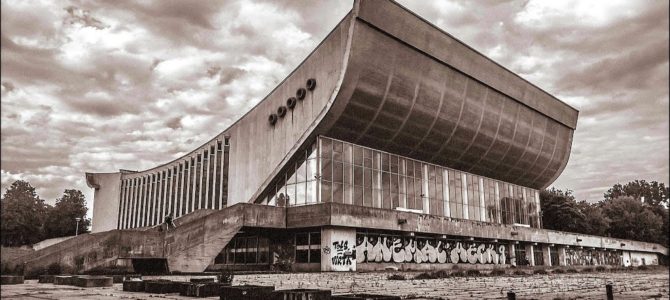
Lithuanian Jewish Community Position on Reconstruction of the Vilnius Palace of Concerts and Sports and Its Use as a Conference Center

In light of the recent intensification of statements in the media on the alleged danger now threatening the conservation of the Šnipiškės Jewish graveyard in Vilnius (hereinafter Cemetery), the Lithuanian Jewish (Litvak) Community (hereinafter LJC) feel it our duty yet again to present the main facts in the case and the LJC’s well-founded position based on those facts regarding the issue of the reconstruction of the Vilnius Palace of Concerts and Sports (hereinafter Sports Palace) and its adaptation as a conference center.

1. To date no work for the reconstruction of the Sports Palace has been carried out, and therefore no possibly negative impact on the graveyard which was destroyed in the 1950s is being effected at the current time. The remains of the Vilna Gaon were removed to the Vilnius Jewish cemetery located on Sudervės street long ago and his headstone is located there.

False statements and rumors have been circulating for some time, so again it is necessary to explain the headstones in the Cemetery were destroyed long ago and the Sports Palace was constructed there back in the Soviet era. At the current time only pre-planning proposals have been drawn up, which could serve later as the basis for a detailed technical project for the renovation and adaptation of the Sports Palace which will be carefully examined and assessed by competent institutions.

2. The Cemetery is entered on the Registry of Cultural Treasures and has been declared a state-protected site, meaning any construction or reconstruction work in the area of the graves or in the buffer zone around it, and any plans for this sort of work, are carefully assessed and strictly controlled under the provisions of the law of the Republic of Lithuania on protection of real estate heritage and the specific requirements of a special protection plan for this Cemetery.

3. This special protection plan for the Cemetery was prepared under the requirements and principles contained in a protocol agreement signed on August 26, 2009, by the leaders of the LJC, the Committee for the Preservation of Jewish Cemeteries in Europe and the Cultural Heritage Department under the Lithuanian Ministry of Culture. All these institutions share responsibility for keeping the agreement and ensuring sufficient authority for doing so.

4. The protocol agreement of August 26, 2009, resolves that:

4.1. Earth-moving work is forbidden in the Cemetery;

4.2. Three additional possible buffer-function zones are defined; the Sports Palace falls into zone A where earth-moving work is proscribed except in cases involving engineering construction (utility pipeline, transportation and communication infrastructure) and/or work to maintain the Vilnius Sports Palace. Jobs involving the movement of earth require consent by the LJC and must be accomplished in the smallest scope possible. All work involving the movement of ground must be done under the supervision of an archaeologist and an authorized LJC delegate. To insure adherence to this requirement, the LJC makes all decisions regarding the conservation of the Cemetery and plans for the reconstruction of Sports Palace only with the knowledge and consent of the Committee for the Preservation of Jewish Cemeteries in Europe.

5. The Vilnius Sports Palace was constructed in 1973. The building and the Cemetery upon which it was built have been listed on the Registry and are protected as a cultural treasure since 2006.

6. According to the original construction documents presented to the LJC, the foundation of the Sports Palace extends 7.37 meters underground, so most likely all burials there were destroyed during building construction. Therefore pre-planning proposals for reconstruction of the Sports Palace are based on the assumption burials do not remain under the building. Despite the low likelihood there are still graves under the building, in the event of actual reconstruction of the Sports Palace the LJC will demand earth-moving work be of minimal scope and conducted under the supervision of representatives of the Committee for the Preservation of Jewish Cemeteries in Europe.

Therefore, bearing in mind that:

1) existing burials were destroyed during construction of the Vilnius Sports Palace;

2) currently not a single headstone remains at the Cemetery (the last monuments were torn down back in 1955), the Cemetery territory is in disrepair, and there are no signs in the huge territory of the Cemetery testifying to its history except for a symbolic statue and an information plaque set up a few years ago;

3) the Sports Palace building along with the Cemetery surrounding it are listed on the Registry of Cultural Treasures and it cannot be torn down, but in its current state cannot either be used and requires renovation;

4) the abandoned Vilnius Sports Palace is in a state of ruin and is unbefitting the city center and the Cemetery, and stands as a horrid symbol recalling the Soviet era when the headstones of the Cemetery were destroyed and the human remains there disturbed;

The Government of the Republic of Lithuania have the right to do as they please with the property in their possession, and certainly the right to merely consider the reconstruction of the Vilnius Sports Palace, adapting it for one or another use, and the LJC has no legal foundation or rational arguments for quelling these activities. Instead of engaging in unconstructive criticism, the LJC is undertaking all measures to insure these plans and their possible realization do not violate Jewish law and tradition, and believes the Government of Lithuania, as a responsible institution with a vested interest in maintaining its reputation, will also exhaust all efforts so that the project is carried out to the highest standards of transparency, quality and respect for heritage. If the project is carried out appropriately, the LJC would achieve our goal of preserving the Cemetery:

1) establishing in city planning and physically demarcating the limits of the Cemetery;

2) renovating the territory of the Cemetery and setting up walking paths there in line with Jewish law and tradition;

3) erecting a commemorative composition including the names of the people buried in the Cemetery;

4) installing necessary educational and information material on site.

Ping-Pong Training

The Lithuanian Jewish Community
and the Naujų Žvaidždžių Club
invite you to play ping-pong

Everyone is invited to attend the ping-pong practice sessions,
to improve their skills and to compete.

This is for people of all ages and all or no skill level,
with professional tables and equipment (no need to bring anything),
freestyle games among friends and family for fun

The practice sessions will be held

in the ping-pong room at at the S. Daukantas Pre-Gymnasium, Naugarduko street no. 7, Vilnius
from 5:00 P.M. to 8:00 P.M. on weekdays and from 12 noon to 2:00 P.M. on Saturday

Cost:

for adults: 3 euros for 2 hours
for students: first session free (with discounts for those who wish to continue)

Everyone is welcome to attend the first introductory practice session free of charge.

For more information, call +370 613 75124 or email stalotenisoklubas@gmail.com

Hen Alon, director
Naujų Žvaidždžių Club
Lithuanian youth team coach

Sholem Aleichem Reunion

Šolomo Aleichemo g-ja kviečia abiturientus į susitikimą

The Vilnius Sholem Aleichem ORT Gymnasium invites former students to its annual reunion to be held at 6:30 P.M. on February 3.

See you there!