

by Grant Arthur Gochin
In 2000 the Lithuanian parliament or Seimas voted to make the 1941 declaration a legal act of the state, then reversed itself within a week. In 2026 the demand to finish the job is back.
On June 19, 2026, the Lithuanian parliament hosted a conference which reconstructed June of 1941 without the Jews murdered during it. I documented that event in They Rewrote History before Our Eyes. The conference was the visible, scholarly face of a longer project. Its legislative face is older, quieter, and now on the move again.
On September 12, 2000, the Seimas adopted a law recognizing the Provisional Government’s June 23, 1941 declaration, Restoration of Independence, as a legal act of the Republic of Lithuania. The vote was 48 in favor, none against and three abstentions, and the official record lists it among laws adopted rather than draft legislation (Seimas record, September 12, 2000).
The declaration that law would canonize carries a list of signatory ministers. One of them is the minister of communal economy, the architect Vytautas Landsbergis-Žemkalnis–father of Vytautas Landsbergis, who chaired the Seimas in 2000.
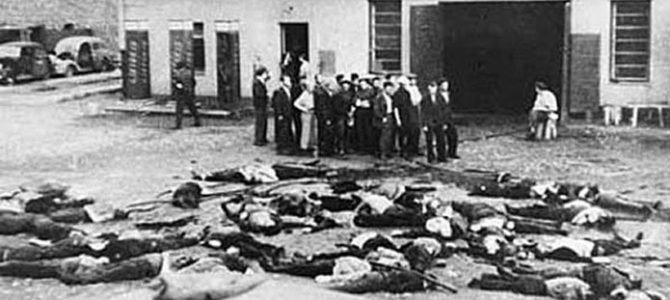
That government didn’t stand apart from the killing. On June 27, 1941, Lithuanian men beat Jews to death at the Lietūkis garage auto-repair cooperative in Kaunas while a crowd looked on. The cabinet heard the report from minister Žemkalnis and resolved not to halt the murders but to avoid public executions (Where Lithuania Starts the Clock). On June 30 the same cabinet ordered a “Jewish concentration camp” in Kaunas–the Seventh Fort, where roughly 5,000 Jewish men were murdered within days (Lithuanian Jewish Community).
On August 1 it adopted Regulations on the Status of Jews and nationalized Jewish property. The Lithuanian Activist Fron who had formed the government demanded Lithuania be emptied of its Jews before a single German crossed the Nemunas (The Doctrine Lithuania Never Revoked). These facts come from the protocols published by Lithuania’s own genocide research center, officially called the Center for the Study of the Genocide and Resistance of Lithuanians.
The 2000 law was never promulgated. It was never sent to the president for signing. The day after the vote, the speaker–Vytautas Landsbergis–said publicly the document should have been better prepared, and that he hoped the president would propose amendments. About a week later the Seimas adopted a protocol resolution declaring that, given contradictions in the law’s consideration and editing, its adoption procedure remained unfinished, and the legislation remained in a post-deliberation stage (the protocol resolution). A proposed law which had been carried 48 to nothing became, by procedure, a law that had never quite passed.
The 2000 Seimas which adopted the recognition law and then left it unfinished was chaired by Vytautas Landsbergis, whose father had signed the 1941 declaration as a minister of the cabinet which had ordered the establishment of the concentration camp in Kaunas.
The question did not die. In 2025 Lithuanian MP Vytautas Sinica announced a fresh draft of the legislation to recognize the declaration as a legal act, presenting it as a response to Russian information warfare (LRT). On June 22, 2026, a rally by the Nation’s Forum in Vilnius promoted by Vytautas Radžvilas demanded the state acknowledge the 2000 law as adopted, complete the procedure and promulgate it in the State Gazetteer. The demand was addressed to the president, every member of parliament, the parliament’s historical memory commission and the genocide research center (Nation’s Forum).
The conference and the campaign are a single undertaking. Both ask Lithuania to grant the Provisional Government’s founding act the standing of state law. Both leave that same government’s Jewish victims–robbed, confined. tortured and murdered in the same weeks–outside the frame. In 2000 the state tried to canonize the declaration and lost its nerve. In 2026 it is being asked to complete that odious task. That conference was documented in full in They Rewrote History before Our Eyes. This is its legislative twin.
Full text here.