

by Grant Gochin, June 24, 2026
Lithuania condemns Russian falsification of history. On June 19, its own parliament provided the screen for another falsification.
Holocaust revisionism was not whispered in a corridor of the Lithuanian parliament. It was projected onto the wall of the Hall of the Act of 11 March.
On June 19, 2026, the Seimas hosted an international conference marking the eighty-fifth anniversary of the 1941 Lithuanian uprising. The official announcement promised a discussion based on “sources and historical analysis,” rather than later stereotypes. The program listed the speaker of the Seimas, senior politicians, members of parliament and historians. This was not a private gathering in a rented hotel room. It carried the location, publicity and institutional prestige of the Lithuanian legislature. (Seimas conference program)
One presentation was delivered by Roman Kuzmyn of Lviv Polytechnic National University. Its subject was the supposed similarities and differences between the 1941 uprisings in Lithuania and Western Ukraine.
The presentation constructed a simple moral sequence:
Soviet occupation.
Soviet terror.
National uprising.
Declaration of independence.
German betrayal.
The Jews were removed from the sequence. The Holocaust was removed. The antisemitism of the Lithuanian Activist Front and the Organization of Ukrainian Nationalists was removed. The pogroms in Kaunas (Kovno, Kovna, Kovne) and Lviv (Lvov, Lwow, Lemburg) were removed. The participation of nationalist activists and local militias in anti-Jewish persecution was removed. The result was not incomplete history. It was a rehabilitation narrative.
There Was No Uprising
The conference sold an uprising. The word is the first falsehood on the program.
An uprising is a revolt against a power that holds the ground. In June 1941 the Soviet authorities in Lithuania were not driven out by local fighters. They fled Operation Barbarossa, the largest invasion in the history of warfare, launched as a war of conquest and racial extermination. The Red Army retreated before the Wehrmacht. It did not retreat before the white-armband men of Kaunas. (USHMM: Invasion of the Soviet Union, June 1941)
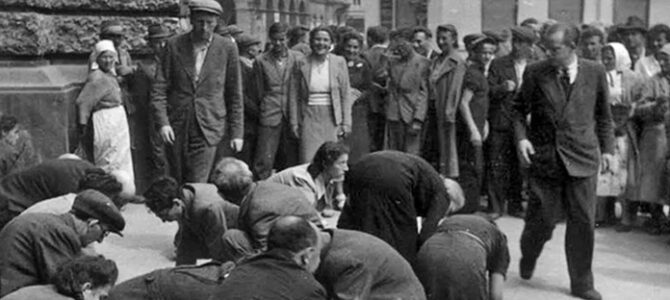
What those men did in the same hours is documented. Before German authority was set up in the city, Lithuanian perpetrators robbed, beat and murdered Jews. The Holocaust in Kaunas began in the gap between the Soviet retreat and the German arrival. (USHMM: Kovno)
This is the same manoeuvre Lithuania runs with its calendar, fixing the start of its Holocaust at the German arrival so the earlier Lithuanian killing falls outside the frame. I have traced that move before. (Where Lithuania Starts the Clock)
That is not a revolt against an occupier. It is the murder of unarmed neighbors who held no power and menaced no one.
The declarations confirm it by their silence. They restored a state. They asked the public to guard property and the police to keep order. Not one of them promised protection to all citizens whatever their origin. While those words were read aloud, Jewish citizens were being murdered by the movement reading them.
Strip the costume and the event is plain. A German army cleared the Red Army. A Lithuanian effort to murder Jews began before the first German order was given. There was no June Uprising in any honest sense. There was an invasion, and there was a slaughter that Lithuanians started on their own. To call that an uprising is the founding move of the whole distortion, and the Seimas built a conference on it.
Lvov “Liberated”
One slide was titled:
“The liberation of Lviv and the Act of Restoration of the Independence of the Ukrainian State, June 30, 1941.”
Another stated that Ukrainian and German units “ceremonially entered” the city.
Germany did not liberate Lvov on June 30, 1941. Germany occupied it.
Anti-Jewish violence began that same day. The United States Holocaust Memorial Museum records that German forces and OUN-B activists incited the violence, blaming Jews collectively for the Soviet prison massacres through the antisemitic fiction of “Judaeo-Bolshevism.” Ukrainian militiamen, nationalist activists, German forces and local civilians participated in the resulting pogrom. Jews were humiliated, robbed, beaten, raped and murdered. The number killed ranged from several hundred to several thousand. (USHMM: The Lwów Pogrom of July 1, 1941)
The presentation showed the Soviet dead. They deserved to be shown. It did not show the Jewish dead who followed them. That omission transformed Nazi occupation into national liberation and converted the first hours of a pogrom into a ceremonial entrance parade.
Pogrom Perpetrators Become Guardians of Public Order
A later slide discussed militia formations disarmed by the Germans. It described them as units that had been:
“taking care of peace and order in the country.”
That phrase is not neutral.
The Ukrainian militia in Lviv was involved in seizing Jews, forcing them toward the prisons, abusing them and facilitating the pogrom. The Holocaust Museum specifically identifies Ukrainian militiamen among the perpetrators. (USHMM: The Lwów Pogrom of July 1, 1941)
Calling such groups guardians of order is the language of the perpetrators. Jews being dragged from their homes become disorder. Their assailants become policemen.
The presentation did not merely leave out the crimes; it supplied a moral alibi for the organizations operating around them.
Hitler Edited Out of Ukrainian Declaration
The slides displayed the June 30 Ukrainian declaration, Yaroslav Stetsko, the Ukrainian State Administration, supportive clergy and cheering crowds.
They omitted one of the declaration’s most incriminating provisions.
The proclaimed Ukrainian state announced that it would work closely with National Socialist Germany under Adolf Hitler, which it praised for establishing a “new order” in Europe and the world. (Lviv Interactive: OUN and the June 30 Act)
That clause did not fit the presentation’s architecture. The audience was meant to see an independent state betrayed by Germany, not a nationalist leadership initially seeking its place within Hitler’s European order.
The later German arrest of Bandera and Stetsko was included. Their earlier political alignment was not.
German repression of nationalist leaders is historically relevant. It does not retroactively erase their ideology, their expectations of German sponsorship or the conduct of their followers when German troops arrived.
A collaborator can later become inconvenient to the occupier. An ally can be discarded. A political movement can seek an independent state while collaborating tactically with a genocidal power. None of those propositions contradicts the others.
The slides pretended otherwise.
OUN Antisemitism Vanishes
The presentation discussed the OUN’s factions, leaders, organization, weapons, underground networks and preparations for revolt. It displayed Andriy Melnyk, Stepan Bandera, Roman Shukhevych, Mykola Stsiborskyi, Ivan Klymiv and Mykola Lebed.
It omitted the movement’s antisemitism.
The Holocaust Museum records that Judaeo-Bolshevism was an important element of both Nazi and OUN-B propaganda and that OUN-B activists helped incite the Lvov violence by collectively blaming Jews for Soviet crimes. (USHMM: The Lwów Pogrom of July 1, 1941)
The presentation gave the Seimas audience the OUN without the Jews. It gave them nationalism without racial hatred. It gave them resistance without complicity. It gave them German imprisonment as proof of innocence. This was not historical context. It was selective exoneration.
LAF Receives Same Cleansing Treatment
The Lithuanian section displayed the seal of the Lithuanian Activist Front and portraits of Kazys Škirpa, Juozas Ambrazevičius, Leonas Prapuolenis, Adolfas Damušis and Juozas Vėbra.
Once again, the Jews vanished.
The United States Holocaust Memorial Museum states that many of the Lithuanians who attacked Jews in Kaunas before the German takeover belonged to the LAF. Its activists called themselves partisans and freedom fighters. They also, in the Museum’s words, “sought to rid Lithuania of Jews.” (USHMM: Kovno)
That fact was not peripheral to June 1941. It belonged at the centre of any serious discussion of the LAF.
The presentation instead used the LAF seal as an emblem of patriotic resistance. It showed their declaration of independence, their leadership and the later German destruction of Lithuanian political autonomy.
It did not show what the same political environment meant for Lithuania’s Jews.
Kaunas Relieved of Jewish Dead
The Holocaust began in Kaunas during the uprising itself. Between the Soviet retreat and the German arrival, Lithuanian perpetrators humiliated, robbed, beat, arrested and murdered Jews. On June 25 and 26, more than 800 Jewish men, women and children were murdered in the Slobodka pogrom. On June 27 Jews were publicly tortured and beaten to death at the Lietūkis Garage. Within a week thousands had been arrested. Approximately 5,000 Jewish men were murdered at the Seventh Fort between June 30 and July 7. The fort was under joint German-Lithuanian control and was administered during the period of the Lithuanian Provisional Government. (USHMM: Kovno)
None of this appeared in the photographed presentation.
No Slobodka. No Lietūkis. No Seventh Fort. No Jewish arrests. No ghettoization. No Lithuanian perpetrators. No relationship between the newly constituted Lithuanian authorities and the institutions that participated in persecution.
Lithuania’s own international historical commission concluded the antisemitic attitudes of the LAF and the Provisional Government were well documented. The government approved measures isolating Jews and confiscating Jewish property, and did not publicly distance itself from the mass murder of Lithuanian citizens. (Discussion of the International Commission’s findings)
The presentation displayed the Provisional Government as a victim of Nazi suppression. It omitted the government’s Jewish victims.
Murderers Wore White Armbands
The men who carried out the first killings were not faceless. They marked themselves. In Kaunas and in dozens of other towns, the attackers, who seized Jews marched them to prisons and beat them to death, wore white armbands. The armband identified self-described partisans. It identified the killer. (Virtual Shtetl: Anti-Jewish pogroms, summer 1941)
These were the para-military formations the presentation dressed in honor. The seal of the Lithuanian Activist Front appeared on the wall as a badge of patriotism. The armband worn beside that seal did not appear at all.
A movement cannot keep the emblem of its statehood and discard the mark its members wore while murdering civilians. The slides kept the seal and erased the armband. The audience was shown the insignia of independence and never shown the insignia of the pogrom.
Policy Conceived before Germans Arrived
The presentation framed the LAF as a patriotic resistance movement which drifted into anti-Jewish violence in the confusion of war. The documents say the reverse. The intent was set down in writing before the invasion began.
The Lithuanian Activist Front announced in advance that the restored state of Lithuania would carry out an immediate and fundamental purge of Jews from the country. LAF founder Kazys Škirpa, Lithuania’s envoy in Berlin and the man named to head the provisional government, called for the removal of every Jew from Lithuania so that none remain as early as December of 1940. The old hospitality once extended to Jews was declared revoked for all time. I have set out this doctrine and its sources before. (Doctrine Lithuania Never Revoked)
The United States Holocaust Memorial Museum records the same intent in plainer language. LAF members called themselves partisans and freedom fighters, and set out to clear Lithuania of Jews. (USHMM: Kovno)
Lithuania’s own institutions try to diminish this into an incident. The state Genocide Centre concedes only “manifestations of antisemitism” and presents expulsion as something gentler than murder. Historian Saulius Sužiedėlis rejects that. He says this ethnic cleansing, a crime against humanity, was one of the central aims of the LAF program, not a random feature included in it. (LRT: Škirpa, Hero or Collaborator?)
A presentation which shows the LAF seal and hides the LAF program is not just telling a partial story. It is concealing the motive. The murder of Lithuania’s Jews was not an accident of the uprising. It was a stated objective of this organization which the Lithuanian Seimas sought to celebrate.
Lithuania Got Basic Fact Wrong
One slide identified Leonas Prapuolenis as the commander of insurgents in Vilnius and originated his infamous radio proclamation there.
Prapuolenis delivered the declaration on Kaunas Radio. Even an official Lithuanian Ministry of National Defence historical publication states he announced the restoration of the independent state over Kaunas radio on June 23. (Lithuanian Ministry of National Defence, Karo archyvas 34)
This is not an obscure dispute over interpretation. Kaunas was the main location of the so-called uprising and the Provisional Government.
A conference advertised as source-based historical analysis presented a basic geographical falsehood about one of its most celebrated figures.
Deportation Numbers Unsupported, Conflate Categories
Another slide claimed deportations from the western regions of Soviet Ukraine during May and June of 1941 affected more than 300,000 people.
The slide supplied no source.
A Ukrainian historical project gives 12,371 deportees from western Ukraine in the June of 1941 wave and 85,716 across all territories affected by that operation. (Territory of Terror: Mass deportations from Western Ukraine)
Figures available for the June 1941 operation are radically lower. The total exceeding 300,000 may have been produced by combining different deportation waves, broader periods and different regions and categories of Soviet repression, but the presentation did not disclose its method for arriving at this sum.
Nazis Portrayed Mainly as Enemies of Independence
The presentation began by identifying Nazi Germany and the Soviet Union as two totalitarian states. It then devoted slide after slide to Soviet annexation, arrests, deportations and prison massacres. Nazi Germany appeared principally in three roles:
the force whose invasion created an opportunity for national uprising;
the army alongside which nationalists entered Lvov;
the occupier who later rejected Lithuanian and Ukrainian independence.
The Nazi war of annihilation disappeared. In fact, Operation Barbarossa was not merely a conventional military campaign against Stalin. It was conceived as a war of conquest, colonization and racial destruction and became a decisive turning point in the Holocaust. (USHMM: Invasion of the Soviet Union, June 1941)
In the slides, German evil was reduced largely to Berlin’s refusal to permit Lithuanian or Ukrainian sovereignty.
The Jews, whose extermination was one of the main objectives and main result of the invasion, were nowhere to be seen.
Later Persecution Used as Proof of Innocence
The presentation repeatedly emphasized that the Germans dissolved the Lithuanian and Ukrainian nationalist administrations and arrested some of their leaders. That is true. The conclusion being smuggled through behind this statement of fact it is false.
German hostility toward an independent Lithuania or Ukraine does not absolve the LAF or OUN of antisemitism, cooperation, incitement and participation by their members and associated groups in persecution.
Nationalist movements across the western Soviet borderlands initially collaborated with Germany in the hope of gaining statehood. German policy instead aimed at colonial domination. The relationship deteriorated when nationalist expectations collided with Nazi imperial plans. (Cambridge University Press: Borderlands under German occupation)
The sequence was not: innocent patriots opposed both dictatorships equally. It was: nationalist movements attempted to exploit Nazi invasion; some collaborated; Jews were attacked; Germany rejected genuine independence; and some nationalist leaders were later imprisoned.
Removing the middle of that story is practicing propaganda.
Independence the Reich Never Intended to Grant
The conference closed on the so-called German betrayal. Berlin dissolved the nationalist administrations and jailed some of their leaders, and the slides offered this as proof of innocence. This proof is based on a fiction.
There was no independence for Germany to betray. The Reich never meant to permit a sovereign Lithuania. Within weeks the Germans stripped the Provisional Government of its powers, replaced its institutions with their own and folded the country into the Reichskommissariat Ostland. The government dissolved in early August, six weeks after declaring an independent state which Berlin had already ruled out. German policy in these lands was colonial control, not midwifery for new nations. (Cambridge: Borderlands under German occupation)
Operation Barbarossa was a war of conquest and extermination. Had Germany won it, no Lithuanian state would have survived to be restored decades later. The land was marked for German settlement, not Lithuanian rule. (USHMM: Invasion of the Soviet Union, June 1941)
Thus the sequence of events which the conference mourned collapses at both ends. Independence was never real. The betrayal was the ordinary conduct of an occupier toward auxiliaries it had finished using. Remove the fiction and what is left of June of 1941 is a German invasion and a local campaign to murder Jews. The presentation removed the murder and kept the fiction.
Omission Not Accidental
A single omitted fact may be an oversight. A wrong city may be carelessness. A questionable number may be poor sourcing. A presentation which repeatedly includes every exculpatory fact and excludes every incriminating fact is a constructed history.
The Soviet crimes were named, dated, illustrated and quantified. The Jewish victims were not named at all. Nationalist leaders were pictured. Pogrom victims were not. Declarations of statehood were displayed. Their Nazi-aligned and antisemitic content was not. German repression of nationalists was emphasized. Nationalist cooperation with Germans was minimized. Militiamen involved in persecution became defenders of order.
Occupation became liberation.
This is misinformation in its individual claims and disinformation in its architecture. I cannot inspect the speaker’s private thoughts. I can inspect the choices on the screen. Titles were written. Captions were selected. Photographs were chosen. Victims were included or excluded. Every choice ran the same way. The slides never erred toward the Jews. No omission ever cost the nationalists. No caption ever overstated Lithuanian guilt. Honest work misfires in both directions. This misfired in only one. The pattern was deliberate in the ordinary meaning of the word. Silvia Foti has documented the identical one-way pattern in the rulings of Lithuania’s Genocide Centre, where every finding about her grandfather fell on the side of his innocence. (Genocide Center’s Pattern Is Proof of Distortion)
IHRA says Holocaust distortion includes intentional attempts to excuse or minimize the Holocaust and the role of collaborators, and efforts to rehabilitate organizations associated with Holocaust-era crimes. (IHRA: Understanding Holocaust Distortion) This presentation fits that description.
Lithuania Appropriates Germany’s Victory
The conference advised Lithuania should take pride in so-called the June 1941 Uprising. Take a closer look at what Lithuania was being asked to own.
The Soviets didn’t flee Lithuanian fighters, they fled the German army. The clearing of the Red Army from Lithuania was a German military operation, constituting the first few days of the largest invasion ever launched. Lithuania didn’t win that, Germany did. The conference takes a German victory and pins a Lithuanian medal on it. (USHMM: Invasion of the Soviet Union, June 1941)
What was Lithuanian, on the ground, was the killing. The killing was not a milder version of the German campaign. In places it was worse. Where Lithuanians ran the violence, German soldiers who came upon it recorded their disgust. A Wehrmacht baggage clerk wrote home to his wife from Kaunas that he had watched a crowd beat Jews to death in a garage yard and then dance on the corpses to an accordion, and that he could not bring himself to set down the rest. He liked the Lithuanians, he had no grievance to settle, but still, he couldn’t watch. I have set out that letter in full. (Letter to Elisabeth)
That reaction was repeated. When the German Field Gendarmerie and the German command in Kaunas intervened, they intervened to make the murder quieter, not to stop it and not to outdo it. The local hands were the eager ones. The uniform which sometimes restrained them was German. I have documented those cases. (Is It Possible to Be Worse than Nazis?)
So the theft runs in two directions at once. Lithuania claims the German conquest as a national uprising it did not achieve. It buries the Lithuanian slaughter which the Germans themselves found excessive. It manufactured an uprising which did not happen, stole a victory which belonged to the invader and erased the murders its own people committed with their own hands. A state only does this when its own record is unbearable.
Eye-witnesses recorded the opposite of what the wall showed. The conference dissolved the local Lithuanian hand into one word, occupation, and left the screen to Germans and patriots. The survivors mapped danger instead. Leyzer Goldman escaped a column of roughly 300 Jews marched out of Valkininkai by Lithuanian partisans, bought his release from his Lithuanian captors with a gold watch and reached Voronova, a town his testimony describes as held only by the Germans. He ran out of Lithuanian-administered space into Nazi-administered space because, for that fugitive in those hours, the Lithuanian zone was the more lethal one. Eugene Levin has traced that route from the survivor record. (Valkininkai, Chapter IV) The Seimas projected liberation. The witness fled the liberators.
This Is the State Speaking
This was not some fringe panel speaking. It was the Lithuanian state.
The Seimas’s own program lists the openers. Speaker of Seimas Juozas Olekas greeted the participants. So did the leader of the opposition Homeland Union, Laurynas Kasčiūnas, and the head of the state’s June Uprising Collegium, Dr. Kostas Ivanauskas. Sitting MP professor Valdas Rakutis opened and moderated proceedings. (Seimas conference program)
President Gitanas Nausėda’s chief adviser Jolanta Karpavičienė addressed the conference. (LRT)
These are not private citizens. They are the head of the legislature, the head of the opposition, a state body created to commemorate the event, a sitting member of parliament and the office of the head of state. They convened in the Hall of the Act of March 11, the room where Lithuania restored its independence in 1990. They billed the event as scholarship. What they staged was the erasure of the Jews murdered in late June, 1941.
This gave the presentation the institutional authority of the Lithuanian parliament. It was not delivered on a fringe platform, but inside the Seimas, under an official program, before the country’s political leadership. A program delivered by national leaders, inside the national parliament, under the seal of the legislature, is the national narrative unless the state repudiates it. No repudiation has come. So it stands as Lithuania’s account of June, 1941: an uprising which was a massacre, a liberation which was an invasion, a roster of patriots who were the killers.
A state which will fabricate this, in this room, in front of these names, has told the world something about itself that reaches well beyond 1941. It has shown that it will rewrite a documented genocide as a founding triumph whenever the documented version is inconvenient. The United States arms this government, trains with it and shields it under treaty. How does Washington justify protecting a state which mounts Nazi-aligned historiography inside its own parliament and calls it history?
In my judgment, once a government formally surrenders its credibility on the best-documented crime of the twentieth century, it forfeits the presumption of credibility on everything else. If Lithuania will lie about this, in the Seimas, with its leadership present, then nothing its institutions assert can be accepted on trust. Doubt now attaches to every official Lithuanian statement, because the state has demonstrated, as policy, that it will substitute a convenient fiction for the record.
Unless the Seimas corrects the record, it bears responsibility for having dignified and disseminated this version of history.
Lithuania Can’t Just Expect the Truth from Russia
Lithuania regularly and correctly condemns Russian manipulation of history. Its Ministry of Foreign Affairs has accused Russia of spreading disinformation and attempting to rewrite the history of anti-Soviet resistance. Lithuanian policy documents describe targeted historical falsification as an instrument of Russian hybrid warfare. (Lithuanian Ministry of Foreign Affairs)
Lithuania is right about Russia. Russia lies about occupation. It launders Soviet crimes. It selects convenient facts, suppresses victims, invents moral continuity and uses historical memory as a weapon of state. Lithuania cannot respond to that method by copying it.
The Soviet occupation of Lithuania was criminal. Soviet deportations and executions were criminal. The NKVD prison massacres were criminal. None of those truths makes the LAF innocent. None erases the Jews murdered during the so-called uprising. None converts German invasion into liberation. None turns pogrom participants into guardians of the public order. None permits a parliament to host a presentation in which June of 1941 is reconstructed to exclude the people whose mass murder began during those same days.
The Seimas is not required to agree with every invited speaker. It is responsible for what it institutionalizes, publicizes and dignifies. The conference was officially promoted, held in the parliament’s most symbolically important hall and framed as serious historical analysis.
Instead, Holocaust revisionism was placed on the screen.
There is a further conclusion, and Americans should draw it. Vilnius values the relationship with the United States for what the United States supplies. The sincerity is missing. A society which manufactures its own central history as state policy is not a truth-based society, and a partner which lies to itself inside its own parliament is not, in my view, a genuine ally. It is a beneficiary.
On the question of historical truth, the distance between Vilnius and Moscow is narrow. Russia recasts occupation as liberation, suppresses the victims and turns memory into a weapon. Lithuania in the Seimas recast occupation as liberation, suppressed the Jewish victims and turned memory into a weapon. The method is identical. On this evidence, the United States should extend Lithuania the trust it extends Russia, which is none. The conclusion must be drawn: a state which fabricates the record cannot be handed secure information and trusted to honor it. Proven liars are not confidants. They are a risk, and they should be treated as the risk they have shown themselves to be.
Lithuanian officials could continue to complain about Russian historical distortion. After showcasing lies inside the Seimas, they have no right to demand moral deference while Vilnius manipulates its own past. A country cannot demand historical truth from Russia while running a deliberate fraud inside its parliament.
This was not amnesia. Amnesia is involuntary. This was researched, captioned and projected on a wall by choice. It was deliberate, fraudulent misinformation, delivered as state policy by the leaders of the state.
Full text here.