

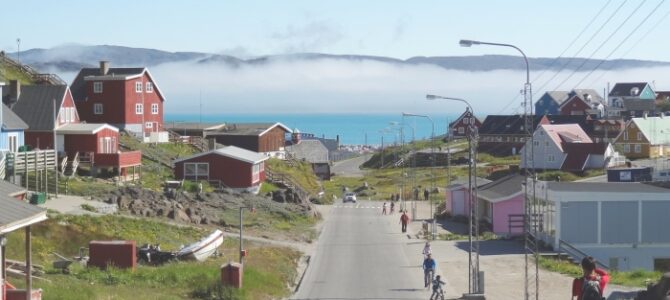
by Geoff Vasil
Not necessarily. What most people don’t realize is that numerous NATO member-states have standing territorial disputes with other NATO member-states and sometimes even attack one another militarily.
Cyprus is a prime example, the divided island split by the so-called Green Line between Turkey and the Greek population, reflecting a larger conflict going back to the Ottoman takeover of Greek territory in Anatolia and spilling over into bombing sorties into one another’s territories at times while both countries remained in NATO.
Denmark and Canada have a dispute over an Arctic island close to the Greenlandic shore. They’ve ritualized the conflict into an annual “occupation” where one side buries a whiskey bottle for the other “occupying army” to find.
Probably the largest territorial dispute within NATO is the American Arctic: Canada claims everything north of its territory, while the US for years has said that part of the Arctic Ocean is international territory and refuses to honor Canadian claims.
Spain and Britain famously contest the Rock of Gibraltar and have done so for centuries.
Back during the so-called Spring Time of Nations, the League of Nations would prescribe a plebiscite on Greenland, meaning a referendum, where the actual population would vote on whether to remain a Danish colony essentially, join the United States or declare independence.
The modern dispute dates back to the end of World War II. During the Nazi occupation of Denmark, the United States agreed to protect overseas colonies of the Kingdom of Denmark including mainly Greenland and Iceland. After the war the Icelanders used their protectorate status to slip away from Danish control and become an independent state. The United States and to some extent the Dominion of Canada and the United Kingdom did repel Nazi forces from Greenland during the war, mainly u-boats hell-bent on establishing mobile weather stations there. Greenland was seen as highly strategic then because it was the only real source of cryolite, a mineral which made possible the refinement of aluminum. Advances in the process soon made cryolite obsolete. Greenland has significant known reserves of gold, uranium, precious stones and unexploited coal, gas and oil. Coal was exploited in the past and uranium and gold exist in the south in portions of island not covered by the ice cap.
The American establishment in the early years of the Cold War also saw Greenland as the first line of defense against Soviet nuclear missiles coming over the north pole and undertook Operation Blue Bird to build the Thule Airbase in the extreme northwest of the island, the greatest logistics and construction project since the building of the Panama Canal. Thule controlled and still controls the DEW stations in Greenland, the Distant Early Warning system, which included bases in Alaska, Canada and the UK forming what was called the DEW line. The DEW network is still in place while the name has changed to Ballistic Missile Early Warning System, or BMEWS. What was essentially the Thule AB is now called the Pituffik Space Base. Many of the DEWS radar stations were abandoned over the years in favor of satellite monitoring and other national technical means for detecting nuclear missile launches, but the DEW line is still a functioning early-detection network feeding intelligence to the headquarters of NORAD (NORth American .Air Defense) inside the famous mountain in the American state of Colorado.
Contrary to statements by EU and other politicians, Greenland is not part of the European Union. Greenland was the first to exit decades ago because of onerous fishing quotas and the native reliance on seal meat and fur, something which clashed with public sensitivities in the greater West.
The American perspective on Greenland is shaped by the sentiments of the Monroe Doctrine formulated by president Monroe which calls for the exclusion of European powers and their colonies operating in the Americas, and supporting independence movements such as Simon Bolivar’s in Venezuela and even, initially at least, Cuban independence from Spain.
Denmark’s claim to Greenland is a strange story involving the Danish take-over of Norway, Sweden and Iceland in historical times. Denmark claimed Greenland when Hans Egede sailed there looking for the lost Norse (Viking) colonists who made a home there around AD 950 and disappeared sometime during the climatic cooling and the European plagues in the 1400s. Some say they simply assimilated with native groups. It’s worth noting the Inuit came to Greenland after the Vikings. Both groups tended to attack one another in initial contacts. Denmark claims Greenland as the conqueror of and successor state to the Kingdom of Norway which nominally controlled the Norse colonies in Greenland during the late Middle Ages from the royal court in Bergen.
Egede didn’t find his Norse colonists but did Christianize the new natives with a Bible in their own language.
While EU leaders rage against US claims to Greenland as if it were an attack upon the European subcontinent–Greenland is physically and geographically well established as a part of North America by all definitions–it’s odd how quiet they were when the EU was physically attacked and economically brought to its knees by the attack on the Nordstream 2 natural gas pipeline agreed by German chancellor Gerhard Schröder and the Russian president supplying a reunified Germany with cheap and plentiful energy.
Opinions expressed here are solely those of the author.