
by Sergėjus Kanovičius, www.lrt.lt
When a half year ago German ambassador to Lithuania Cornelius Zimmermann asked me whether I’d object to an initiative by which soldiers from a Germany armored brigade would help document Jewish cemeteries in Lithuania, I was at a loss for words. The first thought which occurred to me was, why now Lithuanian soldiers?
But as I sat in the waiting room of the German embassy… Over 14 years in the life of Maceva (Matseva, Hebrew for monument), there’s been a bit of everything–Austrian and German volunteers, Christian, Lithuanian high school students, US embassy staff, visitors from Israel. But Bundeswehr soldiers maintaing Jewish cemeteries and documenting grave monuments? Why?
In this situation the average person might think about guilt, making amends, Germany’s consistent attention to the history of the Holocaust and that country’s constant attention to European Jews and their descendants. Maybe these were the motivation for this offer to help. But then, does it really matter for what reason a country decides to do a good and important thing? The important thing is that it gets done.
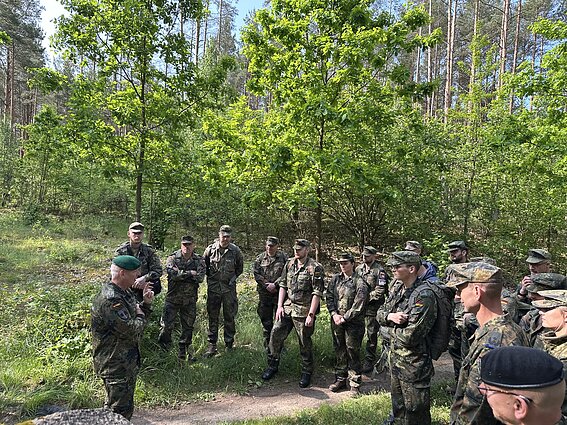
Almost a half year passed. Dawn broke in Merkinė and Maceva director Milda Jakulytė and I stood in the town’s only square, waiting for the first group of soldiers from Germany’s 45th armored brigade to arrive. Military chaplain Eric Hausmann and senior military rabbi Shlom Afanasyev who had flown in specially from Berlin escorted the group of soldiers.
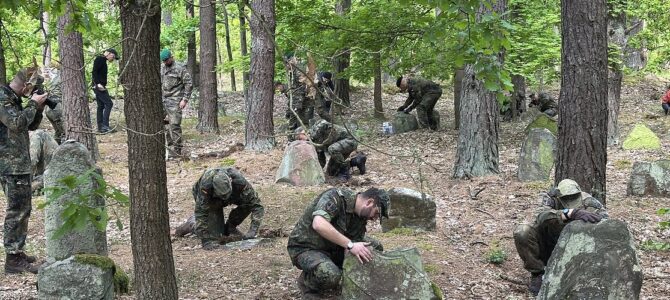
New groups of soldiers arrived in turn over four days. Almost 150 people. Everyone humorously called the final day VIP day. Brigade general Christoph Huber, the German ambassador, the Israeli ambassador and Lithuanian Jewish Community chairwoman Faina Kukliansky and cantor Shmuel Yaatom were expected to visit.
But that day there were no generals, ambassadors or other VIPs. Everyone who had come with their wives, husbands and partners cleaned headstones and collected and carried away brush, along with the remaining soldiers.
Each day when we finished working in the cemetery we went a few hundred meters away to the sadder site of the mass murder of Jews from Merkinė and Liškiava.
Before we went to the mass murder site each day, I was asked to say a few words to the soldiers. Each time I got nervous. I can say I was thinking that among these soldiers there were those whose grandfathers possibly… And I wasn’t wrong. At the close of one day an officer came up to me and said he wasn’t there just because of orders. He was there because his forefathers-. I didn’t let him fihish. Not because it was difficult for me, but because I felt it was difficult for him.
Each time before going to the killing pits, I told them sincerely:
“Dear soldiers, I well understand how difficult it must be for you, for German soldiers to do what you are doing. How it must be especially difficult to go where the peaceful Jewish brothers and sisters of Merkinė and Liškiava were murdered and lie buried. I admit it is difficult for me. I am the descendant of Holocaust survivors, and if my grandmother hadn’t convinced her husband to flee on the morning of June 23, 1941, I wouldn’t be standing in front of you now.
“I don’t believe in collective guilt. I don’t believe in collective responsibility for crimes you didn’t commit. By doing what you’re doing, you’ve proven you are in Lithuania for more than just protecting our territorial integrity. You are here to protect and preserve our common humanity and democratic values. You setting a personal example as well as a military one. For that reason I believe you have the right to be proud of Germany, and Germany should be proud of you. Each one of you individually has the complete right to take pride in yourself and in the flag under which you serve. Today, we are all brothers and sisters in arms for remembrance. We fight for exalted and noble memory. Thank you for your service.”
There were soldiers who approached us and offered to continue to volunteer during their leave from military duty. Almost everyone thanked us for the experience. Gemenral Huber was satisfied and said the experience was so positive that the decision had been made to carry on for as long as the brigade is deployed to Lithuania.
The chief military chaplain said this was the first time in the history of the Bundeswehr that German soldiers acted to preserve Jewish heritage.
This is an amazing example to be followed and in writing about it I was at a loss for words. Maybe because the German soldiers turned the slogans “never again” and “we remember” into deeds.