

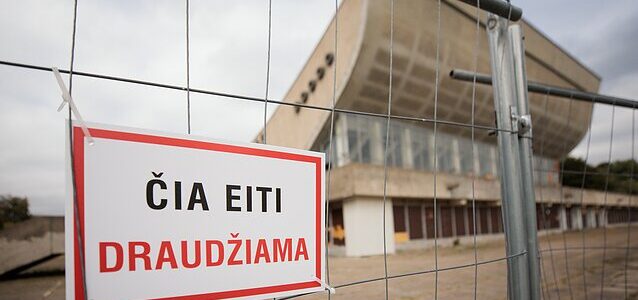
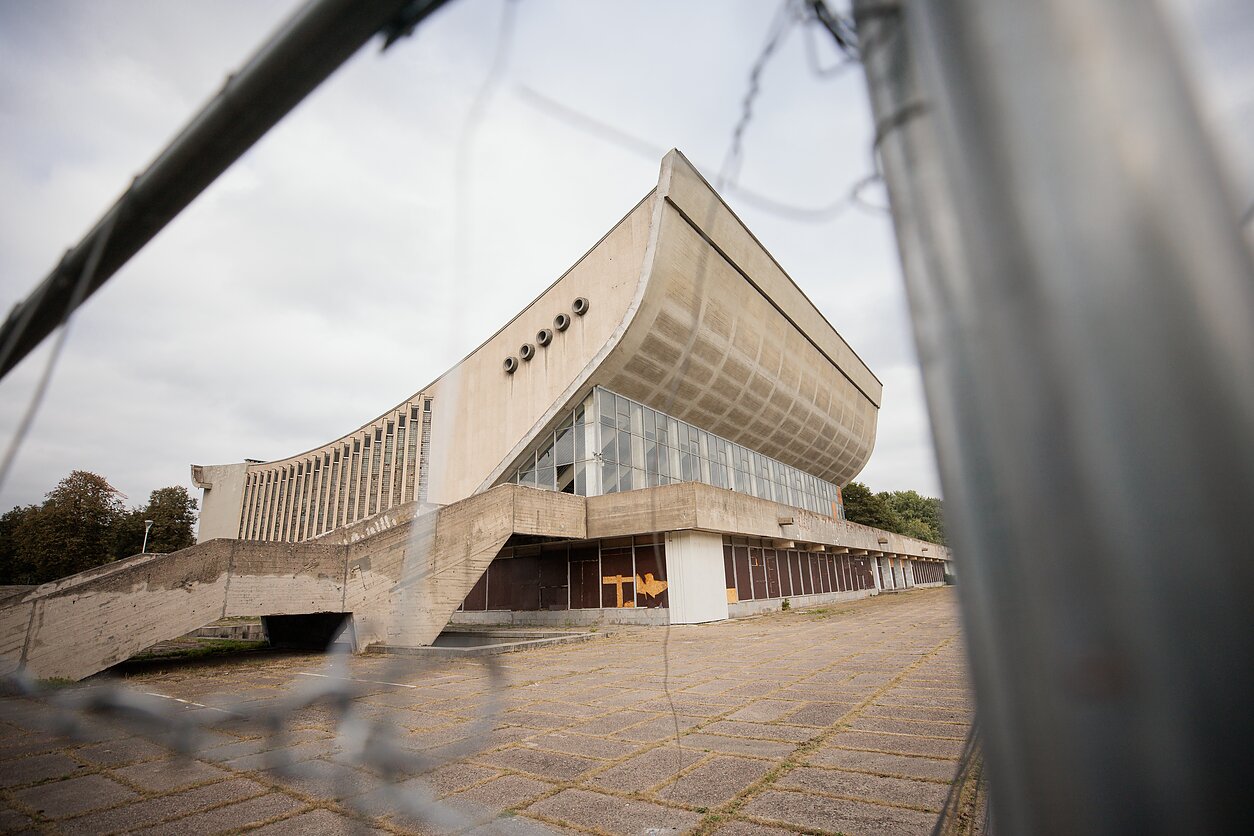
The Lithuanian Ministry of Economics and Innovation has issued a press release on the Baltic News Service webpage expressing approval for the idea of setting up a Holocaust museum at the former Palace of Sports built on top of the Vilna Jewish cemetery by the Soviets in the Shnipishok neighborhood on the northern side of the Neris (viliya( River.. The building has been in serious disrepair for over a decade.
“Taking into account the position held regarding the possibility of adapting the former Palace of Sports, since this site is not suitable for modern and competitive conference tourism… it would be more appropriate to renovate the Palace of Sports and equip it for use as a new memorial and museum,” the Economics and Innovation Ministry posted on the BNS press release webpage.
Vilnius mayor Valdas Benkunskas after meeting with economics minister Edvinas Grikšas last week told BNS the Vilnius municipality and the Economics Ministry have a common position regarding the aging concert and sports complex.
Mayor Benkunskas said: “We perceive in the same way that the Palace of Sports has to be renovated and adapted as a memorial and museum space, and that it wouldn’t be competitive for conference tourism, and would pose a risk to our public image as such.”
The Economics and Innovation Ministry earlier posted the building was not fit to use as a conference venue following a study ordered by the Government.
“According to the current studies, this site could only host some of the requirements as a venue, there would be a lack of parking places, and the costs of reconstruction are difficult to predict,” the Ministry said.
The Economics and Innovation Ministry posted that a study by the Vilnius municipality showed the best site for a new and modern conference center meeting international standards was a little further away down the Neris (Viliya) River, near the current parliament building. The Ministry was reserved on whether it supported Vilnius’s plans to build there instead, posting: “It was agreed to continue constructive cooperation with the aim of finding solutions which would be beneficial to both the city and the state.”
Back in July the former Government of Gintautas Paluckas issued a statement reaffirming the goal of installing a conference center inside the Palace of Sports and of renovating the Jewish cemetery surrounding and underlying the building, and commemorating the victims of the January 13, 1990, attack on the Vilnius television tower by armed Soviet troops.
In August new Lithuanian prime minister Inga Ruginienė expressed support for that plan, but in November she said the best solution was to transfer ownership of the unused building falling into ruin to the Vilnius municipality.
In early December Vilnius mayor Valdas Benkunskas told Lithuanian media the building could not be torn down nor renovated because it is listed as a cultural treasure, and the only option is to set up a Jewish museum there to honor the dead buried in the Vilna Jewish cemetery and victims of the Holocaust.
The city tendered a bid for a conference center downriver near the parliament at the same time. The mayor said investments in that project could reach over 100 million euros. Benkunksas told BNS in October if the Government doesn’t approve that project, the municipality might forge ahead on its own and build the new conference center anyway.
The Jewish cemetery in Shnipishok (Šnipiškės) in Vilnius was the main Jewish cemetery in Vilnius for centuries. The neighborhood was earlier known as Piromont where the noble of the same name maintained his noble estate. The northern edge of the cemetery was bounded by Piromont street in the early 20th century. In the 1960s the area was replanned by the Lithuanian Soviet Socialist Republic as a large public space hosting the Palace of Sports and Culture. Several Jewish graves were removed to other locations during that transformation, including the notional grave of the Vilna Gaon, aka GRO. In the 1990s the Palace of Sports venue mainly featured concerts but also some rallies by political parties. Around 2004 the site was largely abandoned and fell into ruin.
Full story in Lithuanian here.