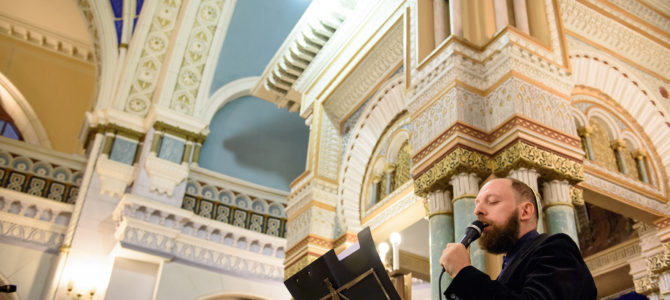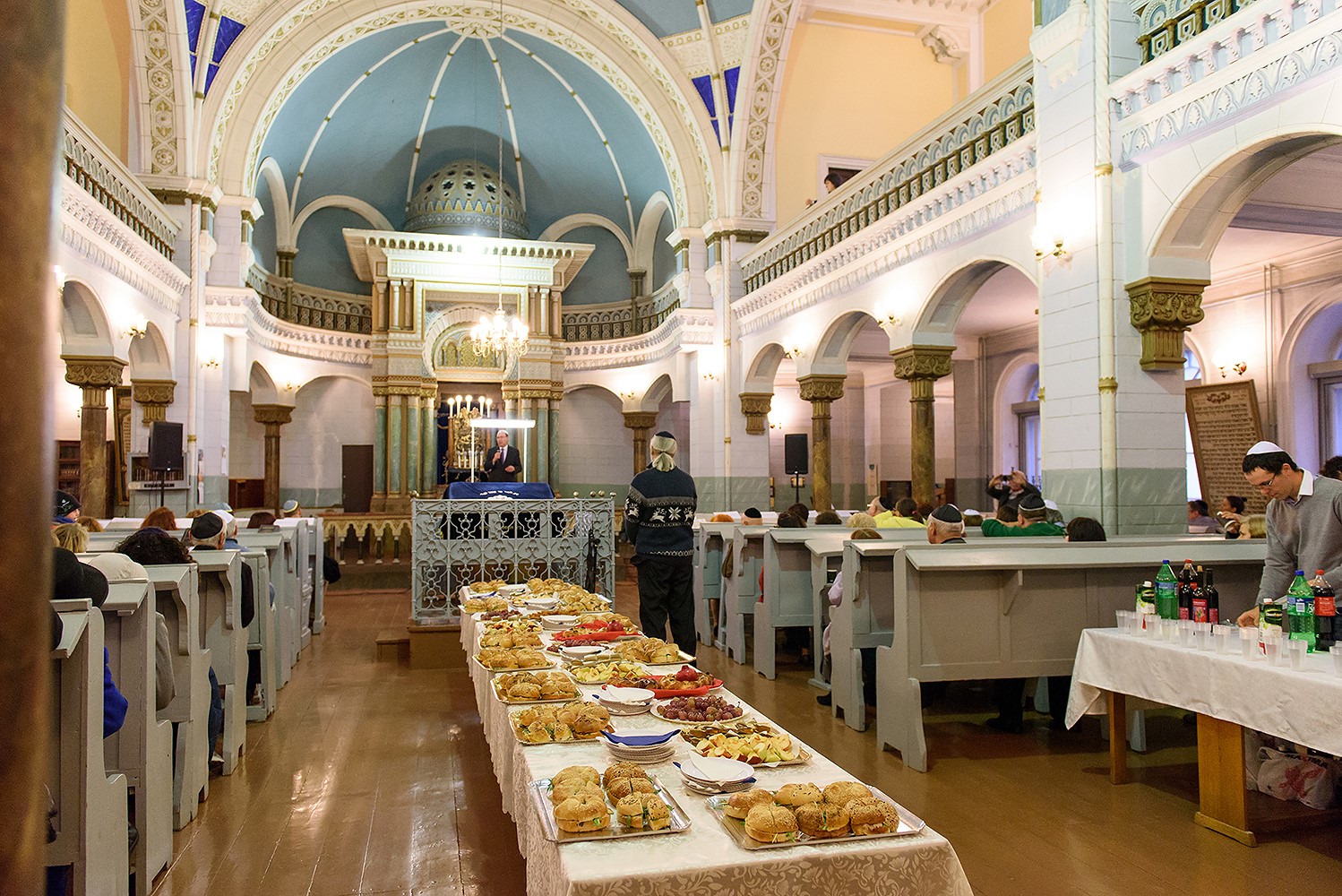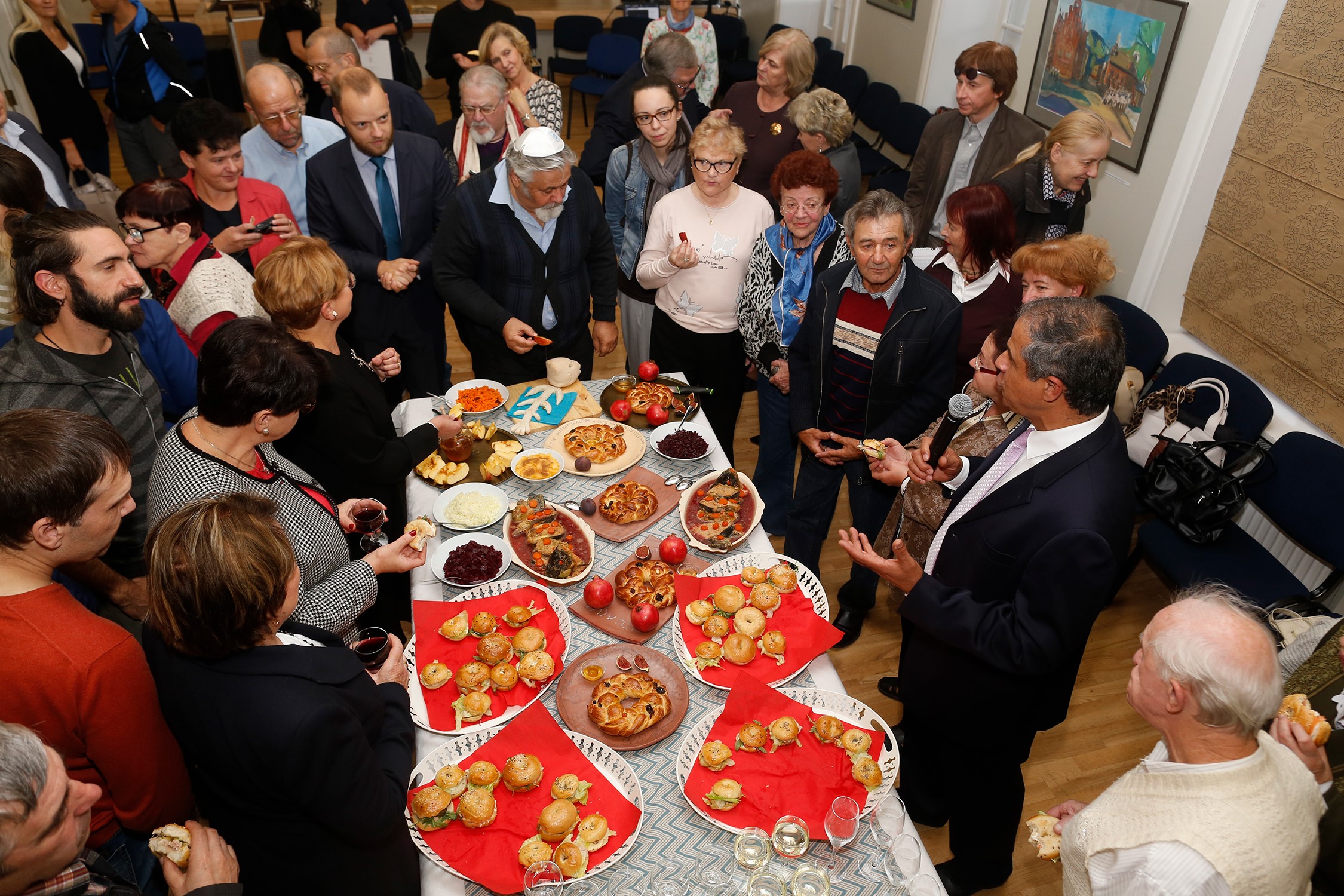
Come meet the Sabbath with the LJC’s Gesher Club.
Time: 7:30 P.M., Friday, May 19, 2017
Location: d’Eco Bar and Restaurant, Dominikonų street no. 15, Vilnius
Cost: 10 euros
Please call Žana Skudovičienė at 370 678 81514 to reserve a seat.
Come meet the Sabbath with the LJC’s Gesher Club.
Time: 7:30 P.M., Friday, May 19, 2017
Location: d’Eco Bar and Restaurant, Dominikonų street no. 15, Vilnius
Cost: 10 euros
Please call Žana Skudovičienė at 370 678 81514 to reserve a seat.

The Judaica Studies Center of the Lithuanian National Martynas Mažvydas Library was officially established May 3, 2017, but will only open to the public May 22 and May 23 with several events and exhibitions.
The Center’s main function is to further research on the Jewish documentary heritage, carrying out educational and informational projects and publicizing the results. The Center is an open enterprise and aimed at educational cooperation. According to its mission statement, the Center actively publicizes information about the Jewish textual heritage at its events, in the national and international media and on the internet, and also conserves collections of modern Judaica publications.
Program:
May 22
1:00 P.M. Opening ceremony (foyer, fifth floor)
2:00 P.M. Launch of exhibit People and Books of the Strashun Library (exhibit hall, third floor)
May 23
1:00 P.M. Samuel Kassow (USA) lecture Uniqueness of Jewish Vilna (conference hall, fifth floor)
2:30 P.M. Presentation The Vilnius YIVO Project (conference hall, fifth floor)
Full announcement in Lithuanian at the Lithuanian National Martynas Mažvydas Library web page here.

Following renovation, the wooden synagogue in Pakruojis, Lithuania, is to open its doors to the public Friday. The synagogue is to house the Pakruojis Regional Juozas Paukštelis Library. The women’s gallery and a permanent exhibition will remind visitors of Jewish life and history in the region. The Pakruojis synagogue was built in 1801 and is believed to be the oldest surviving wooden synagogue in Lithuania. It was renovated and painted in 1885.
Full story in Lithuanian here.

Leo Strauss (1899–1973) was a [Jewish] German and American political philosopher and political philosophy historian. He was born in Germany and served as a translator for the German army during World War I. In 1932 he moved to Paris and in 1934 to Great Britain where he worked at Cambridge. From 1937 to his death he lived and worked in the USA, teaching political science and philosophy at New York City, Chicago and Annapolis.
He developed the idea of what was called natural right, claiming human rights and freedoms are inherent and independent of citizenship and other external factors. …
[Strauss’s Natural Right and History] is being published for the first time in Lithuania…
Full story in Lithuanian here.


Litvak Cemetery Catalogue MACEVA 2016.
This Newsletter contains an overview of activities of Litvak Cemetery Catalogue MACEVA in 2016.
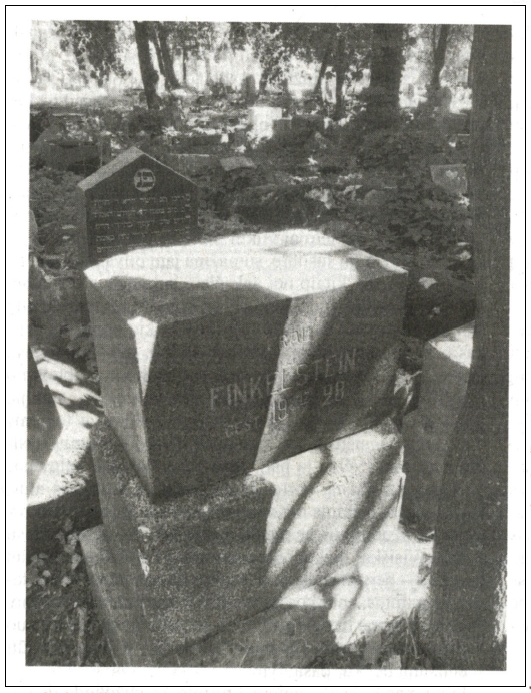
Švenčionys (Svintsyán). It is believed that this cemetery was established during the 15th century. This is one of the oldest and largest cemeteries of Lithuanian Jewry, encompassing an area of 39670.00m2. We had expected to find approximately 2000 graves. Our work with students has found closer to 3,000 surviving graves. Approximately 1200 tombstones still have full, or partially legible inscriptions.
Prior to World War II, the cemetery was larger, it was devastated during the war and beginning in 1941, locals began to plunder stone monuments for construction material. Many tombstones were damaged and uprooted, black marble tombstones were considered particularly desirable.
The current condition of the cemetery is mediocre.
Many of the gravestones are fully, or partially buried, giving us limited ability to access the inscriptions. Many gravestones are leaning or have already collapsed.
The city of Svencionys has no directional signs indicating the location of the cemetery. …
Full catalog here.

The organizers of the Destinies series of evening events are pleased to invite you to come celebrate the birthday of professor Leonidas Melnikas at the Lithuanian Jewish Community.
Program:
Dr. Leonidas Melnikas on piano, Boris Traub on violin, Valentinas Kaplūnas on cello, Gennady Savkov on accordion
Participating:
Silvija Sondeckienė and composer Audronė Nekrošienė-Žigaitytė, president of the Union of Lithuanian Musicians.
Time: 6:00 P.M., Thursday, May 11
Location: Third floor, Lithuanian Jewish Community, Pylimo street no. 4, Vilnius
Event planned and moderated by Maša Grodnikienė, deputy chairwoman, Lithuanian Jewish Community.

Let’s Draw Jerusalem, an exhibit running from May 11 to May 31 in the children’s and young adult literature section of the the Lithuanian National Martynas Mažvydas Library.
From May 11 to 31 the Lithuanian National Martynas Mažvydas Library’s children’s and young adult literature department space will host a national exhibition of drawings by Lithuanian students called “Let’s Draw Jerusalem,” marking the 25th anniversary of the opening of diplomatic relations between the State of Israel and the Republic of Lithuania.
Over 80 drawings in the exhibit come from nine municipalities around the country, including Elektrėnai, Rokiškis, Birštonas, Jurbarkas, Kretinga, Kėdainiai, Molėtai, Utena and Alytus, the result of contests sponsored by the Israeli embassy in 2016 and 2017 also called “Let’s Draw Jerusalem.” In one location the contest was changed to “The Bridge of Friendship between Israel and Lithuania,” since that contest began just as the two countries were celebrating the 25th anniversary of the opening of diplomatic relations this year. Winning drawings in the 6 to 10, 11 to 14 and 15 to 18 age groups have been put on public display at the national library, portraying how the children and young people creatively visualize Jerusalem and friendship between the two states. More than 800 students from 59 schools took part under the direction of over 90 teachers, with help from teachers in other disciplines including history, ethics and geography.
The Lithuanian National Martynas Mažvydas Library is hosting a presentation of the book “Dingusios tautos pėdsakais’ [Traces of a Lost People] by Antanas Žilinskas, the long-serving director of the Vilkaviškis Regional History Museum who has collected material about the Jews once resident in Vilkaviškis over many years, the contents of the book published in 2015. The event will also feature a meeting with Ralph Salinger, an Israeli historian specializing in the history of the Jews of Vilkaviškis. The public event is to be held in Lithuanian and English at 4:00 P.M. on May 12 at the library in Vilnius.
Jews were living in Vilkaviškis in the 16th century when queen Bona Sforza allotted a forest for the Jews to construct a synagogue. The Vilkaviškis synagogue appeared in 1623. There was a Jewish gymnasium in Vilkaviškis from 1919 to 1940. There were around 150 shops in the town, of which about 130 were Jewish. In 1939 there were officially 3,609 Jews living in and around the town, constituting 45 percent of the population.

The Ukmergė Jewish Community marked the 72nd anniversary of Victory Day commemorating the victims of mass murder in the Pivonija forest.
Community members also visited the graves of late members of the community and war veterans at the Old Believers cemetery.

Dear Community members,
Before his death, long-time client of the LJC Social Programs Department Avishalom Moishe Fishman left a last will and testament donating his savings to the Lithuanian Jewish Community who had cared for him in his latter years.
To honor Moishe Fishman’s wishes, LJC chairwoman Faina Kukliansky proposed using the funds for the needs of the Choral Synagogue in Vilnius.
In furthering Jewish traditions of charity, it was decided with Vilnius Jewish Religious Community chairman Simas Levinas to use the funds received to set up a free-breakfast program in the cafeteria on the second floor of the Choral Synagogue, Pylimo street no. 39, Vilnius.

Moishe lived alone and was a client of the Social Programs Department for about 18 years.
The Community and its members, and especially members of the seniors club, became his second home and family.
Let’s remember together this enlightened man beloved and honored by all who knew him.
For the first time a plaque will be placed on the wall of the synagogue to thank and remember a local philanthropist, rather than a donor from abroad.
Everyone knew him as Misha, so this has been dubbed “Misha’s Breakfast Project.” It will begin Monday, May 15. The breakfast program will take place at the synagogue from 9:00 to 10:00 A.M., Monday to Friday.

On March 8 Lithuanian Jewish Community members and veterans marked the 72nd anniversary of the Allied victory over the Nazis.

Victims of fascism, leaders of the ghetto resistance movements, teachers and children were remembered at the Vilnius Jewish Cemetery on Sudervės road. The names of murdered Jews of Vilnius are remembered on the gravestones of surviving members of their families. The Sudervės road Jewish cemetery is a working cemetery, although it is sometimes intentionally confused with the Šnipiškės cemetery for propaganda purposes in the foreign media when the topic is the alleged on-going “destruction of the Jewish cemetery.” In the near future the Sudervės road Jewish cemetery will feature monuments indicating remains removed from the Šnipiškės cemetery and reinterred here in earlier years.

Victory Day celebrations included a ceremony for veterans at the LJC headquarters in Vilnius in the afternoon, during which dinner was served and participants were treated to a concert.

Monday Ukmergė Jewish Community member Elena Jakiševa met Viktorija Marija Lukoševičiūte from Vilnius, a student from Vilnius University who is writing her final bachelor’s work on kosher food. She conducted an interview and then they both went to the hotel/restaurant Big Stone in Ukmergė (Vilkomir), which has kosher dishes on offer. Big Stone makes kosher dishes in cooperation with members of the Ukmergė Jewish Community, including Elena Jakiševa.


South African attorneys Jonathan and Sheli Schlosberg visited the Panevėžys Jewish Community where chairman Gennady Kofman told them about the history of the Jews in the Panevėžys region, community events to teach Jewish history and other social, educational and cultural activities.
There are over 30 mass murder sites where Jews were shot and mass graves in the Panevėžys district. The guests were interested in the history of the Jewish graveyard in the city of Panevėžys. They made use of the opportunity to visit the cemetery site and learned in 1966 the cemetery was destroyed and the headstones used to decorate the walls of the Juozas Miltinis Drama Theater there.
Panevėžys Jewish Community chairman Gennady Kofman presented small token gifts to the guests including Jewish calendars and star of David ornaments. The guests expressed gratitude for the comprehensive survey he provided and wished success to the Panevėžys Jewish Community.

Photo courtesy PBS
by Geoff Vasil
Owen Palmquist’s documentary on two sites in Jewish Vilna aired last week on the US public television network PBS’s NOVA program. According to the director, there are rumblings of a broadcast in Lithuania, but so far there are no concrete plans to show it here.
The documentary is called Holocaust Escape Tunnel and focuses on two sites in and near Vilnius: the former Great Synagogue, which was damaged in World War II and torn down by the Soviets in the early 1950s, and the Ponar mass murder site outside Vilnius, where more than 70,000 people were murdered during the Holocaust.
Obviously Ponar got top billing. Last summer as director Owen Palmquist was shooting the footage with his crew, he said they hadn’t settled on any definite title and hadn’t decided what to feature yet, but he had the idea he wanted to talk about the rich Litvak Jewish culture of Vilnius. Focusing on the Holocaust actually makes more sense within the American context, since Lithuania is generally seen as one of the more enthusiastic societies to take up arms and murder Jews during World War II. It’s an easier sell to media managers. Litvak history is complicated and spans centuries; the Holocaust is immediate and “in your face.”
Jews of Vilna Guberniya: Recruits of the Tsar, Cantonists, Conscripts of World War I

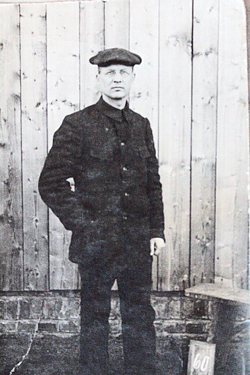
The project contains a rich collection of early 20th-century photographs conserved by the Lithuanian State Central Archive. These are photographs of Jewish young people and conscripts to the Russian army from the Vilna guberniya from 1900 to 1915 with authentic inscriptions identifying the subjects, with surnames written on the photographs and confirmed by stamp and seal. The reverse sides of the photographs contain the signature of a Vilna guberniya police official confirming identity, and an oath to the that effect is sometimes attached to certain photographs.
The collection is comprised of 1,222 portrait photographs. This is the largest portrait-photo collection preserved in the archive and is important part of the historical legacy of the Jews who lived in Vilna guberniya. The photographs are very expressive, young men dressed in their finest clothes, looking with hope and aspiration to the future. The fate of many is unknown: did they serve in the Russian army, were they cantonists, or did they manage to avoid serving? This unique period of Jewish history has been little studied and very few publications about it exist. Research on the origins and fates of the people in the photographs is a subject for a separate historical study.
Most of the portraits were taken in Vilna, but others were done in Warsaw, Minsk, Kiev and St. Petersburg. These century-old photographs taken in the salons of famous photographers of the period (Rembrandt, E. Binkovich, A. Straus, S. Fleri and others) are both cultural and historical treasures and an important part of the history of photography about which the general public knows very little at the present time.


The Lithuanian Jewish Community and the embassy of Israel marked Yom haZikaron, the day for fallen Israeli soldiers and terrorism victims, April 30.
The day chosen for the commemorative holiday isn’t arbitrary. On Iyar 4, 5708 (May 13, 1948) the defenders of Gush Etzion, a cluster of settlements south of Jerusalem, perished, not knowing within 10 hours the independent State of Israel would be proclaimed.
Annually, those who fell in the Arab-Israeli wars and including IDF troops, police, security forces, spies abroad and Jewish underground members are remembered. Officially those who fell from 1860 are counted, the year considered the start of the Jewish battle for the Jewish state of Israel.
There is no tomb of the unknown soldier in Israel because Israelis react deeply and emotionally to every loss, the memory of each one is cherished and everyone is remembered. In recent years the day has also commemorated victims of terrorist attacks, whose numbers increase each year and include children, women, the elderly and youth.


Lithuanian Jewish Community
Pylimo street no. 4, Vilnius
To: His excellency, the minister Linas Linkevičius,
Lithuanian Foreign Ministry
APPEAL
May 2, 2017
Honorable minister,
The Lithuanian Jewish Community and world Jewish organizations please ask you to consider new draft proposals for the United Nations Educational, Scientific and Cultural Organization’s (UNESCO’s) resolution “On Occupied Palestine,” which condemn the State of Israel for “military operations taking the lives of civilian victims in the Gaza Strip” and proclaiming that historical holy sites of the Jewish people, Rachel’s Tomb and the Cave of the Patriarchs, belong to Palestine.
The content of the resolution, in opposition to UNESCO’s mission, displays a specific political tone, is extremely unfair to Israel and serves the interests of only one set of the parties, closing the door on bilateral negotiations between the State of Israel and Palestine. UNESCO is being exploited as a political instrument, exacerbating already strained relations between the states involved.
We ask you please in casting the vote of the Republic of Lithuania at the meeting of the UNESCO executive board to make a decision not opposed to the most progressive democracy in the Near East and the cultural, scientific and educational partner of the Republic of Lithuania.
Respectfully,
Faina Kukliansky, chairwoman

Work in Šeduva, or more precisely work already completed, hasn’t gone unnoticed by Europa Nostra, the heritage protection organization established by the European Commission.
Europa Nostra under a jury selected by the European Commission awarded the Lost Shtetl Project special mention.
Special mentions in the EU Prize for Cultural Heritage/Europa Nostra Awards 2017 were made public today by Europa Nostra and the European Commission. This year the jury granted special mention to 13 heritage achievements from 11 European countries taking part in the EU Creative Europe program.
Special mention goes to outstanding contributions in the conservation and enhancement of European cultural heritage which are particularly appreciated by the jury but did not make it into the final selection to receive an award.
Old Jewish cemetery in Šeduva, Lithuania
In restoring and maintaining the Jewish cemetery in the town of Šeduva, the local community has succeeded in its efforts to restore, commemorate and respectfully maintain the memory of members of their community who, since the Holocaust, no longer live in the town.
For more information, see:
http://www.europanostra.org/2017-eu-prize-cultural-heritage-europa-nostra-awards-special-mentions/

Israeli ambassador to UNESCO Carmel Shama-Hacohen draped in Israeli flag speaks at UNESCO HQ in Paris May 2
Vilnius, May 2, BNS–Lithuania Tuesday voted against a UNESCO resolution condemning Israel’s actions in Jerusalem and the Gaza Strip Tuesday. Positions of EU member-states on the issue differ, but a document tabled by Arab member-states of UNESCO passed with a majority of votes. The UNESCO resolution calls Israel an occupational power in Jerusalem, condemns earth-works conducted by Israel in the Old Town there and condemns Israel’s blockade of Gaza.
Members of UNESCO’s executive council voted on the resolution. Lithuania remains a member of the executive body until 2019. The Lithuanian Foreign Ministry expressed opposition to attempts to exploit the UNESCO format for political purposes.
“We appreciate the efforts of the authors of the UNESCO resolution ‘Occupied Palestine’ to find compromise. We understand the special significance of the holy sites (of the Old Town of Jerusalem) for the monotheistic religions,” press representative for the Lithuanian foreign minister Rasa Jakilaitienė said in comment sent to BNS.
“We are certain protection of the world cultural heritage in the Palestinian territories and Jerusalem demands the involvement of all the interested parties. We are in favor of balanced actions and the avoidance of politicization. Attempts to exploit the UNESCO format for political purposes could serve to discredit this organization,” the Lithuanian diplomat stated.