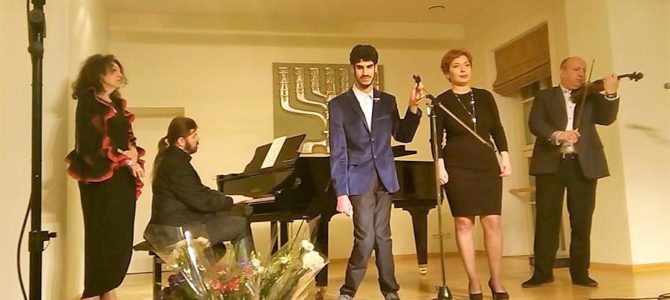
You are cordially invited to attend the launch of Ilja Bereznickas’s book Ir ožka neša laimę [And the Goat Does Bring Happiness] on Monday, October 29 at 6:00 P.M. at the Lithuanian Jewish Community in Vilnius. The author will be there along with illustrator and publisher Leonardas Armonas, and there will be a screening of Ilja Bereznickas’s animated film Ne ožkoje laimė [Happiness Is Not Found in a Goat], perfectly suited for adults and children alike (film and book in Lithuanian).
Global Sabbath
The Vilnius Jewish Religious Community invites you to come celebrate the Sabbath during the global Shabbat project on Friday, October 26. Millions of Jews around the world are participating. We’ll be meeting at the Choral Synagogue in Vilnius Friday evening, with prayer services scheduled to begin at 5:30 P.M. Food will be served after. Wherever you find yourself, you can keep Sabbath in solidarity with millions of others.
It all started in South Africa in 2013, when Chief Rabbi Dr Warren Goldstein called on the community to keep the Shabbat of October 14 together–to astonishing effect. In the days and weeks that followed, communities across the Jewish world lit up with the excitement of the prospect of bringing the Shabbat Project to their city.
Happiness Is Not Found in a Goat (Or Is it?)
The tailor Mendel Katz lived with his prolific family in a small village together with other tailors, cobblers, poor musicians and strange and wise rabbis… They lived in poverty and as head of the house Mendel worked from early in the morning to late at night, sewing shirts, vests and trousers. The work had to be done very carefully and peace and quiet was required to concentrate, otherwise all sorts of things happened: a sleeve was sewn to trousers, or a pant-leg to a shirt. Mendel often made such mistakes. Why? For several reasons. His wife Sonya was a great village gossip. The children–five girls and even worse, ten bone-headed boys. And wife Sonya also had a spinster sister, a mother dissatisfied with everything and a father who was going deaf. This was reason enough for someone to be driven out of their mind.
The entire family lived in a tiny house. Mendel’s sewing machine stood next to a dark window. How can one possibly work when the scandals never end from the morning onwards? But, as the local wise man Josef said, an end comes to every person’s patience, even that of a Jewish tailor. And one morning Mendel’s patience ended.
This is how it happened. Mendel began sewing in the morning, the entire famished family sat around the table, the children banged their spoons waiting for the porridge to be ready. Sonya put a pot of porridge on the table and stood there in silence, but not for long. The eldest daughter, blue-eyed Riva, a real boss, pointed her finger towards, she told the youngest daughter, a fly which had alighted on the ceiling, and this young fool of a girl turned her head upwards and began searching for the fly. You understand that this was exactly what Riva had wanted. As soon as the youngest understood she had been tricked and her porridge eaten, she began to howl so that even the deaf father-in-law was awakened from his slumber, the mother-in-law in fright and the unexpectedness of the thing sat on the cat. And so it began… Mendel’s wife grabbed the broom and began chasing the eldest daughter through the small house with it. The brush flew off the handle and hit the wedding dress which Sonya’s quiet spinster sister had been sewing.
Meeting/Discussion “Prospects for Jewish Heritage in 2020”

You are invited to attend and speak at a meeting and discussion called “Prospects for Jewish Heritage in 2020: Major Tasks and Goals during the Year of the Vilna Gaon and Lithuanian Jewish History” at 5:30 P.M. on October 24 at the Lithuanian Jewish Community, Pylimo street no. 4, Vilnius.
Members of the LJC’s heritage protection group will attend, including Lyudmila Sholokhova from YIVO, Assumpcio Hosta from the AEPJ in Spain and Sergey Kravtsov from Hebrew University.
To register, contact renginiai@lzb.lt
Remembering the Holocaust Victims in Švenčionys

The Lithuanian Jewish Community and residents of Švenčionys remember the victims of the Holocaust from this Lithuanian city at the Menorah statue in the city park October 7. Those who turned out for the event then went to the Švenčionėliai polygon [military reservation] mass murder site in the forest between Platumai village and Šalnaitis lake where about 8,000 Jews from around the Vilnius region were murdered.
The commemoration is always held on the first Wednesday in October by the Menorah statue in what was formerly the Jewish ghetto.
Švenčionys Jewish Community chairman Moshe Šapiro personally thanked all who arrived, especially those who travelled long distances. LJC chairwoman Faina Kukliansky, Kaunas Jewish Community chairman Gercas Žakas, Beit Vilna [Association of Jews from Vilna and Vicinity in Israel] president Mickey Kantor and Polish ambassador to Lithuania Urszula Doroszewska attended the event, among others. Choral Synagogue cantor Shmuel Yatom performed the prayer.
Exhibit of Michailis Duškesas’s Document Collection

The third floor of the Lithuanian Jewish Community is now hosting an exhibit of documents to commemorate the 75th anniversary of the final destruction of the Vilnius ghetto. All of the documents relate to Vilnius and the people of the city, including Rabbi Chaim Ozer Grodzinski, Dr. Tsemakh Shabad, banker Israel Bunimovich, the businessman Isak Shuman and others. The documents are from around the world with the majority from Germany, the USA and Israel.
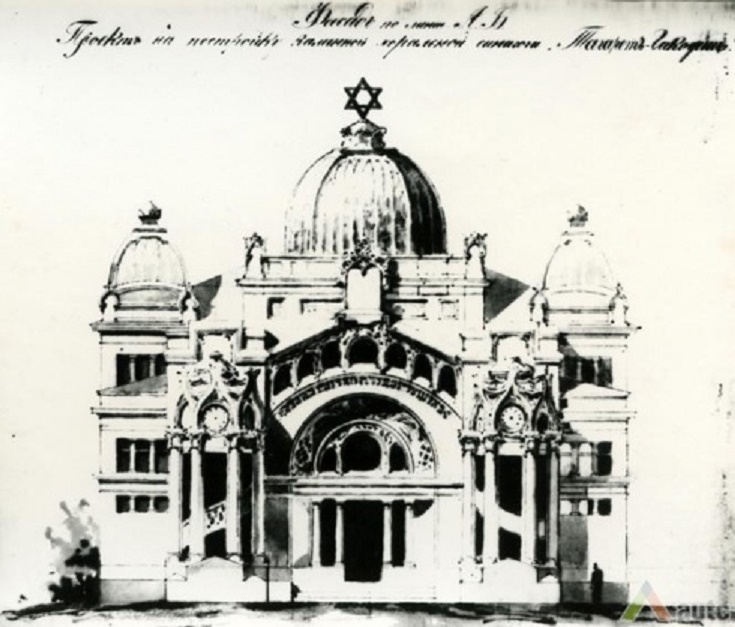
One interesting document appears in the first display case at the new exhibit. It carries the inscription in Russia “Proyekt ustava dukhovnogo obschestva Vilniuskoy sinagogi” and the date 1888. It was acquired in Israel and comes from the collection of Leizer Ran, a well-known collector of Judaica.
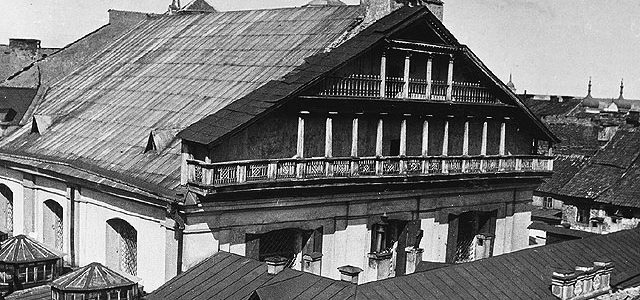
There are many photographs from various angles of the Great Synagogue and the Choral Synagogue.
Document collector Michailis Duškesas says he began collecting pre-Holocaust Lithuanian Jewish documents about 15 years ago, and began collecting stamps since about 1980. He has an extensive stamp collection from around the world featuring the game of ping pong. He says he’s constantly enlarging his Judaica collection and now has a great number of documents concerning Lithuanian cities and towns where Jews lived. His documents have been exhibited before at the Lithuanian parliament, the National M. K. Čiurlionis Art Museum and the Lithuanian Historical Presidential Palace in Kaunas. He says they have also been used in documentary films about Jewish life in Lithuania before the Holocaust.
Lithuanian Public Television Features Program about Litvaks

The Lithuanian Radio and Television television program Misija: Vilnija [Mission: Vilnius Region] about ethnic communities and minority cultures in Lithuania featured Litvaks as the program entered its fourth season at the beginning of October.
In the interview with Miša Jakobas, the principal of the Sholem Aleichem ORT Gymnasium in Vilnius, he remarked how much freer children have become in Lithuania, which he said has its plusses as well as minuses. He said he never sees students carrying books during breaks between classes anymore and that the current student body was born into a technological society they know better than his generation does. Hostess and interviewer Katažina Zvonkuvienė and Jakobas discussed the sense of loss and sadness in which the post-war generation of Lithuanian Jews lives and which is sometimes unperceived as such. They also talked about the role of the state in guaranteeing the rights of all ethnic communities in Lithuania and the multiethnic and interfaith composition of the Sholem Aleichem school’s student body.
Interviewed at the Choral Synagogue in Vilnius, Vilnius Jewish Religious Community chairman Simas Levinas spoke about the glorious reputation for scholarship Jewish Vilna once had, and the slow path to drawing back more Jewish families to tradition and to restoring what existed before.
Sholem Aleichem Gymnasium Hebrew teacher Ruth Reches spoke about the durability of Jewish tradition in the face of assimilation. She said rather than grandparents passing on tradition to children, the reverse process seems to be at work now: children are learning Jewish traditions at school and teaching their parents.
Riva Portnaja, the chief chef and baker at the Bagel Shop Café, recalled her childhood in Žemaitija when keeping a kosher kitchen was the customary thing, and spoke about the great demand in Vilnius for Jewish cuisine among Lithuanians.
Sukkot in Šiauliai


The Pharrajimos and the Shoah: The Uncomfortable Photography of Richard Schofield and Andrew Mikšys

by Agnė Narušytė
Two photography exhibits which don’t exist provoked me to write this article. One was supposed to open next week, but will not, and the other ran for just one day in a synagogue full of construction platforms. Neither artist was born in Lithuania but they live here now. Both exhibits concerned ethnic groups who were victims of the Holocaust: Jews and Roma.
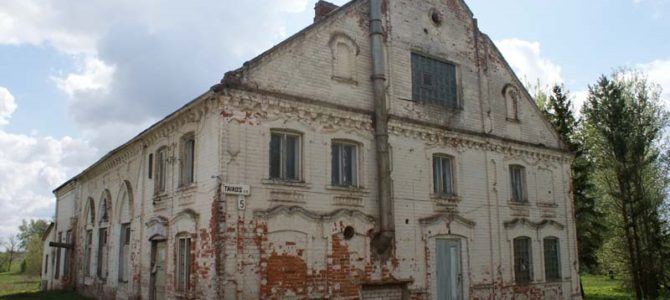
British photo-journalist Richard Schoefeld came to Vilnius in 2001 and lived there until 2013 when he moved to Kaunas to work on a project connected with Litvaks. Since then Litvak culture has been his main theme. In 2015 he established the International Centre for Litvak Photography, an NGO which seeks to make Jewish history and culture topical and especially for young people to learn about Litvak culture using photography, art installations, workshops and other means. For several years now he has been trying to convince the intellectuals and government of Kaunas of the need to restore the Šančiai synagogue which is falling into ruin. He hasn’t succeeded.
So then Schofield drew up a list of about one hundred Lithuanian synagogues and set for himself the task of visiting each one. He hitchhiked for 12 days, kept a diary and used his mobile phone to record some of the people he met and the surviving and ruined synagogues. Only a very few had any signs of restoration work: bags of cement, bricks, tools. Many are simply falling down, although they are protected by the Lithuanian state as “monuments of great cultural, historical and architectural value.” As an example, the entry in his diary about the synagogue in Žemaičių Naumiestis reads: “Trees and bushes are growing in the middle of the building. Rays of sunlight shine through holes in the roof. Someone needed some flooring so they just stole it.”
Sukkot Celebration in Panevėžys

This year the Panevėžys Jewish Community and the Šiauliai Regional Jewish Community celebrated Sukkot together. According to tradition, during Sukkot, the Feast of Tabernacles (or more simply “tents”), everyone sets up a sukka, a booth or tent, together in which the ancient holiday associated with the annual harvest is celebrated. It recalls the sojourn of the Jews in Sinai when the people lived in tents. The usual practice is to make a sukka according to one’s means. This year in Panevėžys a buffet table stood next to the sukka featuring fruit and vegetables grown by community members. The main feature of the Sukkot table is the four species, the lulav, hadas, aravah and etrog, bound in palm fronds.
Panevėžys Jewish Community chairman Gennady Kofman said Sukkot is a continuation of the Jewish high holidays Rosh Hashanah and Yom Kippur.
Many of the older participants spoke about how their families used to celebrate Sukkot when they were children. They used to make the sukka out of green wicker and put the table next to the sukka, where the whole family sat. The children received gifts rare at the time: bananas, oranges and tangerines. They also recalled the times of difficulty for the Jewish people when they wandered in the deserts of Sinai.
Information Stands Recall Tragedy of Zapyškis

The Kaunas administration and the Center for the Study of the Genocide and Resistance of Residents of Lithuania have placed information stands at two sites in the village of Zapyškis.
Zapyškis in 1923 had a population of 589, over half of them Jewish. The center of the community’s cultural life was the Zapyškis synagogue and there was the Bal-Makhshov cultural association, a library, pharmacy, several shops and a Jewish primary school.
Full story in Lithuanian here.
Stele Unveiled for Jewish Rescuers at Monastery of the Missionaries in Vilnius

A stele was unveiled to commemorate those who rescued Jews from the Holocaust in the Tymas neighborhood of Vilnius September 21. The stone marks the future site of a larger monument to rescuers.
This milestone event was achieved only after many years of requests by the Lithuanian Jewish Community to the city of Vilnius for a site for such a statue, without response. Discussions on a monument commemorating Righteous Gentiles continued for several years with the institutions responsible criticizing one another.
The LJC asked for a commemoration site near Ona Šimaitė street, named after the Righteous Gentile Ona Šimaitė, at the intersection of Misionierių and Maironio streets in Vilnius. The courtyard of the Missionaries Monastery was the site of the final selection on the last day of the liquidation of the Vilnius ghetto, September 23, 1943. Thousands of Jews from Vilnius were forced to undergo the selection and several members of the ghetto resistance were hung in the courtyard.
LJC chairwoman Faina Kukliansky, who initiated the idea for a statue to the rescuers, spoke at the ceremony and personally thanked the Žukauskas, Matukevičius, Daugevičius and Lukaševičius families for rescuing her relatives from death.
Sukkot
You and your family are invited to celebrate Sukkot together in the tent beginning at 6:30 P.M. on September 23 at the Choral Synagogue in Vilnius. The prayer service will be followed by a holiday dinner at Bokšto street no. 19 in Vilnius at 7:30 P.M. Additionally, holiday lunch will be served in the sukka at 12:30 P.M. on both September 24 and 25.
WJC and Lithuanian Jewish Community Mark 75 Years Since Liquidation of Vilnius Ghetto

WJC and Lithuanian Jewish community mark 75 years since liquidation of Vilnius Ghetto: “We must continue to strengthen Jewish life in Lithuania”
WJC President Lauder praises Pope’s participation in commemoration: “Pope Francis is a true friend of the Jewish people”
NEW YORK–The World Jewish Congress and its affiliated community in Lithuania marked the 75th anniversary of the liquidation of the Vilnius Ghetto, alongside Pope Francis and other notable personalities.
“Seventy-five years ago, the Germans and local Lithuanian accessories nearly obliterated one of the most vibrant Jewish communities in Europe, a hub of cultural and intellectual Jewish life for thousands of years,” WJC President Ronald S. Lauder said. “But they did not succeed entirely. From the ashes of the Holocaust, the broken community is slowly rebuilding itself and working to ensure the future of Jewish life in Lithuania.”
Star of David Composed of Stones in Former Vilnius Ghetto

Photo: Saulius Žiūra
by Vytautas Budzinauskas, BNS
A star of David was composed of stones on Rūdninkų square in Vilnius Sunday to mark the 75th anniversary of the final destruction of the Vilnius ghetto. Pope Francis is expected to say a prayer in memory of Holocaust victims at the square on Sunday as well, the final day of his visit to Lithuania. More than 50 people turned to wait for the Pope and slowly filled a metal frame with stones in line with the Jewish tradition of placing stones on grave markers. The crowd included entire families and visitors from around Lithuania and from abroad.

Photo: Vytautas Budzinauskas
Events to Commemorate the 75th Anniversary of the Destruction of the Vilnius Ghetto
September 21
10:00 A.M. Ceremony at the President’s Office to award rescuers of Jews the Order of the Life Saver’s Cross (by invitation only)
3:00 P.M. Ceremony for the erection of a stele marking the future site of a monument to Righteous Gentiles in the green space behind the Church of the Assumption and the Missionaries’ Monastery located at Subačiaus street no 28 in Vilnius and accessible from Maironio street (near the former Rosa Square)
September 22
6:00 P.M. Premiere of the play Ghetto, National Drama Theater, Laisvės prospect no. 71, Kaunas
September 23
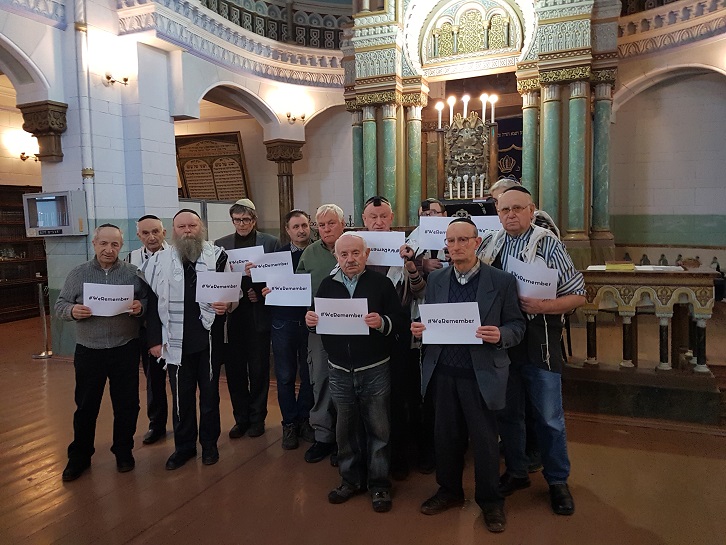
10:00 A.M. Reading of the names at the Choral Synagogue, Pylimo street no. 39, Vilnius
12:00 noon Reading of passages from Yitzhak Rudashevski’s ghetto diary, Rūdininkų square, Rūdininkų street, Vilnius
2:30 P.M. Commemoration at the Ponar mass murder site, Ponar Memorial Complex, Agrastų street, Vilnius. Bus departs LJC at 1:00 P.M.
Exact time to be announced: Pope Francis commemorates Holocaust victims in the former ghetto in Vilnius Old Town
6:00 P.M. World premiere of “Under the Star of David” by the Giedrius Kuprevičius chamber symphony, Vaidila Theater, Jakšto street no. 9, Vilnius
Pope’s Prayer in Ghetto Important to Holocaust Survivors and Rescuers

Vilnius, September 19, BNS–Pope Francis plans to say a silent prayer in the former Jewish ghetto in Vilnius on the 75th anniversary of its final destruction.
Lithuanian Jews say this gesture is important to both Holocaust victims and Christians who rescued Jews.
“We are overjoyed the Pope is sending a message to the world by honoring the 75th anniversary of the liquidation of the ghetto. I hope he includes in his thoughts the Christians who rescued Jews as well,” Lithuanian Jewish Community chairwoman Faina Kukliansky told BNS.
“It is a great honor the Pope is visiting us, without regard that we belong to a different faith. We are citizens of this country and we are so glad this visit is taking place on the occasion of the 100th anniversary of the restoration of the state. This is an extraordinary pope. He is very democratic and is fighting valiantly against violence,” she said.
Pope Francis is scheduled to honor the victims of the ghetto at Rūdninkų square in Vilnius on September 23. The final destruction of the Vilnius ghetto including what is now the square took place on September 23, 1943.
Full text in Lithuanian available here.
![]()
Yom Kippur at the Choral Synagogue
Program of events for Yom Kippur, the Day of Atonement, at the Choral Synagogue in Vilnius
Sunday, September 16
2:30-4:30 P.M. Preparations for Yom Kippur: lessons, kapparot (kappores) ritual
Tuesday, September 18
6:00 P.M. meal before fast
7:00 Kol Nidre
7:10 P.M. beginning of fast
Wednesday, September 19
9:30 A.M. Shacharit morning prayer
12:30 P.M. Izkor prayer
6:15 P.M. Mincha prayer
7:15 P.M. Niila prayer
8:19 P.M. end of fast, meal
Rosh Hashanah at the Šiauliai Regional Jewish Community

The Šiauliai Regional Jewish Community celebrated Rosh Hashanah, the Jewish new year 5779. Cilė Gleizer reminded the audience of the meaning and traditions of the holiday. Frida Šteinienė lit the candles and said a prayer to kick off the celebration. Community chairman Naum Gleizer greeted members and wished everyone a good, healthy and sweet new year. He delivered greetings from the Panevėžys Jewish Community and from former residents of Šiauliai now resident in Israel.
The holiday table contained the tradition dishes–challa, apples and honey, pomegranates and gefilte fish, the latter prepared by Maja Burštein. The traditional treats of teiglakh, imberlakh, apple pie and other sweets were made by Frida Šteinienė, Irina Pres and Cilė Gleizer.
Vadim Kamrazer and his daughter Sofija performed live Jewish music and song. The celebration was much enjoyed by young and old alike. Everyone received the new calendar for 5779.
Rosh Hashanah at the Panevėžys Jewish Community

Members of the Panevėžys Jewish Community celebrated Rosh Hashanah, the Jewish new year, on September 9 at the Parko street restaurant. The event began with the lighting of candles, the blessing was read and good wishes were made to friends and relatives. Michailas Grafmanas blew the shofar horn to usher in the new year 5779. Community chairman Gennady Kofman read the prayer of repentance and hope and Community members greeted one another with the wish God would author them a good coming year.
Guests included city council member A. Petrauskas and the history teacher V. Jakonis from Biržai, Lithuania.
The holiday table included challa, pomegranates, apples and honey. Fish was also served along with other traditional Jewish dishes. The celebration included songs and poetry by children who were rewarded for their work. There was also dancing and different games.