Religion

LJC Social Center Jewish Family Service Celebrates Hanukkah

VaikCha2

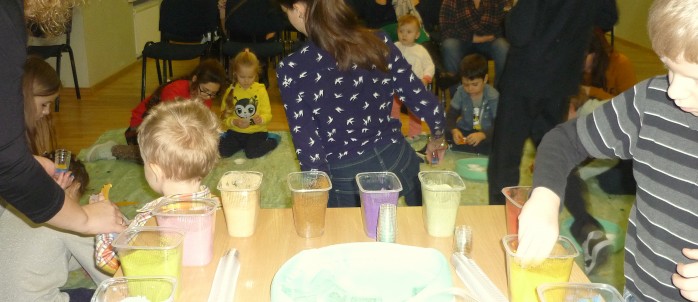
The Jewish Family Service of the Social Center at the Lithuanian Jewish Community held a Hanukkah celebration December 10 for children and parents which included a creative workshop. An experienced developmental psychologist who several years ago led Purim programs for children served as guide at the event. First the children watched a short film about Hanukkah and associated traditions, then in the art workshop portion of the program the children and their parents used colored sand to create a decorative menorah. The children enthusiastically used many different colors to represent the flames. They framed their pictures and then continued to work on them using different decorations. After the work was done, there was a treasure hunt for Hanukkah gelt, gift-giving, dreidl play and snacks of fresh doughnuts.

Approximately thirty children and parents participated. They reported having a lot of fun and said they would remember the event for a long time to come.

More snapshots from the event here.

When Chiune Sugihara Celebrated Hanukkah in Lithuania

Hanukkah, 1939.
Kaunas.

I told him the story of how Judah Maccabee led his men into war against the powerful Greeks, who had defiled the temple, and how their tiny force defeated the much greater armies of Antiochus. Judah and his followers liberated Jerusalem, and set about rededicating the temple, but when they went to light the lamps they could find only enough oil to burn for one day. Keeping the faith, they used the one small cruse they had, and God made the oil burn for eight full days. This is how Chanukah became the festival of lights. Each evening the shammers, the one candle used to light all the others, was used to light one more candle, until on the eighth day all eight candles were burning.

The tables were laden with the best of food and drinks, including some Japanese food which [aunt] Anushka supplied from her shop. We also had veal with small roasted potatoes, roast duck in orange sauce, and many other wonderful things.

Mr. Sugihara also asked me about our family life and my hobbies. When I told him that I collected stamps, he invited me to come and visit him at the consulate. He said he would give me some stamps from Japan.

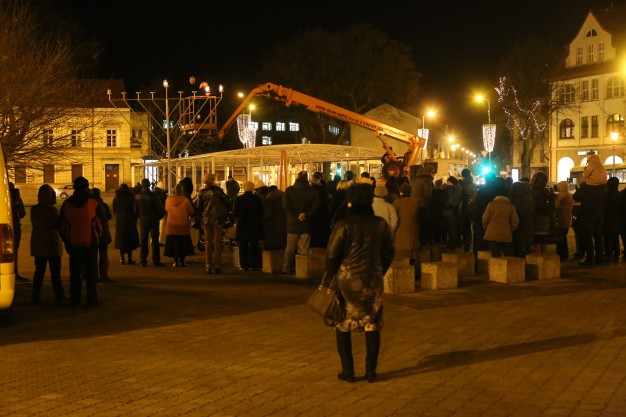
Giant Menorah Lit in Klaipėda

photo_15_28252387
photo © 2015 Egidijus Jankauskas

The Klaipėda newspaper Vakarų Ekspresas reports the city mayor and representatives of the Chabad Lubavitch movement in the Lithuanian port city held a ceremony on central Lietuvninkų square to light the first Hanukkah lamp on the menorah erected there.

Full story and photo gallery here.

Kaunas Jewish Community Hanukkah Celebration

Kaunas du
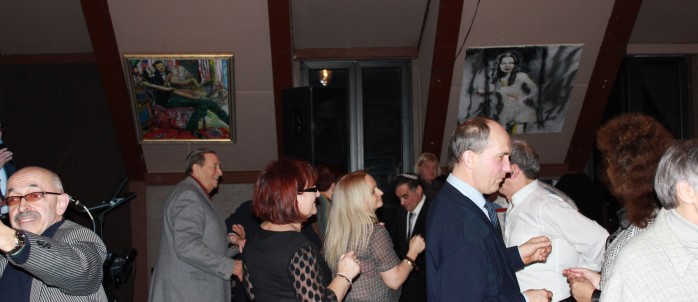
Members of the Kaunas Jewish Community gathered on the afternoon of the first Sunday of December, 2015, at the cafe and music club Punto Jazz to light the first Hanukkah candle and celebrate the start of this eight-day holiday of light and miracles. One of the most senior and most active members of the Community, Šmuelis Šragė, was supposed to light the first candle, but he unexpectedly left us just a week before Hanukkah. His widow Basia Šragienė was called upon by her sons to light the first candle in his place. Despite the somber circumstances, participants managed to have fun at the event, aided by guests from Vilnius Michail Jablonskij and Leonard Zenkevič, musicians from the Fayerlakh musical ensemble. There was a latke-eating contests for the men and a doughnut-eating contest for the women, and a general quiz to test the participants’ knowledge of Hanukkah. Rabbi Efraim Piryampolski and his family who currently live in Kaunas attended and the rabbi addressed the participants. Their visit pleasantly surprised the audience and added spiritually to the Community’s holiday gathering.

Snapshots here:
http://www.lzb.lt/kauno-zydu-bendruomene-uzdega-pirmaja-chanukos-zvake/

First Hanukkah Candles Lit at Vilnius Synagogue

MILDAR-9748

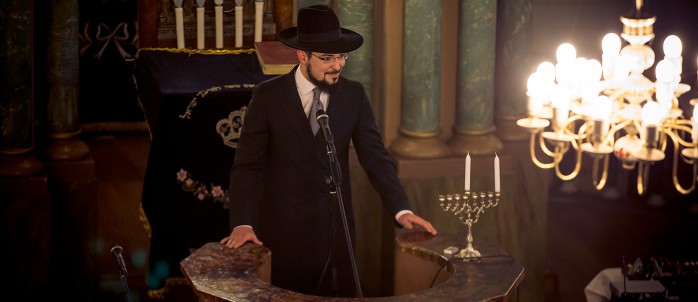
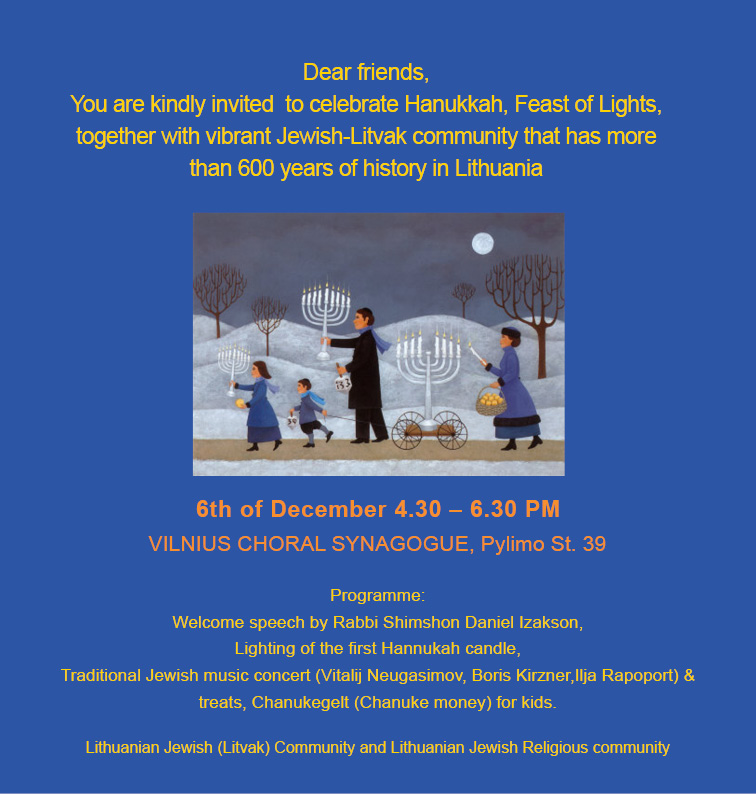
On December 6 the Lithuanian Jewish Community gathered at the Choral Synagogue in Vilnius to light the first Hanukkah candle and enjoy some treats. Israel’s ambassador to Lithuania Amir Maimon and all embassy staff were there, as well as Israel’s honorary consul V. Bumelis and many other honored guests. Rabbi Izakson greeted the assembly. Lithuanian Jewish Community chairwoman Faina Kukliansky lit the first candle and ambassador Maimon lit the second. Traditional Jewish music was played.

Photographs by Milda Rūkaitė
Facebook photo album here.

Tirkšliai Wooden Synagogue Gets Legal Protection

lz

A new cultural heritage site has been placed on the list of Lithuanian cultural treasures: the wooden synagogue of Tirkšliai in the Mažeikiai region of Lithuania. The synagogue is believed to be the earliest synagogue in the region built in the late classical style. Cultural Heritage Department director Diana Varnaitė said: “Wooden synagogues are now a rarity in Europe. Bearing in mind how the world values heritage made of wood from the past, we must understand that wooden synagogues are priceless.” She said she was glad another wooden synagogue had been added to the list of cultural treasures and that it will facilitate preserving the site. Antanas Eičas, head of the Telšiai section of the Cultural Heritage Department, said the Žemaitija region is exceptional for its wooden architecture and especially its wooden churches and synagogues. “The Tirkšliai synagogue built in the first half of the 19th century has been listed on the cultural treasures registry. It is now the only remaining wooden synagogue in the Mažeikiai region. It and the former Seda synagogue are from a similar late classical period. Up until World War II there was also wooden Jewish houses of prayer in Viekšniai, Židikai, Leckava, Laižuva and Pikeliai. Let’s preserve this rare and unique cultural heritage treasure,” Eičas commented.

Full story in Lithuanian here.

Celebrate Hanukkah in Panevėžys

The Panevėžys and Ukmergė Jewish Communities invite you to attend a Hanukkah celebration from 1:00 P.M. to 3:00 P.M. on December 13 at the Vakarinė Žara restaurant at S. Dariaus ir S. Girėno street No. 4 in Panevėžys.

There will be games and gifts for the children.

Please announce your intention to attend via email to genakofman@yahoo.com

See you there!

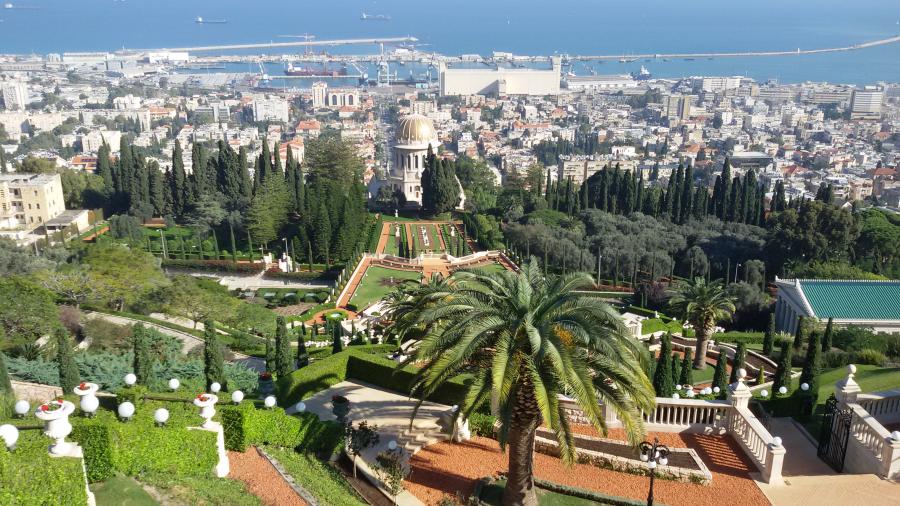
Haifa and Community: Lessons in Tolerance from Israel

by Živilė Juonytė

Mt Carmel

Israelis sometimes joke that while Tel Aviv is partying, and Jerusalem is praying, Israel’s third-largest city and largest port Haifa is busy at work. Maybe that’s why the people of Haifa don’t have time for squabbles and why the different ethnic groups—Jews, Druzes, Arab Christians and Muslims, Ahmadiyya Muslims and Baha’i—get along so well, despite their many differences.

Newest World Religion Recognizes All Others

The unique Baha’i, Druze and Ahmadiyya communities in the kaleidoscope of cultures and religions of Haifa are probably the least known to outsiders. Baha’i is one of the newest religions of the world whose origins are found in 19th century Persia, now Iran. It was immediately banned there, and continues to be. Baha’i believe all religions are valid and study them and their sacred texts. Their emphasis on the shared features of all religions means they are tolerant of mixed marriages. Children born to Baha’i parents don’t become Baha’i automatically. It is the parents’ duty to teach them about all religions, and the young adult chooses the one which most resonates with him or her at the age of 15.

An Evening of Getting to Know One Another

with Rabbi Efraim Priyampolski and his family

Sunday, November 22, 2015

The weekly Vaishlakh

4:00 P.M. Lesson: “Three Sources, Three Ingredients…” (with Rabbi Efraim)
5:00 P.M. Children’s Hour. Let’s learn about Kiddush haShem (Yitzhok and Tsofochka)
6:00 P.M. Lesson “Hanukkah in the Talmud”/free discussion (Rabbi Efraim)
7:00 P.M. Lesson for women: “What is a Lie?” (Devora)
8:00 P.M. We say goodbye, but we remain together

To be held at the Choral Synagogue in Vilnius.

Terrorism Has No Religion? Unfortunately, It Does.

by Arkadijus Vinokuras

It’s at least 13. ISIS, the Islamic State. In 2003 it was a small, insignificant cult, but today it occupies a territory larger than the United Kingdom, rules over six million people and has an army of about 100,000 soldiers. What is ISIS’s religion? Islam. And what is the religion of the other terrorist organizations Hezbollah, Hamas, al Qaeda, the Taliban, Boko Haram and Shehab? Again, Islam.

All of these organizations taken as a whole have another 100,000 armed soldiers. Hamas rules about two million residents of Gaza. Hezbollah has become part of Lebanese society, a state within a state. Iran, a theocracy with sixty-six million residents and about one million soldiers, is the primary supporter of terrorism in the Near East. What is Iran’s religion? Islam. Not to mention the other Arab states.

Memorial Plaque in Memory of Jews of Salantai Unveiled

lenta

On November 12 a memorial plaque was unveiled on the eastern wall, facing Jerusalem, of the former Jewish synagogue, now the Salantai Cultural Center. The plaque bears the inscription “To the memory of the Jews of Salantai from the 17th to the 20th century. The synagogue was in this building, in which a ghetto operated from June to July, 1941.”

Full story in Lithuanian here.

Mini-Limmud is Coming

Dear friends,

You’re invited to the Mini-Limmud educational conference on Judaism December 11-13 at the Vilnius Grand Resort hotel.

Mini-Limmud is and includes:

● Three days of meeting and talking with friends and the like-minded;

● The best speakers from the Baltics, Israel, Russia and elsewhere;

● A special program for children;

● An unforgettable Hanukkah evening with special performers.

Orthodox Rabbi Calls Ban on Female Rabbis Political and Unfortunate

RCA resolution on female ordination ‘political and unfortunate,’ says Riskin.

“I believe the resolution they made wasn’t halachic as much as it was political,” the rabbi said.

Rabbi Shlomo Riskin, the chief rabbi of Efrat and one of the most prominent leaders of modern Orthodoxy, has criticized a recent resolution adopted by the Rabbinical Council of America that banned its member rabbis from giving any form of ordination to women or hiring women in a role of religious or spiritual leadership.

The RCA resolution said its members may not “ordain women into the rabbinate, regardless of the title used,” or “hire, or ratify the hiring of, a woman into a rabbinic position at an Orthodox institution.”

It appeared to be mostly aimed at institutions associated with the liberal-Orthodox movement loosely defined as Open Orthodoxy, including Yeshivat Maharat in Riverdale, New York, founded by Rabbi Avi Weiss, which gives ordination to women to serve as spiritual guides and to give rulings in Jewish law, or Halacha.

Riskin, along with other rabbis in Israel, is himself an RCA member and oversees the Susi Bradfield Women’s Institute for Halachic Leadership (WIHL) at Midreshet Lindenbaum in Jerusalem, which gives women a qualification that amounts to ordination, although it is not labeled as such.

Lecture Series Invitation

J. Greisman, “Curses, the Evil Eye and Porcha (Instilling Fear) in Judaism”

12 noon, Sunday, November 8, 2015

Lecture to be held in Lithuanian in the Jascha Heifetz Hall, third floor, Lithuanian Jewish Community, Pylimo street No. 4, Vilnius

Pope Says Denying Israel’s Right to Exist Anti-Semitism

The World Jewish Congress website reports Pope Francis, the head of the Catholic Church, has issued a strong condemnation of anti-Semitism as he met with over a hundred leaders of the WJC Wednesday. During a private audience in the morning with WJC president Ronald S. Lauder, Francis made it clear that outright attacks against Israel’s existence is a form of anti-Semitism.

“To attack Jews is anti-Semitism, but an outright attack on the State of Israel is also anti-Semitism. There may be political disagreements between governments and on political issues, but the State of Israel has every right to exist in safety and prosperity,” Pope Francis told Lauder and the delegation.

Jews and Catholics today marked the anniversary of the 1965 declaration Nostra Aetate, which condemned anti-Semitism and improved and completely transformed relations between Jews and Catholics.

6 synagogues granted state protection in Lithuania

VILNIUS, Oct 05, BNS – Six synagogues across Lithuania have been listed as cultural objects protected by the state.

Under a decree signed by the minister of culture, state protection was granted to synagogue complexes in Lygumos (the Pakruojis district), Alytus, Cekiske (the Kaunas district), Kaunas, Alanta (the Ukmerge district) and Kurkliai (the Anyksciai district). The synagogues are protected due to architectural and sacral features.


Sukkot Begins

The Festival of Sukkot (Sukkos in Ashkenazic Hebrew) begins on Tishri 15, the fifth day after Yom Kippur, or starting on the evening of September 27 this year. It is a drastic transition from one of the most solemn holidays in the Jewish year to one of the most joyous. Sukkot is such a happy holiday that it is commonly referred to in Jewish prayer and literature as Z’man Simchateinu, the Season of our Rejoicing.

Sukkot is the last of the Shalosh R’galim (three pilgrimage festivals). Like Passover and Shavu’ot, Sukkot has a dual significance as both historical and agricultural. Historically, Sukkot commemorates the forty-year period during which the children of Israel were wandering in the desert, living in temporary shelters. Agriculturally, Sukkot is a harvest festival and is sometimes referred to as Chag Ha-Asif, the Festival of Ingathering.

The word “Sukkot” means “booths,” and refers to the temporary dwellings in which Jews are commanded to dwell during this holiday, in memory of the period of wandering. The name of the holiday is frequently translated “Feast of Tabernacles,” which, like many translations of Jewish terms, isn’t very useful. This translation is particularly misleading, because the word “tabernacle” in the Bible refers to the portable Sanctuary in the desert, a precursor to the Temple, called in Hebrew “mishkan.” The Hebrew word “sukkah” (plural: “sukkot”) refers to the temporary booths that people lived in, not to the Tabernacle.

Sukkot lasts for seven days. The two days following the festival, Shemini Atzeret and Simchat Torah, are separate holidays but are related to Sukkot and are commonly thought of as part of Sukkot.

The festival of Sukkot is instituted in Leviticus 23:33 et seq. No work is permitted on the first and second days of the holiday. (See Extra Day of Holidays for an explanation of why the Bible says one day but we observe two). Work is permitted on the remaining days. These intermediate days on which work is permitted are referred to as Chol haMo’ed, as are the intermediate days of Passover.

You will dwell in booths for seven days; all natives of Israel shall dwell in booths. -Leviticus 23:42

In honor of the holiday’s historical significance, Jews are commanded to dwell in temporary shelters as their ancestors did in the wilderness. The temporary shelter is referred to as a sukkah (which is the singular form of the plural word “sukkot”).

The sukkah is great fun for the children. Building the sukkah each year satisfies the common childhood fantasy of building a fort, and dwelling in the sukkah satisfies a child’s desire to camp out in the backyard. The commandment to “dwell” in a sukkah can be fulfilled by simply eating all of one’s meals there; however, if the weather, climate, and one’s health permit, one should spend as much time in the sukkah as possible, including sleeping in it.


Schedule of Yom Kippur services

Monday, September 21
7:00 P.M. Evening prayer

Kapporois (atonement ritual) and writing of names for Yizkor follow
evening prayer at 7:30 P.M.

Tuesday, September 22
7:15 P.M. Yom Kippur Eve
7:15 P.M. Mincha (evening prayer)
8:10 Kol Nidrei and Ma’ariv

Wednesday, September 23
8:30 A.M. Shacharis (morning prayer)
~11:30 A.M.-12 noon Torah readings and Yizkor
5:30 P.M. Mincha
7:15 P.M. Ne’ila (ending prayer and blowing of Shofar)

Prayer schedule from September 24 to October 7

Morning prayer on weekdays at 8:30 A.M. (9:00 A.M. on Saturday and
Sunday), Mincha and Ma’ariv at 6:30 P.M.

On the Establishment of the Yachad Organization

The Lithuanian Jewish Community would like to inform you that the Jewish organization Yachad is not connected with the Lithuanian Jewish Community, the Vilnius Jewish Religious Community of the Lithuanian Jewish Religious Association. On the organization’s webpage, they say they invited everyone who so desires, without regard to ethnicity, belief or place of residence, to become members and participate in Jewish religious life. The Lithuanian Jewish Community does not support this invitation and does not support the establishment of this organization because we believe it violates the principles of Judaism. This organization seeks to establish itself in the Choral Synagogue in Vilnius, although no permission has been given for this.

We would like to remind them the synagogue is the property of the Vilnius Religious Jewish Community.