Religion

Terrorism Has No Religion? Unfortunately, It Does.

by Arkadijus Vinokuras

It’s at least 13. ISIS, the Islamic State. In 2003 it was a small, insignificant cult, but today it occupies a territory larger than the United Kingdom, rules over six million people and has an army of about 100,000 soldiers. What is ISIS’s religion? Islam. And what is the religion of the other terrorist organizations Hezbollah, Hamas, al Qaeda, the Taliban, Boko Haram and Shehab? Again, Islam.

All of these organizations taken as a whole have another 100,000 armed soldiers. Hamas rules about two million residents of Gaza. Hezbollah has become part of Lebanese society, a state within a state. Iran, a theocracy with sixty-six million residents and about one million soldiers, is the primary supporter of terrorism in the Near East. What is Iran’s religion? Islam. Not to mention the other Arab states.

Memorial Plaque in Memory of Jews of Salantai Unveiled

lenta

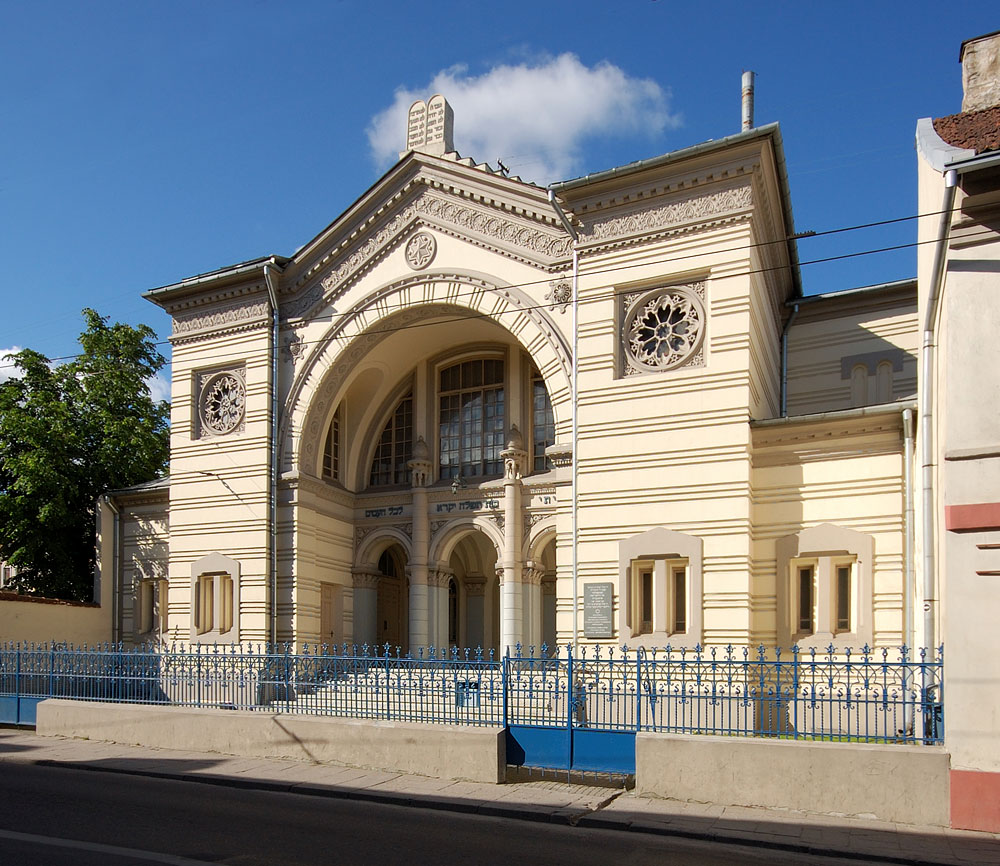
On November 12 a memorial plaque was unveiled on the eastern wall, facing Jerusalem, of the former Jewish synagogue, now the Salantai Cultural Center. The plaque bears the inscription “To the memory of the Jews of Salantai from the 17th to the 20th century. The synagogue was in this building, in which a ghetto operated from June to July, 1941.”

Full story in Lithuanian here.

Mini-Limmud is Coming

Dear friends,

You’re invited to the Mini-Limmud educational conference on Judaism December 11-13 at the Vilnius Grand Resort hotel.

Mini-Limmud is and includes:

● Three days of meeting and talking with friends and the like-minded;

● The best speakers from the Baltics, Israel, Russia and elsewhere;

● A special program for children;

● An unforgettable Hanukkah evening with special performers.

Orthodox Rabbi Calls Ban on Female Rabbis Political and Unfortunate

RCA resolution on female ordination ‘political and unfortunate,’ says Riskin.

“I believe the resolution they made wasn’t halachic as much as it was political,” the rabbi said.

Rabbi Shlomo Riskin, the chief rabbi of Efrat and one of the most prominent leaders of modern Orthodoxy, has criticized a recent resolution adopted by the Rabbinical Council of America that banned its member rabbis from giving any form of ordination to women or hiring women in a role of religious or spiritual leadership.

The RCA resolution said its members may not “ordain women into the rabbinate, regardless of the title used,” or “hire, or ratify the hiring of, a woman into a rabbinic position at an Orthodox institution.”

It appeared to be mostly aimed at institutions associated with the liberal-Orthodox movement loosely defined as Open Orthodoxy, including Yeshivat Maharat in Riverdale, New York, founded by Rabbi Avi Weiss, which gives ordination to women to serve as spiritual guides and to give rulings in Jewish law, or Halacha.

Riskin, along with other rabbis in Israel, is himself an RCA member and oversees the Susi Bradfield Women’s Institute for Halachic Leadership (WIHL) at Midreshet Lindenbaum in Jerusalem, which gives women a qualification that amounts to ordination, although it is not labeled as such.

Lecture Series Invitation

J. Greisman, “Curses, the Evil Eye and Porcha (Instilling Fear) in Judaism”

12 noon, Sunday, November 8, 2015

Lecture to be held in Lithuanian in the Jascha Heifetz Hall, third floor, Lithuanian Jewish Community, Pylimo street No. 4, Vilnius

Pope Says Denying Israel’s Right to Exist Anti-Semitism

The World Jewish Congress website reports Pope Francis, the head of the Catholic Church, has issued a strong condemnation of anti-Semitism as he met with over a hundred leaders of the WJC Wednesday. During a private audience in the morning with WJC president Ronald S. Lauder, Francis made it clear that outright attacks against Israel’s existence is a form of anti-Semitism.

“To attack Jews is anti-Semitism, but an outright attack on the State of Israel is also anti-Semitism. There may be political disagreements between governments and on political issues, but the State of Israel has every right to exist in safety and prosperity,” Pope Francis told Lauder and the delegation.

Jews and Catholics today marked the anniversary of the 1965 declaration Nostra Aetate, which condemned anti-Semitism and improved and completely transformed relations between Jews and Catholics.

6 synagogues granted state protection in Lithuania

VILNIUS, Oct 05, BNS – Six synagogues across Lithuania have been listed as cultural objects protected by the state.

Under a decree signed by the minister of culture, state protection was granted to synagogue complexes in Lygumos (the Pakruojis district), Alytus, Cekiske (the Kaunas district), Kaunas, Alanta (the Ukmerge district) and Kurkliai (the Anyksciai district). The synagogues are protected due to architectural and sacral features.


Sukkot Begins

The Festival of Sukkot (Sukkos in Ashkenazic Hebrew) begins on Tishri 15, the fifth day after Yom Kippur, or starting on the evening of September 27 this year. It is a drastic transition from one of the most solemn holidays in the Jewish year to one of the most joyous. Sukkot is such a happy holiday that it is commonly referred to in Jewish prayer and literature as Z’man Simchateinu, the Season of our Rejoicing.

Sukkot is the last of the Shalosh R’galim (three pilgrimage festivals). Like Passover and Shavu’ot, Sukkot has a dual significance as both historical and agricultural. Historically, Sukkot commemorates the forty-year period during which the children of Israel were wandering in the desert, living in temporary shelters. Agriculturally, Sukkot is a harvest festival and is sometimes referred to as Chag Ha-Asif, the Festival of Ingathering.

The word “Sukkot” means “booths,” and refers to the temporary dwellings in which Jews are commanded to dwell during this holiday, in memory of the period of wandering. The name of the holiday is frequently translated “Feast of Tabernacles,” which, like many translations of Jewish terms, isn’t very useful. This translation is particularly misleading, because the word “tabernacle” in the Bible refers to the portable Sanctuary in the desert, a precursor to the Temple, called in Hebrew “mishkan.” The Hebrew word “sukkah” (plural: “sukkot”) refers to the temporary booths that people lived in, not to the Tabernacle.

Sukkot lasts for seven days. The two days following the festival, Shemini Atzeret and Simchat Torah, are separate holidays but are related to Sukkot and are commonly thought of as part of Sukkot.

The festival of Sukkot is instituted in Leviticus 23:33 et seq. No work is permitted on the first and second days of the holiday. (See Extra Day of Holidays for an explanation of why the Bible says one day but we observe two). Work is permitted on the remaining days. These intermediate days on which work is permitted are referred to as Chol haMo’ed, as are the intermediate days of Passover.

You will dwell in booths for seven days; all natives of Israel shall dwell in booths. -Leviticus 23:42

In honor of the holiday’s historical significance, Jews are commanded to dwell in temporary shelters as their ancestors did in the wilderness. The temporary shelter is referred to as a sukkah (which is the singular form of the plural word “sukkot”).

The sukkah is great fun for the children. Building the sukkah each year satisfies the common childhood fantasy of building a fort, and dwelling in the sukkah satisfies a child’s desire to camp out in the backyard. The commandment to “dwell” in a sukkah can be fulfilled by simply eating all of one’s meals there; however, if the weather, climate, and one’s health permit, one should spend as much time in the sukkah as possible, including sleeping in it.


Schedule of Yom Kippur services

Monday, September 21
7:00 P.M. Evening prayer

Kapporois (atonement ritual) and writing of names for Yizkor follow
evening prayer at 7:30 P.M.

Tuesday, September 22
7:15 P.M. Yom Kippur Eve
7:15 P.M. Mincha (evening prayer)
8:10 Kol Nidrei and Ma’ariv

Wednesday, September 23
8:30 A.M. Shacharis (morning prayer)
~11:30 A.M.-12 noon Torah readings and Yizkor
5:30 P.M. Mincha
7:15 P.M. Ne’ila (ending prayer and blowing of Shofar)

Prayer schedule from September 24 to October 7

Morning prayer on weekdays at 8:30 A.M. (9:00 A.M. on Saturday and
Sunday), Mincha and Ma’ariv at 6:30 P.M.

On the Establishment of the Yachad Organization

The Lithuanian Jewish Community would like to inform you that the Jewish organization Yachad is not connected with the Lithuanian Jewish Community, the Vilnius Jewish Religious Community of the Lithuanian Jewish Religious Association. On the organization’s webpage, they say they invited everyone who so desires, without regard to ethnicity, belief or place of residence, to become members and participate in Jewish religious life. The Lithuanian Jewish Community does not support this invitation and does not support the establishment of this organization because we believe it violates the principles of Judaism. This organization seeks to establish itself in the Choral Synagogue in Vilnius, although no permission has been given for this.

We would like to remind them the synagogue is the property of the Vilnius Religious Jewish Community.

Report by Vilnius Jewish Religious Community on August 14, 2015

We would like to inform you that an extraordinary general meeting of the Vilnius Jewish Religious Community was held today, August 14, 2015. The Vilnius Jewish Religious Community resolved that since now the term of the contract with Chaim Burstein has passed, not to renew the contract and to appoint Shmuel Yatom to serve the function of rabbi in the interim while a new rabbi is found.

Shmuel Levin
Vilnius Jewish Religious Community

Lithuania’s Great Synagogue, demolished by Russians, draws archeological attention  Read more: The Jewish Chronicle – Lithuania s Great Synagogue demolished by Russians draws archeological attention

Lithuania’s Great Synagogue, demolished by Russians, draws archeological attention Read more: The Jewish Chronicle – Lithuania s Great Synagogue demolished by Russians draws archeological attention

The Great Synagogue in Vilnius, Lithuania was demolished by Russian troops just 55 years ago, but a local researcher from Duquesne University is already working on preserving its legacy.

Despite the synagogue’s relatively recent destruction, it is nonetheless the subject of an archeological project headed by a worldwide team of experts, including Philip Reeder, dean and professor of the Bayer School of Natural and Environmental Sciences at Duquesne.

Archaeological work undertaken to preserve or reconstruct history does not necessarily have to focus on ancient structures dating back thousands or even hundreds of years, according to Reeder. Rather, he said, archaeology is about “uncovering any history that is potentially lost, even if it 55 years old.”

Interview with the cantor of the Vilnius Choral Synagogue

Interview with the cantor of the Vilnius Choral Synagogue

The Synagogue‘s Cantor Shmuel: What Jews Need in the Diaspora, Is Unity

Even though Shmuel Yatom, the cantor of the Vilnius Choral Synagogue and a Hebrew teacher, wasn‘t born in Vilnius, he has a special connection with this town. Shmuel says that he comes from a family with a long-lasting cantorial tradition, which was transferred from generation to generation.

European Antisemitism Driving Jews Away From Jewish Life, Says Leading Rabbi (INTERVIEW)

European Antisemitism Driving Jews Away From Jewish Life, Says Leading Rabbi (INTERVIEW)

The recent string of attacks against Jews in Europe has driven many Jews away from an active Jewish life, said the president of one of Europe’s leading Orthodox Jewish networks on Tuesday.

“We’re dealing with a large number of Jews who because of the risk involved, and terrorist attacks, have stopped coming to Jewish events,” Rabbi Pinchas Goldschmidt told the Algemeiner. “It’s more important [for these Jews] to stay alive than to stay Jewish.”

Read more

Why Judaism Needs Journalism

There’s a tendency in the Jewish world to look for big solutions to big problems. One of those problems is the disheartening fact that most Jews today are simply not that interested in Judaism.

This problem isn’t made up — it’s real. We live in a world where the options are so abundant that Judaism is seen as a choice, not an obligation. This is radically different from the world I grew up in, where every Jew in the Jewish neighborhoods of Casablanca would go to synagogue on Shabbat and follow the major rituals. Judaism wasn’t a choice — it was a way of life.

Here in America, in the land where we overdose on choices, Judaism has to compete for people’s time, and, more often than not, it loses. Why would someone go to a prayer house on Saturday mornings when they can take a beautiful hike in the canyon or have coffee with an old friend or go to a gym or yoga class? If the great American question is, “What will make me happiest?” is it that surprising that Judaism so often loses?

Read more