The Lithuanian Jewish Community wishes Lithuanian Makabi Athletics Club president Semionas Finkelšteinas a very happy birthday. Mazl tov. Bis 120!


The Lithuanian Jewish Community wishes Lithuanian Makabi Athletics Club president Semionas Finkelšteinas a very happy birthday. Mazl tov. Bis 120!

A very happy 95th birthday to Samuilas Reckinas, a member of our Abi Men Zet Zich seniors’ club. Mazl tov. Bis 120!
Tamara Jagėlienė passed away on August 16. She was born in 1955 and was a member of the Kaunas Jewish Community. We extend our deepest condolences to her son and other family members.

The Sabbath begins at 8:27 P.M. on Friday, August 18, and concludes at 9:44 P.M. on Saturday in the Vilnius region.

This Sunday’s quiz will test your knowledge of Litvak artists, their influence on art history, what stands out in their work and why Litvak artists are important on the world stage. Prizes are to include falafels, wine and other goodies. It all takes place starting at 5:00 P.M. on Sunday, August 20, at the Israeli street food kiosk in Petras Cvirka Square across the street from the Lithuanian Jewish Community in Vilnius. Everyone is welcome.

by Grant Gochin
Fearing stigmatization and persecution, Lithuanian rescuers of Jews awarded the “Righteous among the Nations” designation, often hid it from their neighbors and family members for decades. Today, the Lithuanian Government honors these Rescuers on a national level (as they should have from the very beginning). Unfortunately, the Lithuanian honors are not sincere and are just another performance. Jewish people who were saved are reduced to vehicles for Lithuanian virtue signaling.
“Righteous Among Nations” Lithuanians comprised only 0.04% of the Lithuanian population. These genuine heroes are now used by the State as an alibi for anyone who is Lithuanian, i.e. the 0.04% are presented to the public as the stereotypical norm, while the 99.96% of Lithuanians who were not “Righteous Among Nations”, are negated or their deeds rewritten. This is clear Holocaust distortion.
Krikštaponis
The case of Juozas Krikštaponis is far more illustrative of Lithuania then, and now. Krikštaponis was a vicious, genocidal murderer. But, he “only” murdered Jews. So, for Lithuania this is not any impediment to national honors. Lithuania honors so many murderers of Jews, that it appears this could be a standard for national hero status.

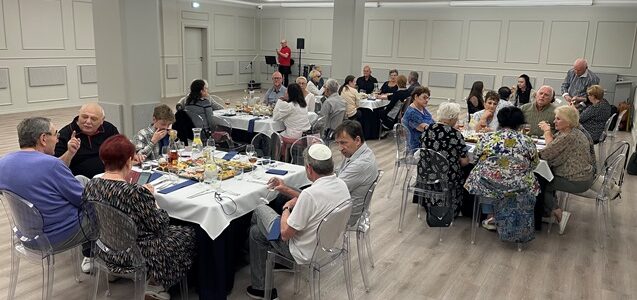
Rosh Hashana is coming up on September 15 and 16 and we hope you decide to usher in the new year 5784 with us. Stay tuned for more information about events and celebrations.
Adasa Skliutauskaitė has died. She was born in Kaunas on May 5, 1931. Skliutauskaitė, a Litvak, was an accomplished illustrator of children’s books and magazines. She also painted and made lithographs. Our deepest condolences to her children, relatives, friends and those who knew her through her work.

Julija Patašnik continues her outdoor Israeli dance workshops with the next meeting from 5:00 P.M. to 7:00 P.M. on Friday, August 18, at the Israeli street food kiosk in Petras Cvirka Square in the park across the street from the Lithuanian Jewish Community in Vilnius. Everyone is welcome regardless of age or dancing ability.

Deputy chief of mission Erez Golan and cultural attaché Virginija Bunevičiūtė from the Israeli embassy visited the Panevėžys Jewish Community. They asked Panevėžys Jewish Community chairman Gennady Kofman about community activities and he gave them a tour of Jewish heritage in the Lithuanian steeped in Jewish historical, cultural and religious lore. Golan was keen to learn more about educational programs in local primary and high schools. The Israeli delegation also visited a famous local theater, met with municipal representatives and that same evening presented the Israeli Film in Your Town project, an Israeli cinema retrospective, at the Garsas movie theater. The first screening was Blaumilch Canal, a 1969 Israeli comedy written and directed by Ephraim Kishon depicting the madness of bureaucracy through a municipality’s reaction to the actions of a lunatic.
“We Jews like to laugh at ourselves on film as well as in life,” Golan told moviegoers.
Lithuanian film critic Auksė Kancerevičiūtė also spoke to the audience about Israeli film.
The Garsas movie theater will hold two more showings in the series: on August 24 they will screen Turn Left at the End of the World (2004) and on August 31 Abulele (2015). All shows are free and with Lithuanian subtitling, a gift from the Israeli embassy to the city of Panevėžys.

The Lithuanian Jewish Community wishes Samuel Bak a very happy milestone birthday. We think you are one of the most remarkable painters of the 20th century. You cut right to the heart of human nature in your work, infusing even the most tragic historical events with meaning and recalling for the world the lost world of Jewish Vilna. Mazl tov. Bis 120!

The #ŽydiškiPašnekesiai Jewish discussion club is to discuss the influence Litvak painters have had and do have on Western art styles. It’s not a one-way street, of course: Litvak artists were also influenced by primitivism, Renaissance realism, impressionism, surrealism, pop-art and so on. So of course one hour won’t suffice. We’ll have to go minimalist this time around. Panel speakers include Shmuel Tatz from New York, a serious art collector, and Raimondas Savickas, a serious artist, along with a number of other experts, thinkers and artists.
Location: Israel street food kiosk in Petras Cvirka Square, Vilnius.
Time: 5:00 P.M., Wednesday, August 16

The Sabbath begins at 8:42 P.M. on Friday, August 11, and concludes at 10:03 P.M. on Saturday in the Vilnius region.
We are sad to report Romanas Švarcas died today, August 10. He was born in 1937. He was a Lithuanian Jewish Community member of long standing and a member of the Abi Men zet Zich Seniors Club. We extend our deepest condolences to his widow Danutė and daughter Lina.
Last farewells can be made between 5:00 P.M. and 9:00 P.M. today, August 10, and between 10:00 A.M. and 2:00 P.M. tomorrow, August 11, at the Nutrūkusi Styga funeral home located at (Ąžuolyno street no. 10 in Vilnius. He will be buried at 2:30 P.M. at the Jewish cemetery located at Sudervės road no. 28 in Vilnius on August 11.
Isaakas Markusas passed away August 8. He was born in 1938. He was a long-time member of the Lithuanian Jewish Community and a client of the Saul Kagan Welfare Center. Chairwoman Faina Kukliansky and the entire Community extend our condolences to his widow Basia, son Leonidas and daughter Rimona.

The Lithuanian Jewish Community is seeking to hire an administrator for the Jewish section of the cemetery on Sudervės road in Vilnius. The job entails serving visitors, working with burial documents and upkeep, maintenance and supervision of the Jewish cemetery. Applicants must be computer literate and speak Russian, Hebrew and English. Write info@lzb.lt or call +370 652 09915 for more information and to apply.

There are so few Litvaks left in the world that every encounter brings forth unexpected and extraordinary feelings and excitement. This time was even more unusual became the Lithuanian Jewish Community received an extraordinary visitor by the name of Marc Berenson.
He’s a professor at one of the most esteemed universities in the world, at King’s College London’s Russia Institute. He’s a specialist in Eastern politics and security who has written a number of academic works and speaks Russian and Ukrainian fluently. He’s also special to us because he’s related to Senda and Bernard Berenson. Senda Berenson Abbott was born in Butrimonys near Alytus in Lithuania and immigrated to America. She was the first champion of women’s basketball in the USA, the author of the first book on women’s basketball and is sometimes fashioned the mother of women’s basketball worldwide.
Her brother Bernard was one of the most renowned and influential audio-visual art historian and critic. Great-grandson professor Marc Berenson is in Vilnius looking for more information about his family history and roots. World Lithuanian Student Organization president Dovydas Šotland-Juzefovičius brought him to the LJC and introduced him to LJC chairwoman Faina Kukliansky. The professor expressed keen interest in current events, culture and Community activities as well as the past.
“It is a moving experience to return to where your family came from,” Berenson said.

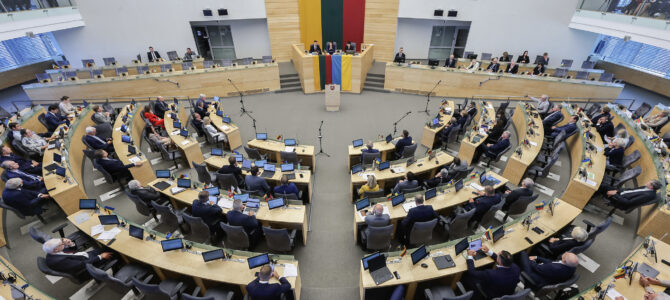
The De-Sovietization Commission convened by the Lithuanian parliament has presented recommendations to the Center for the Study of the Genocide and Resistance of Residents of Lithuania (hereinafter Genocide Center) that the statue commemorating the partisan Juozas Krikštaponis in Ukmergė (Vilkomir) be removed. Unfortunately, instead of taking concrete actions to remove this statue commemorating a person responsible for the murder of thousands of Jews, the Genocide Center has sent a request to the Lithuanian Office of Prosecutor General to rescind this man’s status as a Lithuanian partisan fighter. This is clearly an attempt to prolong the process and to place responsibility on a different agency.
“Krikštaponis’s culpability in the Holocaust is not disputed. This is shown by the documents the Genocide Center has collected and in their own finding of history concerning him. Carrying out mass murder is a crime which is not annulled by other good deeds. In marking the 80th anniversary of the anti-Nazi resistance and liquidation of the Vilnius ghetto, this monument to Krikštaponis is an insult to the memory of all the victims and to their surviving family members,” Lithuanian Jewish Community chairwoman and attorney Faina Kukliansky said.
The Lithuanian Jewish Community calls upon the Genocide Center to take immediate action based on the recommendations by the De-Sovietization Commission to remove this statue to Krikštaponis from the city center of Ukmergė.

The Sabbath begins at 8:57 P.M. on Friday, August 4, and concludes at 10:21 P.M. on Saturday in the Vilnius region.

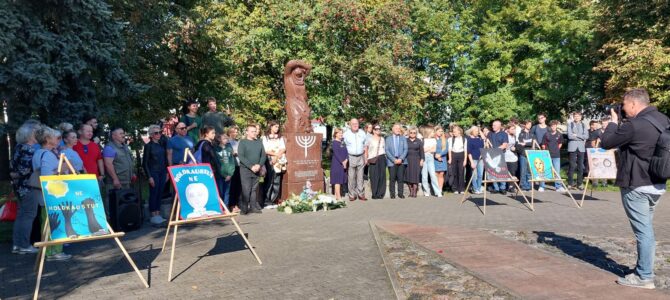
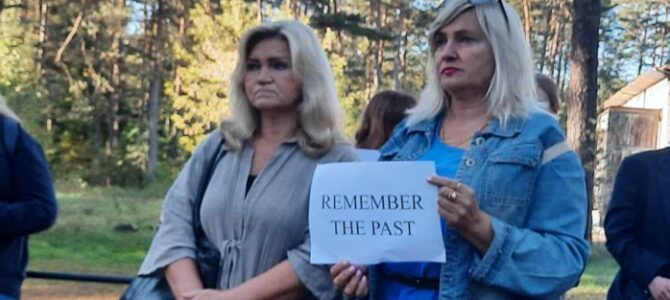
Tuesday a small gathering met at the Ponar Memorial Complex outside Vilnius to remember Roma victims of the Holocaust, known as Samudaripen in Romany. The mass murder of Roma began in Lithuania in 1942. Although there isn’t precise information available, it is thought about 500 Roma, or every third Roma, was murdered in Lithuania.
Representatives of the Lithuanian and Estonia Roma communities, foreign ambassadors, Lithuanian Foreign and Culture Ministry officials, a representative of the Vilnius municipality and members of the Lithuanian Jewish Community attended the ceremony. Konsuela Mačiulevičiūtė sang the Roma anthem and Marius Jampolskis read passages from the book “I Am Karol” detailing the experiences of a Roma boy in a concentration camp.
Lithuanian Jewish Community chairwoman Faina Kukliansky spoke, saying the fate of Jews and Roma was very similar during the Holocaust.
“Yesterday I was in a Lithuanian town where half the population were Jews until World War II. When I spoke with municipal government representatives there, it seems this was news to them. Of course that was 80 years ago, but someone is living in their houses even now. They might even be using their knives and forks when they eat,” she noted.
“It was just like this with the Roma who lived throughout Lithuania. If one day we just forget that these people were a part of our society, if we fail to mark the dates of mass murder, that will be horrible, we will impoverish ourselves. All the more so if we forget the people who were brutally murdered, who were deprived of life then, and who continue to be deprived of respect and memory. This must not happen,” Kukliansky warned.