
News

Special Message from MK Hilik Bar, Chair of the European Forum of the Knesset

Special Message from MK Hilik Bar, Chair of the European Forum of the Knesset

This week the P5+1 and Iran agreed to terms on the Iran Deal, which represents a direct threat to Israel’s national security, and we believe is also detrimental to Europe, bearing in mind EU was also one of the key negotiating partners.

The bottom line of this very bad deal is exactly what Iran’s President Rouhani said immediately following signing of the agreement: “The international community is removing the sanctions and Iran is keeping its nuclear program.”

Meantime, Iran will be rewarded with hundreds of billions of dollars, while its proxies, including Hamas and Hezbollah, which continue to be active throughout Europe, will also present a direct threat to the EU and the national security of European citizens. A number of European nations and companies have already expressed willingness to increase trade with Iran.

Despite the best intentions of those negotiating this deal, unfortunately the world and our region today has become a much more dangerous place, with the world’s leading state sponsor of terrorism, one step closer to nuclear weapons.

Accordingly, this underscores the need for Jewish communities around the world to unite and consolidate, including in support of the State of Israel, at this critical time of need. This is of course at the very core of The Israeli-Jewish Congress (IJC) mission.

Jews Refuse Estonia

A Jerusalem-based research center announced recently the world Jewish community is about the same size now it was before the Holocaust. Estonia, however, only has about half the number of Jews it did in 1939. There are about 2,000 Jews living there currently. Before the war the number was 4,500. The director of Estonia’s Jewish museum says he has no explanation, that Estonia is a good place to live and there is no sense of open hostility there.

According to the announcement there are currently 14.2 million Jews in the world. That number jumps to 16.5 million if you include people with just one Jewish parent. Most live in Israel and America, 6.1 and 5.7 million respectively. In the 1930s the Soviet Union was home to more than 4 million Jews, but not just 300,000 live in the same territory. In 1941 before Germany invaded Estonia the Jewish population had dropped because a majority sought refuge in the Soviet Union. The thousand or so who decided to stay on and brave it out were all murdered by Nazi forces. By December, 1941, there was not a single Jew left in Estonia, and the Nazis proudly hailed the conquered territory as the first judenrein–“Jew-free”–area in the Reich.

LJC Congratulates Jakovas Braveris on His Final Exam

LJC Congratulates Jakovas Braveris on His Final Exam

LJC Congratulates Jakovas Braveris on His Final Exam! Well done!

Thursday the high school students with the best final exam results assembled at the Old Town Hall in Vilnius where Vilnius mayor Remigijus Šimašius congratulated them.

Among the best were Jakovas Braveris of the Sholem Aleichem Jewish Gymnasium in Vilnius.

Jakovas’s father is Igor, a doctor in physics and mathematics who has taught at Sholem Aleichem for 20 years. He said both his sons had inherited their father’s gene for science and he had been aware of that since their early childhoods.

Local Jewish Historian a Walking Encyclopedia

by Simona Simonavičė, simona@skrastas.lt  I skrastas.lt

One of the most remarkable members of the Šiauliai (Shavl) Jewish community in recent decades, Leiba Lipšic (1925-2002) would have celebrated his 90th birthday today [July 14, 2015]. The Jewish community and the local Aušra Museum held an event to celebrate the date. Those who knew Lipšic personally called him a walking encyclopedia to whose end it was impossible to read.

A Walking Encyclopedia

“Looking back on the past, I and the people who worked with Lipšic are sorry we didn’t use him to his full potential. He knew so much that it was impossible for us to comprehend it all, and we lost part of that legacy along with losing him,” Girsh Rafael, a resident of Šiauliai, Lithuania and a friend of Leiba Lipšic said.

Lithuania: City Halts Excavation at Mass Grave Site

Following concerns raised by the Jewish community and an appeal by Lithuania’s Chief Rabbi, authorities in the northern town of Šiauliai are halting excavation of human remains at a Holocaust-era mass grave site that was discovered last week during road construction.

“The municipality of the city of Šiauliai affirms … no digging work will take place until the appropriate respect is guaranteed for the human remains of the people murdered and buried in the mass grave,”  Martynas Šiurkus, the deputy director of the municipal administration of the city, told a press conference Wednesday.

The Baltic News Service reported that Šiurkus said the decision was made to show respect for “the customs and traditions of all ethnic groups.”

 Lithuanian Jewish Community chair Faina Kukliansky welcomed the decision.

“In consideration of a request by the Jewish community, the government of the city of Šiauliai, Lithuania has shelved plans to move human remains discovered during road construction,” she said in a statement issued Thursday on the Lithuanian Jewish Community web site.  “The Šiauliai municipality has given assurances no earth moving work will be performed until due respect is guaranteed for the mortal remains of the people murdered and buried in the mass grave.”

Read more

A statement by Faina Kukliansky, chairperson of the Lithuanian Jewish Community, on the halting of work at a grave site uncovered during construction

A statement by Faina Kukliansky, chairperson of the Lithuanian Jewish Community, on the halting of work at a grave site uncovered during construction

In consideration of a request by the Jewish community, the government of the city of Šiauliai, Lithuania has shelved plans to move human remains discovered during road construction. The Šiauliai municipality has given assurances no earth moving work will be performed until due respect is guaranteed for the mortal remains of the people murdered and buried in the mass grave.

Lithuanian Jewish Community chairperson Faina Kukliansky would like to underline the stop in construction is not somehow the fault of Jews, but rather happened because human remains were found at a location where they should have been expected before construction began.

“I can’t say what sort of historical research was performed before construction work was begun. If it had been performed and a new location was discovered accidentally, that would be possible to understand, to forgive and to correct. Until now eight such sites were known. The issue of the Pročiūnai mass murder site was raised earlier and all of the material associated with that issue is preserved in primary sources at the Lithuanian Central State Archive, meaning it has been collected and is known. Although the location hasn’t been determined definitively, today we have all sorts of technology which we can use to determine where human remains are located without even disturbing the surface of the ground. It doesn’t matter whether those remains are of Jews or non-Jews.

In Response to Jewish Concerns City of Šiauliai Rejects Plans to Move Human Remains Found During Road Construction

In Response to Jewish Concerns City of Šiauliai Rejects Plans to Move Human Remains Found During Road Construction

bg

Vilnius, July 15, BNS–In response to a request made by the Jewish community the administration of the Lithuanian city of Šiauliai has shelved plans to move human remains discovered during road construction.

Deputy director of the municipal administration of the city of Šiauliai Martynas Šiurkus said the decision was made to show respect for “the customs and traditions of all ethnic groups.”

“The municipality of the city of Šiauliai affirms … no digging work will take place until the appropriate respect is guaranteed for the human remains of the people murdered and buried in the mass grave,” Šiurkus told a press conference Wednesday.

The city’s press representative Vitalis Lebedis told BNS the road construction project in Šiauliai will be amended.

Lithuanian Jewish Community chair Faina Kukliansky welcomed the decision.

“Jewish concerns are satisfied because there is a cultural difference and a different requirement for honoring the dead. On the other hand I would still prefer something concrete from the municipality because there is no guarantee that more human remains won’t be found as the work continues,” Kukliansky told BNS.

She said representatives of the Committee for the Preservation of Jewish Cemeteries in Europe and from Lithuania’s Cultural Heritage Department had traveled to Šiauliai Wednesday.

There are documents showing the site in question might have been a mass murder site during World War II where prisoners from the Šiauliai jail were taken and executed.

There are the mortal remains of approximately 40 people in the section of the grave site uncovered during road work. It is likely some of them are Jews. Jewish religious customs forbid moving human remains buried in the ground.

shs

‘Bookkeeper of Auschwitz’ sentenced to 4 years by German court

‘Bookkeeper of Auschwitz’ sentenced to 4 years by German court

IL times

Lüneburg, July 15, AFP/BNS–A German court Wednesday sentenced the bookkeeper of Auschwitz, former SS officer Oskar Gröning, to four years of incarceration. Gröning is considered one of the last possible suspects in Holocaust crimes.

The 94-year-old sat as judge Franz Kompisch read the verdict finding the accused guilty of being an accomplice to the murder of 300,000 people, mainly Hungarian Jews sent to the gas chambers in 1944.

The judge characterized Gröning as cheerfully accepting “safe office work” contributing to the working of “a machine with a single goal,” a system which was “inhumane and almost incomprehensible to the mind of man.”

A European Look at Jewish Heritage

A European Look at Jewish Heritage

A meeting of the Kėdainiai regional council at the beginning of July resolved to establish a Jewish Cultural Heritage Association.

It is to include residents of Ukmergė and Joniškis as well as Kėdainiai.

The Kėdainiai regional leaders have already adopted the plan and are now waiting to see how the two partners resolve to act. the city councils of Ukmergė and Joniškis are supposed to meet in August and their decision is expected at that time.

Once the resolutions are known, work to establish the association is to begin.

Meeting of the Lithuanian Jewish Community Executive Board

Meeting of the Lithuanian Jewish Community Executive Board at 11:00 A.M.July 16, 2015

Dear members of the Executive Board and regional chairs of the Lithuanian
Jewish Community,

You are invited to attend a meeting of the board at 11:00 A.M. on July 16,
2015, to consider:

1. Applications by David Kirzner and Živilė Juonytė for scholarships.

2. Adoption of a common strategy by the LJC and LJC regional headquarters,
with input solicited from regional chairs.

Please respond with news of your ability to attend this meeting.

Dita Shperling: Germans Did Not Distinguish Lithuanians from Jews

“During the first days of the war the Germans who came to Kaunas couldn’t tell the difference between Jews and Lithuanians, but Lithuanians helped them to do,” Kaunas ghetto prisoner Dita Shperling recalled, citing the words of the German soldiers themselves.

09223

Dita (Yehudit) Schperling and her husband Yuda Zupowitch

Dita Schperling tries to travel every summer to Vilnius from Israel where she lives. She agreed to discuss her experience in the ghetto with staff from the LJC webpage.

Unveiling of Plaque Commemorating Yuda Zupavich

A memorial plaque commemorating Yuda Zupavich, Kaunas ghetto Jewish police chief and underground resistance leader, is to be unveiled at E. Ožeškienės street No. 21 in Kaunas at 1:00 P.M. on July 13. The initiative to commemorate this person came from the Lithuanian Jewish Community. LJC chair Faina Kukliansky approached the Kaunas municipality asking them to commemorate this noble citizen of Kaunas who rescued people from the Kaunas ghetto in World War II and who himself was murdered at the Ninth Fort in Kaunas. Zupavich, a lieutenant in the Lithuanian military reserves, was a leader of the Kaunas ghetto Jewish police force and of the underground ghetto resistance, and was brutally tortured to death at the Ninth Fort in Kaunas in 1944.

Yuda Zupavich’s widow Dita Zupovich-Sperling is planning to travel from Israel to attend the ceremony. LJC chair Faina Kukliansky, Kaunas city leaders and LJC members are also planning to attend.

“The Clandestine History of the Kovno Jewish Ghetto Police”

“The Clandestine History of the Kovno Jewish Ghetto Police”

Indiana University Press   2014
416 Pages   

Review by Jack Fischel

This unusual book was composed by members of the Jewish police force who served in the Kovno Ghetto from August 1941 until March 1944, when the Nazis murdered its leadership. The writers of this riveting document were determined to provide a truly balanced history of the Jewish police force as it interacted with ghetto inhabitants, the Nazi occupiers, and their Lithuanian auxiliaries—virulent anti-Semites whose violence against Jews shocked even their German masters. The chronicle is also a refutation of Raul Hilberg and Hannah Arendt, whose works were highly critical of the Jewish councils and the Jewish police leadership in the ghettos. One distinguished Holocaust historians, Samuel Kassow, notes in his introduction to the book that “the chronicle… serves as a caution not to rush to blanket judgments of the Jewish police—or of the Jewish ghetto leadership. Each ghetto had its own context and circumstances.”

Panevėžys, Lithuania Mayor Meets JDC Reps

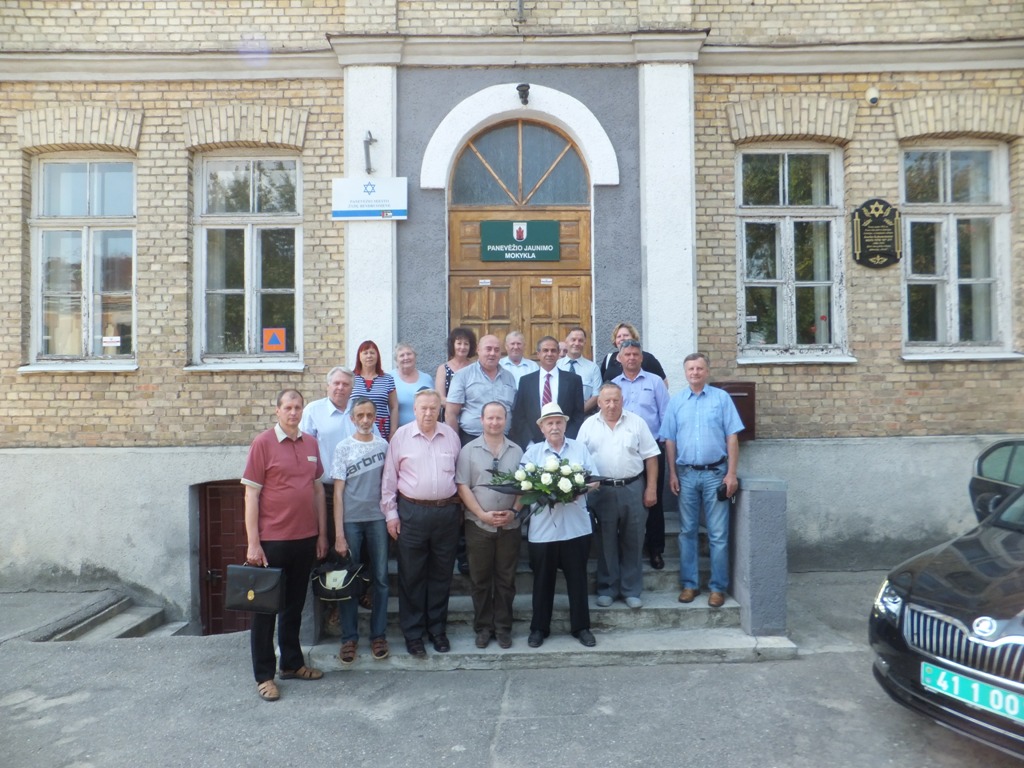
Wednesday Panevėžys mayor Rytis Račkauskas met with Panevėžys Jewish Community leaders and representatives of the Jewish welfare organization the Joint Distribution Committee, including Ra‘anan B. Dotan, JDC representative for Europe. Dotan said he was interested in how welfare projects his organization is supporting are being implemented in Panevėžys.

Panevėžys mayor Račkauskas said he was glad a solution had been worked out recently to return a local synagogue building to the Jewish community, and that this had led to better cooperation between the municipality and the Jewish community and was contributing to the righting of an historical injustice.

“We’re always ready to cooperate, to help the city’s communities, and we are encouraged by the active Jewish community and their contribution to the city’s cultural life. We hope you recognize the fruits of our cooperation and have a good time in our city,” the mayor told the visitor.

Panevėžys Jewish Community chairman Gennadiy Kofman said he was satisfied with the close cooperation with city leaders as well as the projects which have been and are being carried out.

Dr. Yusuf Hamied – Indian Real Life Hero Who Saved Million Lives

Many basic, life-saving medications remain unaffordable in low- and middle-income countries. Spurred on by that fact, Yusuf Hamied, chairman and managing director of Cipla Pharmaceuticals, has steered his enterprise (Cipla Ltd) to the forefront of global pharmaceutical development by manufacturing low-cost drugs, thus making drugs affordable for the poor people of the developing world and saving the lives . In an interview with India Knowledge@Wharton, Hamied describes his company’s skirmishes with multinationals looking to protect their patents on particular medications and explains why rules governing intellectual property rights in industrialized nations should not apply to poorer countries. The patent regime in India should be so devised that utmost priority is given to secure the people’s right to access affordable, quality health care.

Read more

Condolences

The Lithuanian Jewish Community mourns the passing of Rachel Margolis, born in Vilnius, a partisan, biologist and author of the book Partisan from Vilna.

She was born on December 28, 1928. As a young Jewish girl she was sent to the Vilna ghetto, were she joined the FPO, the united partisan  underground, and carried out various military missions. She was blonde and blue-eyed, and able to pass “on the Aryan side” as she put it. She also worked at Herman Kruk’s ghetto library on Strashun Street (now Zemaitijos street) where the FPO sometimes held target practice in the cellar.

She was friends with Hirsh Glik, the young poet who penned the words which would become the Partisan Hymn, Sog Niet Keynmol, still sung when Holocaust survivors gather in Israel and throughout the world. Margolis was the first to hear the poem and put it to musical accompaniment.

Her entire family was murdered during the Holocaust, but she married a fellow partisan and started her own family. She is survived by several daughters in Israel. In the post-war period she worked for many years teaching biology at Vilnius University and was the main force in the decyphering and publishing of the Sakowicz diary, an eye-witness testimony of the mass
murder operations at Ponar outside Vilnius. After making aliyah to Israel she used to return to Vilnius during the summers and volunteered her time constructing exhibits at the Green House Holocaust exhibit of the Vilna Gaon Jewish State Museum and leading tours through the Vilna ghetto.

Ryanair Begins Winter Flights to Israel

Ryanair, Europe’s most popular airlines, announced July 7 the company is opening a new route from Kaunas to Eylat, the Lithuanian news site lrytas.lt reported. The company plans to run two flights per week during the winter season beginning November 5.

Ryanair is offering a fare of 30 euros for flights on the route in November and December. Tickets at that fare can be ordered on-line at ryanair.com from July 8 to July 10, lrytas.lt reported.

Elina Hakkarainen, head of Ryanair sales and marketing in Lithuania, said:
“We are happy to announce a new winter season route to Eylat Ovda Airport in Israel. It will begin in November, and tickets may be ordered already by tomorrow at the website www.ryanair.com.”

lrytas.lt

Bet you don’t know about this southern tourist oasis

Bet you don’t know about this southern tourist oasis

Arad lies west of the Dead Sea, south of the Judean Desert and north of the Eastern Negev with its moon-like craters and breathtaking ridges.

Jerusalem, Tel Aviv, Haifa … Arad?

If this southern Israeli city doesn’t come to mind when you think about touring Israel, Anna Sandler is working hard to put it there.

Sandler is the tourist coordinator for this 52-year-old city bordering the Negev and Judean deserts.Its proximity to the Dead Sea, 25 kilometers (15.5 miles) west, is at once its main attraction and its biggest problem, says Sandler.

“Arad was Israel’s first planned city, and tourism was built into the plan, but once the Dead Sea hotels grew so rapidly, tourism in Arad almost died. So now we’re starting over,” she tells ISRAEL21c.

The ethnically diverse city of about 24,000 offers quite a few advantages to travelers looking to explore the nearby Dead Sea, Masada National Park and Ein Gedi – some of Israel’s most popular tourist sites – as well as lesser-known destinations in Arad itself.

In fact, if you’re heading to the popular Light and Sound Show at Masada (972-8-995-9333), open from March through October, it is accessible only from Arad.

“Arad’s location gives it a number of distinct advantages,” Sandler says.“To the east lies the Dead Sea, with its array of attractions, just to the north is the Judean Desert and to the south lies the Eastern Negev with its moon-like craters, breathtaking ridges and timeless wadis.”