Holocaust

Great Synagogue Site Compared to Acropolis and Vilnius Castle

15min.lt

Last week the Lithuanian Jewish Community confirmed archaeologists had discovered the bimah, or speaking platform, one of the most important elements of the Great Synagogue. Experts say this gives real stimulus to the digs at the site which have been going on for three years now. The Great Synagogue in Vilnius was one of the most important Jewish centers from the end of the 16th century to World War II. Damaged during the war, the Soviets razed what was left to the ground in the 1950s and built a school there. The green and brown Baroque bimah built in the 18th century was found under the school.

Call to Get Rid of Noreika Commemorations

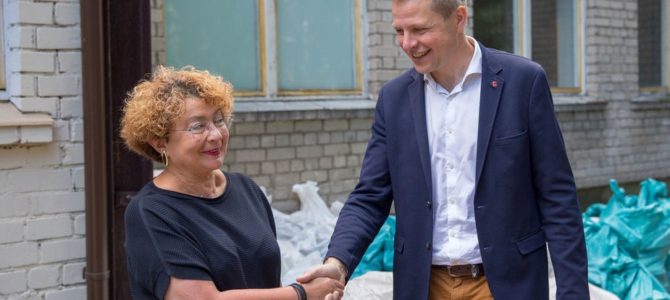
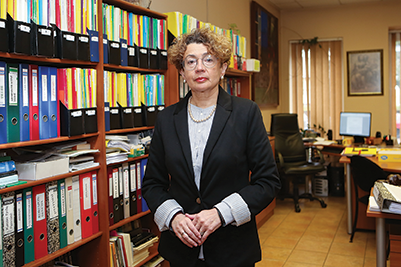
Lithuanian Jewish Community chairwoman Faina Kukliansky thanked the archaeologists who studied historical descriptions and blueprints as well as digging for sharing their finds. “We are in the former ghetto, and this find is comparable on Vilnius’s scale to discovering the Acropolis. Not the shopping center, the historical Acropolis,” Kukliansky said. She thanked the Vilnius municipality for the support and initiative in commemorating the former synagogue, and used the occasion to remind Vilnius city leaders commemoration of the Great Synagogue isn’t compatible with a public plaque commemorating Jonas Noreika. “I want to make this little observation that the Great Synagogue and a monument to Noreika don’t really go together in one city,” the LJC chairwoman said at press conference next to Vilnius mayor Remigijus Šimašius, asking for the issue to be solved..

Full story in Lithuanian here.

Regarding Jonas Noreika

The Lithuanian Jewish Community celebrating this year our 30th anniversary along with celebrations of the Lithuanian independence movement, and commemorating the 75th anniversary of the destruction of the Vilnius ghetto, is concerned by continuing discussions on the commemoration of the memory of Jonas Noreika, aka General Vėtra.

Information has come to our attention demonstrating Noreika was a direct and enthusiastic participant in perpetrating the Holocaust in Lithuania:

a. “…extant documents signed by Noreika for the concentration and isolation of Jews…”

b. On August 22, 1941, Noreika sent a letter to all the aldermen and town burgermeisters [mayors] of the the Šiauliai district for the removal of all Jews and half-Jews from the rural districts, towns and cities to ghettos. This was supposed to be accomplished between August 25 and 29, with Jews also sent to a ghetto in Žagarė. Inventories of property left behind by the Jews was to be delivered to the administrator (Noreika) by August 29. (Lithuanian Central State Archive f R-1099, ap.1, b1,l 156).

c. Noreika administered seized Jewish property. His letter of September 10, 1941, titled “Orders for the Liquidation of Tangible Property of Jews and Communists” was sent to district aldermen and burgermeisters. He wrote a portion of the property (good furniture, rolls of cloth, unused bedding) was to be preserved until a subsequent order on their allocation, a portion was to be sent to schools, rural districts, post offices, shelters, hospitals and other institutions, and a portion was to be used for victims of the war, to be sold at auction. Farm inventories were to be rented out to temporary tenants. Monies generated from the sale of property was supposed to be sent to the treasury of the Šiauliai district administration (Lithuanian Central State Archive f. R-1099, ap. 1, b. 1, l 239). On December 3, 1941, the burgermeister of Žagarė reported to the head of the district of Šiauliai (Jonas Noreika) on progress in dealing with Jewish property seized (Lithuanian Central State Archive f. R-1099, ap. 1, b. 9. 136-137).

This information proves Noreika collaborated with the Nazi regime and contributed to the persecution of Lithuanian Jews, and this person can in no way be portrayed as a Lithuanian hero.

We believe the Lithuanian people, now celebrating 100 years of statehood, are mature enough to accept the whole of historical facts and the state is capable of accepting responsibility for this public display of disrespect to historical truth.

The LJC is concerned that until now a commemorative plaque to Jonas Noreika is still displayed prominently on the outer wall of the library of the Lithuanian Academy of Sciences in central Vilnius. According to the information available to us regarding the circumstances of erecting this plaque, it seems it was done illicitly, without regard to standard procedures used in such instances.

It doesn’t surprise us that the director of the Adolfas Damušis Center for Democracy (Adolfas Damušis was a minister in the pro-Nazi Provisional Government of Lithuania in 1941 and a member of the leadership of the Lithuanian Activist Front), Vidmantas Valiušaitis, has undertaken a defense of Noreika in the public sphere.

The active and systemic apologetics for the anti-Semitics actions of the Lithuanian Provisional Government and the LAF have misinformed and desensitized the Lithuanian people, degrade Lithuania’s reputation and have become a stimulus for the development of propaganda campaigns by states not friendly to Lithuania.

The Lithuanian Jewish Community asks the institutions responsible to take quick action to solve this political, ethical and legal problem and to pay due respect to the victims of the Holocaust. We are asking for the plaque to Noreika to be taken down before the Lithuanian Day of Remembrance of Jewish Victims of Genocide on September 23.


Archaeologists Find Holiest Part of Vilnius Great Synagogue Razed by Soviets


VILNIUS, Lithuania (AFP) — For decades, little did the principal of a kindergarten in Lithuania’s capital realize that her office stood on top of a sacred part of Vilnius’s 17th century Jewish temple, once famous across Europe.

An international team of archaeologists announced THursday the discovery of the most revered part of the Great Synagogue of Vilnius, Lithuania’s major Jewish shrine before it was destroyed by Nazi and Soviet regimes.

Installed in the 18th century, the Baroque bimah was found under the former kindergarten and primary school built by the Soviets on top of the demolished synagogue in the 1950s.

Following this discovery, Vilnius authorities pledged to demolish the school building in a couple of years and properly commemorate the synagogue by 2023.

Condolences

With sadness we report the death of Estera Klabinaitė Grobman who lived in Israel. She lived a long, interesting and difficult life. Born in November of 1920 to a well-to-do Jewish family in Kaunas, she always called herself a Kaunas resident. Her parents had a large bakery before the Holocaust. Imprisoned in the Kaunas ghetto and Stutthof concentration camp, Grobman, who passed away at the age of 98, was an avid reader and shared her memories right up to the time of her death. In May, 2018, the rector of Vilnius University travelled to Israel to present her an honorary diploma.

We share in the pain of her friends and family and send our deepest condolences to her son Aron, her daughter-in-law Ele, her grandchildren Daniel and Saul and too many more to name. Although we seem to know that death is an inevitability, it always hits us painfully and unexpectedly. Rest in peace, Estera.

Arkadijus Vinokuras: Lithuania Doesn’t Need Tainted Heroes

My position is very clear: heroism doesn’t remove responsibility for committing crimes against humanity. On the contrary, this discredits the status of hero.

In this case I’m talking about post-war partisan Jonas Noreika. Several side questions, but they’re to the point: was Christianity abolished during the June uprising in Lithuania in 1941? It was not. Therefore the Ten Commandments had not been rescinded. Do those cleaning their uniforms still remember “Thou shalt not kill,” “Thou shalt not steal,” “Thou shalt not covet thy neighbour’s house, thou shalt not covet thy neighbour’s wife, nor his manservant, nor his maidservant, nor his ox, nor his ass, nor any thing that is thy neighbour’s?” Apparently not. Is there direct evidence Jonas Noreika took part in a mass murder of Jews? No. But there is oral testimony he did. So what’s the problem?

Claude Lanzmann Has Gone

Professor habil. Dr. Markas Petuchauskas, an inmate of the Vilnius ghetto who escaped dramatically and went into hiding, saw every play staged at the Vilnius ghetto theater. While organizing the International Art Days to Commemorate the Vilnius Ghetto Theater event, Dr. Petuchauskas invited Claude Lanzmann to travel to Lithuania and attend. The director agreed and, arriving in April of 1997, presented his film Shoah. This was the Lithuanian premiere of Lanzmann’s film, in the Cinema Program of Art Days. It was Lanzmann’s first and only trip to Vilnius, last only a few days during which he spoke directly with Lithuanian people and gave interviews. We present Professor Petuchauskas’s recollections:

Claude Lanzmann in Lithuania

The news struck like lightning. Claude Lanzmann has gone. The memory of his trip to Vilnius rose up inside me. This is how it was.

One of the first large international art projects organized by the Lithuanian Jewish Culture Club which I founded and directed was International Art Days in 1997, dedicated to commemorating the 55th anniversary of the founding of the Vilnius Ghetto Theater.

I invited Israeli writer Joshua Sobol, well known for his play Ghetto (about the Vilnius ghetto) and who wrote he had never been to Lithuania, to take part in the International Art Days event. Coming to Lithuania for the first time at my invitation, he had the chance to get up on the stage of the theater about which he had written and to tell how he created his play.

The opening ceremony for the Days, dedicated to him, was also held in the former ghetto theater hall.

Famous film director Claude Lanzmann from France, the creator of the globally acclaimed film Shoah, got up on the stage as well. I invited him along with French director Brigite Jaque, who was already known in Vilnius and an acquaintance of mine. It was pleasant to hear Lanzmann, a man who generally avoids lavishing much praise, speak such warm words about my work in holding the Days and about their importance for recalling notable pages in the history of the Shoah.

Burning Stones at the Slobodka Ghetto Gate

kaunas.kasvyksta.lt

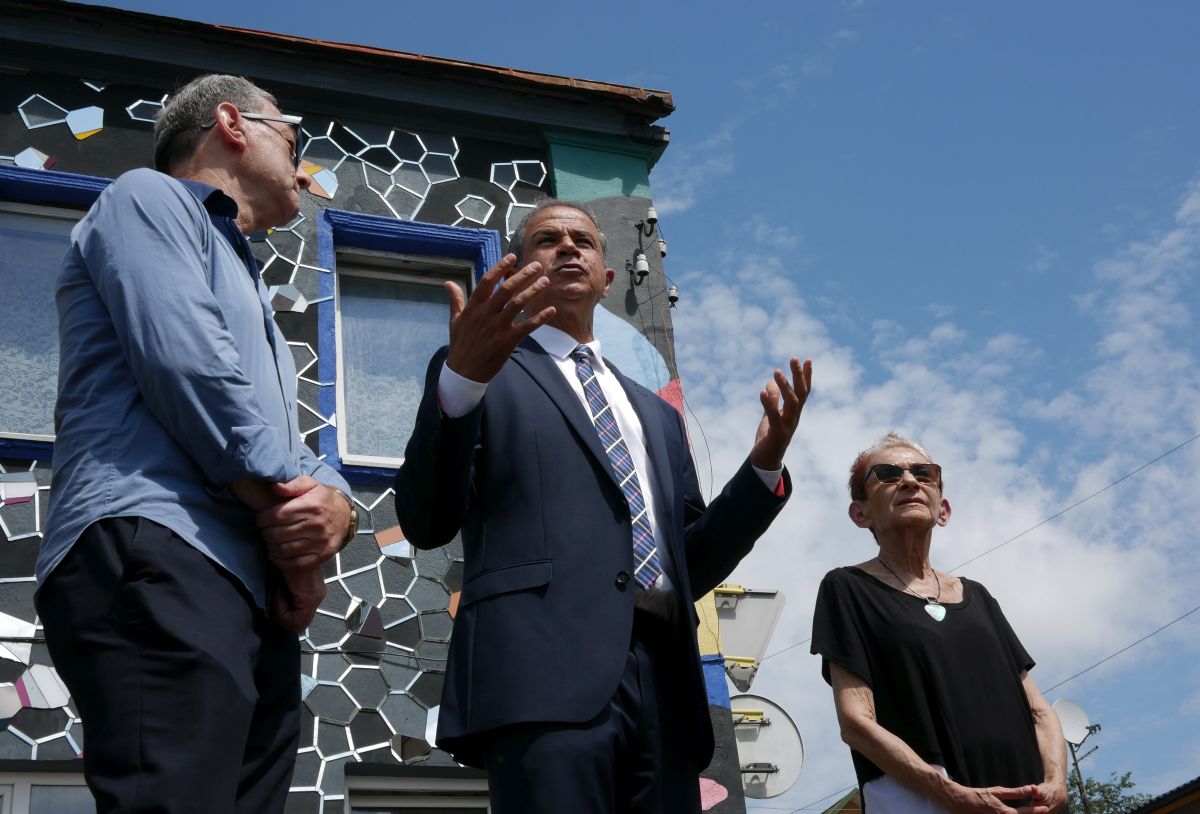
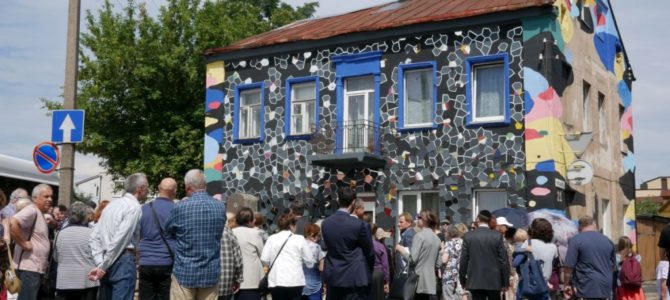
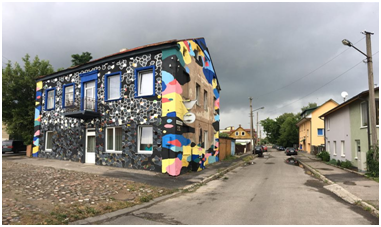
If you drive through the Vilijampolė [Slobodka] neighborhood [in Kaunas] it’s impossible not to notice the brightly-colored house reflecting the sun and car headlights. Artist Vytenis Jakas’s project Burning Stones at the former ghetto gate in Vilijampolė attracted guests to its opening ceremony where the history of the location was recalled publicly. Israeli ambassador Amir Maimon, Kaunas Jewish Community chairman Gercas Žakas and “Kaunas: Capital of Europe 2022” ambassador Bella Shirin attended the ceremony.

“About 40,000 Jews lived in this neighborhood, men, women and children. Each was assigned a living space less than three meters square. The territory was surrounded by barbed wire. Day and night the people here lived in tremendous fear they would be taken to be killed… But, despite everything, life went on here. Although it was forbidden, children were born and the people kept the Sabbath important to the Jewish nation. We should also remember what was good, but we cannot forget the pain and hardships people went through. Today, the Jewish people will live through the bright colors of this house,” Israeli ambassador Amir Maimon said enthusiastically standing next to the large outdoor art project.

Kaunas Jewish Community chairman Gercas Žakas also spoke and members of the Kaunas Jewish Community including Kaunas ghetto survivors attended the event, including Fruma Kučinskienė. Justas Ivanauskas, Saulė Juzelėnienė and others from the Kiemas Gallery in Kaunas contributed to the project.

More photos by Justas Ivanauskas here.

Israeli Defense Forces Honor Holocaust Victims at Ponar

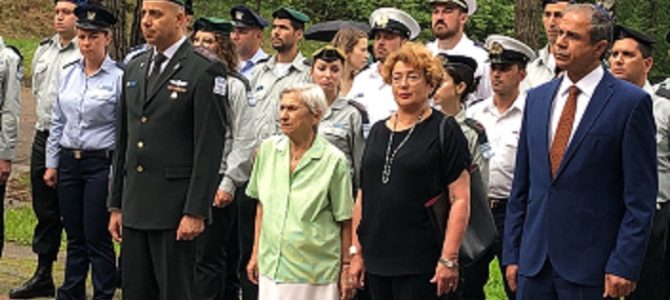
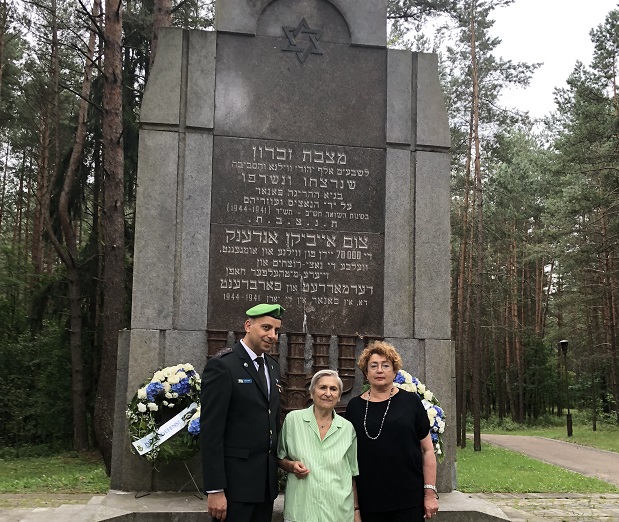
Soldiers from the IDF, the Israeli Defense Forces, visited the Ponar Memorial Complex outside Vilnius to honor the victims of the Holocaust. Israeli ambassador Amir Maimon, Lithuanian Jewish Community chairwoman Faina Kukliansky and Jewish partisan Fania Brancovskaja were present for the commemoration at the main monument in Ponar, the site where the majority of Jews from Vilnius and surrounding areas were shot during World War II.

My Grandfather Wasn’t a Nazi-Fighting War Hero, He Was a Brutal Collaborator


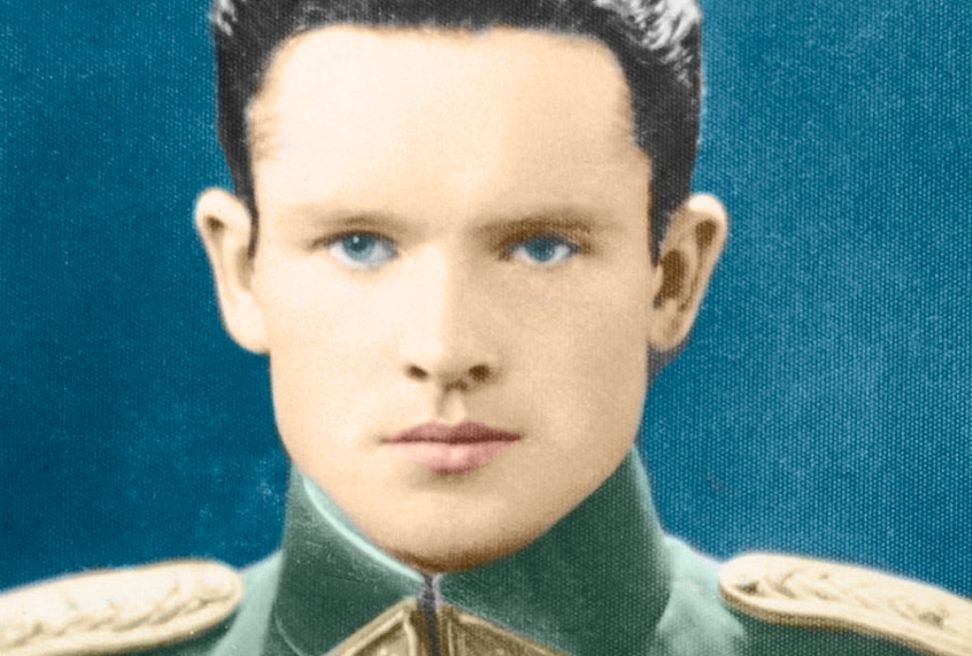
Jonas Noreika. Photo: personal collection of Silvia Foti

A deathbed promise led to me discovering his complicity in the Holocaust, and what it means beyond my family

by Silvia Foti, July 14, 2018

Eighteen years ago, my dying mother asked me to continue working on a book about her father, Jonas Noreika, a famous Lithuanian World War II hero who fought the Communists. Once an opera singer, my mother had passionately devoted herself to this mission and had even gotten a PhD in literature to improve her literary skills. As a journalist, I agreed. I had no idea I was embarking on a project that would lead to a personal crisis, Holocaust denial and an official cover-up by the Lithuanian government.

Growing up in Chicago’s Marquette Park neighborhood–the neighborhood that had the largest population of Lithuanians outside the homeland–I’d heard about how my grandfather died a martyr for the cause of Lithuania’s freedom at the hands of the KGB when he was just 37 years old. According to the family account, he led an uprising against the Communists and won our country back from them, only to have it snatched by the Germans. He became chairman of the northwestern part of the country during the German occupation. According to family lore, he had fought the Nazis and then been sent to a concentration camp in retaliation. He escaped that camp and returned to Vilnius to start a new rebellion against the Communists, had been caught, taken to the KGB prison and tortured. I’d heard how he was the lawyer who had led the defense for 11 rebels before the KGB tribunal, was found guilty and had been executed. His nom de guerre was General Storm. It all seemed so romantic to me.

That is the book I started to write. My mother had collected a trove of material that included 3,000 pages of KGB transcripts; 77 letters to my grandmother; a fairytale to my mother written from the Stutthof concentration camp; letters from family members about his childhood; and hundreds of newspaper and magazine articles. A few months into the project, I visited my dying grandmother, who lived a few blocks away. She asked me not to write the book about her husband. “Just let history lie,” she whispered. I was stunned. “But I promised mom,” I said. She rolled over to face the wall. I didn’t take her request seriously; I thought she was simply giving me a pass because she knew how taxing the project was for my mother.

Full text here.

Yad Ruth Reps Visit Kaunas

Yad Ruth representatives Barbara and Dieter Maier of Hamburg visited Lithuania in June. The Lithuanian Jewish Community and Yad Ruth began working together back in 1994. Members of the organization are Israeli patriots, enthusiastically support Jewish culture and history and study Hebrew and sacred texts.

The idea to start Yad Ruth began in 1980 from personal meetings with Holocaust survivors. The association was formed in 1994, allowing the organization to expand financial prospects and other activities. Yad Ruth means both “Ruth’s hand” and “Ruth in memoriam” in Hebrew, and both phrases fit the organizations activities and goals which are aimed especially at Holocaust survivors and Jews in hard times. Members say as Germans of the post-war generation they feel a special responsibility for the welfare of Jews and for the state of Israel. One of their main tasks is fighting anti-Semitism in Germany and educating the public.

Yad Ruth is active in Germany, Israel, Estonia, Ethiopia, Latvia, Lithuania and Moldova.

Recommendations for Fighting Anti-Semitism and Romophobia in Lithuania, 2018

Attorney and Lithuanian Jewish Community chairwoman Faina Kukliansky on the project “Preparation and Publication of Recommendations for Fighting Anti-Semitism and Romophobia in Lithuania”:

I am truly glad the Lithuanian Jewish Community was given the opportunity to implement the EVZ project “Preparation and Publication of Recommendations for Fighting Anti-Semitism and Romophobia in Lithuania.” Appreciating the great importance and appropriateness of inter-institutional cooperation, the Community carried out the project with experienced and trusted partners: the Roma Social Center, the Lithuanian Human Rights Center, the Women’s Information Center and a specially formed group of experts.

Speaking of expressions of anti-Semitism in Lithuania, the positive changes are obvious. Celebrating 30 years since the restoration of our organization, the Lithuanian Jewish Community is experiencing a real, contemporary cultural renaissance. Our organization is stronger than it was, and interest in Jewish topics in Lithuania is greater than it has been ever. The Community has contributed at least partially, within our powers, to this positive breakthrough. Since 2013 we have been carrying out the Bagel Shop tolerance campaign which to the present has attracted more than 7,000 friends and followers on social media. The year 2017 also saw several important achievements in the field of human rights and the commemoration of historical truth: a jubilee March of the Living at the Ponar Jewish mass murder site, Lithuania’s adoption of the International Holocaust Remembrance Alliance’s definition of anti-Semitism, and the LJC taking the leadership position in the international memory campaign We Remember, which culminated in a commemoration of International Holocaust Remembrance Day at the Lithuanian Foreign Ministry with high state officials, members of the LJC and various public figures. In February of 2018 the Community published our Lithuanian translation of Yitzhak Rudashevski’s Vilnius ghetto diary. This publication, an authentic primary source on the history of the Holocaust, attracted great public interest, and we hope it will be accepted as an aid to teaching the Holocaust in the nation’s public schools and educational institutions.

Despite the evolving discussion by the public and the political class regarding these important issues, the fight against discrimination continues. The history of Lithuanian Jews, spanning 700 years, is still not integrated appropriately in the Lithuanian educational system, the Lithuanian experience of the Soviet occupation is often equated with the Holocaust and the internet is full of expressions of hate directed against Jews as well as Romani.

I am convinced the successful implementation of this project will contribute significantly to the further expansion of human rights and the fight against anti-Semitism and Romophobia, and to encouraging dialogue between distinct communities who share similar problems and institutions in the state and non-governmental sectors.

Recommendations 2018


Condolences

Vidmantė Jasukaitytė, Lithuanian Independence Act signatory, poet, writer, dramaturge and public figure, passed away July 14 following a long battle with illness. She had just turned 70 on July 10.

The Lithuanian Jewish Community express our deepest condolences to her children and friends. Jasukaitytė for many years lived at what was the HKP Nazi labor camp during World War II and created a number of works about the location. Her multimedia poetry installation “Subačius Street. Ghetto” was performed on September 24, 2015, the culmination of a week-long commemoration of Holocaust victims with events held around Vilnius.

Her event was held at the square outside her home where there is a monument to the Jewish inmates and victims of the HKP camp. Moving and still images were projected on the bare brick walls there as professional actors read selections from her poetry, testimonies of HKP camp inmates and Žeraldas Povilaitis’s oratory “Voice from Underground.”

Jasukaitytė had a number of plans for more Holocaust commemoration events including with musicians from the Lithuanian Jewish Community. Today we have a lost a talented writer, a good politician (who personally challenged Gorbachev about locking up Lithuanians avoiding Soviet military duty as mental patients) and a friend, and so we say, may you rest peacefully in the Lithuanian earth.

Lithuanian Jewish Community Asks Pope Francis to Remember Holocaust Victims in Lithuania

The Lithuanian Jewish Community values the upcoming visit to Lithuania by His Holiness Pope Francis as an important gesture of recognition and an historic event as our country celebrates 100 years of independence this year.

The Pope’s visit coincides with the National Day of Remembrance of the Genocide of the Jews of Lithuania, September 23. Seventy-five years ago on this day the final liquidation of the Vilnius ghetto was carried out: men, women, children and the elderly were deported to concentration camps in Poland, Germany, Estonia and Latvia and sent to the Ponar Forest to be shot. The destruction of the Vilnius ghetto is a symbol of the Holocaust in Lithuania. This tragedy not only cost thousands of Lithuanian residents their lives, but also ruined the great intellectual potential of society and deprived us of an important part of the identity of our state.

The Lithuanian Jewish Community calls upon the Lithuanian public and the leaders of global Jewish and Catholic communities and organizations to join us in asking Pope Francis to pray for the lives lost in the Holocaust and for the Righteous Gentiles of Lithuania, and to remember the innocents unfairly condemned and murdered at the Ponar Memorial Complex Jewish mass murder site on September 23, 2018.

Association of Italian Jewish Communities president Noemi Di Segni has called upon Pope Francis to commemorate victims of the Holocaust during his visit to Lithuania on September 23.
Alanta Synagogue Hosts Memory Exhibit

by Vaidotas Žukas, Bernardinai.lt

Jews constituted the majority of the population of the towns of the Molėtai region before World War II. In 1941, however, the Nazi regime issued a verdict against the Jews, the descendants of David were to be abused, tortured and shot… And only God knows how many people from this beautiful lake country contributed to the rescue of their neighbors and vice versa, informing upon them, betraying and shooting them. The Nazis only sent a few Germans to Molėtai. Lithuanian lowlifes performed all of the arrests and shootings of Jews.

There is a bright side, though, to this tragedy: there were also several hundred rescuers of Jews in the Molėtai area, since it took the conviction, daily work and risk-taking in the face of death of several dozen people to hide and protect one Jew. Respect to them!

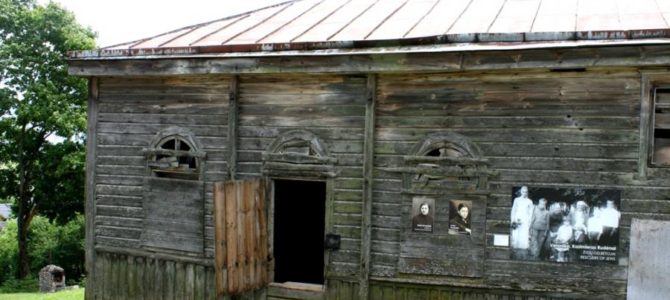
The Alanta synagogue is one of only several surviving wooden synagogues in Lithuania; it hasn’t been destroyed and wasn’t burned down, but it’s still not in good order and unrestored. During the Soviet era grain and fertilizer were stored there. The cut-up wooden walls of the synagogue and the tin roof still with bullet holes from the war witness to both the Holocaust and the continuing reluctant position taken towards Jewish religious and historical heritage in Lithuania.

Ona Šimaitė Dedicated Her Life to the Welfare of Others

by Rasa Baškienė, Bernardinai.lt

Ona Šimaitė was named a Righteous Gentile in 1966 for saving Jews from the Vilnius ghetto. She constantly risked her life from 1941 to 1943, when the Vilnius ghetto existed, saving Jewish children and adults and seeking out shelter and support for them. Vilnius University rector Mykolas Biržiška, his brother Vaclovas Biržiška, the director of the Vilnius University library, and professors and staff at the university helped Ona Šimaitė, as did the writer Kazys Jakubėnas and the clerics A. Lipniūnas, M. Krupavičius, M. Vaitkus and others.

Vilnius Ghetto


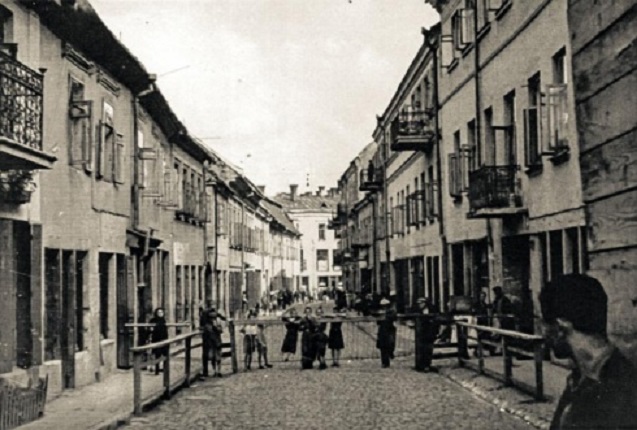
Rūdninkų street in the Vilnius ghetto.

On September 6, 1941, after the Germans had occupied Vilnius, 57,000 Jews were marched to the two ghettos in the Vilnius Old Town. They included many Vilnius University students and teachers, famous professors and scholars. Rector Mykolas Biržiška, university leadership and head librarian Vaclovas Biržiška tried to think of a way to help the Jews condemned to death. Finally a seemingly innocent way to do so was found: they would send two university librarians–catalog department director Ona Šimaitė and reading room director Godliauskaitė into the two ghettos to collect unreturned library books from Jewish readers.

Full story in Lithuanian here.

Jakov Bunka Wooden Sculpture Exhibit

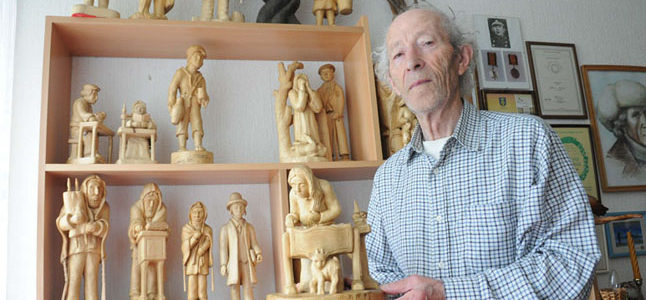
Folk artist and celebrator of Žemaitijan Jewish history Jakov Bunka’s (1923-2014) wooden sculpture exhibition “Moses of Plateliai” is being shown at the Lithuanian National UNESCO Commission gallery at Šv. Jono street no. 11 in Vilnius on occasion of the 95th anniversary of Bunka’s birth.

Bunka was unique. He was the only Jewish folk artist in Lithuania who commemorated Jewish characters within the Lithuanian tradition in wood, he was the last Jew to remain in Plungė and he was rider in the cavalry of the Don Cossacks. After reaching Berlin in 1945 he dedicated his life to commemorating the communities of his fellow Jews annihilated in Lithuania between 1941 and 1945. He made the Kaušėnai memorial to the exterminated Jews of Plungė, wrote a book about the history of the Jews of Plungė, was an honorary citizen of Plungė and was awarded the honor of Knight of the Cross of the Rider of the Order of Lithuanian Grand Duke Gediminas. As Grigoriy Kanovich put it so fittingly in his inscription in his book he gave to Bunka: “To a Žemaitijan Jew, to a Jewish Žemaitijan.”

Jonas Rudzinskas, the chairman of the Union of Lithuanian Folk Artists, said of Bunka: “Jakov Bunka’s aesthetic views, mentality, optimistic nature and work ethic formed in the Žemaitijan environment. … In creating large or inside sculpture, the master did without trifles and insignificant detail. … His responsible, sincere attitude towards creative work and unique style set Jakov Bunka apart from others and he joins the ranks of our greatest folk artists who set the development of folk art.”

Continuing Education Students from Israel Visit Panevėžys Jewish Community

Under an agreement of several years’ standing Edit Perry and Ewa Baranska have led another delegation of people from Jerusalem, Tel Aviv and other Israeli cities to Panevėžys and the Panevėžys Jewish Community. Many are adults involved in continuing education during the academic year on the topic of Jews from the Baltic states. During the summer they strive to visit as many sites as possible where they had family in Lithuania, including Panevėžys. The students were keenly interested in the photography exhibit and archival documents illustrating Jewish life before World War II preserved at the Panevėžys Jewish Community.

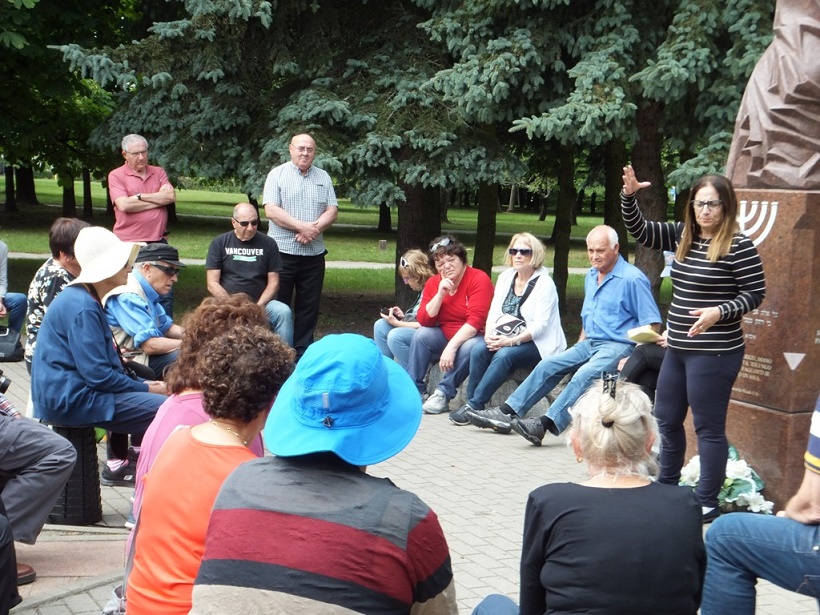
Panevėžys Jewish Community chairman Gennady Kofman and member Jurijus Smirnovas delivered lectures at actual historical sites inside the former ghetto territory and the old Jewish cemetery which is now called Memory Square.

Smirnovas shared his experience of World War II with the visitors. He was a small child at the concentration camps in Panevėžys and Šiauliai and lost his family members.

Burning Stones in the Kaunas Ghetto

The Kaunas Jewish Community and artists from the Kiemas Gallery in Kaunas invite you to the opening ceremony of the Burning Stones project to commemorate the Slobodka Jewish ghetto in Kaunas (1941-1944) at 1:00 P.M. on July 15, 2018, at A. Kriščiukaičio street no. 21 in Kaunas.

“You stand before the gates of the Vilijampolė [Slobodka] Jewish ghetto which operated from 1941 to 1944. Beyond them stretched the territory of death. The stylized stones in the mosaic commemorate the Jewish historical and cultural heritage; while the sun rises and sets, the memory of those who lost their lives in the ghetto, the thousands of Lithuanian citizens of Jewish origin will remain in our minds and those of future generations. The portrait of boys embracing called Neighbors symbolizes the importance of friendly relations between Lithuanians and Jews in the context of those days, closeness, common ground, the ability to forgive. The color clouds floating by remind us of the course of time and, despite the scope of the tragedy which occurred, of hope, and reminds each of us of our responsibility to insure it never happens again.”

–Vytenis Jakas, creator of the Burning Stones project

The project was financed by the city of Kaunas. The opening ceremony will be financed by the Goodwill Foundation.

Happy Birthday to Sora Voloshin Kalavitch


Sora first on left.

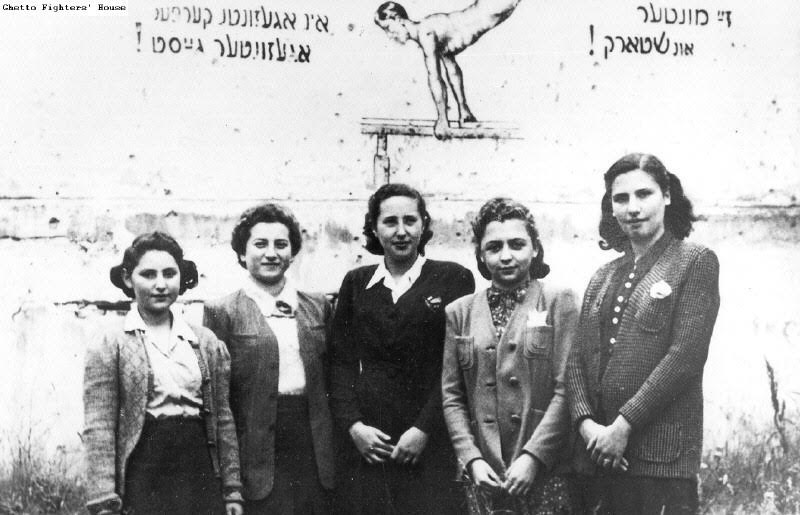
The Lithuanian Jewish Community wishes Sora Voloshin a very happy birthday, good health and to be surrounded by the strong love of family. Mazl tov! Biz hundert azoi ve tsvantsik!

Yitzhak Rudashevski’s cousin Sora survived the Holocaust while Yitzhak and his family were murdered at Ponar. She ran away when they were being taken to Ponar. After the war she went back to the place the Rudashevski family hid, found Yitzhak’s diary and loaned it to Abraham Sutzkever for use as an exhibit in the ill-fated post-war Jewish Museum in Vilnius.

The Lithuanian Jewish Community published a Lithuanian translation of the Yiddish diary this year as we approach the 75th anniversary of the liquidation of the Vilnius ghetto.

Congratulations to Members Decorated by Lithuanian President

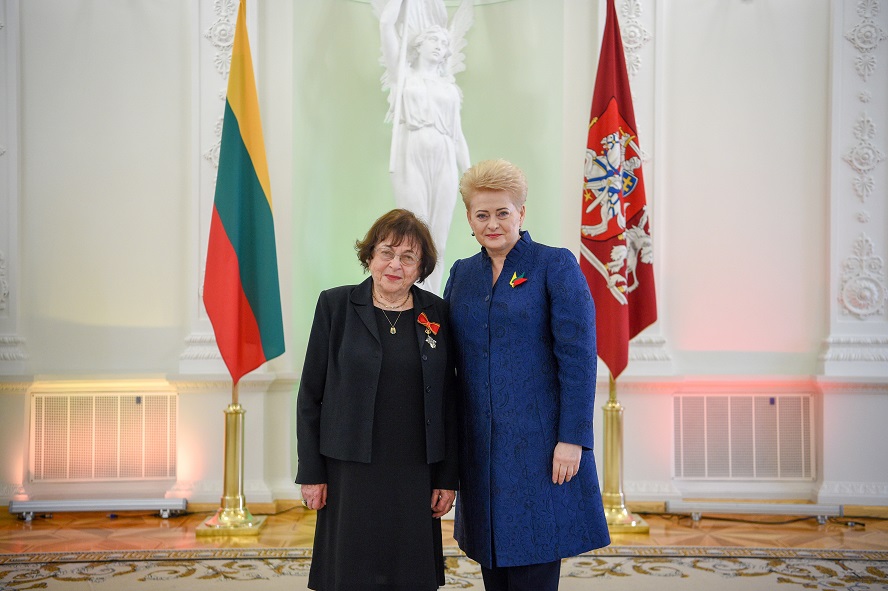
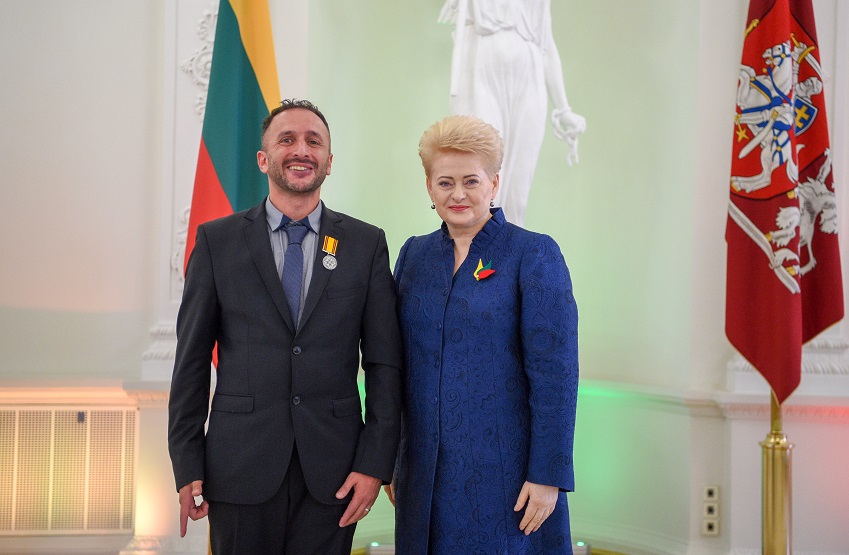
Lithuanian president Dalia Grybauskaitė decorated Lithuanian and foreign citizens for contributions to the Lithuanian state on July 6, State Day.

“Today I would most like to emphasize what has been accomplished, and to thank everyone who works for Lithuania from their heart. Those whose civic-mindedness is not a pose or empty words, those for whom this country is the most important one in the world. Thanks to you Lithuania has in less than three decades travelled this road of statehood and today confidently compares itself to many states in Europe and the world with whom we have strong ties of friendship,” she said at the awards ceremony.

The Lithuanian Jewish Community is proud of and congratulates our members who were decorated on State Day on the 100th anniversary of the Lithuanian state.

Theater expert and propagator of historical memory and tolerance professor Irena Veisaitė was awarded the Great Cross of the Commander “For Merit to Lithuania.”

Journalist and radio host Ernestas Alesinas was recognized for encouraging civic-mindedness and strengthening civil society. He was awarded the Order of the Lithuanian Grand Duke Gediminas.