Learning

Condolences

Condolences

Moshe Kukliansky has died at the age of 97 in Israel. He was the head of the Kukliansky family and was the uncle of Faina Kukliansky, chairwoman of the Lithuanian Jewish Community.

Our deepest condolences to his children Alexander, Zinaida, Liliiana, niece Faina, the multitude of grandchildren and great-grandchildren, and the entire family.

Moshe Kukliansky was a chemist, a witness to Litvak history and a Holocaust survivor. Faina recalls: “Our big family has lost a noble person who survived the Holocaust and was a great witness to Litvak history, a chemist and a just man filled with the law. That’s what he liked to call other people. After my grandmother Zinaida–the mother of Moshe, Samuel and Anna–was murdered and Moshe was forced to work for local farmers, when he came home my father Samuel used to grab his hands and kiss him. Moshe asked ‘What are you so happy about? Our mother is dead.’ My father, who was 11 then, replied ‘I’m happy you’re still here.’ For me, my children and grandchildren, Moshe was like a father and a grandfather, just as all my aunts and uncles were like parents to me, and cousins like brothers and sisters. It is very sad that our last family member of the older generation has passed away.”

Moshe Kukliansky’s telling of the dramatic story of the family’s survival during the Holocaust was immortalized several years back in a film called the Pit of Life and Torment (Gyvybės ir kančių duobė).

Virtual Lectures: Escape from Ponar and Jacques Lipchitz’s Memories of Lithuania

Virtual Lectures: Escape from Ponar and Jacques Lipchitz’s Memories of Lithuania

Please note: the ZOOM platform used for the virtual lectures below is widely known to be unsafe and is considered spyware by competent observers, deployed most likely by China. It can usurp control of cameras and microphones on your computer and telephone. Its use is banned by the U.S. military and U.S. government organizations. The Lithuanian Jewish Community takes no responsibility for those infected by clicking the links below.

§§§

The Vilna Gaon State Jewish Museum is sponsoring two virtual lectures called “Story of Escape from Ponar” and “Lithuania in Jacques Lipchitz’s Reminiscences.”

“I am a sculptor from Lithuania,” Jacques Lipchitz (1891-1973) used to say to introduce himself at openings of his works in museums and galleries around the world, even though Lithuania had disappeared from the world map when these shows took place. Sculpture and memorial heritage researcher Aušra Rožankevičiūtė talks about Lipchitz’s image of Lithuania and his contacts with Lithuanian artists and thinkers.

Happy 100th Birthday to Eta Gurvčiūtė

Happy 100th Birthday to Eta Gurvčiūtė

Happy birthday to Eta Gurvčiūtė as she turns 100. Lithuanian Jewish Community member Eta Gurvčiūtė turned 100 April 27. Clear of mind, with no health complaints and her beautiful smile, she is busy receiving greetings and congratulations today. She was graduated from the Sholem Aleichem Gymnasium before World War II.

Many of our other seniors remember Eta because she volunteered at the medical center of the LJC for so many years, later becoming a client herself. She spends her time these days at the Social Care House for Seniors in Vilnius now.

To celebrate her milestone, the LJC is planning a Fayerlakh concert for everyone at her senior citizens’ home. ALthough she’s celebrating her birthday under strict quarantine at the senior center, the Lithuanian Jewish Center tried to send her a present anyway. We managed to have a vase of flowers and a card delivered.

Greetings from Lithuanian Parliament on Gaon’s 300th Birthday

Greetings from Lithuanian Parliament on Gaon’s 300th Birthday

Dear Lithuanian Jewish Community chairwoman Mrs. Faina Kukliansky, dear Lithuanian Jewish Community,

We mark the 300th anniversary of that most exalted Litvak, Eliyahu ben Solomon Zalman, the Vilna Gaon. The parliament of the Republic of Lithuania named this year, 2020, the Year of the Vilna Gaon and Litvak History, to stress the priceless contribution the Jewish community, an inseparable part of our society for 700 years now, has made to Lithuania’s history, culture, learning and consolidation of statehood through your adherence to tradition and social activity.

In all times there have been people who do not conform to the canons of their era, who through their creativity and unconventional thinking have changed the world. The Jewish people have given so much to the world. One of them, the Gaon or Genius of Vilna, Eliyahu ben Solomon Zalman, was a scholar of Jewish texts and law and a Talmud interpreter and scholar. This was a brave challenge during his times but, happily, Eliyahu grew up in an intellectual environment and was supported by his family and appreciated by the community. Rumors about the young sage and his intellect spread far beyond the limits of Vilnius. The Vilna Gaon became the most renowned religious authority and he changed people’s life paths, thought and the concept of Litvak, and turned Vilnius into a Jewish spiritual center, the Jerusalem of Lithuania. This is a priceless historical, cultural and philosophical legacy of the Jews and Lithuanians of Vilnius and Lithuania and of the other peoples who live in Lithuania.

The Year of the Vilna Gaon and Litvak History is a great opportunity for all of us today, in the words of the Gaon, “to see with our own eyes, hear with our own ears and feel with our entire heart” what significant and rich heritage we have in creating the Lithuania of our future. Congratulations!

[signed]
Gediminas Kirkilas, deputy speaker, chairman of the European Affairs Committee
Lithuanian parliament

Jewish Confederation of Ukraine Sends Congratulations on 300th Birthday of Gaon

Jewish Confederation of Ukraine Sends Congratulations on 300th Birthday of Gaon

April 24, 2020

Dear friends!

The Jewish Confederation of Ukraine sincerely congratulates you on the 300th anniversary of the Vilna Gaon who is a symbol of wisdom and spirituality for Jews around the world.

The memory of the great leader of the best Jewish traditions and laws stands beyond the constraints of time and brings together generations of Jews.

May the brilliant heritage of the Vilnius Gaon help the Lithuanian Jewish Community to successfully develop and increase the traditions embodied in his philosophical teaching.

Jewish Confederation of Ukraine

Anniversary of Gaon Central in Conversation between Israeli and Lithuanian Presidents

Anniversary of Gaon Central in Conversation between Israeli and Lithuanian Presidents

April 23 was the 300th anniversary of the birth of the Vilna Gaon, the outstanding Torah-Talmud scholar from Vilnius in the 18th century. Lithuanian president Gitanas Nausėda and Israeli president Reuven Rivlin called each other to offer congratulations on the occasion.

The Lithuanian president expressed respect for the Vilna Gaon, the Rabbi Eliyahu ben Soiomon Zalman, who put Vilnius on the map as a center for Torah learning. He told the Israeli president the year 2020 had been declared the Year of the Vilna Gaon and Litvak History in Lithuania to honor the Gaon’s bright memory.

“The intellect and erudition of the Vilna Gaon made Vilnius the spiritual center of Jews in Europe, famous throughout the world. It was thanks to him that Vilnius appeared on the world map as the capital of Torah-Talmud scholarship and became the religious center of Judaism. The Gaon’s teaching, based on thoroughness, patience and dedication to revealing spiritual power and to seeking wisdom, is an inspiration in difficult times,” the Lithuanian president said.

President Nausėda emphasized Lithuania remains the home of the large Litvak community spread throughout the world. The Lithuanian Jewish Community maintains active ties with Litvaks living in Israel, the USA, South Africa, France and elsewhere, Nausėda noted.

The two presidents also discussed the health situation in their two countries and measures for restoring economic life. They agreed this time full of challenges the world faces demands special attention to international relations and solidarity between the nations.

At the end of their conversation the Lithuanian president greeted Israel on the 72nd anniversary of statehood and invited the Israeli president to visit Lithuania.

Information from the President’s Communication Group

Letter from WJC President to Member Organizations: Getting Back to Normal

Subject: The Jewish imperative of the coronavirus crisis
From : Ronald S. Lauder, WJC President
To: Affiliate organizations

Dear Friends,

I hope that, despite the difficult circumstances, you and your families had a good Pesach, and that you are managing to deal with the difficulties of the current situation without too much hardship.

As the COVID-19 coronavirus continues to spread around the world and impact all of our lives significantly on a daily basis, I have been giving a lot of thought to how we, as representative of Jewish communities around the world, should act now and also start to prepare for the challenges of transition to the post-corona world.

I hope that you will find my views on this critical issue, published in the Jerusalem Post, to be of interest:

Click Here to Read

Of course, I would be most interested to hear your reactions.

Please keep well and stay safe. If there is anything at all that we can do to be of assistance to you or your community, at this time, please let us know.

Best wishes and Shabbat Shalom,

Ronald

True Meaning of Leonard Cohen’s Love Song

True Meaning of Leonard Cohen’s Love Song


by Ruth Reches

Most people probably know the song “Dance Me to the End of Love” written in 1984 by Leonard Cohen. Many people consider it a love song with its up and down melody. Leonard Cohen, however, wrote the song as a hymn to death.

Consider the first line in the song: ”
Dance me to your beauty with a burning violin.”

When prisoners at some concentration camps were selected for and taken to be murdered, a group of prisoners played violins to mask the sounds of people being slaughtered. The classical music performed erased the border between beauty and the horrific, between life and death.

Small Gathering Honors Memory of Vilna Gaon at Nominal Grave in Vilnius

Small Gathering Honors Memory of Vilna Gaon at Nominal Grave in Vilnius

The Lithuanian Foreign Ministry reports Lithuanian Jewish Community chairwoman Faina Kukliansky, Lithuanian foreign minister Linas Linkevičius and Israeli ambassador Yossef Levy gathered at what is considered the final resting place of the mortal remains of the Vilna Gaon in the Jewish section of the Sudervės road cemetery in Vilnius April 23, the 300th anniversary of the birth of the Gaon.

The Lithuanian foreign minister expressed the hope events planned to mark 2020 as the Year of the Vilna Gaon which were postponed because of the virus epidemic will take place later in the year.

EBRD Awards Grigoriy Kanovich’s Book Devilspel European Literature Prize

EBRD Awards Grigoriy Kanovich’s Book Devilspel European Literature Prize

From Noir Press:

PRESS RELEASE

April 22, 2020

Lithuanian author wins €20,000 Literature Prize from European Bank for Reconstruction and Development
The UK publishing house Noir Press is delighted Lithuanian Jewish author Grigory Kanovich has just won the €20,000 EBRD Literature Prize, a prestigious award celebrating literature in translation.

The prize, normally awarded at Bank headquarters in London, was awarded virtually this year because of the quarantine announced by the UK Government. The award was announced on Twitter on April 22.

Rosie Goldsmith, chairwoman of the panel of judges for this year’s prize, said the winning novel “is sincere, it is warm, it is generous. It has the feeling of a very great classic.”

Three Hundredth Birthday of the Vilna Gaon

Three Hundredth Birthday of the Vilna Gaon

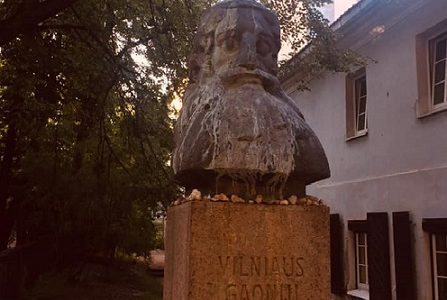
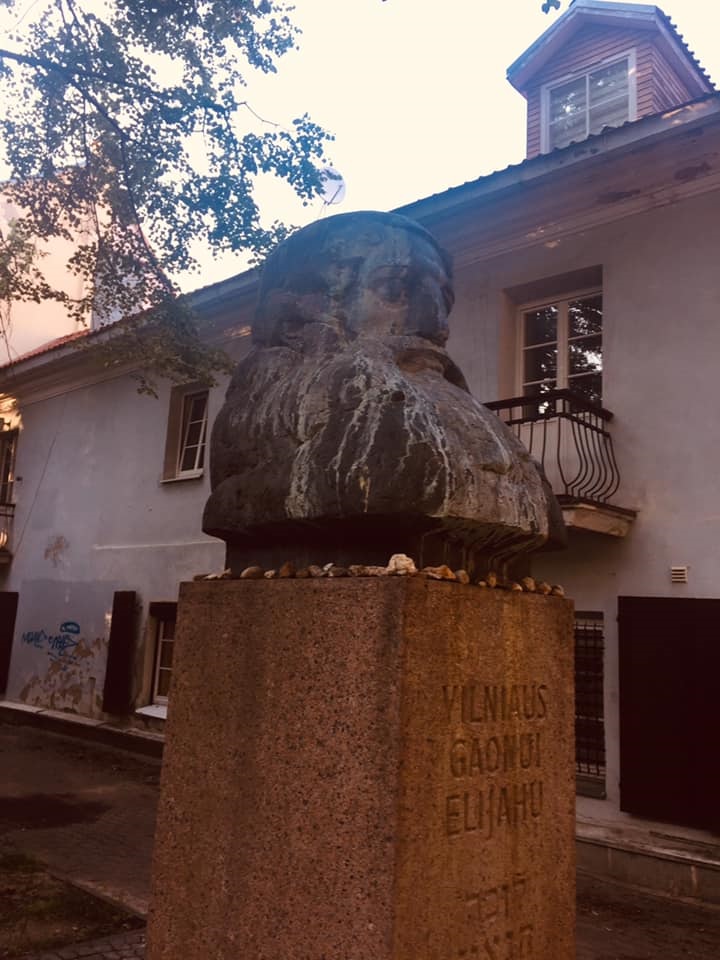
The Lithuanian parliament has proclaimed 2020 the Year of the Vilna Gaon, the 18th century scholar and cultural figure Eliyahu ben Solomon Zalman, and the Year of Litvak History. This anniversary has also been listed on UNESCO’s list of anniversaries for 2020 and 2021. On April 23 we mark the 300th birthday of the Vilna Gaon.

Scholars consider the Gaon the greated Talmudic scholar in Eastern European Jewish history. He is also the father of the rabbinical movement’s struggle against Hasidism and is considered the primary figure in rabbinical learning among Eastern European Jews. The Gaon and his followers, mitnagdim or misnagdim (literally “opponents,” i.e., of Hasidism) are sometimes called prophets of learning.

The Vilna Gaon had a deep interest in different branches of the exact sciences and his texts on geometry, astronomy and geography are often ascribed to the Haskalah, the Jewish enlightenment which arose in the 1770s in Central and Western Europe. Alan Nadler, professor emeritus of religious studies and formerly the director of a Jewish studies program in the USA, says the Gaon’s interest in secular subjects stimulated the expansion of many academic fields and the Gaon became a symbol of educated Judaism.

Eliyahu ben Shelomoh Zalman, the Vilna Gaon

Eliyahu ben Shelomoh Zalman, the Vilna Gaon

Eliyahu ben Shelomoh Zalman

(Gaon of Vilna; 1720–1797), Torah scholar, kabbalist, and communal leader. The Gaon of Vilna (known also by the acronym Gra, for Gaon Rabbi Eliyahu) was a spiritual giant, a role model and source of inspiration for generations, and the central cultural figure of Lithuanian Jewry. Eliyahu ben Shelomoh Zalman was born into a rabbinical and scholarly family, and following a short period of study in a heder, studied Torah with his father. At age 7, he was sent to study with Mosheh Margoliot, rabbi of Keydan (Lith., Kėdainiai). Soon thereafter, he began to study on his own, and at 18, left Vilna to go into “exile”—a period of wandering through Jewish communities of Poland and Germany.

Upon Eliyahu’s return to Vilna, he shut himself in his house and devoted his energy to Torah study. He continued in this path throughout his life, supported by the local Jewish community. When Eliyahu was 35 years old, Yonatan Eybeschütz, who was suspected of Sabbatian leanings, turned to him, seeking support and referring to him as “one who is unique, saintly, holy, and pure, the light of Israel, possessing all-embracing knowledge, sharp and well-versed, with 10 measures of esoteric knowledge . . . whose praise is recognized in all of Poland . . .” (Eybeschütz, Luḥot ha-‘edut [1756], p. 71). It seems, then, that the Gaon of Vilna had already achieved legendary status during his lifetime.

Jewish Vilnius 1990

Jewish Vilnius 1990

German TV, also shown on Israel Channel 2, captures the early days of the revival of the Jewish Community in Lithuania in 1990. First Jewish organizations. Grigory Kanovich’s “Jewish Daisy”: to stay or to leave.

Condolences

Condolences

The Lithuanian Jewish Community extends our deepest condolences to the friends and family of noted writer and producer Felix Dektor who passed away at the age of 89 in Jerusalem. He was born December 21, 1930, in Minsk to a family of Litvaks. He lived there until being evacuated to the Ukraine and then Siberia during the Holocaust.

Graduated from the History and Philology Faculty of Vilnius University in 1955, Dektor continued studies at the Gorky Institute of Literature in Moscow including in Lev Ozerov’s literary translation seminar. Dektor translated a number of Lithuanian writers into Russian, including books by Justinas Marcinkevičius, Juozas Požėra, Alfonsas Bieliauskis and Mykolas Sluckis. His best-known translations were perhaps the novels of Icchokas Meras on Jewish death and valor during the Holocaust (Ничья длится мгновенье (Вечный шах) and На чём держится мир).

Dektor was removed from the Writers’ Union of the Soviet Union in 1975 in response to his publication and distribution of the Jewish cultural and educational magazine Tarbut.

Jewish Holiday of Freedom Celebrated without Foods Recalling Slavery

Jewish Holiday of Freedom Celebrated without Foods Recalling Slavery

Judita Gliauberzonaitė, 42, chairwoman of the Vilnius Lithuanian Jerusalem Jewish community, recalls how her grandmother Cilė Žiburkienė every spring before Passover would cleanse the entire house so that, God forbid, not even a grain of flour would remain, which would mean leavened bread remained in the house, a sign recalling the enslavement of the Jews in the land of Egypt.

Jews around the world who count their history in millennia begin celebrating their Passover holiday on the 15th day in the month of Nisan (March or April), lasting for seven days in Israel and eight elsewhere in the world. Secular Jews who keep to tradition usually celebrate the first and last days of Passover, gathering as families for dinner.

Judita Gliauberzonaitė says more religious Jews attend synagogue every day of Passover.

Passover often coincides with Catholic Easter. This year it began on April 8 and continues till April 15.

We Did It, We Got Matzo to Our Seniors

We Did It, We Got Matzo to Our Seniors

Two weeks ago the Community accepted the challenge to distribute and home-deliver more matzo to more than 900 seniors living in Vilnius. Today we can truly say, mission accomplished.

It would have been mission impossible without the help of our volunteers who heeded the Community’s call for help. We had from 3 to 4 teams of Community staff and volunteers on the street daily.

The distribution of matzo took place so very smoothly because we were able to harness so many who offered to help.

A mitzvah should be done quietly and without fanfare, but the Community has a right to know who its heroes are.

Menachem Rosensaft Sends Passover Greetings

Menachem Rosensaft Sends Passover Greetings

Dear Friends,

I want to wish all of you and yours a peaceful and health-filled Pesach. May we all succeed in adapting to the pandemic crisis sufficiently to have meaningful Seders, in many (most) cases connecting remotely to family members who should have been sitting with us.

In advance of Yom HaShoah, Holocaust Remembrance Day, I also want to share with you a video that the World Jewish Congress produced, in cooperation with the World Federation of Bergen-Belsen Associations, (WFBBA) about the liberation of the Bergen-Belsen concentration camp, the Belsen Displaced Persons camp, and the more than 2,000 children born in the DP camp’s Glyn Hughes Hospital:
https://youtu.be/Jv9M0yvi_J0

I hope that the example of the survivors’ resilience, determination and optimism as they emerged from the horrors of the Holocaust will inspire us at this difficult and anxious time. Please feel free to share the video widely.

I am also pleased to share with you a second video, also produced by the WJC together with the WFBBA, based on the beautiful photography of Debbie Morag featuring daughters of Auschwitz survivors:
https://youtu.be/b_PrrHLp8U4

Again, I wish you and yours a peaceful, health-filled Pesach.

With all warm regards,

Menachem

§§§

Menachem Z. Rosensaft (born 1948 in Bergen-Belsen, Germany) an attorney in New York and the Founding Chairman of the International Network of Children of Jewish Survivors, is a leader of the Second Generation movement of children of survivors,[1] and has been described on the front page of the New York Times as one of the most prominent of the survivors’ sons and daughters.

LJC Chairwoman Faina Kukliansky and Lithuanian Jewish Religious Community Chairman Simas Levinas Send Passover Greetings to Community

LJC Chairwoman Faina Kukliansky and Lithuanian Jewish Religious Community Chairman Simas Levinas Send Passover Greetings to Community

Dear Community members,

So Passover, the holiday eagerly awaited by Jews around the world, has come.

The seder night is so important to Jews, when we eat matzo, meditate and remember G_d’s revelation during the flight from Egypt. We do this year after year. This is what our fathers and forefathers have done, and we do it, and we teach it to our children.

This year the seder won’t be so large, not all family members are able to come to the table, not here in the Diaspora and not in our historical homeland Eretz Israel.

This has happened to Jews many times before–slavery, the Inquisition, wars and other misfortunes have separated families so many times before, leaving some of us alone, turning some of us into outsiders. This year we celebrate Passover during a time which is difficult not just for Jews.

Nonetheless, let’s try. Let’s remember and tell in our thoughts the story of the exodus from Egypt. Let’s pose the questions to ourselves and find the correct answers. Let’s remember at least a few of the 248 mitzvot, let’s believe in miracles if only briefly, and in the arrival of the Messiah.

Let’s believe, let’s dream, let’s think and let’s thank the Most High that we are alive and spring has come, and let’s give thanks for every day lived and believe in the future.

Next year will be better. We just have to believe it.

A happy holiday to all, be free and be happy.

Lithuanian TV Program Crossroads of Cultures: Menora Asks How Lithuanian Jewish Community Is Doing under Quarantine

Lithuanian TV Program Crossroads of Cultures: Menora Asks How Lithuanian Jewish Community Is Doing under Quarantine

Following the state of emergency announced in Lithuania, the daily life of the Lithuanian Jewish Community has changed. All events have been canceled, entry to visitors is restricted and some staff are working from home. The work of the Community’s Social Center hasn’t stopped, though.

To view the program in Lithuanian, click below.

Kultūrų kryžkelė. Menora. Kaip žydų bendruomenė laikosi karantino laikotarpiu?

§§§

Panevėžys Jewish Community Sends Passover Greetings

Panevėžys Jewish Community Sends Passover Greetings

Despite the complicated time in the world, the dates assigned by the Torah to the holidays don’t change and they are part of the history and story of the Jewish people. Passover is one of the main Jewish holy days. Over the days of Passover Jews remember their historic liberation from slavery.

During these difficult days I wish you patience, the love of those around you and endurance. Maintain hygienic requirements and adhere to the safety measures as we fight the corona virus.

Gennady Kofman, chairman
Panevėžys Jewish Community