
Learning

Committee for the Preservation of Jewish Cemeteries in Europe on Šnipiškės Cemetery

Committee for the Preservation of Jewish Cemeteries in Europe on Šnipiškės Cemetery

PRESS RELEASE by the Committee for the Protection of Jewish Cemeteries in Europe
(CPJCE)
January 18, 2022

The Lithuanian Government reaffirms its commitment to follow CPJCE guidelines on future plans of the Sports Palace Building situated in the Snipiskes Jewish cemetery in Vilnius.

The future function of the existing Sports Palace Building was discussed at a meeting held in Vilnius on November 25, 2021, between first deputy chancellor Mr. Rolandas Krisciunas, accompanied by his working team, and Mrs. Faina Kukliansky, chairwoman of the Lithuanian Jewish Community, together with Rabbi H. Gluck OBE and Rabbi Y. Schlesinger representing the CPJCE.

Rabbi Gluck pointed out that regardless what the future plans hold, the Government must respect the agreements signed between the Government and the CPJCE in 2009 and 2015 and therefore no movement of soil is allowed in the entire cemetery area, and the Government should continue to work hand-in-hand with CPJCE to ensure the safeguarding of the cemetery and other cemeteries in the framework of the halachic guidelines.

Lithuanian Prime Minister Talks about Jewish Legacy in Radio Interview

Lithuanian Prime Minister Talks about Jewish Legacy in Radio Interview

LRT.lt: This interview is taking place on January 27, which is International Day of Commemoration in Memory of the Victims of the Holocaust. This topic is important to you, you took part in the Road of Memory procession several times if I recall correctly. The topic of the Holocaust is sparking a great many discussions in Lithuania and it’s clear we haven’t answered many questions. Have we, Lithuania, as a state, bearing in mind the entire history, have we commemorated sufficiently the victims and rescuers?

Lithuanian prime minister Ingrida Šimonytė: I think we haven’t fully realized over all what Jews mean in Lithuanian history. … The very scope, the understanding that 200,000 people, that the residents of the towns were in the majority the large Jewish communities which simply disappeared, someone took and wiped 200,000 people out of the picture. I came to that realization rather late.

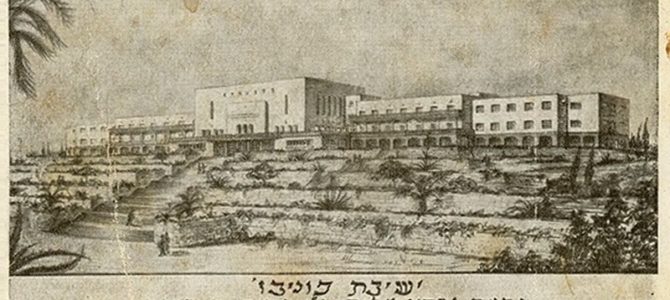
Regarding the Palace of Sports, it has its own specific features because it is a building which is [protected] cultural heritage, nothing new may be built there, it can only be commemorated and put to public use. I won’t hide that there are people who say we should let this building fall into ruin because there are so many off-limit areas, so let the building fall down of its own accord. This is a difficult decision, to wait for the building to fall down in the middle of the city. I don’t think we should do this, but I also don’t think some other kind of application would meet with great support.

Holocaust Distortion Is the Real Challenge Today

Holocaust Distortion Is the Real Challenge Today

Eastern Europe’s post-Soviet “new democracies” have taken to falsely equating Communist and Nazi regimes and denying the role they played in the genocide

Last week a minor miracle occurred, at of all places the United Nations. For only the second time since the establishment of Israel, the General Assembly adopted a resolution sponsored by the Jewish state. In fact, the support for the resolution was so overwhelming that it was approved by consensus, meaning that it passed without a country by country vote, with the only objection registered in the 193 country body by (surprise, surprise) the Iranians.

The resolution itself deserves scrutiny. It expresses concern over “the growing prevalence of Holocaust denial or distortion through the use of information and communications technologies,” and urges all UN members to “reject, without any reservation, any denial or distortion of the Holocaust as a historical event, either in full or in part, or any activities to this end.” It also called upon all UN members “to develop educational programs that will inculcate future generations with the lessons of the Holocaust in order to help to prevent future acts of genocide.”

Symbolically, the resolution was passed on the 80th anniversary of the Wannsee Conference of January 20, 1942, at which 15 leading Nazi officials and SS operatives were informed of the decision to launch the “Final Solution of the Jewish Question,” and the details of its implementation.

Full article here.

Resurrection of the Palace of Sports: Could It Become a Jewish Memorial?

Resurrection of the Palace of Sports: Could It Become a Jewish Memorial?

On International Holocaust Day Lithuanian prime minister Ingrida Šimonytė told LRT.lt the Palace of Sports complex in Vilnius could become a memorial to Jews. For more than a decade now there has been consideration on how to renovate this historical building of brutalist architecture. The main idea was to create a modern conference center, but the Government might not go along with this now.

The building has a unique roof and is an example of brutalism [Soviet architecture]. If there are even a few sites in the Lithuanian capital where it’s possible to travel back through time in an instant, the Palace of Sports is one of them. Abandoned and apparently forgotten, although it once throbbed with life.

Many Lithuanian music stars performed on its stage and festivals and plays were held there.

In 1989 while the USSR still existed the group Sonic Youth performed there.

The Lithuanian independence movement Sąjūdis held its founding conference there.

Vytautas Mikalauskas Art Gymnasium Students Commemorate Holocaust Day in Panevėžys

Vytautas Mikalauskas Art Gymnasium Students Commemorate Holocaust Day in Panevėžys

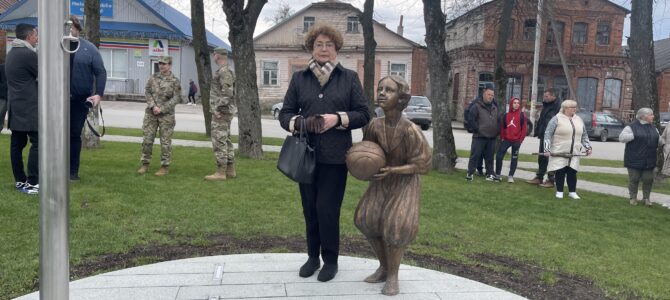
Panevėžys students marked International Day of Commemoration in Memory of the Victims of the Holocaust. Panevėžys Jewish Community chairman Gennady Kofman was invited to speak at the event.

“Today like never before young people must know, understand and remember. This is the only hope that this indescribable horror not repeat itself, it is the only way to bring us out of darkness,” Jewish writer and Holocaust survivor Elisa Springer said.

At the event, Elena Adelina Kofman served as moderator, and said the systematic mass murder and genocide of the Jews, also known as the Shoah, saw the greatest percentage of victims over a very short period in Lithuania. Around 96 percent of Jews were exterminated in Lithuania, around 200,000 people. She said that made this commemoration especially important.

Invitation to Mark International Day of Commemoration in Memory of the Victims of the Holocaust

Invitation to Mark International Day of Commemoration in Memory of the Victims of the Holocaust

January 27 is International Day of Commemoration in Memory of the Victims of the Holocaust, recalling the six million Jews murdered during the Holocaust. The Lithuanian Jewish Community invites Lithuania’s educational and scientific community to join us in the campaign #WeRemember/#MesPrisimename and to remember the victims, eye-witnesses and heroes of the Holocaust who lived in the cities and towns of Lithuania.

We invite you to engage actively in International Day of Commemoration in Memory of the Victims of the Holocaust and to spread the news about the importance of this day among the various educational communities and institutions of general, higher and professional learning. Assign the activities of this day to teaching young people about the memory of Holocaust victims and organize encounters with the older members of the Jewish communities who remember and won’t let these horrific periods of history slip into oblivion. We invite you to pay special attention to remembering those who rescued Jews. Their courage set an example of humanity for future generations.

You can find educational materials, testimonies and stories told by survivors and other useful information which will help present the story of the Holocaust in an interactive and understandable way to young people on the Lithuanian Jewish Community’s webpages lzb.lt, lzb.lt/en and lzb.lt/ru, and at our virtual initiative @AtmintiesKalendorius on our facebook page.

You can also take part in the campaign by visiting the mass murder sites in your local area and by taking photos there and posting them to your social media with the hashtags #WeRemember and/or #MesPrisimename. Take a photo of yourself holding a piece of paper or a sign with the inscription #WeRemember and/or #MesPrisimename. Also, on the eve of the International Day of Commemoration in Memory of the Victims of the Holocaust, join the global campaign by adding a #WeRemember frame to your social media profile. Frames can be found at #WeRemember and/or #MesPrisimename.

#WeRemember #MesPrisimename #Neveragain #NiekadaDaugiau #HolocaustMemorialDay

Thank you,

Faina Kukliansky, chairwoman
Lithuanian Jewish Community

Moshe Kulbak’s Mesiekh ben Efrayim Translated and Published in Lithuanian

Moshe Kulbak’s Mesiekh ben Efrayim Translated and Published in Lithuanian

Lithuania’s Odilė publishing house has translated and printed a Lithuanian translation of Yiddish writer Moshe Kulbak’s book Mesiekh ben Efrayim under the title Mesijas, Efraimo sūnus. The description by internet vendor knygynas.biz says:

Classic of Lithuanian and world Jewish literature Moishe Kulbak (1896-1937) is known to Lithuanian readers as the author of the wonderful poem Vilne. Finally for the first his prose has appeared in Lithuanian, the novel Messiah ben Efraim. This is one of the most famous and most original of Kulbak’s Yiddish works. It was written in Berlin in 1922 and is suffused with magical realism, something which hadn’t been seen before. The author’s vital and innovative imagination connects surrealistic and expressionistic images here with the oral tradition and strong mystical spirit of Lithuanian Jews. This ensemble recalls the impressive paintings of Marc Chagall.

The novel Messiah ben Efraim is based on a Jewish legend which comes from the Talmud that there are always 36 hidden just men living in the world without whose unseen actions the world would pass away [lamed-vavnik tzadikim or lamed-vavniki]. Kulbak creates a story about these holy people living in historical Lithuanian [Grand Duchy] lands–in Belarus and Žemaitija. Elderly miller Benya, Simkha the rabbi who ran away from his community, the philosopher-bum Gimpel, Christian sauna operator Kiril–these souls trapped in the world seeking the light, guided a strange unease embark on a journey without any explicable destination. During this fantastic trip filled with humor and mystical experiences the cause of this unease driving on the travellers gradually comes into focus: it’s the impending advent of the Messiah to the land of Lithuania.

Filmmaker Emilis Vėlyvis Calls Izaokas Best Lithuanian Art Film in 30 Years

Filmmaker Emilis Vėlyvis Calls Izaokas Best Lithuanian Art Film in 30 Years

LRT.lt, August 30, 2021

Jurgis Matulevičius film debut “Izaokas” has been playing for three weeks now at Lithuanian movie theaters and has received much praise from average moviegoers and film-industry colleagues as well, according to a press release by the makers of the film.

“Although the category of art film is not my favorite, the film Izaokas is in my opinion the best work in this category over the last 30 years of Lithuanian cinema. Bearing in mind that this is the first full-length feature by the director, he should be given another medal as well for talent,” film director Emilis Vėlyvis said.

Full article in Lithuanian here.

The film tells the story of an LAF volunteer who murders a Jew named Izaokas, or Isaac, during the Lietūkis garage massacre in Kaunas in 1941 and who is haunted by the memory for years. The IMDB entry for the film says:

UN General Assembly Adopts German-Israeli Proposal against Holocaust Denial

UN General Assembly Adopts German-Israeli Proposal against Holocaust Denial

Deutsche Welle

Ambassadors of Israel and Germany say denying the Holocaust threatens peaceful coexistence worldwide. Their appeal comes 80 years after the Wannsee Conference where Nazis discussed the extermination of Europe’s Jews.

The UN General Assembly on Thursday adopted a resolution proposed by Israeli and German ambassadors rejecting and condemning any denial of the Holocaust.

The 193-member assembly agreed on the proposal without a vote with only Iran distancing itself from the text. The assembly also urged social media companies to “take active measures” to fight anti-Semitism online.

“The General Assembly is sending a strong and unambiguous message against the denial or the distortion of these historical facts,” German UN ambassador Antje Leendertse said. “Ignoring historical facts increases the risk that they will be repeated.”

Full story here.

Yad Vashem Budget Increased by 29 Million Shekels

Yad Vashem Budget Increased by 29 Million Shekels

As expected, the Israeli Government approved an increase to the budget of the Yad Vahsem Holocaust Commemoration and Research Institute on Sunday, January 23, increasing the institution’s budget by 29 million shekels for 2022 to combat anti-Semitism and Holocaust denial. It was reported earlier the budget increase was needed because of flagging donations.

First-Ever Exhibit of Michael Brenner’s Works in Lithuania

First-Ever Exhibit of Michael Brenner’s Works in Lithuania

The Šeduva Jewish Memorial Fund and the Aušra Museum in Šiauliai are pleased to invite the public the first-ever exhibition in Lithuania of works by famous Litvak designer and sculptor Michael Brenner. Brenner almost never exhibited his works during his lifetime and rarely invited anyone into his studios.

The exhibit called “Michael Brenner: Free Fall” will open at the Chaim Frenkel villa located at Vilniaus street no. 74 in Šiauliai at 5:30 P.M. on January 22. For more information, click on the links below.

Sergei Liser Exhibit

Sergei Liser Exhibit

The Lithuanian Jewish Community is pleased to announce the opening of an exhibit of paintings by Sergei Liser called “Surviving Vessels.” The opening will be held at 3:00 P.M. on January 30 at the Bagel Shop Café at Pylimo street no. 4 in Vilnius. The exhibit will run till February 28.

#WeRemember/#MesPrisimename 2022

#WeRemember/#MesPrisimename 2022

On January 27 International Day of Commemoration in Memory of the Victims of the Holocaust will be marked around the world, recalling the death of six million Jews in the Holocaust.

The Lithuanian Jewish Community invites you to participate in the event and to remember the victims, eye-witnesses and rescuers who lived in Lithuania’s towns and cities.

Remembrance of the suffering Holocaust victims experienced compels us to accept shared responsibility to prevent crimes against humanity. We invite you to get involved by visiting the mass murder and mass grave sites where you live, or by sharing the hashtag #WeRemember or #MesPrisimename on your social media accounts.

The Forgotten Proto-Zionist: The Visionary Life of Warder Cresson

The Forgotten Proto-Zionist: The Visionary Life of Warder Cresson

by Michael Medved

Israel’s contemporary critics angrily insist that the special relationship between America and the Jewish state stems solely from the outsize electoral and economic clout of American Jews. But those who argue that this undue influence has always shaped our policies in the Middle East ignore the fact that the commitment to a rebuilt Jerusalem and a reborn Israel began at a time when the Republic’s Jewish community played an insignificant role in national life, with a minimal population amounting to far less than 1 percent of the federal total. In fact, the idea that the United States ought to link its fate to a Jewish state officially originated in 1844 with the very first diplomat America ever dispatched to Jerusalem, more than a century before Israel’s Declaration of Independence. His name was Warder Cresson, and he led an extraordinary and singular American life.

Cresson’s own Huguenot forebears first came to the New World from Holland in 1657, settling in Delaware and New York. After some adventures in the West Indies, his grandfather Solomon found his way to Philadelphia, where he became an ardent member of the Society of Friends and part of the new city’s Quaker establishment. As successful artisans and entrepreneurs, the Cressons owned prime real estate on Chestnut Street in the center of town as well as valuable agricultural properties in the surrounding countryside.

Born in 1798, Cresson began working the family farms in nearby Darby and Chester counties at age 17, impressing relatives and neighbors with his business and leadership abilities. Married at 23 to another devout Quaker, he proceeded to raise six children of his own and to follow the clan’s pattern of judicious investment and accumulation of wealth.

Full story here.

Jonas Noreika Was Holocaust Perp, Not Righteous Gentile, Granddaughter Says

Jonas Noreika Was Holocaust Perp, Not Righteous Gentile, Granddaughter Says

Jonas Noreika: Savior or slayer of Jews?
by Silvia Foti

My maternal grandfather was declared a Rescuer of the Jews by the Lithuanian Genocide Resistance and Research Centre. This division is funded by the Lithuanian government, dedicated to establishing and enforcing the legal and official historical narrative of the nation.

The context of the pronouncement was the impending launch of my memoir The Nazi’s Granddaughter: How I Discovered My Grandfather Was a War Criminal. Reluctantly, I had come to the horrific conclusion that my grandfather, Jonas Noreika, was involved in the murder of 8,000 – 15,000 Jews in Lithuania. The book launch in March 2021 coincided with multiple lawsuits against the government of Lithuania, accusing them of Holocaust fraud; these were filed by Grant Gochin, the descendant of some of my grandfather’s victims.

Father Borevičius

A single testimony, given by the Lithuanian priest, Father Jonas Borevičius, was the well from which this decree about my grandfather was drawn. His deposition was given 40 years after the Holocaust in a court in Chicago.

Who Turned Anne Frank In? New Book Takes Fresh Look

Who Turned Anne Frank In? New Book Takes Fresh Look

The story of Anne Frank has captivated millions of readers, but no one knows how the Franks hidden in an Amsterdam annex were discovered in 1944. A team of cold-case researchers has just published a new theory of who might have done it and why.

A cold case team that combed through evidence for five years in a bid to unravel one of World War II’s enduring mysteries has reached what it calls the “most likely scenario” of who betrayed Jewish teenage diarist Anne Frank and her family.

Their answer, outlined in a new book called “The Betrayal of Anne Frank: A Cold Case Investigation” by Canadian academic and author Rosemary Sullivan, is that it could have been a prominent Jewish notary called Arnold van den Bergh, who disclosed the secret annex hiding place of the Frank family to German occupiers to save his own family from deportation and murder in Nazi concentration camps.

Silvia Foti Book on Grandfather to be Launched at Vilnius Book Fair

Lithuanian publisher Kitos Knygos has announced the impending launch of SIlvia Foti’s book about her grandfather Jonas Noreika in Lithuanian under the title “Vėtra Lietaus šalyje” [Storm in the Rain Country].

“Journalist Silvija Kučėnaitė-Foti (born 1961) grew up in Chicago’s Lithuanian community hearing about her grandfather’s achievements fighting for Lithuania’s freedom. He was initiator of the June Uprising, imprisoned at the Stutthof camp by the Nazis and killed by the KGB when he returned to Lithuania,” Kitos Knygos wrote on their facebook page.

“Before she died, her mother asked Silvia to complete her mission, to commemorate General Storm in a book. Silvia agreed. Later when she was travelling in Lithuania she discovered people who believed Noreika as head of the Šiauliai district during the Nazi occupation perpetrated Holocaust crimes. Silvia, who considered her grandfather an important hero of the Lithuanian nation, found this incredible: could her family really have hidden from her salient facts in Noreika’s biography?

“In this literary memoir the author presents her 20-year-long investigation of her grandfather’s actions in 1941. This is the story of the author’s own difficult road to learning the truth about her family. Foti relies upon Noreika’s correspondence, orders signed by him, documents issued by the Lithuanian Activists Front and KGB and other documents. The book includes compelling portraits and recollections from Noreika’s fellow travellers.

“This will be an authorized and checked edition. Martas Geležauskas translated from English, Darius Pocevičius translated Russian-language KGB documents and Asta Bučienė and Aira Naiuronytė edited the text. Kazimieras Dainovskis did design.”

Lithuanian publisher’s facebook page here.