Learning

Show the File

Show the File

by Grant Gochin

Eight days before Artur Fridman’s next hearing, Lithuania’s state history center should disclose the research behind any historical premise used against him.

The next hearing in the criminal case against Artur Fridman is scheduled for August 26. He is innocent, and the prosecution against him is illegitimate. Before the Vilnius City District Court hears more historical evidence, Lithuania should answer a simpler question: what research file, if any, supports the state history being carried into the case?

The prosecution began with a Facebook post. On May 9, 2024, Fridman stood at Antakalnis Cemetery in Vilnius to honor his grandfather Aron Fridman, a Jewish soldier who fought Nazi Germany in the Red Army. He wrote about Soviet victory, Lithuanian partisans, and Lithuania’s heroization of Adolfas Ramanauskas-Vanagas. Algirdas Ramanauskas filed a complaint with the Vilnius Regional Prosecutor’s Office on July 16, 2024. On January 8, 2025, authorities imposed a written undertaking restricting Fridman from leaving Lithuania. On October 30, 2025, prosecutor Kristina Minko signed charges in Criminal Case No. 02-2-00512-24 under Criminal Code Articles 170² §1 and 313 §2. The formal indictment runs twelve pages; the broader pre-trial file runs to roughly 220. The Vilnius City District Court opened the trial on March 5, 2026.

Condolences

Violeta Palčinskaitė has passed away. She was born in 1943. Poet, playwright, writer and children”s author, her work inspired the entire Lithuanian cultural sphere during and after the Soviet occupation. She set the tone for future writers of Lithuanian children’s books, her plays inspired the creation of the Lėlė Theater and at least three films came from her writing. The Lithuanian Jewish Community expresses our deep condolences to her surviving family, friends and fans throughout the Community and the country.

Biržai Marks 85th Anniversary of Start of Holocaust

Biržai Marks 85th Anniversary of Start of Holocaust

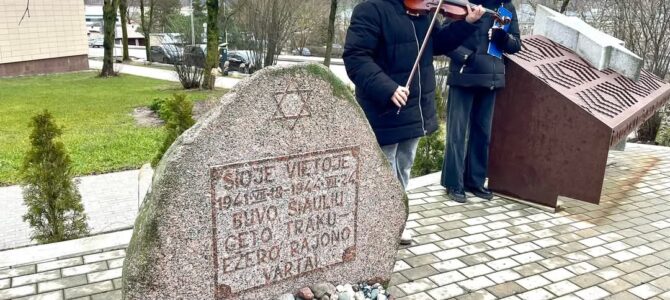
Sėla Museum director Edita Landsbergienė and museum staff held a Holocaust commemoration at the site of the former synagogue in Biržai/Birzh last week. Lithuanian Jewish Community chairwoman Faina Kukliansky, Panevėžys Jewish Community chairman Gennady Kofman, Israeli ambassador to Lithuania Shelly Hugler Livne, a representative from the city’s mayor’s office and others spoke at the event.

A procession walked from the city about 3 kilometers to the mass grave marked in Pakamponys Forest.

The commemorative ceremony and procession were followed by the premiere of an opera called Kitas Miestas [A Different City] at a local high school gymnasium about the pre-Holocaust Jewish community in Birzh and how they were murdered in the Holocaust. An internet stream of the opera will be made available here.

Plaque Commemorating Litvak Photographer Shimon Bajer Unveiled in Kaunas

Plaque Commemorating Litvak Photographer Shimon Bajer Unveiled in Kaunas

A plaque commemorating Litvak photographer Shimon Bajer (1893-1942) was unveiled Thursday on Freedom Alley, Kaunas’s main pedestrian walking mall, at his former residence at Laisvės alley no. 97 (formerly no. 58). Bajer was one of the most famous figures in Lithuanian photography in the period between the two world wars and pioneered studio photography in the country. He photographed Lithuanian president and later dictator Antanas Smetona and Lithuania’s chief rabbi Rozensen, among others. Shimon and his Raja were murdered in the Kaunas ghetto in 1942.

Photographs by Gediminas Pašvenskas courtesy the Kauno Diena newspaper and website.

Photographer Shimon Bajer Celebrated in Kaunas

Photographer Shimon Bajer Celebrated in Kaunas

A plaque commemorating Jewish photographer Shimon Bajer (aka Bayer) will be unveiled in Kaunas at 4:00 P.M. on Thursday, August 13, at his former residence at Laisvės alley no. 97 (formerly no. 58). The Kaunas Jewish Community invites the public to come remember this important Kaunas photographer from the interwar period. Bajer and his wife Raja were murdered in the Kaunas ghetto in 1942.

Nobel Prize Winner Aaron Klug to be Remembered in Vilkomir

Nobel Prize Winner Aaron Klug to be Remembered in Vilkomir

The Ukmergė Regional History Museum invites the public to the town of Želva in the Ukmergė (Vilkomir) region at 11:00 A.M. on August 11 to celebrate the 100th anniversary of the birth of Aaron Klug, who won the Nobel prize for chemistry. Želva is the Klug family hearth. At the age of two Aaron Klug and the rest of his family immigrated to the Union of South Africa. While he later said he remembered almost nothing about Lithuania, he often expressed pride in his Litvak roots and did related family stories from Želva. His grandfather on his father’s side was a cattle merchant. In 1982 Klug was awarded the Nobel prize for chemistry for his work on biological macro-molecular structures. Queen Elizabeth II knighted him in 1988.

Names Read in Klaipėda

Names Read in Klaipėda

The names of 1,225 people buried at the desecrated Jewish cemetery in Klaipėda were read out at a ceremony held in the first week of August called “Voices of the Departed.” A symbolic headstone was also erected there in their honor.

Master of ceremonies Nerijus Gedminas said: “This was the Klaipėda Jewish cemetery and ritual funeral home right up until World War II. The Klaipėda Jewish community was annihilated during the Nazi occupation and its material legacy was largely destroyed as well. The post-war Soviet government set up a secret radio jamming station in the former [sic] cemetery called No. 61. Jewish headstones were used as construction material and for the bases of the antennae.”

Klaipėda Jewish Community chairman Feliksas Puzemskis said: “On the eve of Klaipėda’s birthday we want to give the city a list of the people who built this city and who are buried in this cemetery. Many visitors from around the world come here looking for their roots. Until now there hasn’t been a database for visitors to check whether their relatives are buried here. To accomplish this, organizers and money were required, but more importantly, the right person to undertake this work. We were very fortunate that Klaipėda University invited in professor Ruth Leiserowitz, thanks to whom this list has been reconstructed. She compiled a priceless treasure house of information.”

Rendezvous with Living Family History in Panevėžys

Rendezvous with Living Family History in Panevėžys

The Panevėžys Jewish Community received visitors from France: Mr. Matt Nguyen and his mother. The warm meeting with Community members was more than just a search for roots, it was a return to the place where their family called home more than a century ago.

Nguyen’s father was Maurice Hendel, aka Moshe Lozer Gendel, who immigrated from Panevėžys to the United States in 1922, although the family hearth isn’t Panevėžys but Pastovys now in Belarus (Postavi). Following the path of Rabbi Yosef Shlomo Kahaheman, the Hendel family moves to Panevėžys during the First World War. Moshe’s future wife Rochel Lea Tuvman moved later from Vidžiai, Lithuania, to Panevėžys. They built a family together in Panevėžys, traces of which remain to this day.

Moshe died at the Panevėžys Jewish Hospital in 1938 and was buried in the city’s Jewish cemetery. The cemetery was destroyed during Soviet times to build a city park. Moshe’s mother, sister and daughter-in-law remained in Panevėžys during the Holocaust and were murdered there.

I Was Not the First to File

I Was Not the First to File

by Grant Gochin, August 4, 2026

Since 2015 I have filed forty-nine formal submissions with Lithuanian state bodies. Eight lawsuits and international filings. Eleven to the Genocide and Resistance Research Centre. Five criminal complaints under Article 170-2. Eleven institutional submissions. Two to the Commission of Journalist Ethics. Twelve letters. Not one produced a finding on the merits.

Lithuania’s answer has been consistent. I am a foreigner with a grievance. The controversy is manufactured. In February 2025 Laurynas Kasčiūnas–member of the Seimas, former Minister of National Defence, newly elected chairman of the Homeland Union–called me a Russian agent and called me trash.

That answer rests on a premise: that the file begins with me.

It begins in Paris on December 30, 1921, in a letter signed by Leo Motzkin.

I know that because of a book almost nobody reads. In July I borrowed it through interlibrary loan from Duquesne University. Herbert von Truhart, Völkerbund und Minderheiten-Petitionen, Vienna and Leipzig, 1931. I could locate no openly accessible full-text scan. To consult the complete inventory you borrow the physical volume.

Jewish Heritage Walking Tour in Palanga

Jewish Heritage Walking Tour in Palanga

The Palanga Jewish Community is pleased to announce a guided tour of the traces of Jewish life in Palanga. The tour starts at 4:00 P.M. on Friday, August 7, at the main entrance to Birutė Park, by the gates, Vytauto street no. 19. The walking tour will proceed from there through the city and end up at the city square and the plaque commemorating the former synagogues there. The tour is free and open to the public, but registration is necessary. Please indicate the number of people in your party while registering by sending an email to palangoszb@gmail.com or by calling+370 682 55164.

International Day of Remembrance of Roma Genocide Marked in Ponar

International Day of Remembrance of Roma Genocide Marked in Ponar

Members of the Lithuanian Roma community gathered August 3 at the Ponar Memorial Complex to remember their compatriots murdered during the Holocaust. According to EU reports, 1 in 3 Roma still experience discrimination in EU member-states. Approximately 500 to 1,000 Roma were murdered at Ponar along with the largest mass murder of Jews in Lithuania and a number of Poles, Soviet POWs and Lithuanian anti-Nazi dissidents.

Condolences

With great sadness we report the death of Arie Ben-Ari Grozdensky on July 29. He was born in 1946. He was chairman of the Association of Lithuanian Jews in Israel, a member of the Lithuanian Jewish Community, a long-time supporter of the Litvak community and a member of the board of the Goodwill Foundation. Born and raised in Lithuania, Grozendsky and family were able to repatriate to Israel in 1972. He was a tireless defender of Litvak heritage and proponent of Holocaust justice and remembrance. His grandparentsm uncles and cousins were murdered in the Alytus region in Lithuania.. The Lithuanian Jewish Community and chairwoman Faina Kukliansky extend our deepest condolences to his wife Bella, children, grandchildren, many friends and the entire Litvak community. May his memory be a blessing.

Voices of the Departed

Voices of the Departed

The Klaipėda Jewish Community will hold a ceremony at the old Jewish cemetery there to name the names of 1,225 people buried there and to unveil a monument to the lost Jewish community and lost Jewish graves. Ruth Leiserowitz will speak about the history of Jewish cemeteries in Klaipėda, formerly known as Memel. The Jewish actors troupe Shatil will perform as well.

Time: 4:00 P.M., July 30
Place: Old Jewish cemetery, Sinagogų street no. 13, Klaipėda

Holocaust Commemorations in Šiauliai and Kužiai

Holocaust Commemorations in Šiauliai and Kužiai

The Šiauliai District Jewish Community commemorated the establishment of the Šiauliai ghetto 85 years ago, its liquidation several years later and Holocaust victims buried at the mass grave in Kužiai on July 20.

The International Commission to Assess the Crimes of the Nazi and Soviet Occupational Regimes in Lithuania organized the procession to the Kužiai mass grave in the Luponiai Forest.

Šiauliai District Jewish Community chairwoman Rašella Galinienė addressed the gathering at the ghetto site in central Šiauliai and Choral Synagogue cantor Shmuel Yaatom performed kaddish. Šiauliai deputy mayor Justinas Švėgžda also spoke about the need to keep memory alive.

The commemoration continued indoors at the Chaim Frankl villa where Lithuanian Jewish Community chairwoman Faina Kukliansky spoke about how her mother, an inmate at the Šiauliai ghetto, was marched with other prisoners to Radviliškis, where they were put on trains and sent to different concentration camps. Her mother was sent to the Stutthof concentration camp in what is now Poland surviving against all odds the barbarity of the camp.

Ukmergė Jewish Community Planning Holocaust Commemoration for Early September

Ukmergė Jewish Community Planning Holocaust Commemoration for Early September

The Ukmergė Jewish Community is planning a series of events on Sunday, September 6, to remember the victims of the Holocaust in Pivonija Forest. A ceremony will be held in the forest at one or more the mass graves, followed by the opening of an exhibit on Righteous Gentiles and a presentation of a new web site about the Jews of Ukmergė (Vilkomir).

Tentative program:

12:00 noon Commemoration of victims in Pivonija Forest
1:00 P.M. Righteous Gentiles exhibit opening at Tolerance Center, Ukmergė
1:30 P.M. Presentation of web site on Jews of Vilkomir, Tolerance Center, Ukmergė

Natalja Cheifec on Tisha b’Av

Natalja Cheifec on Tisha b’Av

Natalja Cheifec continues here internet lecture series and discussion club with a presentation of Tisha b’Av, which starts at sundown Wednesday. Log on and find out why this is the saddest holiday in Judaism, what this date on the Jewish calendar commemorates, why this fast day is different from others and the various stories and traditions associated with Tisha b’Av. Natalja will also discuss what fast days mean in general in Judaism., Everyone interested in Jewish culture, customs and religion is invited. To receive zoom credentials, click here.

Time: 6:00 P.M., Wednesday, July 22
Place: internet

Šiauliai Regional Jewish Community Marks Ghetto Anniversaries

Šiauliai Regional Jewish Community Marks Ghetto Anniversaries

July 15 was the 82nd anniversary of the liquidation of the Shavl ghetto. In July of 1941 two ghettos were set up in the northern Lithuanian city to imprison around 6,000 Jews from there and surrounding locations. Thousands were tortured and murdered there. By Himmler’s order the ghetto was renamed a concentration camp in 1943. From July 15 to 19, 1944, the 3,000 or so survivors were sent to Dachau and Stutthof concentration camps where the majority were murdered and the Shavl ghettos were closed.

Members of the Šiauliai Regional Jewish Community gathered at the stone stele marking the entrance to the ghetto to remember both anniversaries on July 15 with a minute of silence, flowers, stones and candles to remember the victims.

This was followed by a film at the Povilas Višinskis Public Library. Professor Hektoras Vitkus from Klaipėda University spoke about the prevailing circumstance when the Nazis set up the two ghettos in the Lithuanian documentary. He said the city had a population of about 14,000 Jews on June 26, 1941.

The testimony of late Holocaust survivor and author Markas Petuchauskas was then presented. His testimony is well known in Lithuanian Holocaust historiography and the Holocaust Museum in Washington, D.C., and the Vilna Gaon Jewish History Museum in Lithuania both conserve recordings of his testimony.