Holocaust

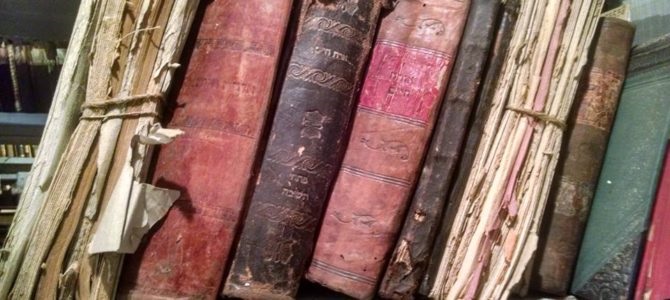
YIVO Vilna Collection Online

YIVO Vilna Collection Online

Dear Faina,

Today, I am delighted to announce that The YIVO Institute for Jewish Research (YIVO) completed the Edward Blank YIVO Vilna Online Collections Project (EBYVOC), a historic 7-year, $7 million international initiative to process, conserve and digitize YIVO’s divided prewar library and archival collections.

These materials, divided by World War II and located in New York and Vilnius, Lithuania, have now been digitally reunited for the first time.

Comprising approximately 4.1 million pages of archival documents and books, the EBYVOC Project is an international partnership between YIVO, the Lithuanian Central State Archives, the Martynas Mavydas National Library of Lithuania, and the Wroblewski Library of the Lithuanian Academy of Sciences.

The completion of the EBYVOC Project is an epic milestone in the preservation of Eastern European Jewish history and culture. It was completed on schedule and within budget, providing a global audience access to these treasures through a dedicated web portal free-of-charge. We invite you to explore this remarkable collection at https://vilnacollections.yivo.org/.

Chaim Grade: Facts of a Life

Chaim Grade: Facts of a Life

Photo: Jung-Vilne literary group: Chaim Grade is stand­ing in the top row to the left, the poets Shmerke Kacz­er­gin­s­ki and Abra­ham Sutzkev­er are seat­ed in the mid­dle. YIVO archives

by Susanne Klingenstein and Yehudah DovBer Zirkind, In Geveb, December 15, 2021

INTRODUCTION

When on May 2, 2010, Inna Hecker Grade passed away at the age of eighty-five, a sigh of relief, unkind and hard-edged, coursed through some corners of the Yiddish literary world and a small circle of scholars and archivists tensed with expectation. For twenty-eight years, since the passing of her husband Chaim Grade on June 26, 1982, the literary legacy of one the most important Yiddish prose-stylists and documentary story­tellers to emerge from the ashes of Vil­na, had lain concealed in the couple’s Bronx apartment, guarded by his angry widow who deemed the world unworthy of her husband’s genius. After a brief foray into the publishing world, she had withdrawn into a tomb filled with her husband’s treasures.

The sepulchral metaphor was first used by Ralph Speken, the psychiatrist who had taken care of Inna Grade during the last months of her life. On the eve of breaking the seal, Speken pleaded: ​“They should take over that apartment as if they were taking over King Tut’s tomb.” Scholars and readers expected the discovery of manuscripts in drawers and closets that would speedily be published, perhaps in critical editions, and bring Grade back to literary life. No new work, no critical edition or biography has yet appeared.

Remembering Documentary Photographer, Author, Screenwriter Alter-Sholem Kacyzne

Remembering Documentary Photographer, Author, Screenwriter Alter-Sholem Kacyzne

Photo: Alter Kacyzne. “Green Fields” theater still. ca. 1921. Museum of the City of New York.

text by Yitskhok Niborski, translated from Yiddish by Yankl Salant

Kacyzne, Alter-Sholem (May 31, 1885-July 7, 1941)

(1885–1941), Yiddish writer and critic; photographer. Born in Vilna to a working-class family, Alter-Sholem Kacyzne (Yid., Katsizne) attended heder and also a Russian-language Jewish elementary school. At 14, after his father’s death, he stopped his formal studies. Kacyzne was an autodidact and remained an avid reader not only of literature in Russian, Yiddish, and Hebrew, but also of Polish, German and French works. For about 11 years he lived in Ekaterinoslav where he learned to be a photographer and was married.

In 1909, Kacyzne first published two Russian stories in the periodical Evreiski mir (Jewish World), edited by S. An-ski. In 1910, attracted by the work and reputation of Y. L. Peretz, Kacyzne settled in Warsaw, where he opened a photography studio. He grew very close to Peretz, who became a literary mentor, but did not begin publishing in Yiddish until after Peretz’s death in 1915. Kacyzne’s first Yiddish texts appeared in collections in Vilna and Kiev. In 1919 and 1920 his first two books were published in Warsaw, the dramatic poems Der gayst der meylekh (The Spirit, the King) and Prometeus (Prometheus). He was also a consistent contributor to (and sometimes co-founder and co-editor of) a series of literary periodicals, most of them short-lived, in Warsaw and Vilna, in which he published novellas and stories that in 1922 appeared in book form as Arabeskn (Arabesques).

Israel Advancing UN General Assembly Resolution Aimed at Combating Holocaust Denial

Israel Advancing UN General Assembly Resolution Aimed at Combating Holocaust Denial

Times of Israel

Envoy confident measure will pass overwhelmingly later this month; it won’t have enforcement mechanism, but Erdan says effects of new international standard will be significant

Israel will bring a resolution aimed at combating Holocaust denial for a vote before the United Nations General Assembly later this month, Ambassador Gilad Erdan announced on Wednesday.

The resolution will provide a specific classification for Holocaust denial, using the working definition put together by the International Holocaust Remembrance Alliance. It will provide actions expected of signatory countries in order to address the phenomenon, and will demand social media networks remove posts that fall under the IHRA definition, Erdan said in a briefing with reporters.

Discussion on Jewish Contributions to Lithuanian Statehood

Discussion on Jewish Contributions to Lithuanian Statehood

Arkadijus Vinokuras will moderate a discussion on Jewish contributions to Lithuanian statehood from 1918 to 1940 and from 1988 to 2022 as part of the #ŽydiškiPašnekesiai series of talks at the Bagel Shop Café in the Lithuanian Jewish Community in Vilnius at 5:00 P.M. on January 12. This is the eve of January 13, an important date in modern Lithuania’s history, the morning on which Soviet tanks attacked and killed citizens defending the Vilnius television tower in 1991. Participants are to include father of Lithuanian independence Vytautas Landsbergis, Lithuanian Jewish Community chairwoman Faina Kukliansky and Lithuanian MP and signatory to the 1990 Independence Act Emanuelis Zingeris, among others.

Musical accompaniment is to be provided by Vytas Mikeliūnas on violin and Darius Mažintas on piano performing Lithuanian and Jewish songs. The discussion will be held in Lithuanian. Those wishing to attend may come in person or watch the live-feed on the LJC facebook page.

Emmanuel Levinas’s Son Cries Foul over Use of Father’s Name

Emmanuel Levinas’s Son Cries Foul over Use of Father’s Name

Valdemaras Šukšta, LRT.lt

Michael Levinas, the son of Litvak French philosopher Emmanuel Levinas, isn’t happy a center was named after his father in Kaunas. He said his objections because of the Holocaust weren’t taken into consideration. The Levinas Center is part of the Lithuanian Health Sciences University who claim Levinas’s daughter and grandson liked the idea.

Michael Levinas explained his position on the internet page of the French newspaper Le Figaro in late December. His main objection was the anti-Semitism and crimes against humanity aimed at Jews in the Holocaust in Lithuania. He pointed out the center is located near the apartment where his father lived, and where his father’s family was abducted and taken to the Ninth Fort where they were subjected to the depredations of the Nazis and Lithuanians.

The younger Levinas recalled he had received a letter from then-rector of the Lithuanian Health Sciences University Remigijus Žaliūnas in 2019 in which Žaliūnas is alleged to have said his wishes would not be taken into consideration and there would be no further discussion of the matter. Levinas said his father repeated vowed never to visit Lithuania again and not to have anything to do with the country.

Joint Lithuanian-YIVO Digitization Project Complete

Joint Lithuanian-YIVO Digitization Project Complete

New York-based YIVO has announced the completion of a joint project to digitize the Edward Blank collection in what is known as the Edward Blank Vilna On-Line Collections Project. The historic initiative took seven years and $7 million to complete. The goal was to sort, conserve and digitize pre-war collections from the YIVO library and archives, and to make them available to everyone online.

The project was carried in concert with the Lithuanian Central State Archive, the Martynas Mažvydas Lithuanian National Library and the Vrublevskiai Library of the Lithuanian Academy of Sciences.

Ruth Levine, the director of the board of YIVO, called the completion of the project a new phase in the modern history of the YIVO institute and part of their main mission. She said heroes and martyrs gave their lives to preserve the books and documents in the collection, and expressed gratitude to the Lithuanian partners in the project.

Name Changes but Fate Remains the Same

Name Changes but Fate Remains the Same

by Lina Dranseikaitė

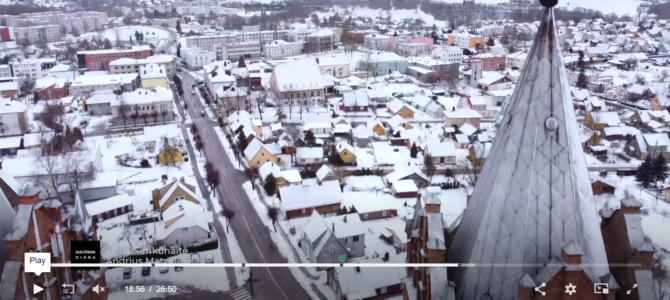
The century-old red-brick synagogue standing on M. Valančiaus street in almost the exact center of the city of Panevėžys from now on will be known by its true name, the Torah Association.

Panevėžys Jewish Community chairman Gennady Kofman said historical justice has been restored. But even with the restoration of historical justice, this decaying heritage site in the historical part of the city might completely vanish over the coming decades.

Although Lithuania’s state Property Bank attempted to sell the synagogue two years ago, no takers have appeared. Panevėžys Jewish Community chairman Gennady Kofman says he isn’t even considering that Jews might buy the red-brick synagogue since this building is supposed to belong to Jews already.

Full text in Lithuanian here.

May You Live Long and Be Prosecuted

May You Live Long and Be Prosecuted

Efraim Zuroff

At 100, Herbert Wahler has outlived other Germans listed as members of the genocidal Einsatzgruppe C. His age should not shield him from accountability.

This past Friday [December 10, 2021], Herbert Wahler celebrated his 100th birthday. Quite an achievement for a German who spent a significant part of World War II serving on the Eastern front in Ukraine. Yet upon closer examination of Wahler’s service record, it’s not that surprising, since, for a significant part of the conflict, Wahler was not dodging bullets shot at him by Red Army soldiers, but rather contributing to the efforts of Einsatzgruppe C to mass murder innocent Jews and other “enemies of the Reich.”

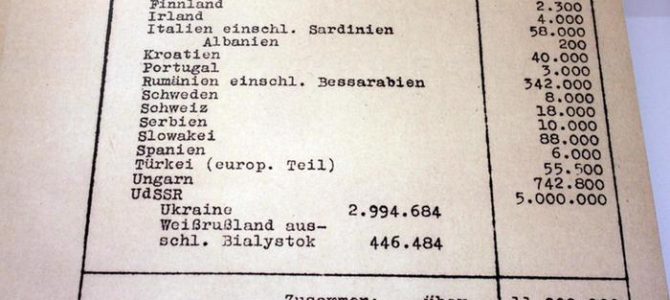
Einsatzgruppe C was one of the four special killing squads, labeled A, B, C, and D, the Nazis sent in June of 1941, along with the Wehrmacht troops invading the Soviet Union in Operation Barbarossa, to begin the mass murder of Jews, even before the formal decree of the Final Solution was officially adopted at the Wannsee Conference on January 20, 1942. They spread out over the entire territory, with A responsible for the former Baltic countries of Lithuania, Latvia, and Estonia; B in charge in Belarus; C was active in central Ukraine and D in southern Ukraine. Over the course of 1941-1943 these units which numbered approximately 3,000 men with assistance from members of the Wehrmacht, German police units, and local collaborators, were responsible for the mass murder by shooting of approximately 2 million people, including 1.3 million Jews.

A Look at the Recent Lithuanian Press on the Holocaust

A Look at the Recent Lithuanian Press on the Holocaust

Geoff Vasil

In December the Lithuanian news outlet 15min.lt treated its readers to the strange spectacle of a Lithuanian defense against American and Allied accusations of the collective guilt of average Germans in the crime of genocide against the Jewish people.

“‘Nonetheless, too many people tried not to see what was happening.’ German president Richard von Weizsäcker said these words on May 8, 1985, at a commemoration of the 40th anniversary of the end of World War II.

“…The Belarussian opposition website zerkalo.io tells how Germans suffered de-Nazification and tried to come to terms with the past. ‘This town is guilty!’ Many have heard of the process known as de-Nazification. The Allies who won World War II (USA, Great Britain, France and the Soviet Union) began the process of de-Nazification.”

Kaunas Jewish Community to Hold Concert to Commemorate Rescuers

Kaunas Jewish Community to Hold Concert to Commemorate Rescuers

The Kaunas Jewish Community is planning an evening of classical music dedicated to those who rescued Jews during the Holocaust at 6:00 P.M. on December 27 at Vytautas Magnus University in Kaunas. Actor and director Aleksandras Rubinovas will speak about the Righteous Gentiles who saved Jews 80 years ago. The event is free to the public but prior registration is required at https://forms.gle/1vzWccjif3yduBFv6

For more information call+370 652 19204 or write ieva0102@yahoo.com

Final Road of Memory Event Held in Telšiai

Final Road of Memory Event Held in Telšiai

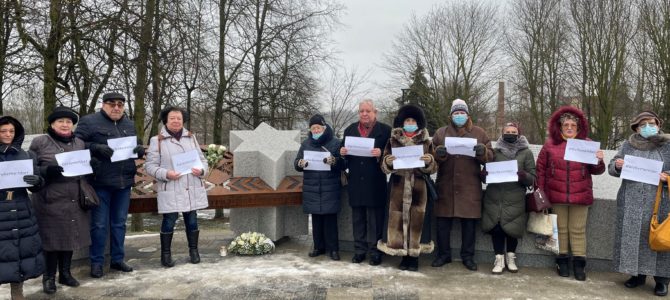
Lithuania’s International Commission to Assess the Crimes of the Nazi and Soviet Occupational Regimes in Lithuania held their final Road of Memory event in the Lithuanian town of Telšiai on December 9. The Commission held these processions in concert with other organizations at different locations in Lithuania from June till now to mark the 80th anniversary of the beginning of the Holocaust. This final procession included local politicians, foreign ambassadors, students from local schools and others. Miša Jakobas performed kaddish, a number of speakers spoke indoors and out, and the musical group Klezmer Klangen Vilne performed.

Will Ukmergė Find the Courage to Decide?

Will Ukmergė Find the Courage to Decide?

by Zigmas Vitkus

By invitation of the mayor of Ukmergė, a public discussion was held in Ukmergė (Vilkomir) on December 2 concerning the problem of historical commemoration of captain Juozas Krikštaponis, an officer of the Second Lithuanian Auxiliary Police Battalion. Lithuanian History Institute historian Mindaugas Pocius delivered an extremely important report there detailing his comprehensive and repeated research on this man’s activities during World War II and demonstration Krikštaponis as an officer in a unit which served the Nazis from October to December of 1941 had taken part in the mass murder of thousands of Jews and Soviet POWs in Nazi-occupied Byelorussia.

The Ukmergė administration which has long postponed addressing this problem will have to decide soon what to do with the statue located in the town center dedicated to “the commander of the Lithuanian partisan military district Vytis who died in 1945” in battle with NKVD troops, a man who, as the facts show, was also a war criminal.

Full text in Lithuanian here.

Historian Calls for End of Controversy on Lithuanian Nazi Juozas Krikštaponis

Historian Calls for End of Controversy on Lithuanian Nazi Juozas Krikštaponis

A Lithuanian History Institute historian says it’s a mistake to issue awards to commander of the partisan Vytis military district captain Juozas Krikštaponis and to commemorate him in Ukmergė (Vilkomir) and elsewhere.

Mindaugas Pocius who works at the institute’s Twentieth Century History Department said: “There are no doubts among historians regarding Krikštaponis’s participation in the mass murder of Jews and other civilians. We need to put an end [to this controversy].” He was speaking last Thursday at a discussion held by the Ukmergė regional administration, the Lithuanian History Institute and the Ukmergė Jewish Community on the life and person of Juozas Krikštaponis.

The former partisan commander is commemorated and lauded in Ukmergė as a fighter in the post-WWII liberation struggle, but historians say they have determined he was a Holocaust perpetrator. Pocius says bestowing state awards on him was done too hastily and a mistake was made in not doing comprehensive research on Krikštaponis’s biography before commemorating him. A stone monument was erected in his honor and a street named after him in Ukmergė in 1996. In 1997 Dalia Kuodytė, director of the Center for Research of the Genocide and Resistance of Residents of Lithuania, provided him the status of military volunteer. In 2002 president Valdas Adamkus issued a decree promoting Krikštaponis posthumously to the rank of colonel, based on the recommendation of Lithuanian defense minister Linas Linkevičius.

“Of course neither the Defense Ministry nor the President’s Office had complete information. They went by [Genocide] Center’s recommendation, which at that time had not performed research on Krikštaponis’s biography and knew nothing about his activity during the war,” Mindaugas Pocius said.

Full story in Lithuanian here.

Holocaust Quiz for Students in Panevėžys

Holocaust Quiz for Students in Panevėžys

The Panevėžys Jewish Community held their annual Holocaust quiz for high school students on December 2 this year, the 80th anniversary of the beginning of the Holocaust in Lithuania. Four teams of students competed.

Before the quiz the high school students watched a documentary film about the Auschwitz-Birkenau concentration camp complex where more than 1.5 million people were murdered, more than one million of them Jewish men, women, children and elderly.

Panevėžys Jewish Community chairman Gennady Kofman said it wasn’t just Jews who suffered from the barbaric actions planned by the Nazis in World War II against humanity. Europeans of other ethnicities also suffered because of their religion, ethnic origin, traditions and disabilities. Nonetheless, six millions Jews were exterminated simply because they were Jews.

LJC Rejects Communist China’s Statements on Lithuanian Ethnic Minorities

LJC Rejects Communist China’s Statements on Lithuanian Ethnic Minorities

The Lithuanian Jewish Community looks on in surprise and with concern at statements issuing from the press secretary of the Communist Chinese Foriegn Ministry claiming Jews and other ethnic minority communities in Lithuania are suffering “serious discrimination” and pressure, the LJC said in a press release.

Although there is public and free dialogue between the LJC and Lithuanian government institutions concerning commemoration of the past and other painful chapters of history regarding the Holocaust, we vigorously reject any and all accusations Jews are experiencing discrimination in Lithuania today.

Lithuanian Jewish Community chairwoman Faina Kukliansky said: “Lithuania is a democratic country which respects its Jewish citizens and safeguards the rights of all its citizens. While we sometimes have differing opinions regarding heritage and property destroyed during World War II by the Nazis and their Lithuanian collaborators, or regarding unreturned property, we are nonetheless and active and free part of Lithuanian society. In our country we freely express our views, and we support open and public dialogue with institutions and other groups of society. It is absolutely unacceptable attempting to draw our small community into a solution of bilateral and international disagreements through mendacity and manipulation.”

Condolences

Jenta Timukienė passed away Sunday. She was born in 1939 and was an inmate of the Kaunas ghetto. May her soul rest in peace. Our deepest condolences to her family, friends and fellow members of the Union of Former Ghetto and Concentration Camp Prisoners.

Israeli Ambassador Visits Panevėžys

Israeli Ambassador Visits Panevėžys

Panevėžys mayor Rytis Račkauskas held a reception for Israeli ambassador to Lithuania Yossi Avni-Levy. They spoke about projects taking place in the Lithuanian city and opportunities for cooperation.

“I thank the ambassador and the embassy for their attention to Panevėžys. For many years now we’ve enjoyed intense cooperation between the municipality and the Israeli embassy. I hope and believe our cooperation with our sister-city Ramla and with the embassy will only continue to grow in strength,” Račkauskas said.

The Israeli ambassador met with the Panevėžys Jewish Community and visited Jewish historical and commemoration sites including the former Rabbinate, yeshiva, Jewish high school and the Yavne school following the meeting with the mayor.

A Bloody Story: They Were Murdered in Kaunas

A Bloody Story: They Were Murdered in Kaunas

Kauno.diena.lt

The tragic events of the Holocaust have left visible marks at the Ninth Fort. During World War II it was turned into one of the largest mass murder sites in Nazi-occupied Lithuania. From 1941 to 1944 Jews from Lithuania and transported here for Austria, Czechoslovakia, Poland, France, the Soviet Union and Germany were murdered here.

The mass murder began November 25, 1941 [sic]. That day 2,934 Jews were shot. The newspaper Kauno Diena presents our readers with a text by a former resident of Kaunas living in Germany concerning the blood-curdling events, commemorations of them and her feeling of guilt. Her grandparents’ home was right next to the Ninth Fort and the so-called road of death.

Full story in Lithuanian here.