

The writer Grigoriy Kanovich has passed away at the age of 93. Our deepest condolences to his sons Sergejus and Dmitrijus, wife Olga and his many friends and fans around the world. He served as chairman of the Lithuanian Jewish Community from 1989 to 1993, when he moved to Israel.
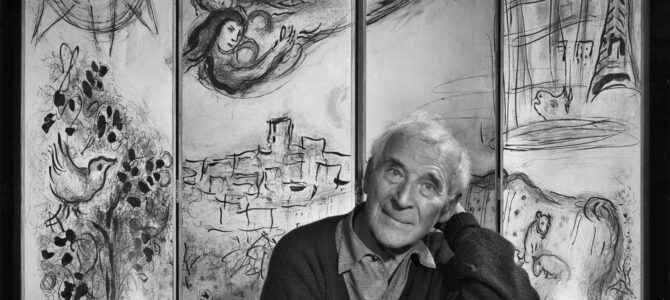
Marc Chagall: World in Turmoil
“The whole history is packing bundles and getting away. Nobody else can be as tender and delicate with bundles. That’s a Jewish man tying a bundle.”
Those lines from Arthur Miller’s Monte Saint Angelo aptly characterizes an unusual exhibit of paintings by Marc Chagall during his period of exile from the 1930s and 1940s which opened in Frankfurt and will run till February 19, 2023. The exhibit is called World in Turmoil.
“A few kilometers from there is a place, more precisely a town, which I haven’t visited for a long time, but I always remember it. So I took advantage of your invitation to go and wander around there a little,” Marc Chagall said at the World YIVO Conference held in Vilnius (Wilno) on August 14, 1935.
This conference is mentioned in the artist’s biography and the catalog for the exhibit at that time. His journey back to Poland (now Lithuania) gave rise to works which appear unusual and dark for Chagall. His oeuvre is usually arranged chronologically, from his native Vitebsk, striving to reattain this magical homeland. In Vilnius Chagall comes as close as possible to actually returning.
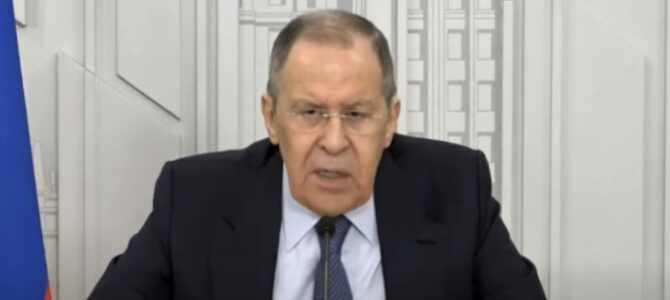
European Jewish Congress Shocked, Appalled by Russian FM’s Holocaust Reference
Wednesday, January 18, 2023–The European Jewish Congress has expressed its concern and dismay following comments today by Russian foreign minister Sergey Lavrov comparing Western governments’ support for Ukraine to Hitler’s Final Solution which resulted in the murder of six million Jews in the Shoah.
Lavrov claimed Wednesday the United States had put together a coalition of European states to solve the “Russian question” in the same way Hitler had organized the Final Solution for Europe’s Jews.
“We are shocked and appalled by this shameful comparison drawn by minister Lavrov between the actions of a coalition of democratic countries and Hitler’s persecution and murder of six million Jews in the Shoah,” EJC president Ariel Muzicant said.
Condolences
With deep sadness we announce the death of Nina Dubrovskaja on January 18. She was born in 1932. We extend our deepest condolences to her daughter Liudmila.
International Day of Commemoration in Memory of the Victims of the Holocaust
To mark the International Day of Commemoration in Memory of the Victims of the Holocaust instituted by the United Nations in 2005, the Lithuanian Jewish Community will host a presentation of Vytautas Magnus University teacher Linas Venclauskas’s monograph about Lithuanian anti-Semitism and of Vytautas Toleikis’s book about the portrayal of Jews in Lithuanian literature.
The two presentations in Lithuanian begin at 6:00 P.M. on Thursday, January 26 at the Lithuanian Jewish Community in Vilnius. Note the United Nations’ International Day of Commemoration in Memory of the Victims of the Holocaust. more commonly called International Holocaust Remembrance Day, is officially on Friday, January 27, to mark the anniversary of the liberation of the Auschwitz-Birkenau concentration camp complex by the Soviet Red Army in 1945.
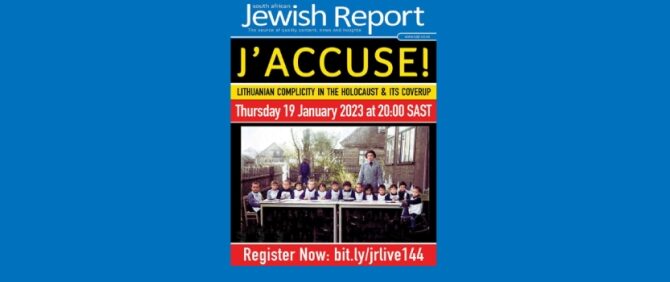
South African Jewish Report Invites You to Private Internet Screening of J’Accuse!
J’ACCUSE! Lithuanian complicity in the Holocaust and its coverup
Date: 8:00 P.M. South African Standard Time (UTC +2, same time zone as Lithuania), Thursday, January 19, 2023
Register here:
https://us02web.zoom.us/webinar/register/WN_t4pEdH4LR3ano0wwyzfEnA
What would you do if you discovered that your grandfather, a national hero in Lithuania, was also a genocidal killer of Jews? Would you keep quiet or expose the truth?
This controversial documentary exposes Lithuania’s policy of Holocaust denial and its celebration of the perpetrators of the genocide of its Jewish citizens.
This is a unique opportunity to view the documentary in full and meet the filmmakers and heroes of this ground-breaking story.
Please note that this is a private screening by invitation only. The recording of this internationally award-winning documentary will NOT be available on YouTube after the event.
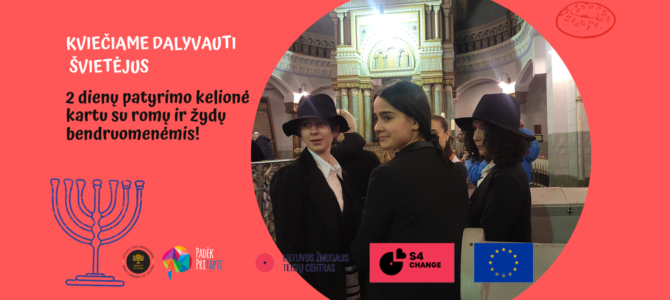
Call to Teachers, Youth Workers: Two-Day Introduction to Roma, Jewish Communities
The two days of activities are intended to teach the traditions and customs of the Roma and Jewish communities in Lithuania and to counter stereotypes and fight anti-Semitism and Romophobia at home and abroad in various contexts. This is the first time educators from Lithuania are being invited to meeting with representatives and lecturers from both communities. We believe these teachings will be helpful for teachers working with young people as well as for cultural workers in the towns and cities where Jewish heritage is undergoing restoration. Those who work with young people and representatives from NGOs are invited to attend. The two-day workshop begins in January at the Sholem Aleichem ORT Gymnasium in Vilnius with the participation of experts from the Lithuanian Human Rights Center and the Padėk Pritapti organization, and of course the Lithuanian Jewish Community as well. We invite you to share this invitation with your colleagues. For more information, click https://bit.ly/3PXEoTz. To register, click https://bit.ly/3jDbJa5. A program in Lithuanian is available here.
For more information, contact Dovilė Rūkaitė at projects@lzb.lt.
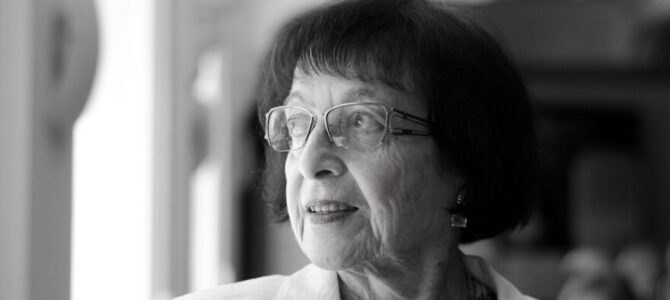
Remembering Irena Veisaitė
The Old Vilnius Town Hall and the Lithuanian Literature and Folklore Institute invite you to an evening to remember the life and work of Irena Veisaitė. The event marks Irena’s 95th birthday and will also serve to launch the book “Our Irena: Memories Irena Veisaitė” edited and compiled by Reda Pabarčienė. The book will be available for purchase at the presentation. The venue is the Old Vilnius Town Hall, 6:00 P.M., January 9, 2023. It is free and open to the public. The event will be conducted in Lithuanian.
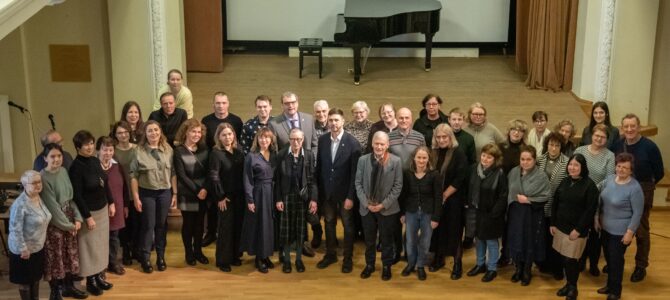
Simonas Strelcovas Appointed Director of Vilna Gaon Museum
Simonas Strelcovas was appointed by the Lithuanian Culture Ministry to the post of director of the Vilna Gaon Jewish History Museum in Vilnius. He has a doctorate in history and is a credentialed teacher. Earlier he directed the Humanitarian Research Center at Šiauliai University and the Defense and Warfare Educational Center. He served as chairman of the board of directors of the scientific institute at Šiauliai University. More recently he was head of projects at the Lithuanian National Regional Development Agency. In 2019 he went to Meijo University in Japan as visiting researched and headed a project there on the collective memory of traumatic experiences.
“One of my main tasks as director of the Vilna Gaon Jewish History Museum is to clarify with the staff the museum’s priority activities, setting a strategic goal for ourselves to make the museum one of the leaders in the region,” he told Lithuanian Radio and Television.
According to press reports, Strelcovas began his duties in the post Tuesday.
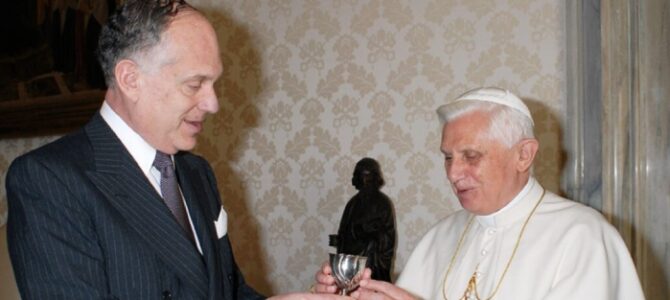
World Jewish Congress Mourns Death of Benedict XVI
World Jewish Congress president Ronald S. Lauder mourned the passing of Pope Benedict XVI on Saturday night.
“It is with great sadness that I learned today that Pope Emeritus Benedict XVI has passed away,” he said. “He was a towering figure of the Roman Catholic Church, both as pope and before that as the cardinal who gave the Catholic-Jewish relationship solid theological underpinning and enhanced understanding. No pope before him visited as many synagogues, and he made a point of meeting with local Jewish community representatives whenever he visited foreign nations.”
Lauder recalled having met the former pope at the Vatican three times and said that each time, he was “deeply moved by his affection and friendship for the Jewish people, his commitment to remembrance of the Shoah, and his unambiguous condemnation of Holocaust denial in any form.”
Condolences
The Lithuanian Jewish Community is sad to report the death of Eliyahu Stoupel. He was a cardiologist who did important work on the effects cosmic rays, solar activity and geomagnetism have on human health and mortality rates. Born in Kaunas in 1929, he later moved to Israel and recently worked for the Beilinson Hospital and Medical Research Center in Petah Tikva just east of Tel Aviv. He always maintained ties with the land of his birth, came to teach university students and carried out joint studies and projects with other Lithuanian cardiologists. We extend our deepest condolences to his many friends, family members and colleagues around the world.
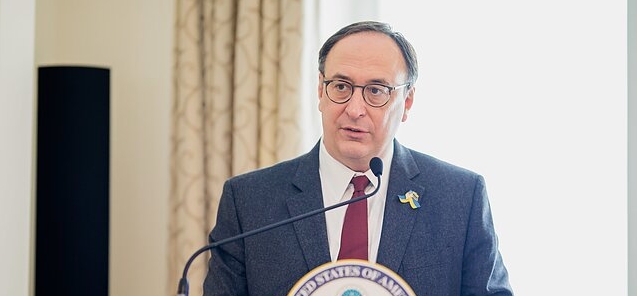
United States of America Hail Jewish Compensation by Lithuanian Parliament
Photo: Robert Gilchrist, by D. Umbrasas courtesy LRT.lt
The U.S. embassy in Vilnius said Tuesday the United States hail the Lithuanian parliament’s decision to compensate Jewish private property seized by the Nazis and Soviets to the tune of 37 million euros.
American ambassador to Lithuania Robert Gilchrist said: “The passing of this legislation is an important step in recognizing the tragedy of the Holocaust in Lithuania. It is not, however, only about addressing claims for the past. It is about preserving the memory of the Holocaust for future generations and working together against intolerance and hatred.”
U.S. special envoy for Holocaust issues Ellen Germain commented: “After the Holocaust, there was little time to create successful restitution programs before the Communist regimes nationalized private property. By passing this bill, Lithuania has taken another important step in fulfilling restitution commitments. For survivors and their families, this is a direct acknowledgement of the great wrong that was done to them.”
The Lithuanian parliament Tuesday adopted a new redaction of the existing Law on Goodwill Compensation which additionally allocates 37 million euros for compensating Jewish private property. The existing law and previous compensation payments were for communal and religious property seized by the Nazis and the Soviets. The new legislation comes into effect in January.
Lithuanian prime minister Ingrida Šimonytė proposed the new compensation package saying Lithuania has made compensation for Jewish religious community property, but hasn’t made compensation for nationalized private property.
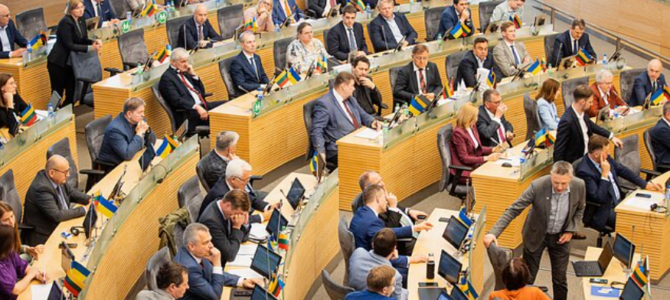
Lithuanian Parliament Allocates 37 Million Euros for Private Property Looted from Jews
The Lithuanian parliament Tuesday voted in favor of compensation to the amount of 37 million euros for private property looted from Jews by the Nazis and the Soviets.
Seventy-two MPs voted in favor, six against and two abstained in the ballot of a new redaction of the Law on Goodwill Compensation which will come into effect in January.
Lithuanian prime minister Ingrida Šimonytė proposed the new compensation package saying Lithuania has made compensation for Jewish religious community property, but hasn’t made compensation for private property nationalized.
“There are two kinds of property, and for one a solution was found, while the search for a solution to the second was sought, perhaps not entirely sincerely, perhaps sincerely… I believe the Government has succeeded in agreeing to and proposing such a solution, and today we consider this legislation,” she said.
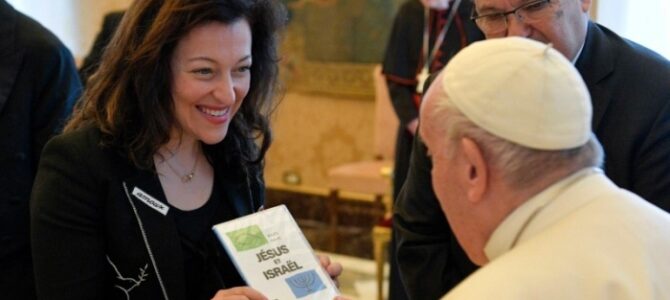
Pope Francis Calls for Return to Judaeo-Catholic Dialogue
Addressing members of the Jewish-Christian Friendship Association of France on December 12, Pope Francis called for a return to dialogue between Catholics and Jews in what he called hostile times with a rise in anti-Semitism and violence against Christians.
ADDRESS OF HIS HOLINESS POPE FRANCIS TO MEMBERS OF AMITIÉ JUDÉO-CHRÉTIENNE DE FRANCE
Consistory Hall
Monday, December 12, 2022
_____________________________________
Dear friends,
I welcome you, members of Amitié Judeo-Chrétienne de France, celebrating the 75th anniversary of its founding.
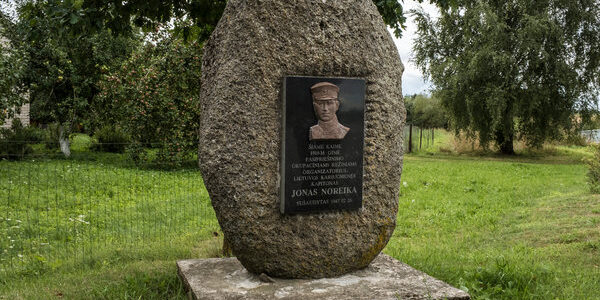
US Calls on Lithuania to Recognize Holocaust Crimes Committed by National Heroes
The Lithuanian telegraph agency ELTA reports US State Department special envoy for Holocaust issues Ellen Germain said Lithuanian authorities must recognize the involvement of so-called Lithuanian heroes in Holocaust crimes.
She said some Lithuanians who fought the Soviet regime are lionized and commemorated even though they were Nazi collaborators and committed war crimes and genocide. She called on Lithuanian politicians and society to admit the facts. As an example she pointed to Jonas Noreika, a Lithuanian Activist Front commander directly responsible for the ghettoization and mass murder of Jews in the Šiauliai (Shavl) district. She also pointed to Juozas Krikštaponis, part of a punitive unit who murdered Jews in Belarus. Noreika was awarded the Lithuanian Cross of Vytis posthumously and has a commemorative plaque hanging on the Lithuanian Academy of Science. There is a monument to Krikštaponis at the city park in Ukmergė (Vilkomir).
Germain said the United States is asking Lithuania to recognize the involvement of a number of alleged national heroes in Holocaust crimes.

Community Hanukkah Events
In addition to all the other events already announced, the Lithuanian Jewish Community is offering a walking tour of Jewish Vilna with guide Viljamas Žitkauskas and an Israeli dance marathon with Rikudim.
The tour begins at 2:00 P.M. on Saturday, December 17, meeting at the bell tower at the Arch-Cathedral in Vilnius. Program: Tour, avdala ceremony, dinner at the Bagel Shop Café, performance by the children’s section of the Fayerlakh Jewish song and dance ensemble. Registration required. Send an email to zanas@sc.lzb.lt or call +37067881514 on weekdays between 10:00 A.M. and 6:00 P.M.
The Rikudim Israeli dance marathon will be held in the Jascha Heifetz Hall at the Lithuanian Jewish Community in Vilnius from 11:00 A.M. to 3:00 P.M. on Sunday, December 18. To register send an email to Julija at Juliradv@gmail.com.
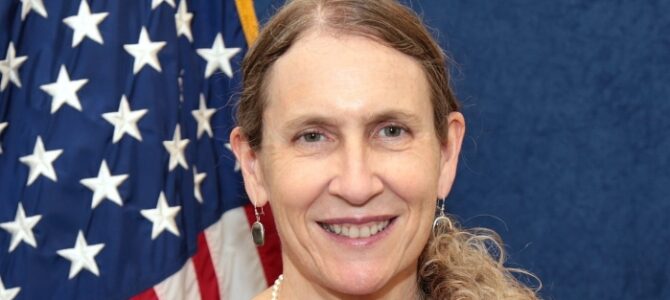
US Envoy Welcomes Lithuanian Government’s Jewish Private Property Restitution Proposal
VILNIUS–Ellen Germain, special envoy for Holocaust issues at the US State Department, welcomed the Lithuanian Government’s proposal to compensate Jews for lost private property when she visited Vilnius on Monday, the Foreign Ministry said.
“Germain welcomed the draft law submitted by the Lithuanian government to the Seimas, which aims to address the outstanding issues of the unreturned property of Jewish persons who lived in Lithuania before or during World War Two, stressing that ensuring justice for Holocaust survivors and their heirs is an important issue of human rights and the rule of law,” it said in a press release.
The bill calls for transferring 37 million euros to the Goodwill Foundation in 2024 to 2030 as compensation for expropriated private Jewish property. The foundation would pay out the money to property owners and their heirs based on the claims received.
Under the existing law adopted in 2011, Lithuania committed to paying 37 million euros over a decade in compensation for seized Jewish communal property. The process should be completed by next March.
Full story here.
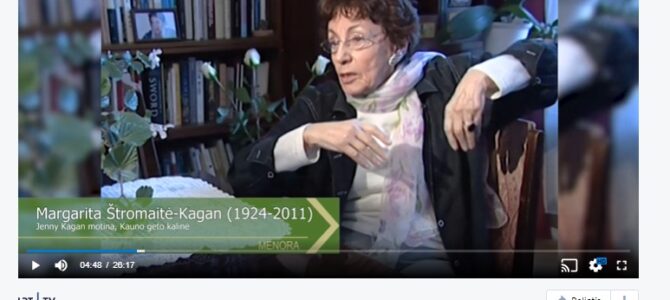
Menora Program on Lithuanian Television: A Story of Love and the Struggle to Survive
Lithuanian Radio and Television presents the story of Kaunas ghetto inmates Margarita Štromaitė and Juozas Kaganas, two inmates of the Kaunas ghetto who fell in love and survived.
Click here.
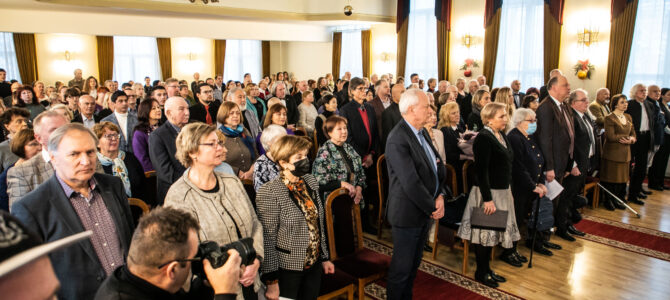
LJC Members and Friends Recognized on International Human Rights Day
To mark international Human Rights Day on December 10, Lithuania’s Department of Ethnic Minorities held an awards ceremony at the M. K. Čiurlionis School of the Arts in Vilnius and recognized the work of a number of members and friends of the Lithuanian Jewish Community, including architect and designer Victoria Sideraitė-Alon, LJC executive board member and president of the Lithuanian Makabi Athletics Club Semionas Finkelšteinas, chairman of the Klaipėda Jewish Community Feliksas Puzemskis, Vilnius Jewish Public Library director Žilvanas Bielauskas, violinist and member of the Fayerlakh Jewish song and dance ensemble Boris Kirzner, Fayerlakh chairwoman Larisa Vyšniauskienė and documentary filmmaker and television producer Lilija Kopač.
The Ethnic Minorities Department awards are distributed to members of ethnic communities, the media and NGOs for their work increasing ethnic harmony, encouraging cultural diversity and unifying multicultural Lithuania.
We sincerely congratulate all prize recipients on the recognition of their work forging a better future for the Lithuanian Jewish Community and Lithuania.
Condolences
The Lithuanian Jewish Community and LJC chairwoman extend our deepest condolences on the death of Adolfas Šleževičius to his many friends and relatives. The Lithuanian prime minister from 1993 to 1996 was born February 2, 1948 and his parents rescued Jews from the Holocaust. His Government stabilized the Lithuanian economy not least of all through the re-introduction of the Lithuanian currency the litas, and through improved relations with neighboring countries in the aftermath of the break-up of the Soviet Union. He is the author of over 50 articles and two books. Both his parents were recognized as Righteous Gentiles in 1994 by the Yad Vashem Holocaust Commemoration and Education Institute in Jerusalem.