Holocaust

Remembering the Jewish Community in Čekiškė

Remembering the Jewish Community in Čekiškė

To mark Lithuania’s Jewish Victims of Genocide Remembrance Day, Audra Girijotė will give a presentation about Dovydas Matishohu Lipmanas at the synagogue in Čekiškė, Lithuania (Tsaykishok in Yiddish). Lipman was perhaps the most famous writer from the small town, and focused on the history of the Jewish community there, in Kaunas, Žemaitija and in Lithuania in general. He also wrote about the Vilna Gaon and was a frequent contributor to Yiddish periodicals. Born in 1888 in the village of Nemakščiai in the Raseiniai district, Lipman lived in and around Čekiškė from 1925 to his murder. He bought and ran a pharmacy there while writing a number of books. He was a qualified pharmacist with a degree from Dorpat (Tartu). He was murdered just outside the village in late July, 1941, by Stanislovas Gudavičius, a commander of local Lithuanian white-armbanders, according to Lithuanian historian Alfredas Rukšėnas.

Audra Girijotė is a writer and journalist who has been researching the life and death of Dovydas Lipmanas over the last several years.

Time: 1:00 P.M., September 23
Place: Čekiškė synagogue, Lašišos street no. 21, Čekiškė, Kaunas district

JewishGen yizkor for Tsaykishok here.

More biographical information in Lithuanian and English here.

Remembering Holocaust Victims in Kupiškis and Subačius

Remembering Holocaust Victims in Kupiškis and Subačius

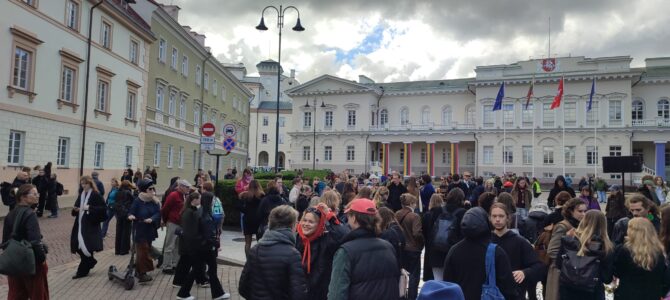
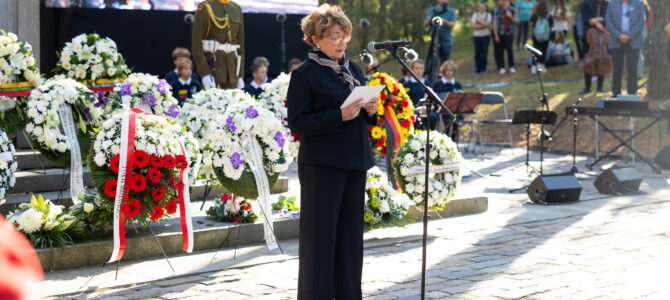
September 23 is a national day of mourning, marking the significance of the loss of Lithuanian Jewry in the Holocaust and the loss to Lithuanian society.

The village of Subačius, the shtetl Subotch, had a large Jewish population engaged in wholesale, shopkeeping, running bars and taverns and all sorts of other business endeavors. Almost all the Jews there were exterminated in 1941 in the Ilčiūnai Forest, also known as Lapkalnis, two kilometers from Subačius. From 80 to 300 Jews from Kupiškis andr Subačius were murdered there, according to different sources. A monument marks their mass grave. There were Righteous Gentiles there as well who saved Jews.

The ceremony to mark Jewish Genocide Remembrance Day in Subačius will include a descendamt of one family who rescued Jews, the Markevičiuses. The ceremony includes a presentation of the book “Kupiškėnai – žydų gelbėtojai” [Kupiškis Residents Who Rescued Jews] put together by historian and Kupiškis Museum specialist Aušra Jonušytė. Students from the Kupiškis Art School will provide a musical component.

Time: 11:00 A.M., September 23
Place: Subačius House of Culture, Aukštaičių street no. 14, Subačius

New Documentary on Irena Veisaitė

New Documentary on Irena Veisaitė

A new documentary on Litvak, Holocuast survivor and life-long Holocaust educator, the late Irena Veisaitė is scheduled for release in late October.

Variously titled “A Goodnight Kiss,” “Irena” and “For Irena” the Lithuanian Catalog of Cinema describes the film this way:

The film chronicles the incredible life of professor Irena Veisaite, a survivor of the murderous Holocaust and Stalinist reign in Lithuania. She is today a cultural icon, uniting people of different ages, religions, nationalities from all over the world. As she approaches her 93th birthday and shows no signs of slowing down, we follow Irena as she addresses our contemporary issues and revisits her painful past. A film that shows that the power of love can overcome trauma, and transform it into the art of living.

Irena Veisaitė passed away December 11, 2020.

Lithuanian state radio and television and the news website 15min.lt report the film will premiere October 24 in Lithuania. The Kino Pavasaris film festival and movie theater association announced the premiere of the documentary in a press release last week.

Description and more information here.

Interviews with director in Lithuanian here and here.

Day of Remembrance of Lithuanian Jewish Victims of Genocide in Panevėžys

Day of Remembrance of Lithuanian Jewish Victims of Genocide in Panevėžys

The Panevėžys Jewish Community invites you to mark the Day of Remembrance of Lithuanian Jewish Victims of Genocide on September 23. The commemoration begins at 2″00 P.M. at the Sad Jewish Mother statue in Memory Square on Vasario 16 strret in Panevėžys.

The commemorative date was adopted by the Lithuanian parliament in 1994 based on the nominal date for the liquidation of the Vilnius ghetto in 1943. The Panevėžys ghetto was liquidated in mid-August, 1941, meaning the 13,500 Jews there were murdered ib the immediate area.

Program:

Lost Shtetl Museum in Šeduva to Open to Public September 20

Lost Shtetl Museum in Šeduva to Open to Public September 20

by Anthea Gerrie, Hewish Chronicle, August 24

The Jews of Šeduva were murdered 84 years ago. Now a new museum will commemorate their shtetl way of life

Eighty-four years ago more than 600 Jews, men, women and children, of the shtetl of Šeduva in rural Lithuania were executed in the forest outside the town. Now the finishing touches are being made to a museum which will commemorate the shtetl way of life which was extinguished in the Holocaust, not just in Seduva or Lithuania, but all over Eastern Europe.

The Lost Shtetl Museum will use cutting-edge technology to recreate the sights and sounds of everyday pre-war Jewish life, based on the history of Šeduva and more than 200 similar small Lithuanian towns, and the thousands more communities in neighboring Latvia, Belarus, Poland and Ukraine which were wiped off the map forever.

Vilnius Shalom Festival 2025

Vilnius Shalom Festival 2025

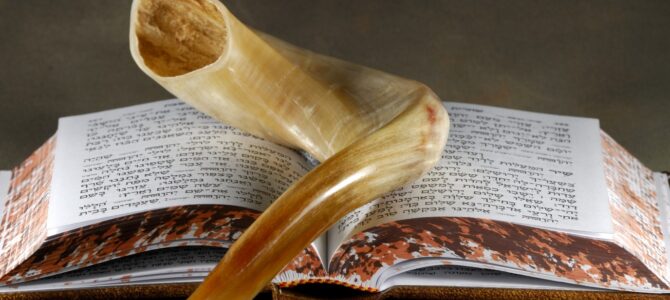
From September 21 to October 21, 2025, the Lithuanian capital will host the Vilnius Shalom Festival. The month-long Jewish music and culture festival will bring together the unique Shofar March (unprecedented in the region), educational activities and high-level classical jazz, and klezmer music concerts. The festival will feature the Be’er Sheva Municipal Concert Band, the State Choir Vilnius, the St. Christopher Chamber Orchestra and renowned performers from Lithuania, Israel, Germany, Ukraine and the USA.

We believe these events will gather lovers of Jewish culture and music from across Lithuania and abroad in Vilnius, often called the Jerusalem of the North.
Thanks to our sponsors and partners, all festival events are free of charge. Advance registration required here: www.shalom.lt

Program:

Condolences

Mira Imbrasas has died. She was born ub 1937. She was a member of the Lithuanian Jewish Community and a client of the Saul Kagan Welfare Center. We extend our deep condolences to her daughter and many friends and family.
Condolences

Raisa Savalyeva has passed away. She was born in 1934. She was a member of the Lithuanian Jewish Community and a client of the Saul Kagan Welfare Center. Our deepest condolences go to the son she leaves behind and all who knew and loved her.

Pivonija Massacres Eighty-Four Years Later

Pivonija Massacres Eighty-Four Years Later

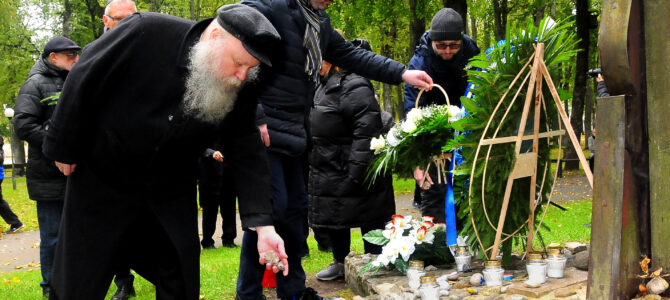
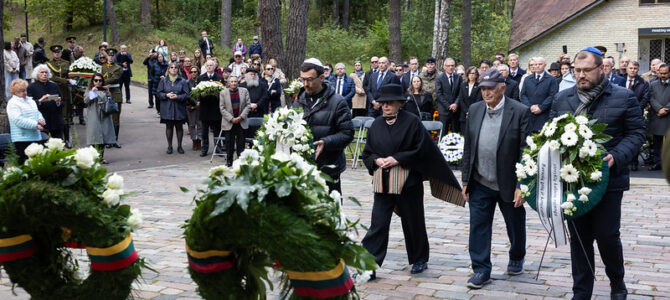
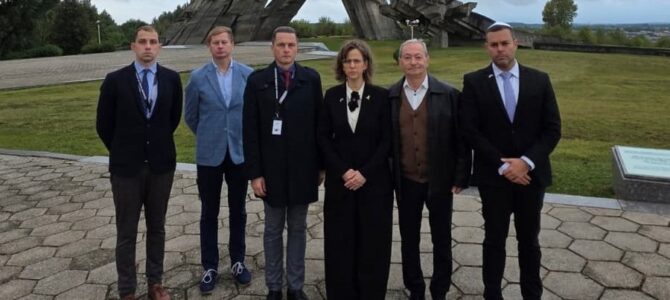
The 84th anniversary of the mass murder of the Jews of Vilkomir (Ukmergė) in the Pivonija Forest jut outside the town was commemorated on the first Sunday in September, the traditional date selected for honoring these victims of the Holocaust.

The entire Jewish population of Vilkomir and surrounding villages was exterminated ruing three mass murder operations in 1941. A sole survivor hid in the forest and later told the tale to the world.

Pivonija is the third-largest Jewish mass murder site in Lithuania after Ponar and the Ninth Fort.

Lithuanian and Jewish Communities Meet in Los Angeles County

Lithuanian and Jewish Communities Meet in Los Angeles County

The Lithuanian Consulate and Lithuanian consul Sandra Brikaitė hosted an evening called “History, Heritage and Diplomacy” earlier this mont, bringing together the Lithuanian-American community, the Lithuanian Jewish Community, the local Valley Outreach Synagogue, diplomats and other interested parties.

The Lithuanian Consulate is located in Calabasas in the southwestern end of the San Fernando Valley in Los Angeles County.

Consul Sandra Brikaitė, Valley Outreach Synagogue Rabbi Ron Li-Paz and Lithuanian Jewish Community chairwoman Faina Kukliansky all spoke at the event and all three discussed together the deep roots of Litvak culture, the Holocaust and Righteous Gentiles, among other things.

“The Jewish heritage is part of the soul of Lithuania,” Brikaitė said.

French Documentary on the Great Synagogue

French Documentary on the Great Synagogue

The French Institute will show a documentary film by Loïc Salfat on the history of the Great Synagogue of Vilnius at 5:30 P.M. on September 10. The French Institute is located at Didžioji street no. 1 in Vilnius.

The film includes ancient lore regarding the synagogue complex and the Vilna Gaon, damage from bombs during WWII, removal by Soviet authorities after the war and archaeological digs over the last several decades there. The French film has English and Lithuanian subtitles.

The event is free but registration is required by filling out the form here.

The screening of the documentary is part of an educational program called “Make No Idols,” For more information about that program in Lithuanian, click here.

Remembering the Unknown, Experiencing the Non-Existent

Remembering the Unknown, Experiencing the Non-Existent

The Vilnius Picture Gallery and the Lithuanian National Art Museum invite the public to a lecture by Giedrė Mickūnaitė called “risiminti nežinomą, patirti nesantį–keli žydiškojo Vilniaus maršrutai” [Remembering the Unknown, Experiencing the Non-Existent: Several Tracks in Jewish Vilnius] at the Vilnius Picture Gallery at 5:30 P.M.om September 9. The galLery is located at Didžioji street no. 4 in Vilnius.

According to the hallery’s announcement of the public lecture:

“Historical knowledge and making it topical, urban planning not just as space and architecture, but as a way of life–these are the questions confronting Vilnius. The lecture invites you to an indirect tour of the current city and provides a glimpse of the Jewish past, asking you to experience that loss in the present.”

The lecture is free, open to the public and registration is not required.

Akvilė Grigoravičiūtė on Early 20th Century Litvak Identity in Yiddish Literature

Akvilė Grigoravičiūtė on Early 20th Century Litvak Identity in Yiddish Literature

The Ieva Simonaitytė Public Library in Klaipėda is pleased to host a presentation by Akvilė Grigoravičiūtė, Yiddish literary researcher and translator, on changes to Litvak identity in the early 20th century as illustrated in Yiddish literary works.

The event is scheduled from 5:30 to 6:30 P.M. on Wednesday, September 10.

Called “Yiddish Literature in Interwar Lithuania,” the author discusses the evacuation of Jews from the borderlands in Tsarist Russia during the First World War and the lasting effects that had on Jewish identity. She characterizes Lithuanian Yiddish literature in the 1920s as showcasing separation, alienation and solitude. In the 1930s, she says, a new Jewish identity began to coalesce, tied organically to the culture and society of the Republic of Lithuania. Her presentation will include passages from Yiddish writers, literary clubs and publications from 1918 to 1940

The library is located at Herkaus Manto street no. 25 in Klaipeda. For those unable to attend, the lecture will be live-streamed via the internet, register here.

For more information in Lithuanian, click here.

In Search of the Shtetl in Švėkšna

In Search of the Shtetl in Švėkšna

The Švėkšna Museum presents “In Search of the Shtetl in Švėkšna” illustrating the town’s multicultural and multiethnic past and legacy starting with an exhibit at the Švėkšna synagogue, now the Švėkšna Museum, at 1:00 P.M. on Saturday, August 6. The address is Liepų alley no. 12, Švėkšna, Lithuania. The exhibit features mosaics by Lina Šlipavičiūtė and Lauryna Kiškytė who both plan to attend the event. This will be followed by a guided tour of the town discussing the settlement by Jews in the 17th century, emigration, the period of thriving trade and a thriving economy, life and education of young Jews and the religious life of the shtetl. The event is part of the European Days of Jewish Culture which falls on the first Sunday in September every year.

For more information, call +370 657 57 152. or for more information in Lithuanian, see here:

Grigoriy Kanovitch Literary Prize

Grigoriy Kanovitch Literary Prize

The Grigoriy Kanovitch Public Library in Jonava in central Lithuania will hold their 9th annual awards ceremony to present the Grigoriy Kanovitch literary prize to the most worthy recipient on September 10.

Attendees will have the chance to meet and talk with the winner afterwards, followed by a street theater performance called Quintetto della Morte.

The Grigoriy Kanovitch Public Library is located at Žeimių street no. 9, Jonava, Lithuania.

Event to Re-Open Former Synagogue in Žemaičių Naumiestis

Event to Re-Open Former Synagogue in Žemaičių Naumiestis

The town of Žemaičių Naumiestis is inviting the public to attend an event reopening the former synagogue there as a cultural and performance space, reintegrating it into the municipal landscape.

In the past the synagogue was used as a storage space and as a Soviet Palace of Culture, and for a time as a sports gymnasium. It has been empty and abandoned for years now.

The organizers of the upcoming festival called “Bridges of Michael” hope to extend a bridge between the past and present through art.

Ot begins at 5:00 P.M. on September 23 with an exhibit of works by Ilja Bereznickas including screenings of his animated films. At 6:00 P.M. an installation with live music opens featuring pianist Darius Mažintas, with video by Andrius Seliuta von Rath and Dali Rust. Organizers of the event invite visitors to photograph and film as much as they like, and to share their recordings on social media.

The event is free and open to the public but seating is limited, so attendees are asked to register by sending an email to mykolotiltai25@gmail.com or by clicking here.

There will be a party afterwards at the Pas Virgą café and ffor that registration is strictly required by clicking the same link indicated above.

Comedy in Jewish Poetry

Comedy in Jewish Poetry

Miglė Anušauskaitė, a noted Lithuanian cartoonist as well as translator and Judaica scholar, will give a presentation in Lithuanian on humor in Jewish poetry at the Lithuanian National Library at 6:00 P.M. on Thursday, August 4. This is the first installment in a series of events and lectures dedicated to an exhibit of works by Tania Mouraud, the French artist. The Mourand exhibition runs till November 9 at the Lithuanian National Art Museum, Gostauto street no. 1, Vilnius, and is titled “In Honor of Revived Pain” [loose translation].

International Yiddish Courses a Success

International Yiddish Courses a Success

The two-week International Yiddish Courses hosted by the Lithuanian Jewish Community and the Sholem Aleichem ORT Gymnasium brought students together from around the world with Yiddish song, excerpts from classical texts, comedy and the lore of Jewish Vilne.
“I would like to thank all the organizers who helped us hold the annual courses. We are so happy that Jewish students from Lithuania and from abroad are studying Yiddish, that they are interested in it as a language, but also as a tradition, partially religious, including food and songs. All this together constitutes Jewish culture which we strive to preserve,” Lithuanian Hewish Community chairwoman Faina Kukliansky commented.

News from Šiauliai

News from Šiauliai

Visitors from Germany visited the Šiauliai Jewish Community last week. In the company of Šiauliai Jewish Community members they visited the Šeduva Lost Shtetl Jewish Museum whuch they said left a deep impression on them. The visitors said they’d like to visit the museum again.

The guests from Germany attended a Sabbath celebration with the Šiauliai Jewish Community.

Snapshots from the Journey the Kaunas Jewish Community Made to Germany

Snapshots from the Journey the Kaunas Jewish Community Made to Germany

A delegation from the Kaunas Jewish Community recently returned from a trip to Germany where they visited Dachau and other sites. Kaunas Jewish Community chairman Žakas Gercas’s uncle and father were imprisoned at Dachau.

The delegation also visited Wrocłaq in Poland, two castles in Germanym the city of Munich, the quaint town of Regensburg.and Nürnberg (Nuremberg). They stopped in Krempną in Poland on the way home.