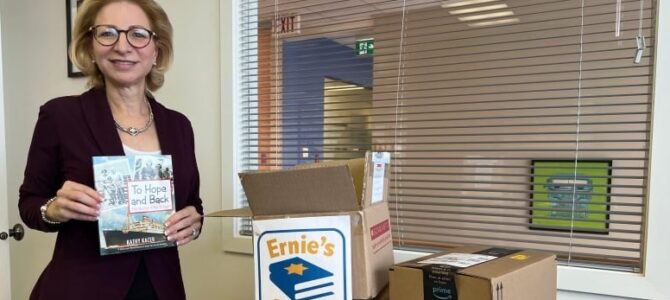
Photo: Marilyn Sinclair’s Holocaust education group Liberation 75 is sending free copies of a middle school title To Hope and Back: The Journey of the St. Louis to 6th grade classrooms across Ontario as part of an initiative named for her father Ernie, a Holocaust survivor. Photo by Nazima Walji/CBC.
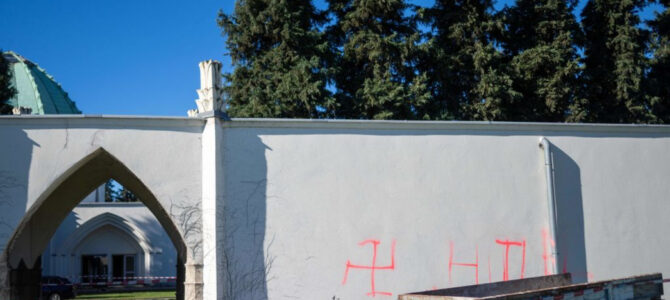
As Holocaust Education Becomes Compulsory in Some Provinces, Advocates Call for Wider Adoption
Curriculum changes in Ontario and British Columbia to take effect in 2025
by Jessica Wong, CBC News, November 6, 2023
Marilyn Sinclair says she’s feeling “pretty great” about Ontario’s new requirement that sixth-graders learn about the Holocaust.
Sinclair, founder of Holocaust education organization Liberation 75, is responding to more than 8,000 requests for copies of a book from 6h grade teachers across the province. Told from a child’s perspective, the book recounts the real-life story of the St. Louis, a ship filled with Jewish refugees that fled Nazi Germany in 1939 and was turned away from Cuba, the US and Canada.
The free books from Sinclair’s organization will also come with a toolkit of teaching resources, information about a forthcoming speaker series with the author,and links to an online book club where educators can trade teaching strategies.
“[The package] was our way of saying, ‘Don’t be scared, we’re here. We’re going to provide you with the resources you need,'” Sinclair said. “Teachers have a lot to teach in the curriculum. We want to make it as easy and as pleasant for them as possible.”