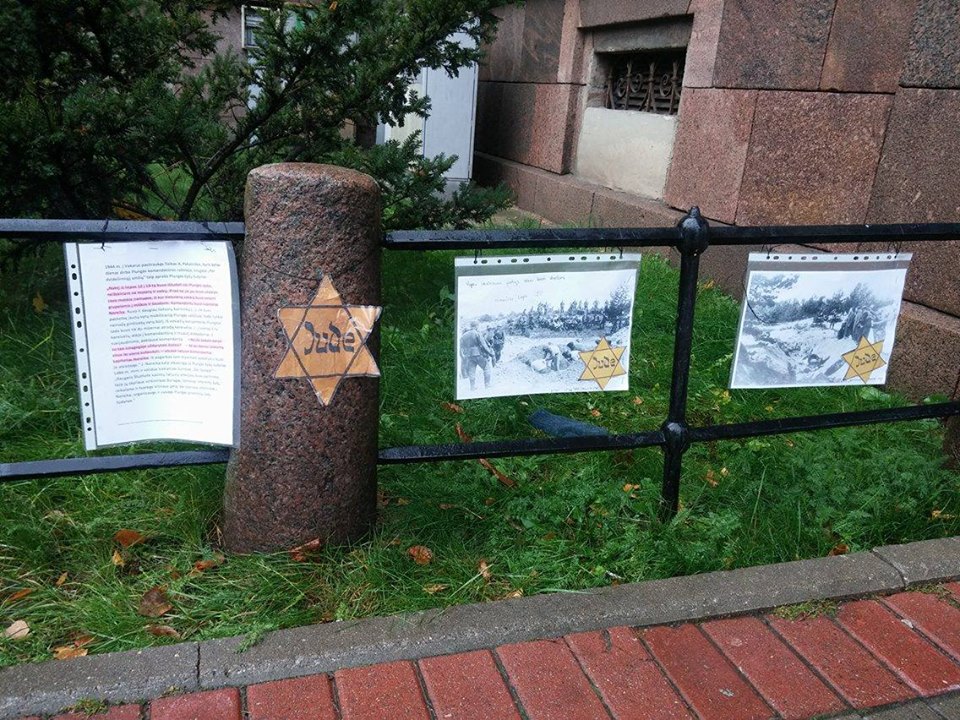
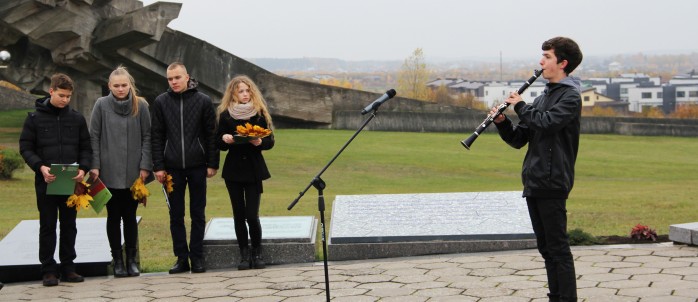
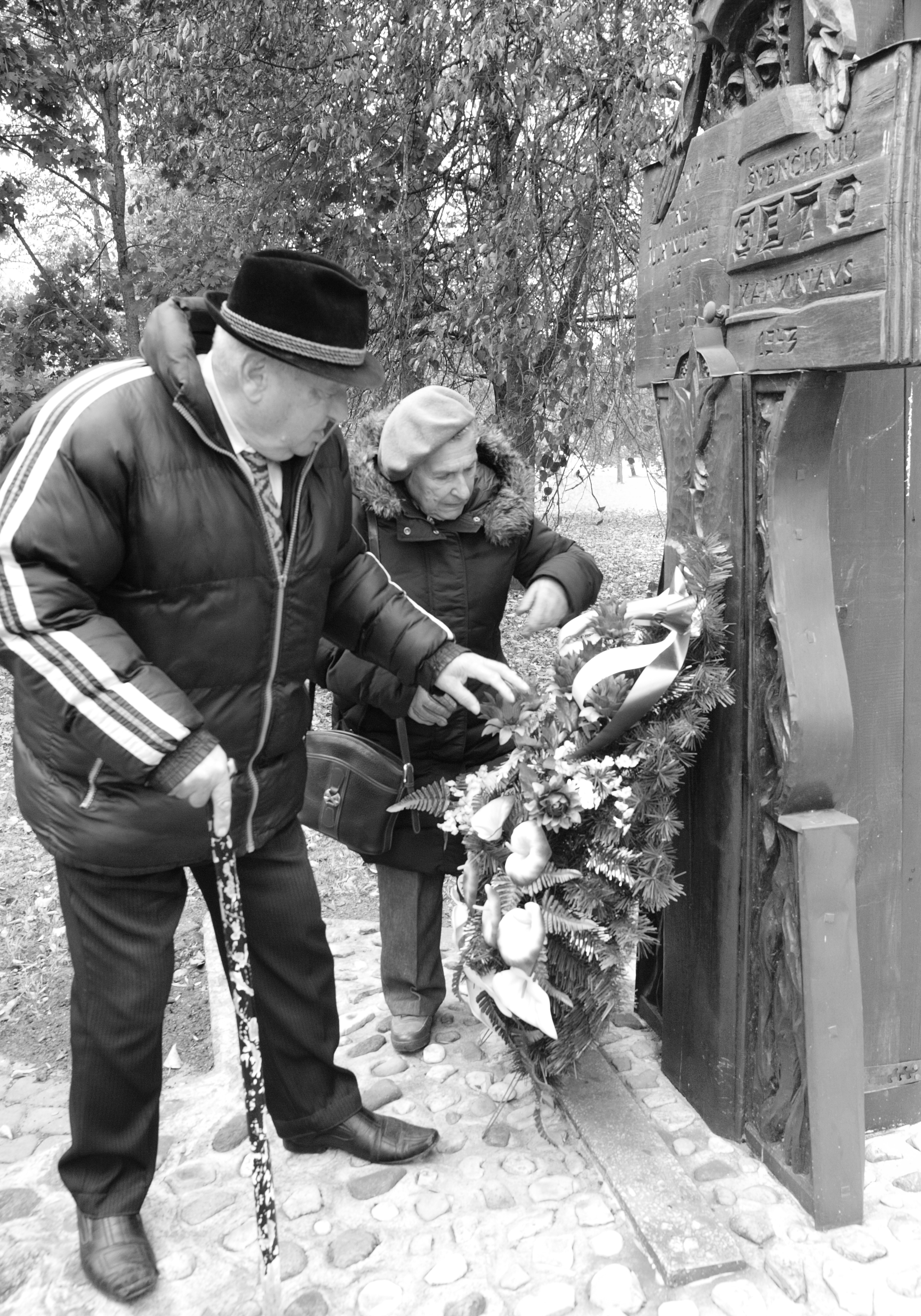
Vidmantė Jasukaitytė, an award-winning Lithuanian poet, prose and theatrical writer, as well as a signatory to the Lithuanian Act of the Restoration of Lithuanian Independence in 1990 when she was a member of the first free Lithuanian parliament, was the initiator of a multimedia artistic performance at the site of the Holocaust-era HKP slave labor camp on Subačiaus street in Vilnius. The performance took place on the evening of September 24, 2015, and was called simply “Subačiaus street. Ghetto,” also the name of one of Jasukaitytė’s collections of poetry published in 2003 which earned her the Lithuanian Television Literary Prize loosely based on her own experiences and impressions living in the former Nazi camp, two brick apartment blocks which still serve as housing for an entire Vilnius neighborhood just outside the Old Town.
The construction of the buildings as cheap housing for Jews was funded in 1900 by Baron Maurice de Hirsch (aka Moritz Hirsch, freeman from Gereuth), who established in 1891 the Jewish Colonization Association to help Russian and Eastern European Jews emigrate to Argentina:
“Large tracts of land were purchased in Buenos Ayres, Sante Fé, and Entre-Rios. The Russian government, which had rejected the baron’s offer for the amelioration of the condition of the Jews in the empire, cooperated with him in the organization of a system of emigration. A central committee, selected by the baron, was formed in St. Petersburg, at the head of which were Barons Horace and David Günzburg, together with S. Poliakoff, M. Sack, Passower, and Raffalovich, the latter three being distinguished members of the St. Petersburg bar. The baron also formed a governing body in Argentina; and the personal direction of the colonies was entrusted to Col. Albert Goldsmid, who obtained temporary leave of absence from the English War Office for the purpose.”
from http://www.jewishencyclopedia.com/articles/7739-hirsch-baron-maurice-de-moritz-hirsch-freiherr-auf-gereuth
One of the baron’s main concerns was overcrowding among Jews, whether in their new colonies in South America or Palestine, or in their European home lands, and his philanthropical activities included supporting Jewish communities where the lived in the Diaspora, with special emphasis on providing Russian Jews with trades and an industrious attitude. In 1898 the Jewish Colonization Association allocated funds for “the construction of cheap housing for the impoverished Jews of the city of Vilna.” A Healthy Homes Association was established in Vilnius and had the two buildings with 216 apartments built in the year 1900. The architect was Eduard Goldberg. Poor Jews, students, and young Halutzim who were planning to go to Palestine to practice agriculture there. The land around the “cheap housing” was turned into gardens.
Later the Healthy Homes Association transferred the buildings to the Vilnius Jewish Community. In 1940 the Soviet government nationalized the buildings and the plot of land there.
In the fall of 1941 the residents of the buildings were murdered at Ponar along with many other Vilnius Jews during the initial extermination operations. The Germans used these emptied buildings to house the wives and children of Soviet officers, so creating a “Russian ghetto.” Later some of these women were shot at Ponar and the children placed in orphanages. Some of the women were sent to forced labor camps in Germany. Thus by 1943 the buildings had been emptied of people a second time.
As August turned to September in 1943, just before the liquidation of the Vilnius ghetto, several Jewish labor camps were established in Vilnius. One of them was at the two buildings on Subačiaus street, whose address at that time was No. 37, but is now Nos. 47 and 49. Several hundred qualified workers with their families were taken from the ghetto and housed here. The majority were mechanics, metal workers, glass workers and so on, i.e., those who had worked before the establishment of the new camp at the German military equipment repair workshops called HKP (an abbreviation of the German “Heereskraftfahrpark Ost 562”) while living in the ghetto.
These auto repair workshops where ghetto prisoners worked were scattered all over the city, at the barracks and garages in the Verkių street neighborhood (some of the workers, mainly single men, lived there, and were taken back to the camp on Subačiaus street by truck on their days off), and at the bus park garage at Savanorių street No. 2 where, as at the barracks, automobile engines were outfitted and hardened for military duty. The main headquarters and workshop for HKP Ost 562 was the technical school building at Olandų street No. 12 (now No. 16) and across the street from it.
Workshops were also housed on the first floors of both buildings on Subačiaus street and in surrounding buildings, including the one-floor building to the left of Block I (there’s a sauna there now). Vehicles brought to the camp were also repaired or disassembled into parts at the repair pit to the left of Block II (in the 1960s a five-storey building was erected there). The perimeter of the camp was surrounded by barbed wire and guarded. SS officer Richter was in charge of this camp as well as the Kailis labor camp in Vilnius. Entry to the camp was from Subačiaus street between the two apartment blocks. After the war this entrance was blocked by a new four-storey building. Entering from Subačiaus street, Block I was on the left and Block II on the right. There was also a sauna in Block II.
There is information indicating Wehrmacht officer Karl Plagge came up with the idea of creating a separate Jewish camp for the HKP. He was in charge of the camp and was responsible for the automobile repair workshops in general. Was he trying to save “his” Jews from certain death as preparations were being made to liquidate the Vilnius ghetto? Was it because he was responsible for automobile repairs, and more qualified workers were needed? Whatever the case, many of those who survived say major Plagge saved them.
In September of 1943 workers were sought directly on the streets of the ghetto. Plagge compiled the first lists of those to be moved to the new camp in August. During August’s deportations of ghetto inmates to Estonia, however, many mechanics experts were lost. So additional lists of those to be sent to the HKP camp were drawn up, and many people, not just specialists, tried to get on those lists. People listed their fathers, relatives and spouses and others offered bribes to the people making the lists. It was a hope to survive and everyone sought that at any cost.
These lists have not come down to us (or at least haven’t been found yet but exist in some archives somewhere). We don’t know the exact number of camp inmates when it began. Documents published earlier show the number of camp inmates a the beginning November, 1943. According to those documents, the total number of inmates on November 6, 1943, was 1,218 people. This number grew somewhat to stand at 1,257 on March 26, 1944. It seems this was due to some people legalizing themselves after entering the camp without being specialists, or as family members of non-specialists. Others sought shelter and work there and Vilnius ghetto prisoners who survived the liquidation by hiding in malinas there found a way to get into the two apartment blocks on Subačiaus street. Some of these found haven outside the camps and there were escapes. Perhaps some remained as “illegals” there as much as conditions at the HKP camp allowed for that; there were constant roll calls and scrupulous counts of workers.
There were many women and children at the camp besides men. Initially only a few women worked in the vehicle repair shops. One supposed Plagge knew that the train carrying Vilnius ghetto prisoners supposedly to Kaunas, where “there was a lack of labor,” at the beginning of April, 1943, actually stopped at Ponar where all 4,000 or so prisoners were shot. Perhaps this explains Plagge’s strenuous justifications that the presence of women and children in the camp ensured high-quality work by the men, and that sending unemployed women to Kaunas was not a good idea. Plagge initiated workplaces for almost all women at the camp in the winter of 1944, sewing and repairing military uniforms to order for the E. Reitz Uniformwerke and Meier Herbert companies. The sewing sections located on the top floor of Block I and in a specially constructed barracks to the left of the entrance to the camp were outfitted by the local construction team and the Reitz and Meier companies later supplied sewing and weaving machines.
On March 27, 1944, “Children’s Operations” were carried out at both HKP and the Kailis camp. Only a few children found suitable hiding places and became illegals whom no one should ever see in public again. These mass murder operations also targeted non-working and mainly elderly women. All of them were shot at Ponar. The camp population lost 246 women and children (1,257 people on March 25 dropped to 1,011 on April 13). There were work disruptions, and some people made use of the fact that no one was sure of the exact number of prisoners at that point to make their escape.
In mid-May the number of prisoners dropped again, this time because of the loss of 67 people, mostly men. Some accounts say some of them were sent to mine peat in Kazlų Rūda and others were sent to exhume and burn corpses at Ponar.
The camp existed until the summer of 1944.
As the front drew closer on July 1, 1944, Plegge warned the workers the camp was to be evacuated and would come under the jurisdiction of the SS. Other accounts have it that Josef “Sep” Gramer mentioned the coming liquidation to several of the workers under him. Understanding the true meaning of “liquidation” in the Nazi lexicon, some prisoners escaped with their families that very day as soon as it was slightly dark. Others went to their malinas, hiding places whose existence they kept even from fellow slave laborers.
During the last roll-call on July 2, many were missing. The next day everyone was brought to trucks which were to carry them away. These people were shot at Ponar along with the surviving Jews from other slave labor camps in the city. Those found hiding were shot the same day right beside the two residential blocks. Some managed to flee.
The Germans quit the camp on July 4, 1944.
Some of the malinas in the eaves, basements and behind brick walls went undiscovered and nearly 100 Jews half-dying of thirst lived to see liberation. The Soviet Red Army was already on the outskirts of Vilnius and on July 7 broke through the German defensive lines. By July 9 Nazi forces were surrounded and on July 13 soldiers of the 3rd Byelorussian Front entered the city proper.
for more information on the history of the HKP camp, see:
http://www.jmuseum.lt/index.aspx?TopicID=405