
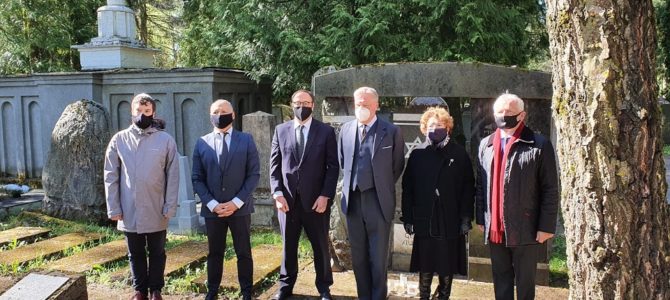
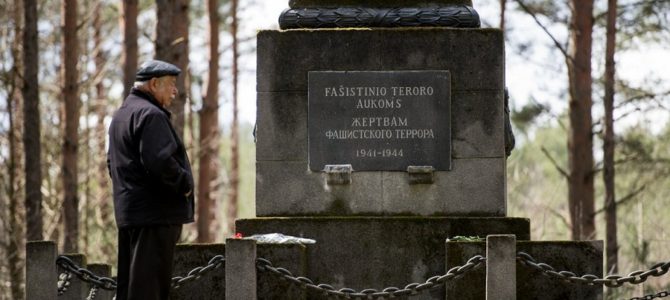
The Lithuanian Jewish Community and resident foreign ambassadors to Lithuania marked Victory in Europe day with a small, solemn gathering at the Jewish cemetery on Sudervės road in Vilnius on the morning of May 8. German ambassador Matthias Sonn, Israeli ambassador Jossy Avni-Levy and US ambassador Robert Gilchrist gave short addresses stressing the need to remember the past while looking to a better future.
Remembering the Victims of World War II
On the day marking the end of World War II in Europe, Victory Day, May 8, a small group gathered at the Jewish cemetery on Sudervės road in Vilnius to honor the victims of WWII, including Holocaust victims. Lithuanian Jewish Community chairwoman Faina Kukliansky was there with German ambassador Matthias Sonn, U.S. ambassador Robert Gilchrist, Israeli ambassador Yossy Avni-Levy, deputy Lithuanian foreign minister Dalius Čekuolis and Vilnius municipal administration director Povilas Poderskis.
Video Highlights of the Fifth World Holocaust Forum in 2020 in Jerusalem
Dear Presidents,
Dear Friends,
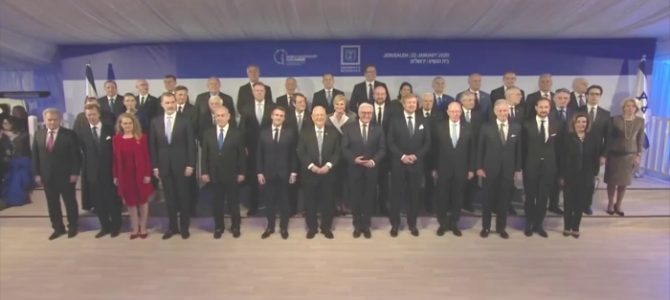
We are very happy and proud to share with you a video featuring highlights of the EJC event last January – The Fifth World Holocaust Forum – initiated by our President Moshe Kantor and hosted by the President of the State of Israel, Reuven Rivlin, at Yad Vashem.
Nearly 50 heads of state and royalty from across the world, as well as the three leaders of the European Union institutions, gathered in Jerusalem to reaffirm their unity against the upsurge of antisemitism globally and to honour the memory of the victims of the Holocaust.
Although it is difficult to encapsulate such a historic event in a few minutes, the video contains the most beautiful images, and the strongest and most touching excerpts of speeches and musical performances.
We hope this film will bring back precious memories of these emotional two days and allow those who could not be with us to grasp the intensity of the commitment expressed by world leaders for such a noble cause.
Stay safe and best regards,
Raya and the EJC Team
Lithuanian MPs Defend Noreika
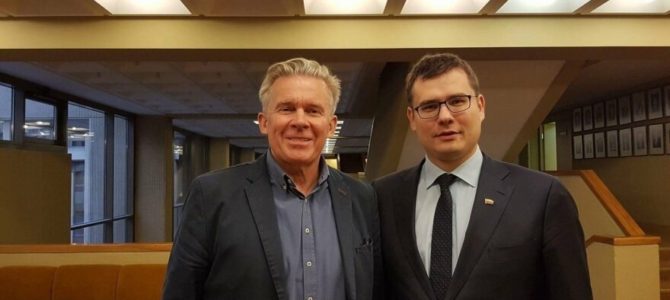
The following open letter appeared on the delfi.lt website. It is called “Reacting to Linkevičius’s Reply on Request to Review Positions on Jonas Noreika, aka General Storm.” Linas Linkevičius is the Lithuanian foreign minister. The two authors of the open letter were Audronius Ažubalis and Laurynas Kasčiūnas, members of parliament in the Homeland Union/Conservatives-Lithuanian Christian Democrats faction. Ažubalis was also a foreign minister in a previous government.
§§§
On April 6 we contacted foreign minister Linas Linkevičius and Vilnius mayor Remigijus Šimašius asking them to review their earlier positions regarding Jonas Noreika, aka General Storm, in light of the final and unappealable decision of the Lithuanian Supreme Administrative Court on April 1. We got an answer from the minister, and thank you for following the law, but from the mayor there was the usual silence, but we’ll talk about the lack of political culture [sic] another time…
Replying to the minister by open letter, we want to raise again respect for decisions by the Lithuanian courts and recall a few essential details which have been forgotten in this discussion of history policy.
It seems as if it’s clear to everyone that officials of a state under the rule of law should not ignore court decisions and laws in their activities. Especially not the fact the Lithuanian Supreme Court rehabilitated Jonas Noreika of the full extent of the Soviet accusation, that is, for cooperating with the Germans.
Lithuania and the Holocaust: Endless Seizures Instead of Healing Wounds (Part III)
part three
by Vytautas Bruveris
What are the methods for Lithuania as a country and society to demonstrate by deeds rather than words true solidarity with the country’s Jewish community, almost completely exterminated in the Holocaust, with the victims and with their descendants?
Long-Awaited Victory Celebrated
A third problematic bloc in modern Lithuania’s relationship towards the Holocaust is the definition, including legal, of Soviet crimes and oppression.
Should the mass murders and oppressions the Soviets carried out in Lithuania not just be called but legally recognized as genocide? Should they also be recognized as genocide outside Lithuania in the international arena?
On Anti-Semitic Comments on the Internet Site www.lrytas.lt
May 7, 2020
To:
Evaldas Pašilis, prosecutor general, Republic of Lithuania
Renatas Požėla, commissar general, Police of the Republic of Lithuania
STATEMENT
On anti-Semitic comments on the internet site www.lrytas.lt
The Lithuanian Jewish Community (LJC) constantly investigates information about possible expressions of anti-Semitism and provides the corresponding information to international organizations battling anti-Semitism on expressions of anti-Semitism and reactions from state institutions to these.
Last week the internet webpage www.lrytas.lt published a three-part feature called “Lietuva ir Holokaustas: vietoj žaizdų gydymo – nesibaigiantys traukuliai” [Lithuania and the Holocaust: Endless Seizures Instead of Healing Wounds]. (URLs to these texts:
Lithuania and the Holocaust: Endless Seizures Instead of Healing Wounds (Part II)
part two
by Vytautas Bruveris
What are the methods for Lithuania as a country and society to demonstrate by deeds rather than words true solidarity with the country’s Jewish community, almost completely exterminated in the Holocaust, with the victims and with their descendants?
Why Is There No Basic Number?
So if there’s no national agreement on what should be considered contributing to the Holocaust and what criteria might define this, then does the determination of direct participation in the mass murder of Jews not raise any conceptual misunderstandings?
Lithuania and the Holocaust: Endless Seizures Instead of Healing Wounds (Part I)
part one
by Vytautas Bruveris
What are the methods for Lithuania as a country and society to demonstrate by deeds rather than words true solidarity with the country’s Jewish community, almost completely exterminated in the Holocaust, with the victims and with their descendants?
After all, this year has been declared not only the Year of the Vilna Gaon but also the Year of Litvak History at the highest level of state.
Moreover, this year Lithuania and the world mark the round anniversary of a date connected with World War II, Nazi crimes and the Holocaust.
At least two such methods have long been clear.

Happy Birthday to Rozeta Ramonienė
Rozeta Ramonienė, the chairwoman of the Union of Former Ghetto and Concentration Camp Prisoners, celebrated her birthday on May 1.
Happy birthday, dear Rozeta! As the fragrant buds of spring emerge, we wish you long life, a very happy birthday celebration, much happiness and many happy days to come!
Mazl tov! May you live to 120!
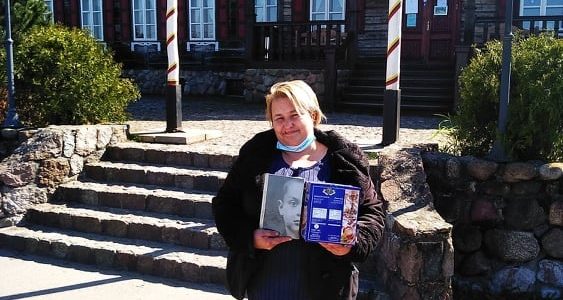
Big Thank You to Svetlana Who Found a Jewish Headstone in Her Garden
Vilnius resident Svetlana Šitelienė contacted the Lithuanian Jewish Community to report her discovery of what appears to be a Jewish headstone, or matzeva, on her farm.
Thank you, Svetlana.
We’ve reached Svetlana and thanked her, and sent her a box of matzo and the Vilnius ghetto diary of Yitzhak Rudasheviski translated into Lithuanian.
Studying the photographs she provided, it appears this might be an unfinished headstone made for someone named Esther, with the surname partially completed. Mrs. Šitelienė said the grave stone might have ended up in her yard 47 or more years ago, and according to relatives it came from the Jewish cemetery near the Palace of Marriage in Vilnius.
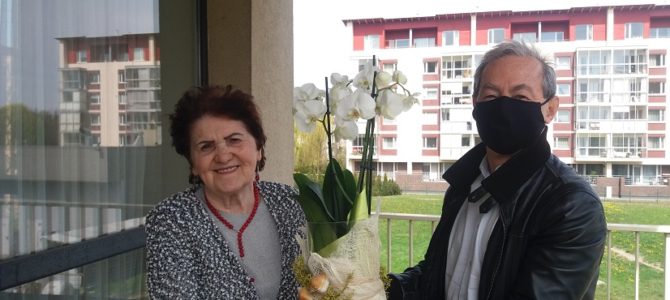
Musical Happy Birthday from the Kaunas Jewish Community
As spring finally arrives, the Kaunas Jewish Community sends birthday greetings to our beloved member Liuba Stulgaitienė.
Liuba is very active in Community events, a member of the Yiddish Club, a member of the Union of Former Ghetto and Concentration Camp Prisoners and a woman who always radiates positivity, optimism and joy. She smiles at the whole world despite all injuries experienced and the world answers her the same way.
Dear Liuba, keep being so young at heart, so energetic, so thirsty for knowledge and someone who is able to say the years are not a burden, but a rich experience.
Mazl tov! May you live to 120!
Condolences
The Lithuanian Jewish Community sends its condolences to Arkadijus Gotesmanas on the death of his father, Burnitalis Arnoldas Gotesmanas, who passed away at the age of 90. The late Gotesmanas survived Auschwitz and Mauthausen. He died in Brooklyn and was buried there.
Israeli Ambassador Yossi Levi Gives Interview on Israeli Independence Day
Faina Kukliansky Interviewed by Lithuanian Media on Yom haAtzma’ut
Lithuanian Jewish Community chairwoman Faina Kukliansky was interviewed by Lithuanian publicist Donatas Puslys on Yom haAtzma’ut, Israeli independence day, and spoke about what the holiday means to Jews in Lithuania, to her personally and to Jews around the world. She also spoke about the Holocaust, Litvaks living in Israel, the promise Eretz Israel held out to Soviet Jews and the country’s progress over the last 72 years. The interview was conducted in Lithuanian but concludes with warm wishes in Yiddish.
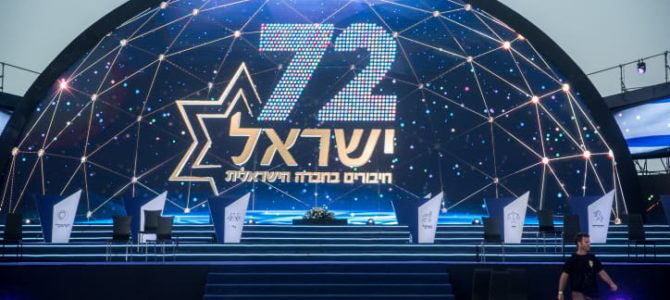
Yom haAtzma’ut, Israeli Independence Day
Israelis began celebrating 72 years of statehood this year by greeting medical personnel. A torch-lighting ceremony began without an audience in honor of Israel’s doctors, nurses, care-givers, hospital staff and volunteers who have been fighting the Wuhan virus, with many fireworks displays and hospital fly-overs by the Israeli Air Force canceled.
Most Israelis marked Independence Day at home.
Prime minister Binyamin Netanyahu addressed the nation in a video saying “We’ve never celebrated this kind of Independence Day. We are in a physical sense far from one another, but we’ve never been closer.” Praising hospital workers Netanyahu added “The day will come when embraces return… But we still can’t do this because the pandemic is still here.”
Knesset speaker Benny Gantz lit a torch on the eve of Independence Day and spoke of national unity, saying Israelis must prepare for even more difficult days, and called for creating “a new moral face of the country.”
Condolences
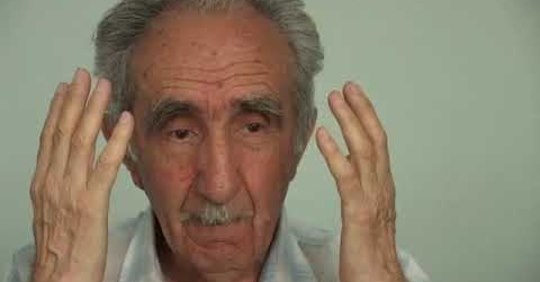
Moshe Kukliansky has died at the age of 97 in Israel. He was the head of the Kukliansky family and was the uncle of Faina Kukliansky, chairwoman of the Lithuanian Jewish Community.
Our deepest condolences to his children Alexander, Zinaida, Liliiana, niece Faina, the multitude of grandchildren and great-grandchildren, and the entire family.
Moshe Kukliansky was a chemist, a witness to Litvak history and a Holocaust survivor. Faina recalls: “Our big family has lost a noble person who survived the Holocaust and was a great witness to Litvak history, a chemist and a just man filled with the law. That’s what he liked to call other people. After my grandmother Zinaida–the mother of Moshe, Samuel and Anna–was murdered and Moshe was forced to work for local farmers, when he came home my father Samuel used to grab his hands and kiss him. Moshe asked ‘What are you so happy about? Our mother is dead.’ My father, who was 11 then, replied ‘I’m happy you’re still here.’ For me, my children and grandchildren, Moshe was like a father and a grandfather, just as all my aunts and uncles were like parents to me, and cousins like brothers and sisters. It is very sad that our last family member of the older generation has passed away.”
Moshe Kukliansky’s telling of the dramatic story of the family’s survival during the Holocaust was immortalized several years back in a film called the Pit of Life and Torment (Gyvybės ir kančių duobė).
LJC Members Recall Israeli Military Service
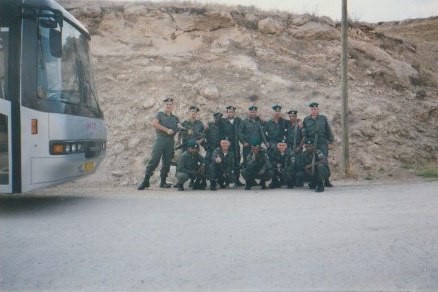
Members of the Lithuanian Jewish Community have shared with us some of their thoughts about and memories of service in the Israeli armed forces.
Itzhak Solomon: “I hope Israel doesn’t experience new wars… I have many photographs from my life in the army.”
Itzhak Soliomon sent us photos from the Yom Kippur War in the Sinai Peninsula in October of 1973 where he saw combat.
On October 6, 1973, a military coalition of Egypt and Syria (formerly joined as one state in the United Arab Republic), attacked Israel during the holiday of Yom Kippur. They took the Sinai and retook the Golan Heights in Syria which Israel had occupied since the Six-Day War in 1967. While the Syrians and Egyptians made inroads during the first 48 hours, Israel quickly seized the initiative.
By week two the Syrians had been completely routed from the Golan. In Sinai Israel attacked forces who had crossed the Suez canal, the former cease-fire line, and cut them off from resupply. After two weeks of hostilities, the US came to Israel’s aid supplying ammunition by airlift, and Israel pushed enemy forces back to their initial positions.
Itzhak Solomon hopes Israel won’t face new wars and remembers victory was bitter in the Yom Kippur War with so many young lives lost.
Virtual Lectures: Escape from Ponar and Jacques Lipchitz’s Memories of Lithuania
Please note: the ZOOM platform used for the virtual lectures below is widely known to be unsafe and is considered spyware by competent observers, deployed most likely by China. It can usurp control of cameras and microphones on your computer and telephone. Its use is banned by the U.S. military and U.S. government organizations. The Lithuanian Jewish Community takes no responsibility for those infected by clicking the links below.
§§§
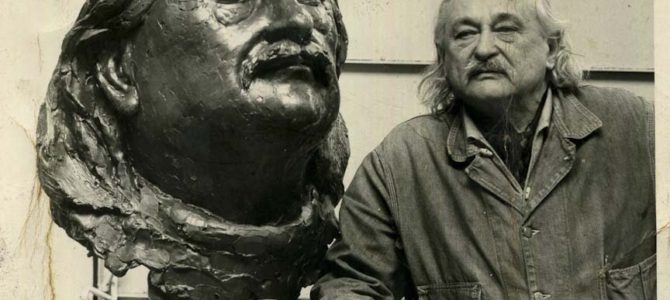
The Vilna Gaon State Jewish Museum is sponsoring two virtual lectures called “Story of Escape from Ponar” and “Lithuania in Jacques Lipchitz’s Reminiscences.”
“I am a sculptor from Lithuania,” Jacques Lipchitz (1891-1973) used to say to introduce himself at openings of his works in museums and galleries around the world, even though Lithuania had disappeared from the world map when these shows took place. Sculpture and memorial heritage researcher Aušra Rožankevičiūtė talks about Lipchitz’s image of Lithuania and his contacts with Lithuanian artists and thinkers.
Happy 100th Birthday to Eta Gurvčiūtė
Happy birthday to Eta Gurvčiūtė as she turns 100. Lithuanian Jewish Community member Eta Gurvčiūtė turned 100 April 27. Clear of mind, with no health complaints and her beautiful smile, she is busy receiving greetings and congratulations today. She was graduated from the Sholem Aleichem Gymnasium before World War II.
Many of our other seniors remember Eta because she volunteered at the medical center of the LJC for so many years, later becoming a client herself. She spends her time these days at the Social Care House for Seniors in Vilnius now.
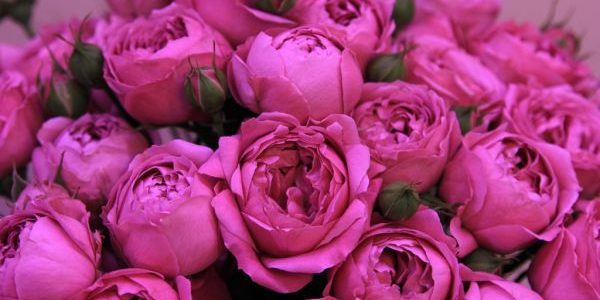
To celebrate her milestone, the LJC is planning a Fayerlakh concert for everyone at her senior citizens’ home. ALthough she’s celebrating her birthday under strict quarantine at the senior center, the Lithuanian Jewish Center tried to send her a present anyway. We managed to have a vase of flowers and a card delivered.
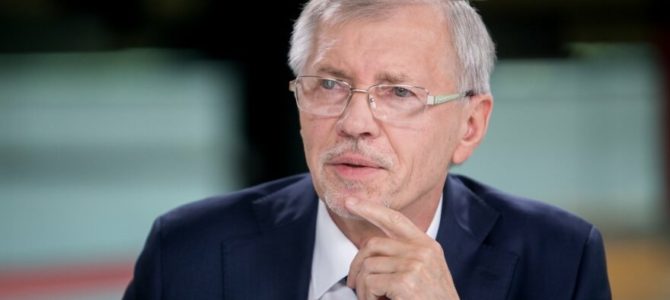
Greetings from Lithuanian Parliament on Gaon’s 300th Birthday
Dear Lithuanian Jewish Community chairwoman Mrs. Faina Kukliansky, dear Lithuanian Jewish Community,
We mark the 300th anniversary of that most exalted Litvak, Eliyahu ben Solomon Zalman, the Vilna Gaon. The parliament of the Republic of Lithuania named this year, 2020, the Year of the Vilna Gaon and Litvak History, to stress the priceless contribution the Jewish community, an inseparable part of our society for 700 years now, has made to Lithuania’s history, culture, learning and consolidation of statehood through your adherence to tradition and social activity.
In all times there have been people who do not conform to the canons of their era, who through their creativity and unconventional thinking have changed the world. The Jewish people have given so much to the world. One of them, the Gaon or Genius of Vilna, Eliyahu ben Solomon Zalman, was a scholar of Jewish texts and law and a Talmud interpreter and scholar. This was a brave challenge during his times but, happily, Eliyahu grew up in an intellectual environment and was supported by his family and appreciated by the community. Rumors about the young sage and his intellect spread far beyond the limits of Vilnius. The Vilna Gaon became the most renowned religious authority and he changed people’s life paths, thought and the concept of Litvak, and turned Vilnius into a Jewish spiritual center, the Jerusalem of Lithuania. This is a priceless historical, cultural and philosophical legacy of the Jews and Lithuanians of Vilnius and Lithuania and of the other peoples who live in Lithuania.
The Year of the Vilna Gaon and Litvak History is a great opportunity for all of us today, in the words of the Gaon, “to see with our own eyes, hear with our own ears and feel with our entire heart” what significant and rich heritage we have in creating the Lithuania of our future. Congratulations!
[signed]
Gediminas Kirkilas, deputy speaker, chairman of the European Affairs Committee
Lithuanian parliament