History of the Jews in Lithuania

Victims of First Mass Murder Remembered in Palanga

Victims of First Mass Murder Remembered in Palanga

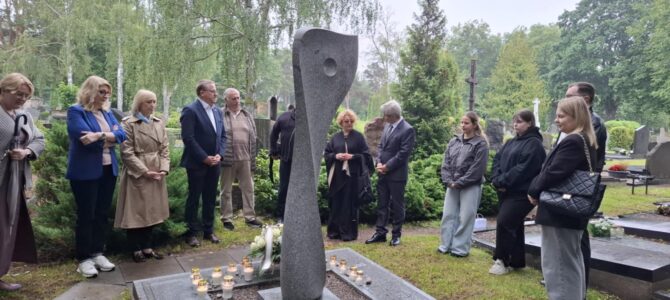
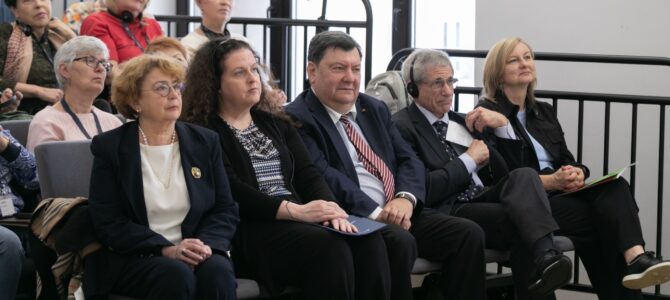
Palanga Jewish Community chairman Vilius Gutmanas, Lithuanian Jewish Community chairwoman Faina Kukliansky, members of the Palanga Jewish Community, Lithuanian MPs Mindaugas Lingė, Dalia Asanavičiūtė-Gružauskienė and Paule Kuzmickienė, Palanga mayor Šarūnas Vaitkus, deputy mayor Akvilė Kiljonienė, Palanga municpal Vulture Department director Robertas Trautmanas, staff from the Jonas Šliūpas Museum and high school students gathered to remember the first mass murder of Jews in Lithuania on June 27.

On June 22, 1941, a Young Pioneers summer camp of mainly Jewish children saw the brunt of the Nazi invasion with a building burnt down from aerial bombardment and children fleeing in panic. On June 26 all Jews in Palanga were arrested and crowded into two synagogues, one designated for females and young children and the other for males. The males were taken out and shot in the city’s main park on June 27. Around 111 people were murdered there that day, including 106 Jews and 5 Lithuanians. Remaining Jews were subjected to mass murder again on October 12, 1941. It is believed more than 400 Jews from Palanga were killed during both mass murders.

Hundredth Anniversary of Birth of Leiba Lipshitz in Šiauliai

Hundredth Anniversary of Birth of Leiba Lipshitz in Šiauliai

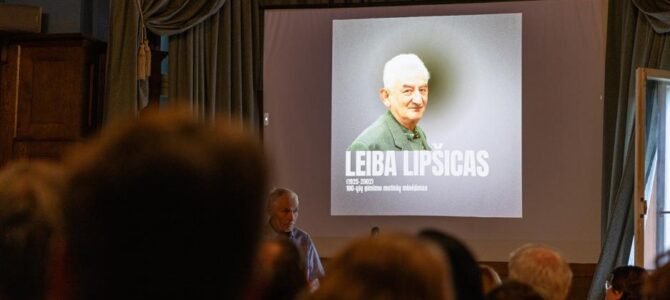
The Šiauliai District Jewish Community invites you to come celebrate the 100th anniversary of the birth of Leiba Lipshitz. The Community and the Aušra Museum in Šiauliai will mark the date with an event commemorating this chronicler of the Šiauliai Jewish community in the 20th century and well-known personality with a presentation by historian Jonas Kiriliauskas.

Time: 4:00 P.M., Wednesday, July 16
Place: The Chaim Frenkl Villa and Museum, Vilnius street no. 74, Šiauliai

Hundredth Anniversary of the YIVO in Vilnius

Hundredth Anniversary of the YIVO in Vilnius

An international seminar for Lithuanian teachers dedicated to the 100th anniversary of the founding of the YIVO Institute (Jewish Research Institute) in Vilnius was held at the Martynas Mažvydas National Library, and a virtual museum was presented with a prepared methodological manual entitled “Beba’s Story,” based on the story of Beba Epstein, a girl who lived in Vilnius.

The opening of the seminar was attended by library director Aušrinė Žilinskienė, Israeli ambassador Hadas Wittenberg Silverstein, Lithuanian Jewish Community chairwoman Faina Kukliansky, MP Emanuelis Zingeris, diplomats from the USA and Germany and deputy Vilnius mayor Vytautas Mitalas.

The seminar was attended by 40 teachers from different locations in Lithuania who are interested in the history of Lithuanian Jews and the possibilities of using various historical sources in their curricula.

Speakers included Egidijus Aleksandravičius of Vytautas Magnus University, YIVO sirector Jonathan Brent, director of the National Library’s Judaica Center Lara Lempertienė and historian Saulius Sužedelis.

The seminar was organized by the YIVO Institute (USA) in cooperation with the International Commission for the Evaluation of the Crimes of the Nazi and Soviet Occupation Regimes in Lithuania, the Martynas Mažvydas National Library, the city of Vilnius, the Goodwill Foundation and the Lithuanian Jewish Community.

Brothers and Sisters in Arms in the Service of Remembrance

Brothers and Sisters in Arms in the Service of Remembrance

by Sergėjus Kanovičius, www.lrt.lt

When a half year ago German ambassador to Lithuania Cornelius Zimmermann asked me whether I’d object to an initiative by which soldiers from a Germany armored brigade would help document Jewish cemeteries in Lithuania, I was at a loss for words. The first thought which occurred to me was, why now Lithuanian soldiers?

But as I sat in the waiting room of the German embassy… Over 14 years in the life of Maceva (Matseva, Hebrew for monument), there’s been a bit of everything–Austrian and German volunteers, Christian, Lithuanian high school students, US embassy staff, visitors from Israel. But Bundeswehr soldiers maintaing Jewish cemeteries and documenting grave monuments? Why?

Scouting Camp by Boat

Scouting Camp by Boat

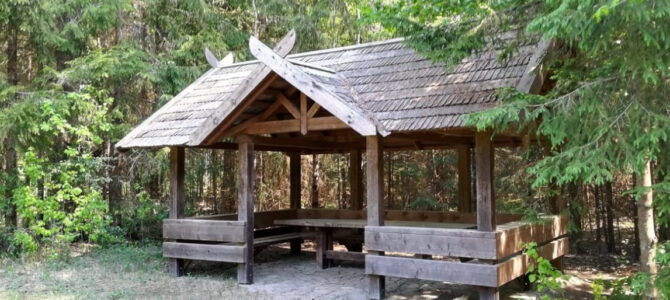
ewish scouting leader Michail Adomui Kofman is planning a scouting camp at the Vaitlunkis camp and recreation area in the Panevėžys district to be reached and exited by boat from July 2 to July 8.

The program includes abundant activities, four meals per day, amenities and camp badges and emblems.

The cost is 90 years for the full program, 15 euros per day for part-time participants and a donation of 30 euros from adult volunteers and older scouts. Part-time volunteers are asked to pay 5 euros per day. Parents and guests attending visitor’s day are asked to pay 10 euroes per day. Scout leaders supervising groups of young people are not asked to pay anything. There are discounts for two children from the same family at 75 euros per person, and 3 members of the same family pay just 6- euros each. Discouns don’t apply to adult family members.

Journey to Agartha Scouting Jamboree in Panevėžys

Journey to Agartha Scouting Jamboree in Panevėžys

A jamboree of scouts from across the Panevėžys district including a contingent of Jewish scouts met in the Žalioji Forest and camped there from May 31 to June 1.

Almost 150 scouts already on scene greeted a minbus full of Jewish scouts just before the opening ceremony for the campsite.

The scouts were divided into age groups and activities for the youngest included handicrafts and botanical identification. Scouts aged 10-14 played games to increase vigilance, leadership and strategic thinking. Scouts 14-18 honed their skills in constructing shelters (knots, wooden construction, tool safety), built a dug-out bunker and cooked for themselves.

This was the first time Jewish scouts appeared with their new official troop title, the Yitzhak Meir Jewish Scouting Club.

The jamboree was called A Journey to Agartha, the mythical subterranean kingdom popularized in Europe by Ferdynand Ossendowski and René Guénon.

Bundeswehr, Maceva Clean Up Old Jewish Cemetery in Merkinė

Bundeswehr, Maceva Clean Up Old Jewish Cemetery in Merkinė

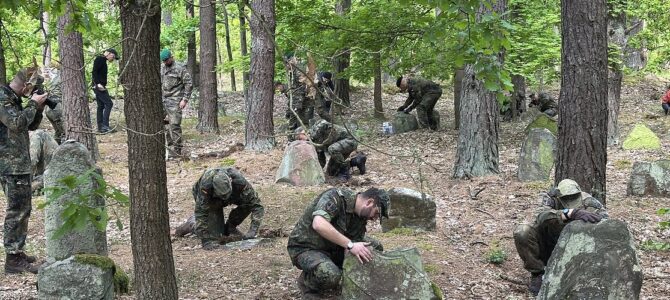
Soldiers from the German Bubdeswehr’s 45th armored brrigade and members of the Maceva Jewish cemetery preservation group spent four days last week cleaning up the old Jewish cemetery and Holocaust monument in Merkinė in southeast Lithuania.

Merkinė is the site of early if not the earliest Jewish settlement in Lithuania.

Brigade commander Christoph Huber, German ambassador to Lithuania Cornelius Zimmermann and Lithuanian Jewish Community chairwoman Faina Kukliansky visited the cemetery to see the soldiers’ work at a special ceremony for concluding the upkeep mission.

About 130 soldienrs working with people from Lithuania’s Maceva Jewish cemeteries initiative removed moss, polished headstones and cleared brush from the site. Members of Maceva photographed the markers and cemetery as well.

One German soldier stationed in Lithuania since April said: “It’s not an obvious thing to me that I as a German soldier can contribute to the meaningful work by Maceva at Jewish cemeteries. This was an especially moving experience for me, to look at our complicated page of history in Lithuania.”

The War with Iran: No Contest

The War with Iran: No Contest

by Geoff Vasil

Critics contend the claim Iran is weeks away from a nuclear bomb has been a talking point for at least a decade if not 30 years now.

Israel and the International Atomic Energy Commission say Iran has violated restrictions on uranium enrichment under the Nuclear Non-Proliferation Treaty in the last several months.

Iran says this is their first violation and that they don’t want and never have wanted a nuclear bomb.

If Iran has been accused of the same thing for over a decade, and Israel maintains that the danger is here at the door, which side is right?
\
Actually, it turns out all sides are right. The reason is simple. the funny little secret about nuclear bombs is that they aren’t very high technology at all. In fact, the basic atomic bomb is as simple as smashing two rocks together.

On the War in Israel and the Situation in Lithuania

On the War in Israel and the Situation in Lithuania

Israel along with every country in the world has the right to self-defense. As has become known from open sources, Iran has come dangerously close to producing a nuclear bomb, and that is a direct threat to Israel, named by Iran as their second-greatest enemy. We therefore view Israel’s actions as the necessary defense.

This situation is especially painful to members of the Lithuania Jewish Communit as, despite our love and respect for Lithuania, Israel is the homeland of the Jews and the only Jewish state in the world, where many of our elderly parents and other friends and loved ones live, and our children sserve in the ranks of the Israeli Dfense Forces. Our hearts and our prayers are with them and have been with them and wuth the hostages taken and held by terorists since October 7, 2023,

We support Israel unconditionally in the country’s struggle for existence and call on all nations of the world to come together against terrorism of the highest level.

The Lithuanian Jewish Community, which includes 32 member-organizations in Lithuania and abroad, also invites the Government of Lithuania and the governments of other countries to exert all efforts to insure the safety of the Jewish communities and their members who fund themselves the targets of anti-Semites.

We are also extremely grateful to the people of Lithuania who support Israel and also ask that the public assess critically the information they are receiving, and ask that information provided by Israel be trusted over that of other parties in the conflict, and that only verified information be shared.

Am Yisrael chai.

Faina Kukliansky, chairwoman
Lithuanian Jewish Community

From Lithuania to Israel via Siberia

From Lithuania to Israel via Siberia

The Vilnius Jewish Public Library is pleased to announce a presentation of a  translation of Shmaryahu Pustopetsky’s book From Lithuania to Israel via Siberia on Monday, June 16.

Translators Regina Kopilevich, an accomplished genealogist and tourist guide for Jewish Vilna, and historian and author Dalia Epšteinaitė will discuss the book with sociologist and historian Violeta Davoliūtė who specializes in family studies as moderator.

Pustopetsjy was a military officer in pre-World War II independent Lithuania, and was deported to Siberia, He was an active member of the Beitar movement before the Holocaust. In the book, he discusses both world wars, Litvak culture in the 1930s, the story of the so-called prisoners of Zion and the brutal prison camps under Stalin.

Time: 6:00 P.M., Monday, June 16
Place: Vilnius Jewish Public Library, Gedimino prospect no. 24, Vilnius

Rafael Gimelstein Takes Respectable 2nd Place in Lithuanian Championship

Rafael Gimelstein Takes Respectable 2nd Place in Lithuanian Championship

Lithuanian Makabi athlete and LJC member Rafael Gimelstein, 47, recently took second place in the Lithuanian Table Tennis Veterans Championship, both in individual play and in duals with partner Jurga Grucytė,

Last year Gimelstein won first in dual matches and shared third and fourth places for one-on-one play. He is currently preparing to compete at the World Maccabiah Games in Israel later this year as part of the Lithuanian delegation. Even so, he finds time to teach ping-pong to students at Sholem Aleichem in Vilnius. He also holds table tennis sessions at the park across the street from the Lithuanian Jewish Community in Vilnius open to the general public, with matches on the weekends.

Art of the Jewish Renaissance Exhibit

Art of the Jewish Renaissance Exhibit

The Jewish Culture and Information Center is pleased to announce an exhibit called Art of the Jewish Renaissance from the collection of Tanya Rubinstein-Horowitz. She comes from a family of collectors and inherited much of the family collection from granfather Jakov Rubinstein, born in Warsaw in 1901, deceased in Moscow 1983. Jakov managed over a quarter of a century to amass a collection of early 20th century Jewish art from the Russian Empire and tje Soviet Union rivalling any other such collection in the world.

This period of creativity has been called the Jewish Renaissance, tragically cut short by Soviet ethnic and religious policy.

The exhibit includes a portion of wokrs by Tsfania-Gedalia Kipnis in her series Shtetl: Arayn un Aroys.

The exhibit is free and open to the public.

Time: June 5 to August 8
Place: Jewish Culture and Information Center, Mėsinių street no. 3a/5, Vilnius

New Holocaust Remembrance Project Echoes

New Holocaust Remembrance Project Echoes

A new Holocaust remembrance project called Echoes kicked off in May of 2025, subtitled “Conversations with Holocaust Survivors using Artificial Intelligence.” The project was first demonstrated in Thessaloniki, Greece recently with staff from the Lithuanian Jewish Community participating. Thessaloniki has had a Jewish community for over 2,000 years.

Project partners include the Saloniki Jewish Museum, the European Commussion, CERV, the Lithuanian Jewish Community and others.

Kaunas Jewish Community Honors Righteous Gentiles

Kaunas Jewish Community Honors Righteous Gentiles

Although sadly their numbers continue to diminish naturally, Righteous Gentiles were again honored by the Kaunas Jewish Community at their annual event.

Kaunas Jewish Community chairman Gercas Žakas said: “It is also great to receive these old family friends of ours we know so well, and it is equally great to meet these new descendants of rescuers and to make new friends with them.”

Architect Tauras Budzys attended the event for the first time this year. He’s been marking the graves of Righteous Gentiles with a symbol of his own design, at his own initiative and expense. Conservative MP Paulė Kuzmickienė also attended. She initiated legislation for Lithuania’s Day of Righteous Gentiles, March 15, in parliament back in 2022. The duet Perfect Nemesis provided musical accompaniment for the evening.

Moshe Shapiro Honored on Lithuanian Ethnic Minorities Day

Moshe Shapiro Honored on Lithuanian Ethnic Minorities Day

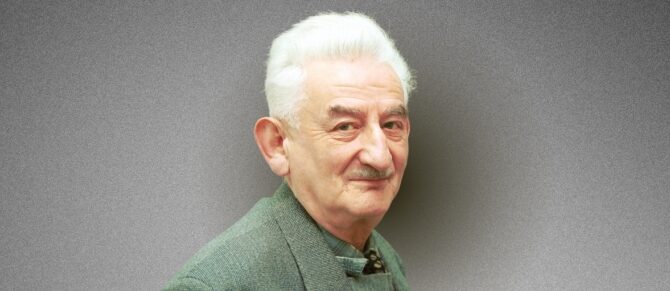
Švenčionys Jewish Community chairman Moshe Shapiro received the Silver Honor Award from the Lithuanian Ethnic Minorities Department on Lithuania’s Ethnic Minority Communities Day May 21 at St. Catherine’s Church in Vilnius.

Shapiro was recognized for his contributions to preservation of Jewish historical memory, tireless community work, working for integration, educating the younger generations and contributing to the culture of Lithuanian ethnic minorities.

Pabradė municipal cultural center director Lolita Vilimienė presented the prize to chairman Shapiro.

Visitors with Roots in Panevėžys

Visitors with Roots in Panevėžys

The Panevėžys Jewish Community received visitors with roots in the northern Lithuanian city last week. Larry Shuman and wife Barbara live in Pittsburgh. Grandfather Jakob Shuman and great grandparents Natan and Yelka Shuman lived in Panevėžys and went to America in 1890. Gary Kaiserl also comes from the USA. His grandfather Israel and great-grandmother Yulia Levit (their surname used to be Cezarski in Panevėžys) left for America between 1880 and 1890.

Local High School Tolerance Center Visits Panevėžys Jewish Community

Local High School Tolerance Center Visits Panevėžys Jewish Community

Ninth-graders and teacher Jekaterina Ledneva from the Velžys Pro-Gymnasium in the Panevėžys set up a Tolerance Center at their school and visited the Panevėžys Jewish Community as part of that initiative. They wanted to know more about the pre-Holocaust local Jewish population, Jewish customs and traditions, holidays and what happened in the Holocaust. The students visited the ghetto territory in the northern Lithuanian city and laid floral wreaths at the monument marking the former ghetto gate.

Panevėžys Jewish Community chairman Gennady Kofman spoke to the young people as part of the Community’s ongoing educational outreach program and spoke about how Jews and Lithuanians lived together before the Holocaust, often enough as co-owners of businesses, sharing their expertise. They celebrated holidays together and shared in their joys and misfortunes, sometimes sacrificing their last bit of bread for one another, Kofman said. Russian and Jewish children attended the same high schools both in Tsarist Russia and independent Lithuania, Kofman recalled.

The ninth-graders also learned about Jewish holidays including Passover, Purim, Rosh Hashanna and others, and the stories behind these holidays. Kofman spoke about kosher food and why healthy food and cleanliness is so important in Jewish tradition. The students had the chance to sample matzo bread and heard the story of unleavened bread during the Exodus from Egypt. The students posed many questions and had a chance to tour the Community building as well.

Jewish Communities across Africa

Jewish Communities across Africa

Photo: Delegates from around the world attended the Jewish Africa Conference

The third Jewish Africa Conference, an event spearheaded by the American Jewish Committee (AJC), Mimouna Association (Morocco) and the American Sephardi Federation (ASF), took place during April in Cape Town.

The conference was supported by the Cape SA Jewish Board of Deputies, with a welcome address by chair of the board Adrienne Jacobson. Predecessor conferences were held in New York in 2019 and in Rabat, Morocco, in 2022. The event took place at the Old Shul, the SA Jewish Museum and the Kaplan Centre for Jewish Studies at the University of Cape Town.

According to Wayne Sussman, director of the AJC Africa Institute who oversaw conference proceedings, “We all know that the South African Jewish community has made a rich contribution to Jewish life around the world. This is also true with other African Jewish communities. They have strong traditions and customs. Many made a huge impact on their respective countries. This conference allowed Jews from across Africa and scholars interested in Jewish African life today to come together and make sense of how we carry on building our respective communities and ensure we preserve our past properly.”

While we in South Africa tend to think of Jewish life from an Eastern European bias–because the bulk of our community is of Ashkenazi origin–Jewish life in fact traces a great deal back to Africa. With roots in ancient Egypt, Jewish religious and cultural practice are certainly a significant feature of the African continent.

Holocaust Historian, Litvak Wife Visit Panevėžys Jewish Community

Holocaust Historian, Litvak Wife Visit Panevėžys Jewish Community

Noah and Frances Schoen (Milinsky) visited the Panevėžys Jewish Community May 12. The family lives in Pittsburgh. Noah is an historian and teacher who reseraches the Holocaust. His lectures discuss forms of anti-Semitism from prejudice to genocide. He was an eye-witness at the Tree of Life synagogue in 2012 when a gunman opened fire on the congregation.

His wife teaches children aged 11 to 14 and leads summer youthg camps. Her father’s family comes from Panevėžys and immigrated to America early on, preserving their Litvak heritage.

Chairman Gennady Kofman spoke to them about the Community’s current activities and showed them around the archive collection, and they talked about anti-Semitism in Europe and America. Kofman gave them a tour of the northern Lithuanian city focusing on Jewish heritage sites.

Kaunas Jewish Community Celebrates Righteous Gentiles from the Čiurlionis Family

Kaunas Jewish Community Celebrates Righteous Gentiles from the Čiurlionis Family

As part of the Year of Mikalojus Konstantinas Čiurlionis, the Lithuanian artist and composer, the Kaunas Jewish Community presents two events June 2 to celebrate the Righteous Gentiles in his family.

At 4:00 P.M.a plaque will be unveiled commemorating Čiurlionis’s wife Sofija, daughter Danutė and son-in-law Vladimir Zubov, all people who rescued Jews. The plaque will be located on the building which houses the memorial apartment once occupied by Sofija. The address is Žemaičių street no. 10, Kaunas.

At 6:00 P.M. Vyautas Magnus University will host a concert dedicated to Sofija, Danutė and Vladimir at their Great Hall (Gimnazijos street no. 4, Kaunas) featuring music and recollections by pianist Rokas Zubovas and his wife Sonata, pianists and organists who have received the Čiurlionis prize, Kaunas Jewish Community member Robertas Lozinskis and Vytautas Magnus University’s own choir Vivere Cantus.

These events are free and open to the public.