

Litvak Won’t Give Grandchildren Pancake Recipe
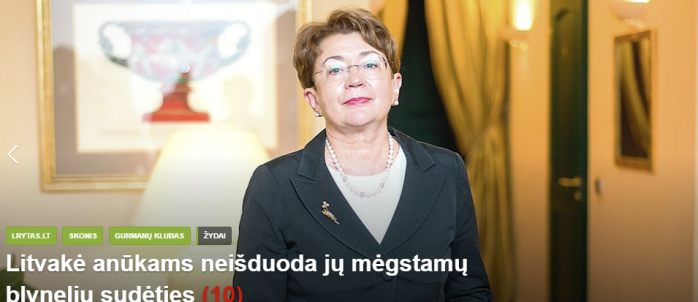
As kosher cafés open around Vilnius and it’s possible to eat kosher food and bagels, Lithuanians are rediscovering Jewish culture with an emphasis on cuisine. That pleases the chairwoman of the Lithuanian Jewish Community, attorney Faina Kukliansky, 61.
Jewish cuisine has always been popular in Lithuania. And it’s no wonder, since many Jews have lived in our country from ancient times, the Lifestyle Section of the Lietuvos rytas newspaper writes.
Some dishes which everyone thinks are traditional Lithuania are actually borrowings from Jews.
One such is potato pancakes, called latkes in Jewish cuisine. Kugel is also of Jewish origin.
Many are shocked to discover that even zeppelins, of which we are so proud, are also somewhat connected with Jews. They travelled to our country about 100 to 150 years ago from northern Germany together with Jews.
Read the entire article in Lithuanian here.
img class=”alignnone wp-image-9629″ src=”http://www.lzb.lt/wp-content/uploads/2015/07/lr.png” alt=”lr” width=”83″ height=”26″ />
Bagel Shop Editor Published in Israeli Academic Journal
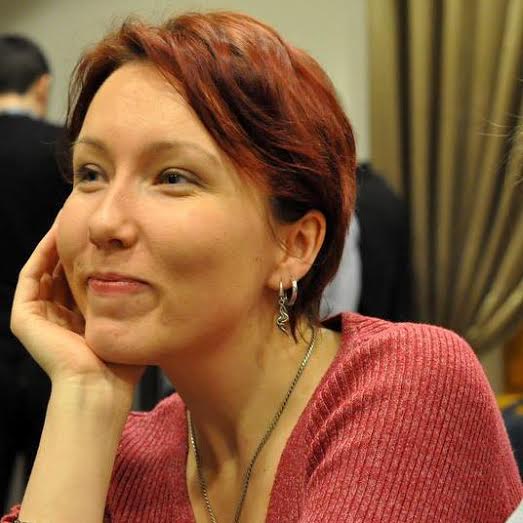
Radvilė Rimgailė-Voicik
Radvilė Rimgailė-Voicik, who writes and compiles the quarterly Bagel Shop newsletter, has had an academic article published by the Israel Journal of Plant Sciences. The article, called “Plant Community Associations and Complexes of Associations in the Lithuanian Seashore: Retrospective on the Studies and Tragic Fate of the Botanist Dr Abromas Kisinas (1899–1945),” pursues the topic Radvilė wrote about in a previous issue of the Bagel Shop newsletter.
Abstract:
The life and scientific activities and discoveries of Dr Abromas Kisinas (1899–1945, also appearing in the literature as Avraham, Abraham, Kisin or Kissin) are presented here for the first time. He was a botanist, a Lithuanian, a graduate of Vytautas Magnus University in Kaunas, a polyglot and a social figure. In 1936, Kisinas’ major phytosociological work “Plant Associations and Complexes of Associations in Lithuanian Seaside (without Klaipėda Region)” was published in the Works of Vytautas Magnus University Faculty of Mathematics and Natural Sciences. The publication was written in Lithuanian with a summary in German and summarized Kisinas’ PhD dissertation, which was defended in 1934 under the supervision of Prof. Constantin Regel. In his research, Kisinas applied ideas proposed by the Uppsala School of Phytosociology. For plant communities evaluation he used linear transects with 1 m², 4 m² and 16 m² sampling squares. In a 15 km seashore range Kisinas determined 63 plant community associations and 26 sub-associations. The fate of this gifted scientist was tragic. In 1941 he and his family were deported to the Kaunas Ghetto. In 1945 Kisinas died at the Dachau concentration camp in Germany.
Challa at the Bagel Shop Café

The Bagel Shop Café has begun making challa bread for Sabbath the way it should be. Besides bagels, visitors can now purchase authentic challa bread, not too sweet but very delicious. A good Sabbath to all.

Lox on Bagels: An Answer to Eggs Benedict?

A Bit about Bagels
The history of the bagel is surrounded by myth and legend but seems to begin in the 12th century. One version has it that a Church ban on commercial Jewish bakeries was responsible for its appearance. In 1264 Polish grand duke Bolesław the Pious issued his Statute of Kalisz or Charter for Jews of Grand Poland which allowed Jews to freely by, sell and touch bread in common with Christians. In response a group of Polish bishops forbade Christians from buying any food at all from Jews, as it were anathema. As Moses ben Israel Isserles put it in the 16th century” “it is preferable to live on dry bread and in peace in Poland” than to remain in better conditions in lands more dangerous for Jews. At some point Jews were allowed to work with bread which was boiled, and they created the bagel to comply with his ruling, according to this version. In 1610 the first mention appears of the word “bagel” in Yiddish in the written sources, in regulations issued by the Jewish council of Kraków, which stated that bagels were to be given as a gift to women in childbirth.
Whatever the case, the bagel was popular among Jews in Eastern Europe, and came with them to America in the 19th and 20th centuries.
New Issue of Bagel Shop Newsletter
An English translation of the new issue of the Bagel Shop newsletter is now available.
Please click BK_16_1_ENG_A4_screen for a PDF version.
Bagel Shop Café Purim Holiday Schedule

The kosher Bagel Shop Café of the Lithuanian Jewish Community is in full gear getting ready for the Purim holiday. There are several new pastry items the chefs there have cooked up, including the “red velvet” pastry taking the Jewish culinary internet by storm. Their special hamantashen recipe passed down through the generations uses yeast as well.
Senior chef Riva Portnaja says her family calls hamantashen “omentashen,” and that her mother always put yeast in the dough. According to her, Litvak hamantashen only contain poppy-seed fillings, and the triangular pastry is made so that is almost closed.
Bagel Shop Café on Television
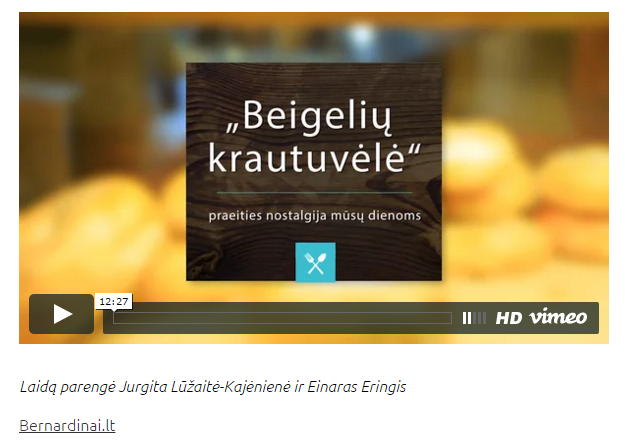
The Catholic newspaper and website bernardai.lt now has a video outlet as well and has presented a feature on the new Bagel Shop Café located at the Lithuanian Jewish Community in Vilnius. The video presentation in Lithuanian, Hebrew and English features short conversations with Lithuania’s two new rabbis on the meaning of kosher food and cooking, as well as a brief interview with Smhuel Levin, the chairman of the Lithuanian Jewish Religious Community, among others.
To view the interview, please direct your browser here.

Shtetl at Kaziukas Fair
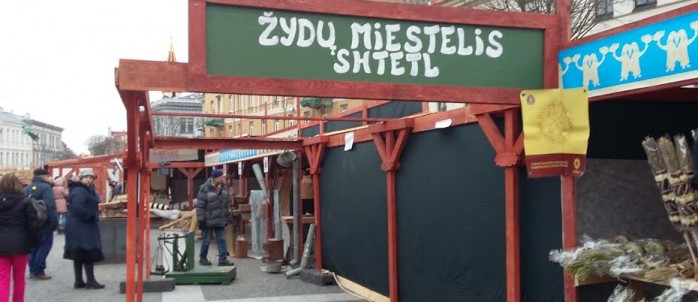
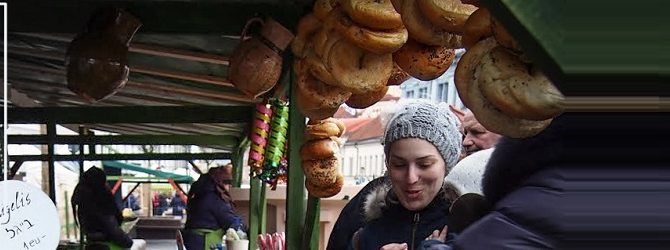
The Jewish shtetl section of the annual Kaziukas Fair in Vilnius came to life at 4:00 P.M. last Friday when the Jewish ensemble Fayerlakh performed on the adjacent stage. Jewish music including those sung in the pre-WWII Lithuanian Republic rang out from the Old Town Hall and enveloped fair-goers. On-lookers swayed to the beat as Fayerlakh performed wedding melodies and love songs. As the afternoon turned into Sabbath evening, there was a prayer and those assembled had the chance to hear it, observe Sabbath rituals and listen to the music.
A line of people wanting to get a taste of a Jewish bagel formed at the Bagel Shop Café booth and more than a thousand bagels were sold on Friday afternoon alone. Some scenes from the shtetl exhibit are provided below and at the facebook link provided above.
Traditional St. Casimir’s Fair Kicks Off in Vilnius
VILNIUS, March 4, BNS–The traditional St. Casimir’s Fair is starting in Vilnius on Friday, for the 1st time including a Jewish Township.
During the fair on March 4-6, the township will be based in the Town Hall Square, featuring traditional Jewish crafts, Jewish literature and Jewish food.
The township will include about a dozen of craft tents and marketplaces with Jewish souvenirs, a bookstore, a fabric shop, a laundry and a gramophone shop.
About 500 guests from 16 foreign countries are expected at the St. Casimir’s Fair this year.
St. Casimir’s Fair evolved from the Casimir’s processions that date back from 1604.

Fayerlakh Concert and Bagel Shop at the Kaziukas Fair in Vilnius

The opening of Vilnius’s annual street fair will feature a concert by the Jewish song and dance ensemble Fayerlakh, at 5:00 P.M. at the Vilnius Old Town Hall square. The group is promising a whole range of music and performances, including a traditional Sabbath prayer and song.
Don’t forget, the Bagel Shop Café will also be at the fair on Friday, Saturday and Sunday. LJC staff, members and volunteers are all invited to come and help sell Jewish bagels during the fair. It should be a lot of fun and this year the annual street fair will include a Jewish shtetl section.
New Bagel Shop Opens with Great Expectations
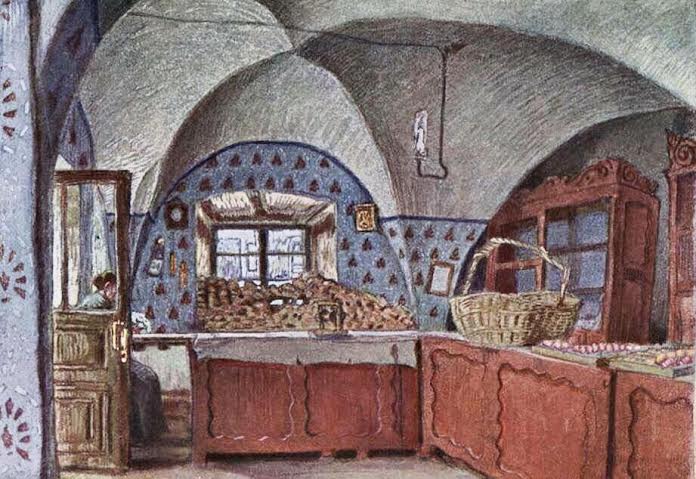
Bagel shop, Vilnius, 1910, by Mstislav Dobuzhinsky.
A new kosher café in Vilnius, Lithuania, had its grand opening Thursday with an overflow crowd spilling into the street.
The Bagel Shop café is housed on the first floor of the Lithuanian Jewish Community, which some visitors still refer to as the Kahilla, in a mostly neglected and empty cafeteria hall.
Guests and LJC staff began filtering in well before the scheduled 3 P.M. start and four cheerful women behind the counter began placing bagel sandwiches cut into quarters on plates on the café’s six small tables.
LJC chairwoman Faina Kukliansky addressed the small packed room and said the Bagel Shop Café is an important part of the Bagel Shop tolerance program the LJC has been carrying out for the last year or so with funding from Norway and the EEA Grants program. She said the project was supposed to end earlier but had been continued into the next year.
The Smell of Fresh Jewish Bagels Returns to Vilnius

The Bagel Shop, a new kosher food café, opens its doors February 4. The café will prepare kosher food and different traditional sweets according to the rules of Judaism. The Bagel Shop’s main draw will be freshly-baked bagels and bagel sandwiches. Adhering to the strictest rules, the bagels will be made under the supervision of a rabbi versed in kosher food rules.
Bagels are a traditional European Jewish food product often referred to as a “baronka” in Lithuania in the past, and when cooked may be cut in half and made into a sandwich. The book Joy of Yiddish furnishes one version of the origin of the bagel, according to which the recipe for bagels was created in Cracow at the beginning of the 17th century, and that bagels were given then as gifts to women giving birth. The bagel was supposed to symbolize the “wheel of life” because of its roundness. The bagel’s popularity quickly grew and spread to other countries where Jews speaking Yiddish lived, and was quickly adopted in America, where today about five million bagels are baked daily!
Haifa and Community: Lessons in Tolerance from Israel
by Živilė Juonytė

Israelis sometimes joke that while Tel Aviv is partying, and Jerusalem is praying, Israel’s third-largest city and largest port Haifa is busy at work. Maybe that’s why the people of Haifa don’t have time for squabbles and why the different ethnic groups—Jews, Druzes, Arab Christians and Muslims, Ahmadiyya Muslims and Baha’i—get along so well, despite their many differences.
Newest World Religion Recognizes All Others
The unique Baha’i, Druze and Ahmadiyya communities in the kaleidoscope of cultures and religions of Haifa are probably the least known to outsiders. Baha’i is one of the newest religions of the world whose origins are found in 19th century Persia, now Iran. It was immediately banned there, and continues to be. Baha’i believe all religions are valid and study them and their sacred texts. Their emphasis on the shared features of all religions means they are tolerant of mixed marriages. Children born to Baha’i parents don’t become Baha’i automatically. It is the parents’ duty to teach them about all religions, and the young adult chooses the one which most resonates with him or her at the age of 15.
New Bagel Shop Magazine On-Line
The Bagel Shop newsletter is now a magazine and is available on-line in three languages, Lithuanian, English and Russian.
In this issue we present an interview with Laurina Todesaitė about Jewish cuisine, an excursion through the world of Jewish botanists in the inter-war period, a tour of Jewish Vilna, a new questions section and a new Mystery Photograph contest as well as all the usual columns.
Amit Belaitė: Jewishness Isn’t Always a Religious Thing

“The busier you are, the more you get done,” Vilnius University medical student Amit Belaitė says. The young woman studying social medicine has earned the tolerance award for her work with the Bagel Shop campaign and she is an active promoter of Jewish culture. Belaitė currently heads the Lithuanian Jewish Student Union and was elected vice-president and executive board member of the European Jewish Student Union last summer.
The organization Belaitė leads operates at the Lithuanian Jewish Community. She says the student union’s spectrum of activities is broad and shouldn’t be construed as an exclusively religious or exclusively cultural institution.
“We celebrate Jewish holidays, attend cultural events and attempt to learn more about our history. We organized a Purim holiday party, for example…”
Full article in Lithuanian at the Vilnius University website.

Invitation to the conference on Anti-Semitism, Radicalisation and Violent Extremism
Lithuanian NGO Programme operator Human Rights Monitoring Institute is organizing a conference on Anti-Semitism, Radicalisation and Violent Extremism. The event will take place on 30 September, 2015 in Vilnius.
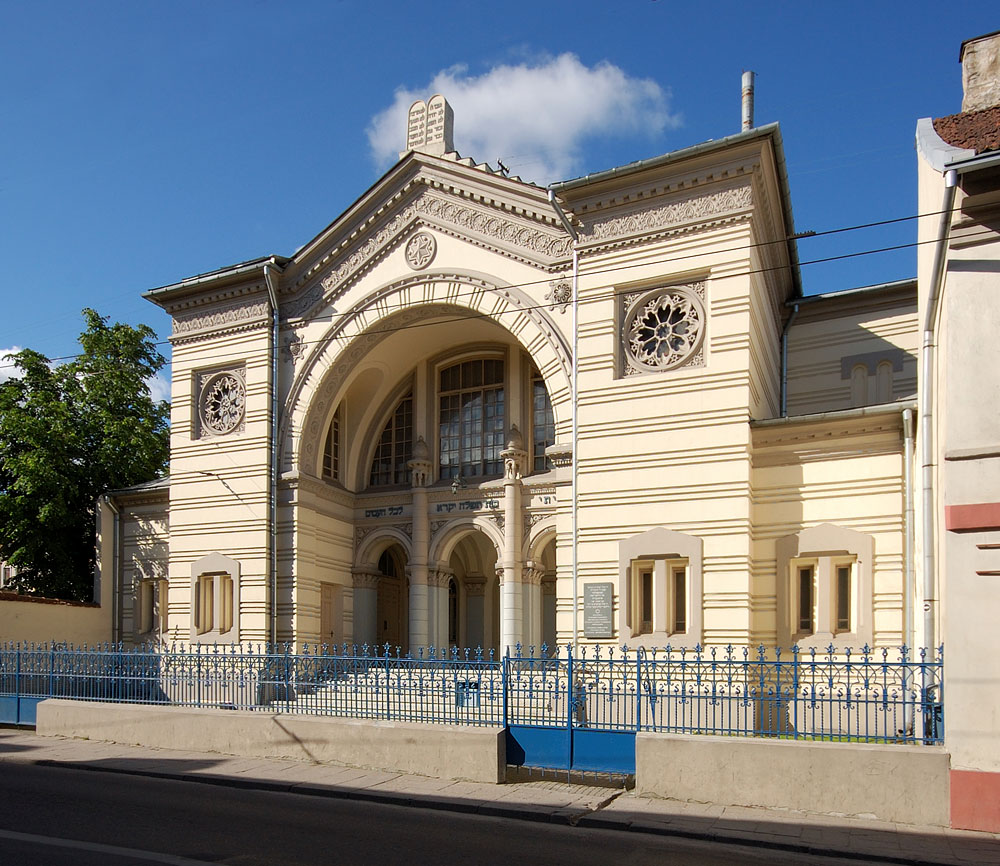
Interview with the cantor of the Vilnius Choral Synagogue
The Synagogue‘s Cantor Shmuel: What Jews Need in the Diaspora, Is Unity
Even though Shmuel Yatom, the cantor of the Vilnius Choral Synagogue and a Hebrew teacher, wasn‘t born in Vilnius, he has a special connection with this town. Shmuel says that he comes from a family with a long-lasting cantorial tradition, which was transferred from generation to generation.

Lithuanian Jewish Tolerance Awards Presented at Lithuanian Government
Vilnius, June 5 BNS — On Friday the Government House in Vilnius hosted an awards ceremony by the Lithuanian Jewish Community for fostering tolerance in Lithuania. The awards are presented to six people or organizations.
Historian Lara Lempertienė was recognized for her work in passing on the Jewish cultural legacy to future generations and Žana Skudovičienė, long-time coordinator of LJC Social Center programs, received the award for her lifelong devotion to her work.
Museum specialist Monika Žąsytienė received the distinction for her work in preserving historical memory and the heritage of ethnic minorities, and the Jewish song-and-dance ensemble Fayerlakh were awarded for their enduring promotion of Yiddish culture in Lithuania and abroad.
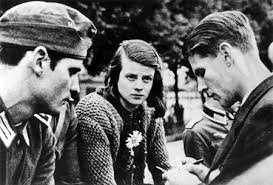
Exhibition “The White Rose: Student Resistance against Hitler 1942/1943”
The Jewish (Litvak) Community of Lithuania kindly invites
to the opening of the exhibition “The White Rose: Student Resistance against Hitler 1942/1943” and reception
to be held on April 28, 2015, 17:00
in the Jewish (Litvak) Community of Lithuania, Pylimo Street 4, Jascha Heifetz Hall (3rd floor).