A new Bagel Shop Newsletter has been published for the first part of 2023. A PDF file of the newsletter is provided below.
Bagel_Shop_Newsletter_2023If your browser doesn’t display the file, you can download it by clicking here.



A new Bagel Shop Newsletter has been published for the first part of 2023. A PDF file of the newsletter is provided below.
Bagel_Shop_Newsletter_2023If your browser doesn’t display the file, you can download it by clicking here.

The Sabbath begins at 6:35 P.M. on Friday, March 31, and concludes at 8:50 P.M. on Saturday in the Vilnius region.
.
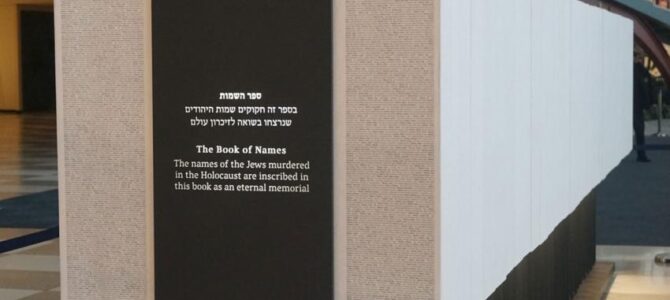
Since its establishment Yad Vashem has endeavored to gather the names of the six million Jews murdered in the Holocaust, one of its central missions. Yad Vashem’s Book of Names is the unique result of meticulous and painstaking work that commemorates 4,800,000 men, women and children whose details have been gathered and uncovered over the years, through Pages of Testimony, the location of various Holocaust-era documents, cooperation with memorial sites and more, which are memorialized in Yad Vashem’s Central Database of Shoah Victims’ Names.
The Book of Names actualizes the inconceivable number of Holocaust victims, and displays their names together with their dates of birth, hometowns and places of death, when known. The information is printed on pages measuring two meters high and one meter wide, with the details illuminated by a gentle beam of light that shines from between the pages. The massive dimensions of the Book of Names testify to the enormity of the collective and unimaginable loss for humanity as a whole and for the Jewish people in particular. The last pages of the book are empty, symbolizing the names that are yet to be retrieved, documented and commemorated, and which perhaps never will be.
Designer: Chanan De Lange
The Book of Names was produced with the generous support of Marilyn and Barry Rubinstein, USA.
Opening: March 29, 2023.
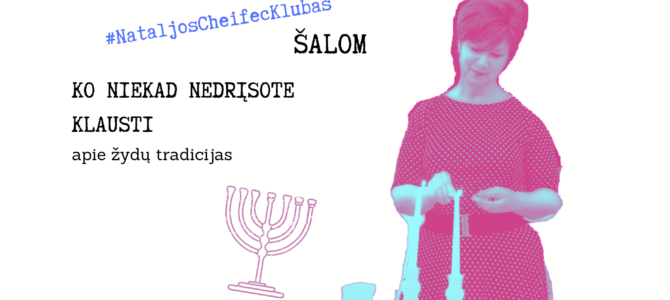
Natalja Cheifec’s Shalom discussion club is planning to meet for an open-ended discussion at 5:30 P.M. on Wednesday, March 29, on the zoom internet platform. To receive login credentials register at https://bit.ly/3q0j7hg and when you’re filling out the questionnaire don’t forget to mention the topics you’d like to see discussed by the club. Wednesday evening’s meeting will include a link to a film which will be a topic for discussion as well.
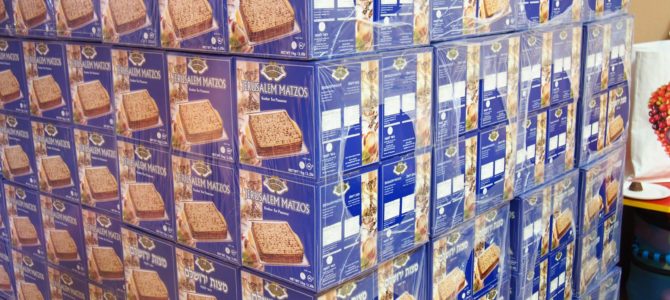
Matzo has arrived for Passover and is available in 450 gram for 5 euros and 1 kilogram boxes for 10 euros at the Lithuanian Jewish Community, Pylimo street no. 4, Vilnius, on workdays except Tuesday, from 10:00 A.M. to 5:00 P.M.
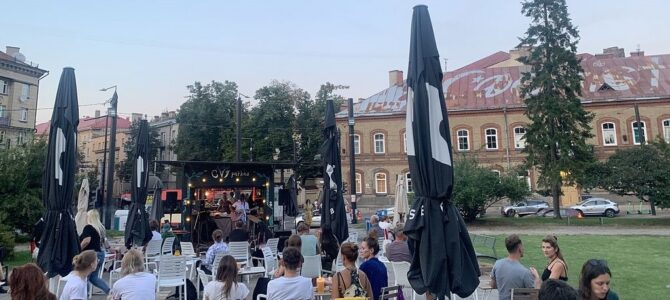
Spring is in the air and the Israeli street food kiosk and performance space Cvi Park at the former Cvirka square in Vilnius is getting ready for a new season of food and all kinds of music.
Music such as that performed by violinist Dalia Dėdinskaitė and cellist Gleb Pyšniak at Cvi Park in the past: http://shorturl.at/xGQZ6
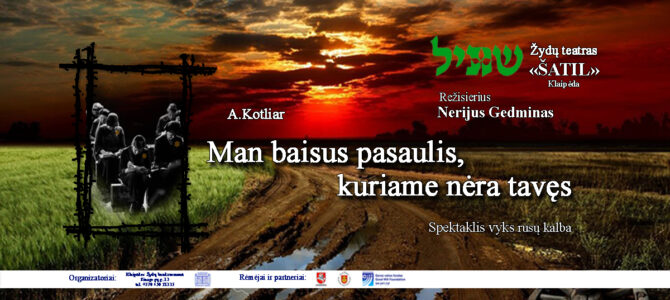
The Klaipėda Jewish Community theater Šatil is preparing to stage the play “Man baisus pasaulis, kuriame nėra tavęs” [A World Without You Horrifies Me] based on the work of Maja Tarachovskaja (Майя Тараховская, Maya Tarakhovskaya) in Vilnius.
The play tells the story of a Jewish girl named Mirka who escaped from a train on the way to a death camp. She is forced by circumstances to make the hard decision to leave her son with the villager woman who rescued them in order to save her newborn baby.
“And I left, in the night, for nowhere, leaving to that woman two priceless gifts: I gave her you, and the only existing photograph of your father,” a heartbroken Mirka says in the play.
The play, directed by Nerijus Gedminas, is in Russian and will debut Tuesday, April 11, at the Russian Drama Theater at Jono Basanavičiaus street no. 13 in Vilnius.

The Sabbath begins at 6:21 P.M. on Friday, March 24, and concludes at 7:35 P.M. on Saturday in the Vilnius region.
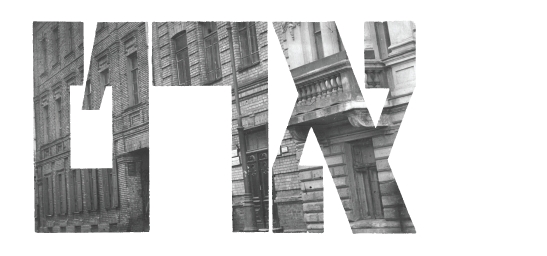
The Lithuanian National Martyna Mažvydas Library will host an exhibit called “The Vilnius ORT Technicum: A Window to the Future” as part of the 700th birthday celebrations for the city of Vilnius. The exhibit will talk about the history of the Jewish vocational institution and the importance of acquiring a craft or trade for economic survival in the early 20th century. Work by students and original documents and textbooks in Yiddish will be displayed. The exhibit will also include a projection of documents from the library’s Judaica center projected on windows located at Islandijos street no. 3, formerly Gdansk street where the ORT operated starting in 1925. The light show is to take place from 8:00 P.M. to 4:00 A.M. during the entire course of the exhibit at the library. The main exhibit will be demonstrated on the fifth floor of the national library. The exhibit will run from April 4 to May 31 during the library’s working houses and is open to the public. An opening ceremony is scheduled for 6:00 P.M., April 4, in the atrium on the fifth floor.
More information is available in Lithuanian here.
Deadline April 16th. Apply here:
https://www.cognitoforms.com/Paideia1/PaideiaProjectIncubator2023Application
More info here:
https://paideia-eu.org/programs/the-paideia-project-incubator

Grigoriy Shur’s Vilnius ghetto diary has been reissued with support from the Goodwill Foundation, with a new cover and new introduction.
Perhaps the most informative of the several Vilnius ghetto diaries, Shur’s manuscript was originally published in Lithuanian translation by the Era publishing house in Vilnius in 1997 with partial funding from the Lithuanian Culture Ministry, and was roundly ignored by the general public.
The new edition is the same translation published by Era back in 1997 by Nijolė Kvaraciejūtė and Algimantas Antanavičius. It contains the same introduction by Pranas Morkus and forward by Vladimir Porudominsky, but adds a new and short introduction by the writer Vytautas Toleikis, who surveys recent Holocaust literature published in Lithuanian, including his keen observations about the book “Mūsiškai” [Our People] by Rūta Vanagaitė and Efraim Zuroff, or more precisely, how Lithuanian nationalists responded to it. Here’s a rough translation of part of Toleikis’s introduction:
The Sabbath begins at 6:08 P.M. on Friday, March 17, and concludes at 7:21 P.M. on Saturday in the Vilnius region.
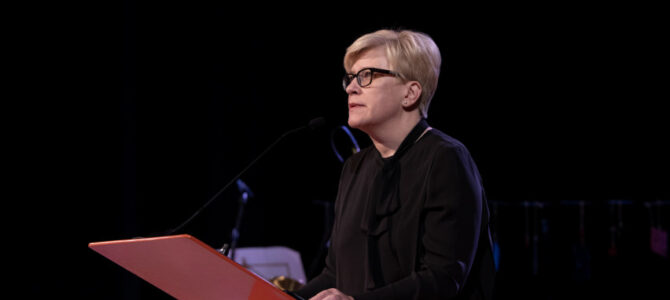
On March 15 Lithuania will celebrate the Day of Rescuers of Lithuanian Jews for the first time, included on the official list of commemorative days late last year. The day will include a number of events including a reading of the names of rescuers at Vilnius University at 4:00 P.M. and the opening of an exhibition on Righteous Gentiles at the Marija and Jurgis Šlapelis Museum located at Pilies street no. 40 in Vilnius.
“Great challenges don’t just destroy, they also awaken heroes. Those whose deeds kindle endless hope. Those thanks to whom today we aren’t just talking about victims and murderers, but also about the rescuers. Those who pass on to all coming generations the clear knowledge that we can always chose the light, even in the darkest night,” Lithuanian prime minister Ingrida Šimonytė said.
Full article in Lithuanian here.
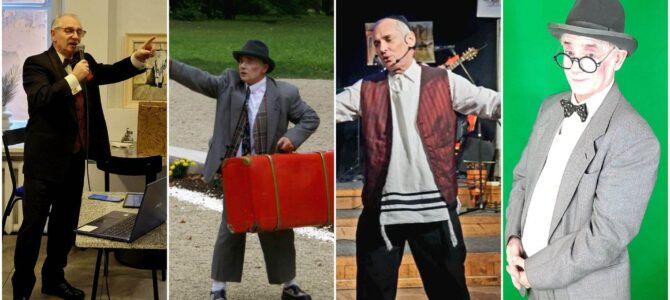
The quizzes go on, this coming Sunday around the topic of Jewish theater. Come and show off your knowledge, or learn something new. Presented by writer, philosopher, mime and circus performer Arkadijus Vinokuras, the quiz will take place at the Bagel Shop Café at Pylimo street no. 4 at 2:00 P.M. on Sunday, March 19. Register by sending an e-mail to Katrina at katrina@lzb.lt.

Matzo has arrived and will be distributed to Saul Kagan Social Welfare Center clients at room 220 from 11:00 A.M. to 4:00 P.M. on March 15, 16, 17, 22, 23 and 24.
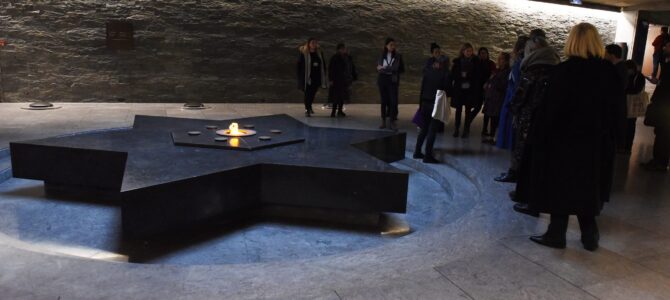
Organizers and coordinators of the European Days of Jewish Culture for 2023 events met in Paris in late February and decided upon the theme “Citizens, equality, rights and values” for this year’s celebrations.
Most meetings and seminars took place at the Shoah memorial in Paris with meetings on the second day at UNESCO headquarters in Paris.
The European Days of Jewish Culture are scheduled to begin on the first Sunday in September, 2023.
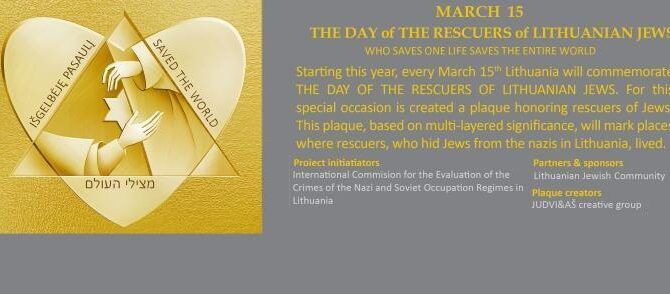
This year Lithuania marks March 15 as the day of rescuers of Lithuanian Jews for the very first time. To celebrate this important date, the Lithuanian Jewish Community presents a special plaque to commemorate the rescuers. The plaque, with multiple layers of symbolism and meaning, will be placed on residences where the rescuers lived and hid Lithuanian Jews from the Nazis.
“This is our thanks to the brave people who didn’t falter in the face of danger and who were not just the rescuers of Jews, but, as Icchokas Meras wrote, were also the blossom of goodness of their nation and heroes of the spirit who resisted the murderers,” LJC chairwoman Faina Kukliansky commented. Her family was also saved from the Holocaust by brave Lithuanians with big hearts, rescuers who number among the 900 Yad Vashem recognizes as Righteous Gentiles in Lithuania.
Plaque designed by the JUDVI & AŠ creative group.
Project author: International Commission for Assessing the Crimes of the Nazi and Soviet Occupational Regimes in Lithuania.
The Sabbath begins at 5:54 P.M. on Friday, March 10, and concludes at 7:07 P.M. on Saturday in the Vilnius region.
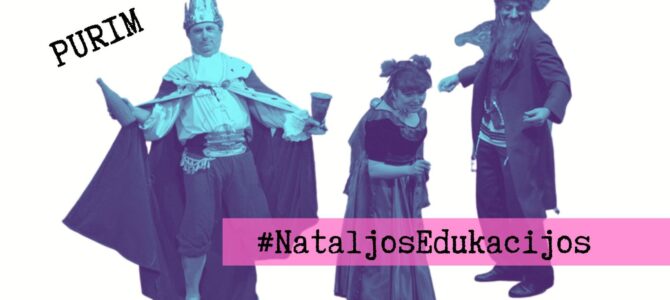
Natalja Cheifec will deliver a lesson via zoom about the meaning and traditions of Purim from 5:30 P.M. till 7:00 P.M. on Wednesday, March 8. To receive zoom log-in credentials, register here: https://bit.ly/3K73kEE. The lecture will be conducted in Lithuanian.