

In Petras Cvirka’s Place, Falafel

In Petras Cvirka’s Place, Falafel

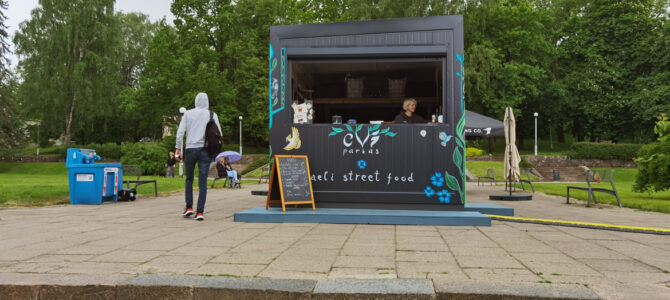
The web-based Vilnius city guide 1323.lt (1323 is the nominal year of the founding of Vilnius) has reviewed the Cvi in the Park Israeli street food kiosk organized this year and last in the park across the street from the Lithuanian Jewish Community headquarters in Vilnius.

Their review is titled “In Petras Cvirka’s Place, Falafel,” a reference to the name of the park still used by almost all Vilnius residents despite the municipality’s decision a few months back to remove its trademark statue to Soviet-era Lithuanian poet Petras Cvirka.

“For the second season now the Cvi Parkas Jewish street food kiosk had been luring passers-by to have a snack (and not only that). It debuted last year when the statue to Petras Cvirka, which caused so much discussion, still stood by.

Presidential Palace Reception on Coronation of Mindaugas Day

Presidential Palace Reception on Coronation of Mindaugas Day

Photo: Lithuanian Jewish Community chairwoman Faina Kukliansky and son Rafaelis attended the reception. Photo by J. Stasevičius courtesy Lithuanian State Radio and Television.

The Lithuanian president invited special guests to attend a reception at the presidential palace compound Wednesday to mark Coronation of Mindaugas Day, the day chosen by historians and others to celebrate the coronation Lithuania’s first and only king, Mindaugas, in A.D. 1253 with a crown sent by Pope Innocent IV.

Full story in Lithuanian here.

Story of King Mindaugas in brief here.

New Condo Ad in Kaunas: “Lietūkis: A Building with History”

New Condo Ad in Kaunas: “Lietūkis: A Building with History”

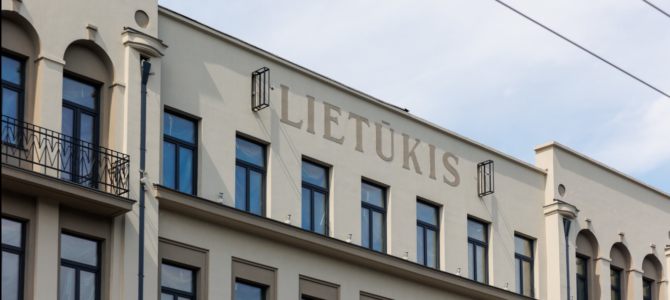
A building built between the two world wars on Vytautas prospect in Kaunas is now undergoing renovation. The architect was Karolis Reisneris, the same architect who designed the Church of the Assumption in Kaunas. Advertisements to purchase apartments have caused controversy because of the phrase “Lietūkis: A Building with History,” recalling the Lietūkis garage massacre in Kaunas in late June of 1941.

Artist Paulina Eglė Pukytė spotted the advertisement on facebook and was surprised by it.

“If the ad campaign is mentioning history, then how can it ignore completely some of the blackest pages of 20th century history connected with the word Lietūkis? The advertisement suggests ‘touching history.’ How should we touch it, and which history?” she said to 15min.lt.

Between the two world wars the compound word “Lietūkis,” made up of Lietuva or Lithuania, shortened to Liet-, followed by ūkis, meaning economy, farm or household, was the name adopted by the Union of Lithuanian Agricultural Cooperatives, which operated in Kaunas from 1923 to 1940. Their headquarters were located at no. 43 on Vytautas prospect. The daylight pogrom and mass murder of Jews was perpetrated at the garage, actually an automobile service and repair station, located on Miško street in Kaunas and still known as the Lietūkis garage, despite abolition of the Lietūkis organization, the Union of Lithuanian Agricultural Cooperatives, prior to that.